Braemar Shipping pays dividends

Shipping broker Braemar Shipping offers a dividend yield of 6% given the annual dividend of 26p and the current share price of 430p. The “catch” is that the dividend isn’t well covered and that shipping is cyclical. However, the group has withstood difficult market conditions with first half earnings per share up by 58%.
The story of a company, from the perspective of investors, can be told through the annual dividend payments. Looking back over the last few decades and the dividend resilience and growth rate are both revealing.
The personal care group PZ Cussons, for example, boasts of 42 consecutive years of year-on-year increases in its annual dividend. The company has therefore clearly been able to withstand the economic downturns.
Turning to the small cap (£130m) shipbroker Braemar Shipping and the company cut its dividend in 2002. However, the annual payout has at least been maintained since then and was last increased to 26p in 2011.
Braemar Shipping EPS & dividends (year to February)

Source: Braemar Shipping presentation
Shipbrokers are currently grappling with historically low dry bulk shipping rates and the related slowdown in China. If Braemar can withstand these headwinds then the current valuation, with a 6% dividend yield, is attractive.
Braemar’s earnings per share came in at 48.4p in the year to February 2011 but had fallen to 31.3p in the year to February 2015. The current financial year to February 2016 should, though, see a return to earnings growth.
As a small cap company Braemar is high risk and it’s not easy to buy into or sell out of the shares. However, the July 2014 merger with ACM Shipping has boosted Braemar’s market position and the first half financial results were strong.

Braemar Shipping 101
Braemar Shipping has a history stretching back to 1842 when the Cory brothers formed a shipping merchant. The company was listed on the London main list in 1997, started trading at 255p and today the share price is around 430p.
Since listing in 1997 the group has become more diversified by undertaking a series of mergers and acquisitions. Braemar’s three divisions today are Shipbroking, Technical and Logistics.
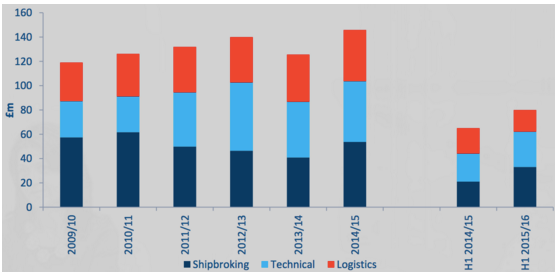
The acquisition of ACM Shipping at the end of July 2014 has boosted the importance of Shipbroking to the group. In the first half of the current financial year Shipbroking was over half of the total divisional operating profits.
Braemar Shipping revenue by division
Source: Braemar Shipping presentation
Looking more closely at the divisions and Shipbroking offers ship chartering services, ship sale and purchase assistance and research. The key drivers for the division are ship charter rates and demand for ship chartering.
The Technical division features five leading engineering, environment and technical consultancy firms. They serve the shipping industry and also the energy, offshore and insurance industries.
The Logistics division provides services for Port Agency, Liner and Logistics and has a global network of offices and partners. It includes Cory Brothers, the initial Braemar business, which has over 170 years of experience.
Divisional contributions
First half results (six months to 31st August 2015) are the first financial period that includes a full contribution from ACM Shipping. It therefore gives an idea of the importance of each division going forward.
Shipbroking generated revenue of £33m in H1 versus £21m last year and the division’s operating profit was £4.6m versus £1.4m last year. The Shipbroking profit figure excludes acquisition related costs and non-recurring costs.
The Technical division generated £28.6m revenue versus £22.9m last year and saw operating profit rise to £3.1m from £2.3m. However, Logistics saw revenue fall from £20.6m to £17.6m and profits were flat at £1m.
Shipbroking therefore generated 53% of first half divisional profits, Technical generated 35.5% and Logistics came in at only 11.5%. The group clearly needs the Shipbroking division to hold its own for profits to remain on track.
Shipbroking in focus
We note that the shipbroker Clarkson recently lowered its guidance for full year profits due to weak trading. However, the issues at Clarkson relate to dry bulk shipping rates and finance rather than crude carriers (i.e. tankers).
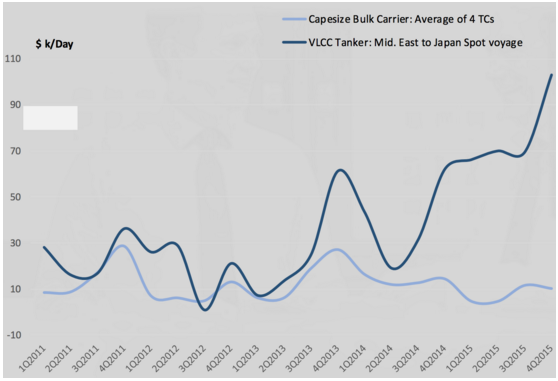
In the first half 61% of Braemar’s broking revenue came from Tankers which are seeing strong demand due to oil price weakness. Buyers of crude oil have been chartering ships to take advantage of the weak oil price environment.
Braemar states that it is the market leader in this sector and that the earnings rate for tankers is at the highest rate for years. This will help the company to offset the historically low charter rates in dry bulk shipping.
Very Large Crude Carriers (VLCCs) are in demand
Source: Braemar Shipping
First half financials and prospects
Braemar ended the first half with a modest net debt position of £3.1m and should move into net cash by February 2016. Underlying EPS came in at 18.6p in the first half versus 11.7p a year ago.
Braemar characterises the long-term prospects for the company as one of “long-term growth in volatile markets.” Shipping is a growth area with seaborne trade up from 4.5bn tonnes in 1990 to around 10.5bn tonnes in 2014.
Trade has increased on the back of general economic expansion with China’s demand for raw materials a key driver. Rising income per capita has also been important with demand increasing for higher end goods like cars.
Summary and valuation
Buying stocks for the dividend yield is not a prudent strategy and the investment focus should always be on the total return (including capital gains). Braemar Shipping’s yield is attractive but the company is in a cyclical sector.
However, earnings per share should return to growth this year and the first half did see an earnings rebound. Braemar has also managed to maintain the dividend since 2007 despite a fall in earnings per share since 2011.
The group’s Shipbroking division has a strong position in oil tankers and the other divisions offer meaningful diversification. The Chinese slowdown is the main risk for the company with it having hit dry bulk charter rates.
On balance the risk/reward ratio appears to be attractive given the return to earnings per share growth. If the dividend can at least be held at 26p then it appears unlikely that the shares will fall significantly below 430p.
This report was produced by Fat Prophets Senior Analyst, Andrew Latto
Disclaimer
This is not financial advice. Our content is intended to be used and must be used for information and education purposes only. Please read our disclaimer and terms and conditions to understand our obligations.
No comments yet
No one has commented here yet! Why not be the first one?