Broker price targets: Worth following or a trap?

Many readers will know Warren Buffett as one of the world’s top investors. The Oracle of Omaha strikes us as sharp, witty and don’t forget he has a photographic memory. Many people buy a stock just because Buffett bought the very same stock. But fewer people realise that this blind, unquestioning faith in heroes once got him into a spot of bother… way back in 1950. At the time, Buffett idolised Ben Graham and David Dodd, the founding fathers of value investing. He had memorised their textbook, Securities Analysis, and later admitted, ‘I knew the book even better than Dodd.’
Warren was still a student at Columbia, networking to improve his job prospects. Through a chance encounter, he found himself having lunch with a man called Lou Green, one of Ben Graham’s business associates. They bounced investment ideas.
Lou Green asked, ‘Why did you buy Marshall-Wells?’
Warren replied, ‘Because Ben Graham bought it.’ Then his stomach churned. Warren later recalled: ‘I’ll never forget the way he looked at me.’
There was a long pause, then Green said: ‘Strike one!’
Buffett was with this impressive character, and then all of a sudden he was ‘striking’ out. The key lesson is this… You have to think for yourself! Blind faith in heroes had led Warren to make the faux pas.
Does every Padawan need a Jedi Master?
We should perhaps be a little more forgiving towards Warren. Having a mentor is essential, especially when starting out. Movie lovers will know that every Harry Potter needs a Dumbledore. Every Luke Skywalker needs an Obi-Wan Kenobi.
Investing, particularly private investing, can be a lonely business. We do not have direct access to Warren Buffett or the stock-market equivalent of Dumbledore. So when I started out, the “experts” I gravitated toward tended to be brokers. Their recommendations were structured in a way that was easy to understand. I looked at brokers’ price targets and made one of two conclusions:
- If a stock was trading at a discount - i.e. below the broker's target - I assumed brokers were optimistic and bullish. I saw a buying opportunity;
- If a stock was trading at a premium - i.e. above the broker's target - I assumed brokers were pessimistic and bearish. I saw a selling opportunity.
Everything seemed clear and actionable. I absorbed broker targets with the same level of trust as someone following a weather forecast. I literally believed that if brokers were bullish, then the share price would go up. It was as if a stock had been recommended to me personally, by Ben Graham’s ghost. Of course, I should have known better…
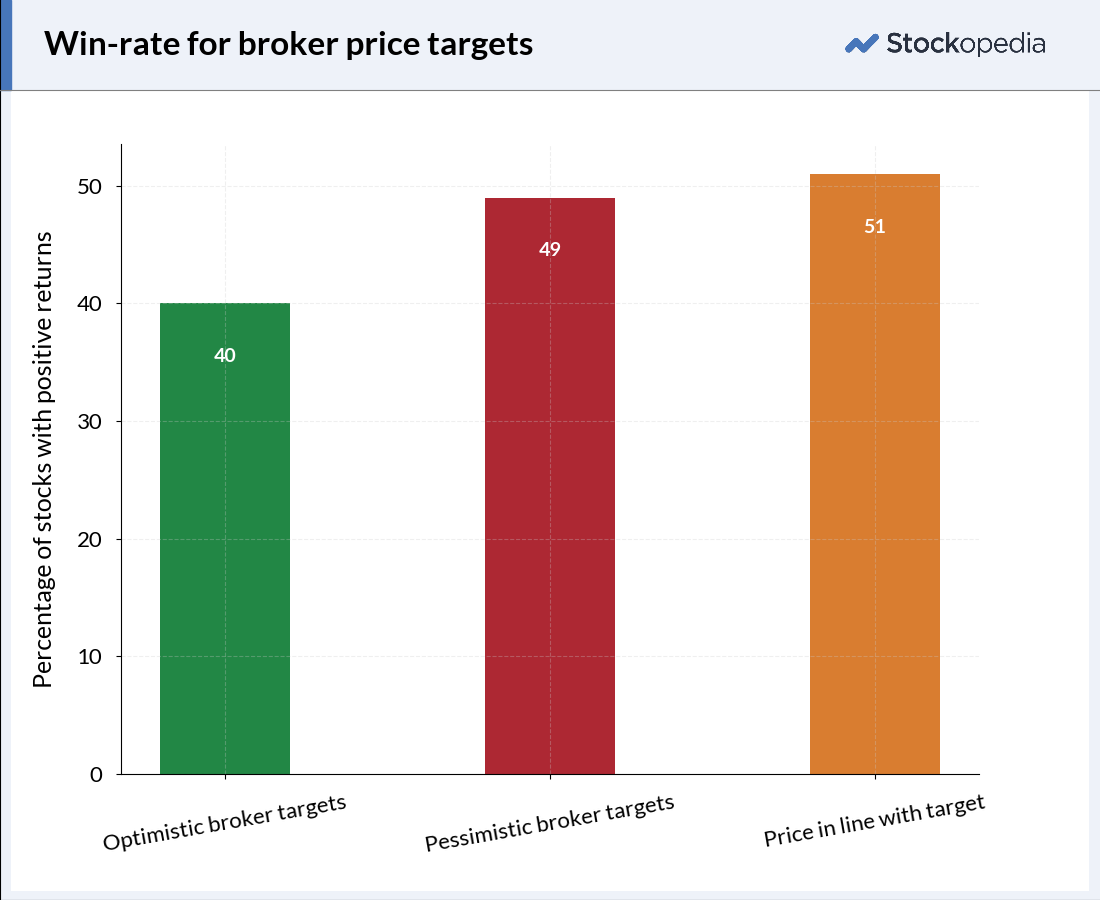
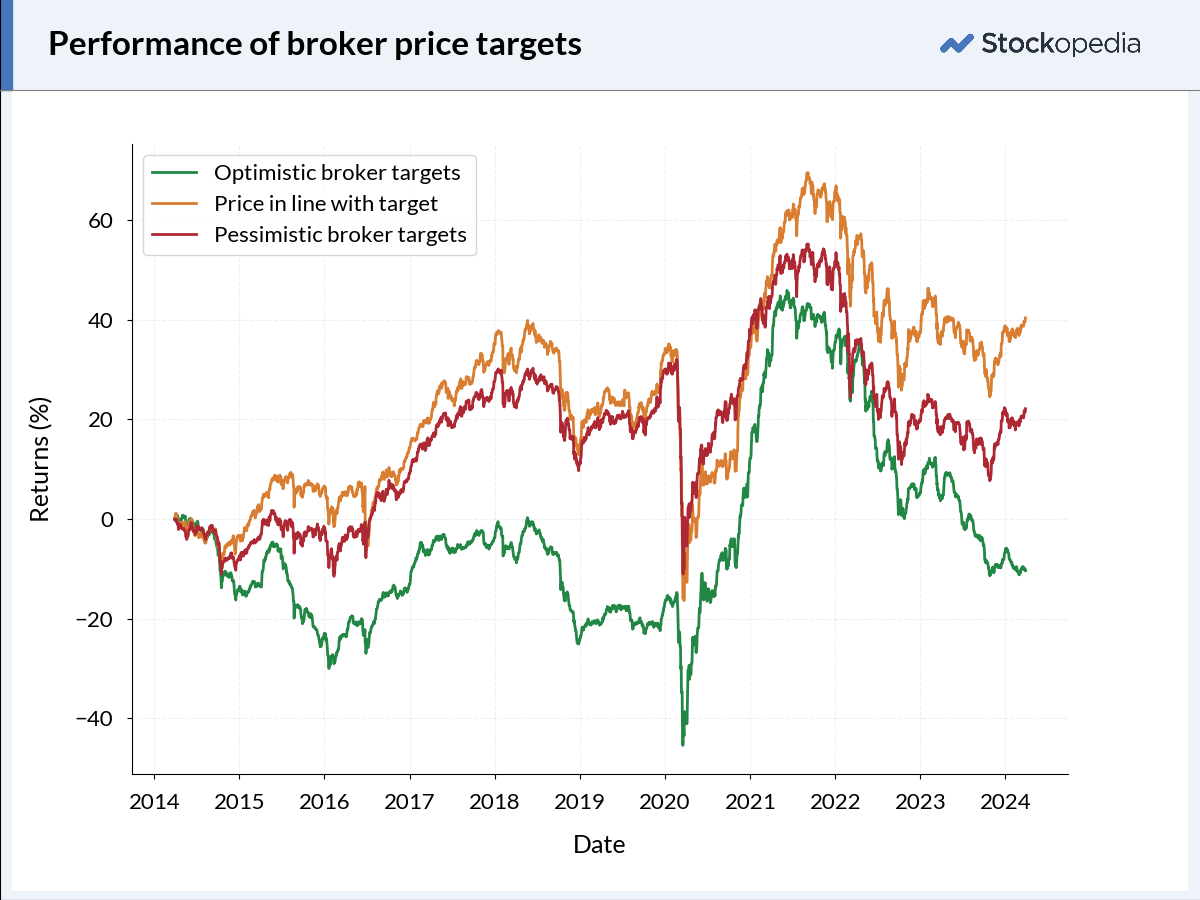
How to view price targets
My research suggested that if investors shunned broker tips, then they were more likely to pick winning stocks. Let’s unpack why…
Brokers do not wield some sort of financial alchemy, like magic or the Force — if you’ll excuse another movie analogy! Of course, there is no such thing as an all-powerful Force controlling the stock market. The stock market is not a 'deterministic' environment, where a given input always produces the same output.
At the same time, there is arguably a ‘system’ that tends to influence stocks’ behaviour. The stock market is ‘semi-deterministic’, in that sense. We can identify rules of thumb which explain stock returns, even if they are not iron laws. We should explore whether these rules align with broker targets…
Guard against weak momentum
One key investing rule is the rule of momentum. Stocks that have risen often continue to climb. Stocks that have dropped often keep on dropping. It’s like an inverse law of gravity. What goes up often keeps going up and what goes down goes down deeper!
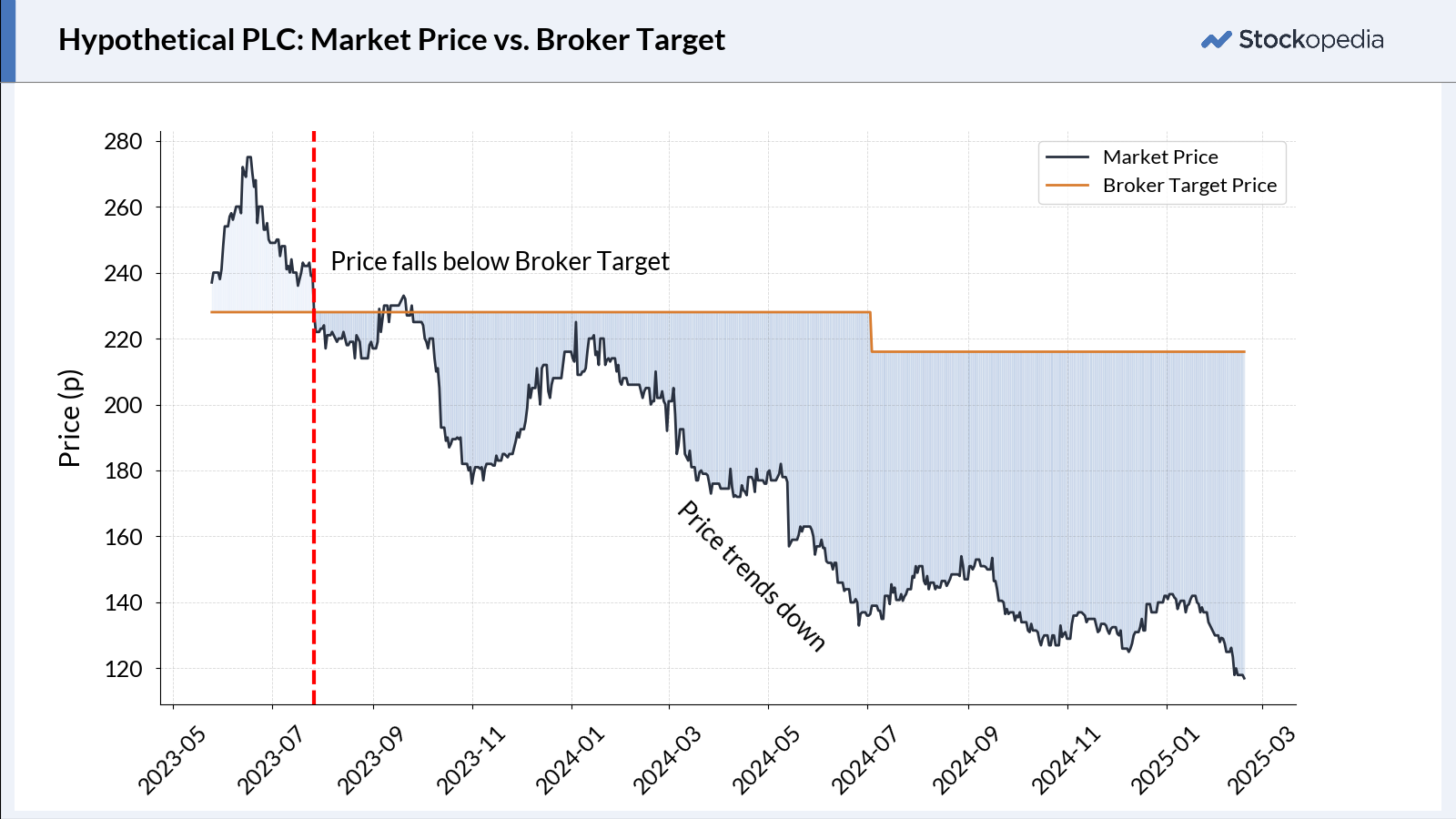
Stocks trading at a discount to the broker target are more likely to have experienced a price drop already. As such, price discounts can be a symptom of weakening momentum. Discounted stocks could be on the wrong side of the momentum effect.
Consider this hypothetical case. Suppose a stock is trading around 260p, above a broker target of 230p. The target would appear bearish because the target is lower than the market price. Suppose the price drops to 180p and then keeps falling, in line with the momentum effect. The brokers would appear optimistic, because the target is above the current, discounted price. However, investors could be working against the momentum effect if they bought the stock.
Look out for poor quality
Another important rule is the rule of quality. Companies that are profitable, financially stable and cash generative tend to outperform those that are loss making, highly leveraged and cash-strapped. We can see that as profits start to drop off, the discount grows. This means that investors risk going against the quality effect when they buy discounted stocks.
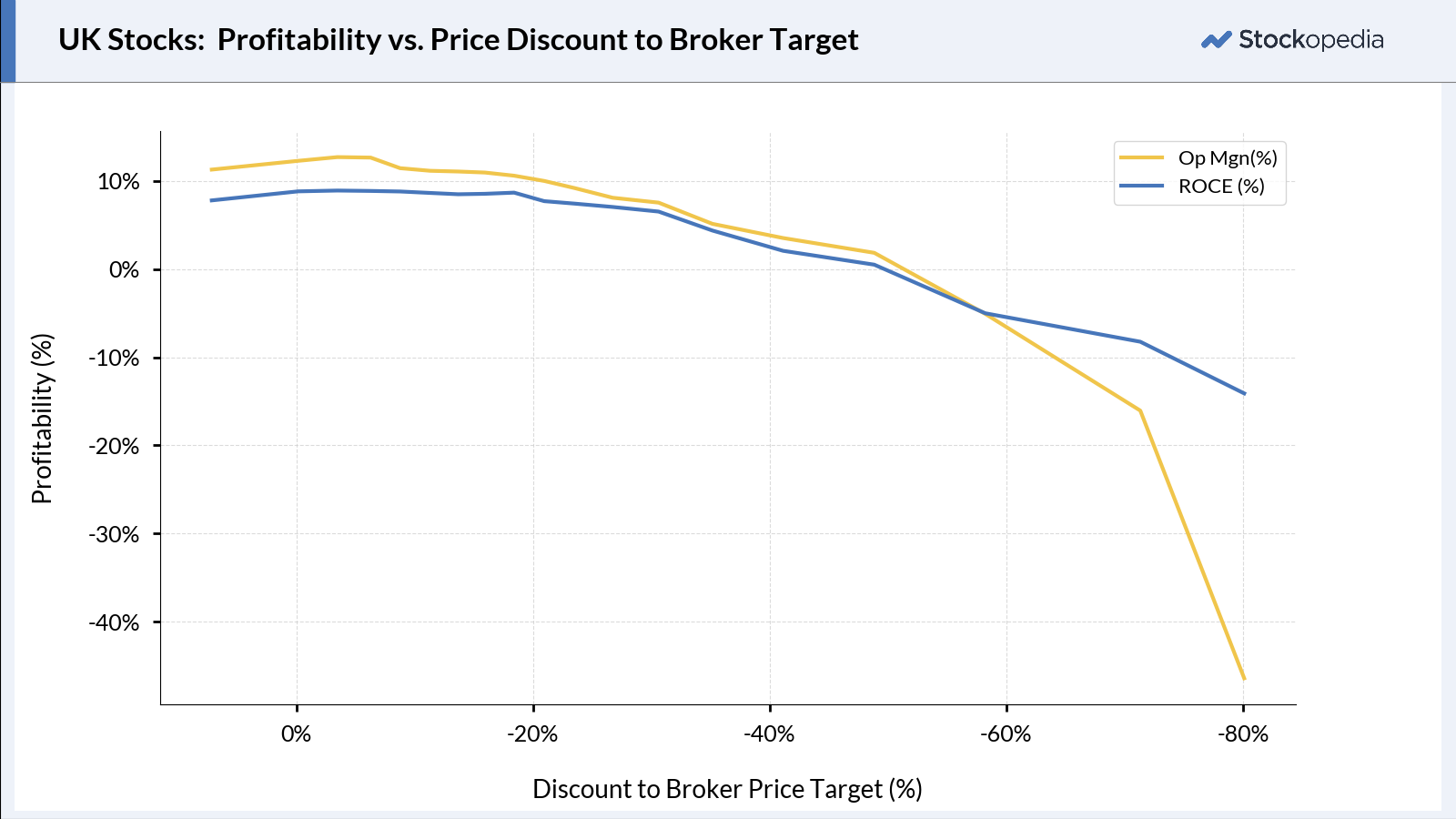
This makes sense. The price would fall if investors get scared about declining profits. There is another factor worth mentioning, but not overstating. As companies become less financial stable, they will more likely need to raise capital on the equity or bond markets, with the advise of investment bankers who in turn issue bullish price targets to encourage investment. Regulatory reforms have arguably made this practice more difficult, but it is still worth putting this potential factor on the table.
Be wary of value traps
When a company's stock price drops, the valuation ratios also drop (all other factors being equal). This makes companies appear cheap.
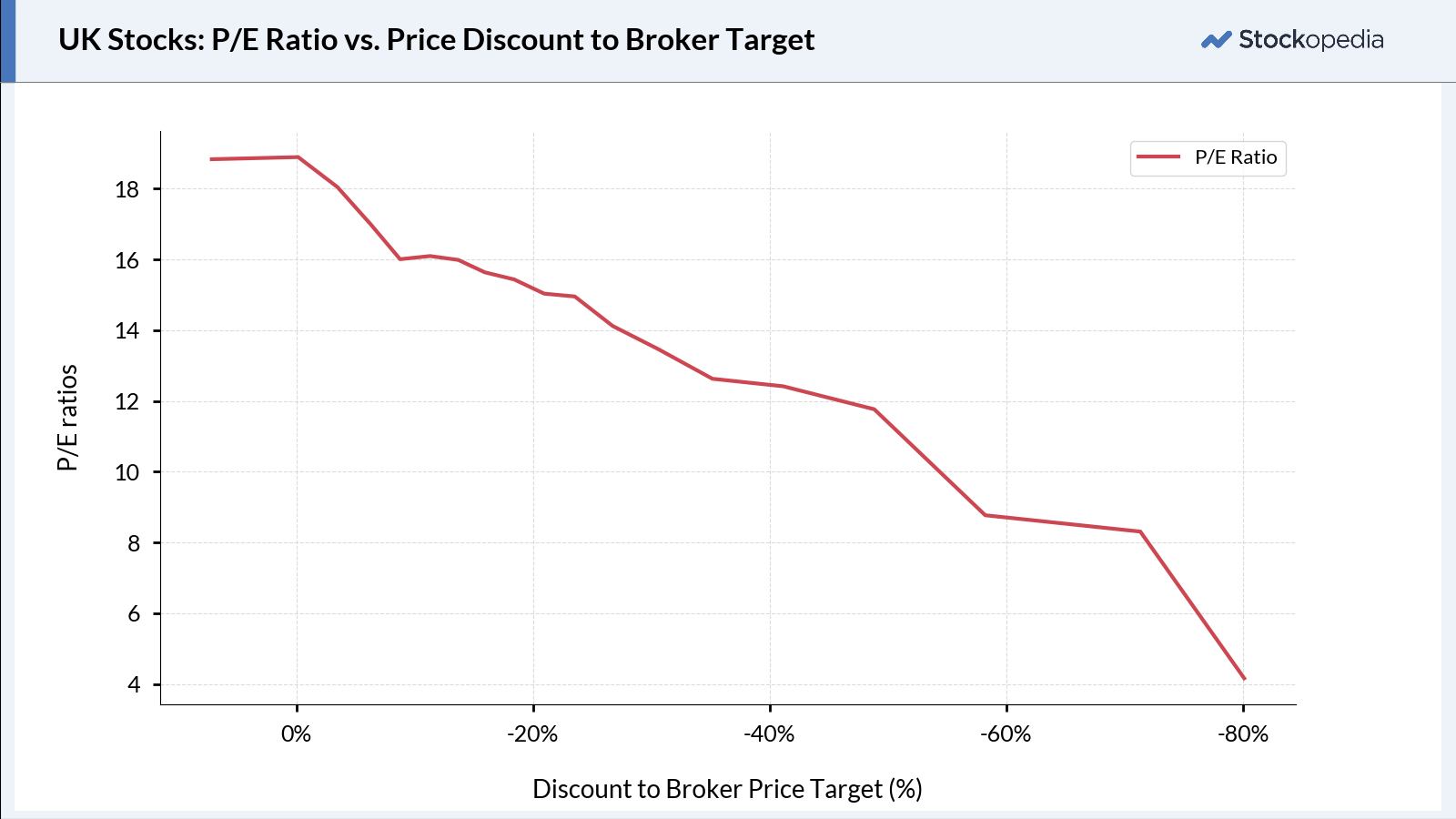
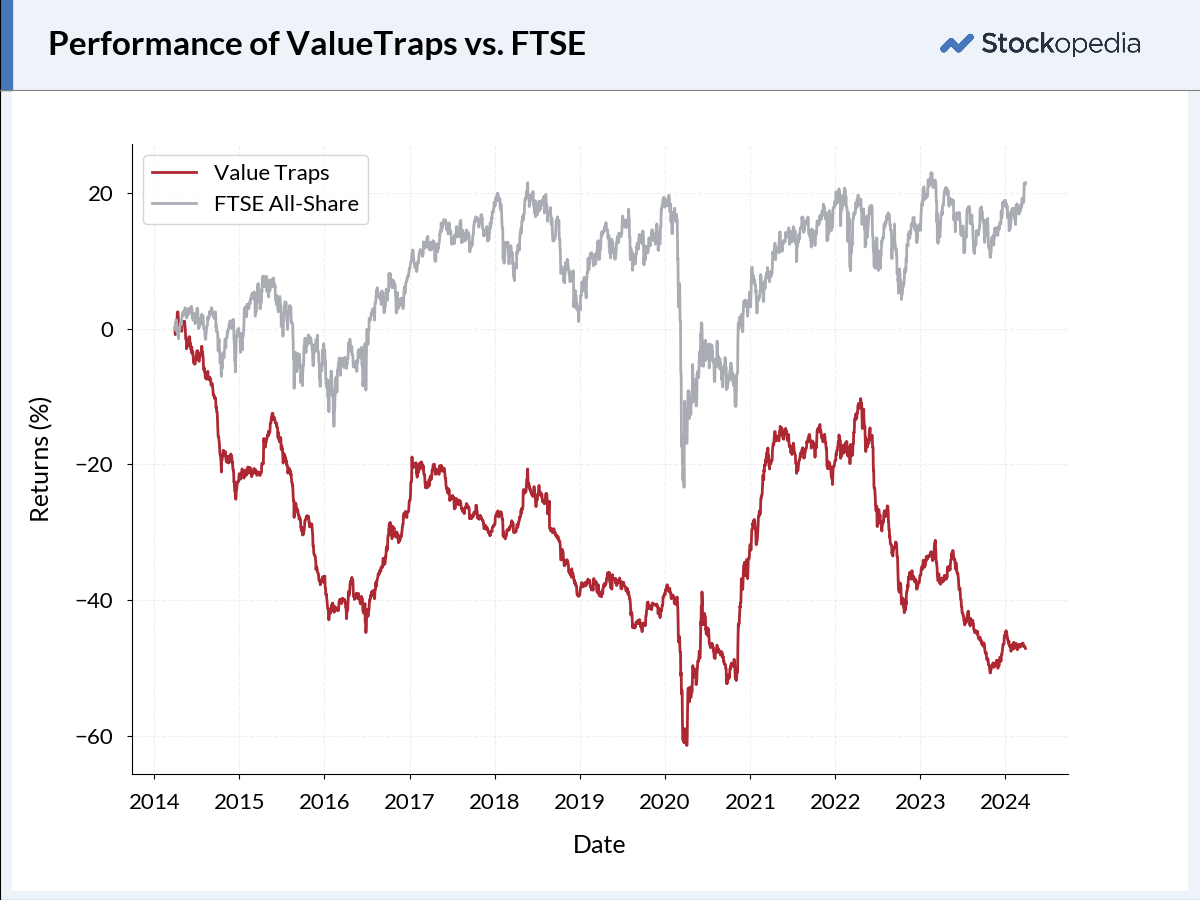
Companies trading below target price may look like attractive bargains. However, a low valuation isn’t always a good sign. Companies could be cheap for a reason, e.g. because profits are deteriorating. In such cases, the stock may be a value trap. The great investor, Seth Klarman once warned that value traps are a ‘dagger through the heart of value investing’. We have our own algorithm to identify cheap companies with weak price momentum and weak fundamentals.
Are we our own worst enemy?
When something goes wrong, we often project blame outwards. But as the cartoon character, Pogo, once said: ‘We have met the enemy and he is us’. The point was put forward more eruditely by Charlie Munger, the late business partner of Warren Buffett. In various speeches and articles, he talked about cognitive biases that lead us to trust authority figures, including brokers. Let’s examine a few…
- 'Over-influence by authority' — i.e. our tendency to trust authority figures without critical evaluation. He cited the well-known Milgram experiment, where one group of participants was instructed to administer electric shocks to another group, even when they screamed in pain and begged for the experiment to stop. Milgram’s contention was that many participants continued to deliver the shocks, simply because an authority figure in a lab coat urged them to proceed.
- The Halo Effect — i.e. a cognitive bias where our overall impression of a person is influenced by a single prominent trait. This bias may influence our investment decisions. For example, if a broker gives one successful stock tip, we may develop a positive impression which can in turn lead us to trust their future recommendations, even if those tips are less reliable.
We can resist cognitive biases by consistently questioning our own thinking. Always ask yourself: Am I following someone just because they have a suit and tie? A dose of skepticism can help too. The psychologist Daniel Kahneman said it best: ‘When somebody tells you that they have a strong hunch about a financial event, the safe thing to do is not to believe them.’
Conclusions
The data we reviewed suggests that following broker targets can lead to worse returns, not better returns. Stocks trading below broker targets often continue to decline, partly due to the momentum effect. These stocks often have weaker fundamentals.
We can protect ourselves with a checklist. If a stock is trading below the broker target, here’s a few things to consider:
- Guard against weakening momentum. Ensure a company is not caught in a negative momentum trend. We often interpret the price target relative to the current share price and make a bullish/bearish inference. But this often flies against the reality of how momentum works.
- Look out for poor quality. Unprofitable, low-quality stocks usually underperform. Review the company’s fundamentals and balance sheet for signs of weakness.
- Be wary of value traps. If a company is cheap, it could be cheap for a reason. Stocks with low valuations ratios may be cheap because they are low-quality junk.
- Guard against the Self. Remember Pogo’s words of wisdom: ‘We have met the enemy and he is us’. And it sometimes pays to be skeptical. When anyone gives advice, make sure you are not being swayed by the Halo Effect!
Disclaimer
This is not financial advice. Our content is intended to be used and must be used for information and education purposes only. Please read our disclaimer and terms and conditions to understand our obligations.

9 comments
Alex. Thanks for a very thought provoking piece. The way in which the brokers come up with their share price targets tends to rely heavily on the broker's earnings forecasts. So this strongly suggests that we should 1) Pay little or no attention to brokers' share price targets. 2) Pay little or no attention to brokers' earnings forecasts. Has there ever been any research which examines whether the companies in house brokers tend to produce more reliable earnings forecasts and share price targets than the overall brokers consensus does?
Hey, Good question. It is an interesting angle of research, but we do not have the breakdown to explore it further, unfortunately. We know the average/median estimate and the number of brokers feeding into said estimate, but we have no means to know which broker is making a specific estimate. Otherwise, yes... it would be a great research piece. If I see something like it on the web, I'll post it here.
interesting article Alex. I tried plotting the performance of the stock factor "price target/market price" on the US stock market with the results sorted into 50 different buckets. the time period is 1999 to the present. The buckets on the right are the stocks where the price targets are far above the current price. It seems that bucket 32 does best, where stocks are slightly below the target price. But the extremes are to be avoided, it seems
Hi,
Interesting graphic!
Thanks for sharing.
And I agree: the extremes are to be avoided. As you can see above, the stocks that are generally 'in line' with the target perform better, although I should add that the problem with extreme discounts was bigger than the problem with extreme premiums.
We can see below that discounted stocks (Bullish Broker Target) have far less QVM exposure - e.g. a StockRank of 44, well below 64 and 65. The red flag for extreme premiums (Bearish Broker Targets) perhaps lies in the over exposure to momentum and the under exposure to value. Extreme premiums were maybe dipping into momentum trap territory.
Best,
Alex
Alex, A super and thought provoking article that lays bare the risks of believing analysts’ recommendations.
Coincidentally there is a podcast released this week that covers similar ground. In an interview by Steve Chapman, Dan Rasmussen questions the accuracy of analyst forecasting. Controversially Dan’s research indicates that past growth rates of revenue, earnings, or cash flows do not accurately predict future growth.
Dan has written a new book, “The Humble Investor: How to Find a Winning Edge in a Surprising World”, which describes how he manages $1B of assets.
I am always curious about others edge perception , so have just ordered my copy.
Podcast here: https://behindthebalancesheet....
A great article and confirms my own thoughts on brokers, long before the day of the internet and of being able to do wider searches there was more reliance on brokers tips. I developed a pattern of going the opposite direction of what they say, I must say it has held me in good stead being a self taught novice investor of 45 years.
Thank you for the article
My SIPP has a potential 34% upside based on my calculations and projections, whilst the aggregate of brokers is 76%. A similar trend exists on the other portfolios. The history of my portfolios tells me I'm optimistic in my projections.
Thank you. You have confirmed what I thought of brokers and their fairy land targets. When a stock has a rating by 2 brokers on the same day; one saying strong buy, the other a strong sell, credibility went out the window a long time ago. The broker is the reality of experts; 'an ex is something that has been: and a spurt is a drip under pressure'.
Glad you enjoyed. I guess the trick is to distinguish between experts and experts. Obviously, a world without specialists would be complete and utter anarchy. At the same time, there is no substitute for a little doubt and a little skepticism, as your namesake, Descartes, pointed out!