Caledon 4Q10: How's it going?

Caledon Resources (LON:CDN) is currently "under offer" by Guangdong Rising, at price of 112p/share. If, as expected, this offer goes through the following discussion will be irrelevant. However, whilst there would probably be a sell-off in the event of a failure to complete, there could be value here - and even the possibility of a late counter-bid, if my analysis is correct.
Caledon recently released their report for the final quarter of FY10. As I have mentioned previously, Caledon's management have a bit of an unfortunate reputation for missed targets. So how do the latest figures fit this picture?
In December 2009, Caledon said:
Saleable production in 2009 is forecast to be approximately 485,000t of which
405,000t (83%) will be coking coal and the balance thermal coal. Sales for the
year will be broadly in line with these figures. The Company is currently
planning on a base production of 700,000t of saleable coal for 2010 and
investigating options for further expansion.
The actual out-turn for 2010 has been 529,000t of saleable coal. Not too good. However, management has recognised it's shortcomings and several new appointments have been made, including that of Stephen Bywater at Board level.
Getting down to "brass tacks", how is the production record looking? Here's my chart, looking at half-year figures (in '000 tonnes):
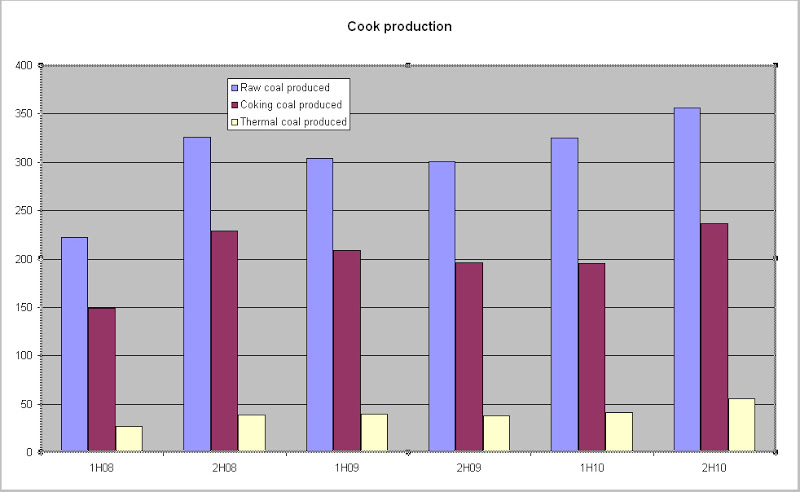
2009 saw the company forced to scale back production in the wake of the GFC. At the end of 2009/beginning of 2010 a major revamp of operations was conducted, with the main ABM-25 miner being refurbished and moved to the more accessible and newly created southern workings of the Cook mine. Despite weather-related disruption in Q4 of 2010 (which has extended into Q1 of 2011), it is apparent that productivity is improving - albeit at a slower rate than management had hoped for. 2H2010 represents a record half for Caledon.
Now, this is where things get interesting...
- Under normal circumstances (and until the WICET project is built, which will provide Caledon with 4MTpa of export capacity), Cook output is constrained by rail capacity.
- Many of Caledon's competitors with open-pit mines in the Bowen Basin have been severaly disrupted by the recent flooding, and will take some considerable time to restore to normal operations. Caledon's underground Cook mine, OTOH is already operating normally again, as per the production report.
- The Blackwater rail network that Caledon uses is, so far, unaffected by Cyclone Yasi - whereas networks used by some competitors are affected.
The net effect of these factors may be to increase Caledon's ability to export coal at a time when prices are rising strongly, in the face of massive weather disruption:
...The disruptions in supply because of the floods havedriven coking coal spot prices up by USD40-50 per tonne to USD280-290 per tonne, the report stated...
With Caledon's costs likely to be around $150/tonne, 2011 ought to be a highly proftable year for the company.
I am intending to attend to tomorrow's EGM and get the word "from the horses mouth". Watch this space. :0)
Mark
Disclaimer
This is not financial advice. Our content is intended to be used and must be used for information and education purposes only. Please read our disclaimer and terms and conditions to understand our obligations.
4 comments
OK, here are my findings from this morning's EGM (with thanks and acknowledgement to "drag100" from another site for helping compile a list of questions for the Board).
David Weill, Mark Trevan, Steve Bywater and David Treadwell were present.
The formal business was dealt with and then the directors accepted informal questions.
Cheers,
Mark
Hi M
I accept everything you say. But the bottom line for me was that the upside provided by the offer was about 10% compared with a downside that was much bigger. What are the % probabilities of each case? I'd estimate a 90% COS vs 10% COF. (Chance of Failure). So mathematically there was an expected value from continuing to hold of less than 9%.
If I had not been holding yesterday morning, would I have bought the shares (or any others) with an expected return of less than 9% with some unknown level of downside risk? No, absolutely not.
Which really meant that I ought to sell. So I did.
My Damascene experience last year is making me much more circumspect about managing the risk/reward balance.
Must confess that I sold this afternoon. Caledon has done extremely well for me. I followed Mark's analysis and bought last summer since when I have made a gain of 290%. I had intended to hold on for the current offer to be concluded but decided that the hundred year cyclone about to ravage Australia might do some damage to the bid negotiations and hence to the share price. I decided that it would be greedy to hang on for the final 10% (from current price) that is going to be achieved if the bid concludes. Better to take the healthy profit currently on the table rather than see it evaporate if disaster strikes.
good luck to those who continue to hold (as well as those poor souls exposed to the ravages of the weather in Oz)
T
Hi T,
Just to clarify my own position, I have taken profits along the way, as the price has risen and only have a relatively small number of Caledon shares left - though I also have exposure through my larger holding of Polo.
I went through the same thought processes as you - but concluded that recent weather events actually improved Caledon's attractiveness. The Bowen basin, where Cook and Minyango are situated, is the world's largest seaborne exporter of coking coal, so consumers cannot simply ignore the region. Considering how well Caledon appears to have come through the recent extreme weather events, surely that must make its mines attractive properties within the region? Many of the other coking coal mines are open-pit. That makes them cheaper to operate - but intrinsically more vulnerable to flooding. Of course, we have yet to see the impact of Yasi but, so far, it's looking OK from Caledon's POV.
In the light of the above I did consider whether to top up my current holding - but tend to agree that the risk/reward doesn't look quite attractive enough for me at the current price. However, IMO, well worth keeping on the radar in case the price does dip, either in fear over Yasi or if the Chinese bid falls through causing the stock to sell off too far. With funding in place and strong coal prices Caledon's future looks sound, bid or no bid. There is even a chance that a higher bid could come along, for the reasons outlined in the previous paragraph, if the Chinese don't get a move on!
I echo your sentiments and sympathy to the Queenslanders - hard to imagine it can get much worse for the good folk there.
Cheers,
Mark