Can brokers outperform simple algorithms in the world of investing?

Brokers get a bad rap. Even grandfatherly figures like Warren Buffett take the occasional jab. He once said there’s only one place in the world where people ride in a Rolls-Royce to get advice from those who take the subway. That place is Wall Street!
In movies, brokers are often portrayed as villains. The Wolf of Wall Street drives this message with a scene where Jordan Belfort is told that the goal is to ‘move the money from your client's pocket into your pocket.’ Much of the criticism is arguably a hangover from the days when brokers were incentivised to prioritise trading volumes over investors’ profits. Brokers earn commissions every time an investor makes a transaction, regardless of whether a stock rises or falls. So some brokers would ‘churn’ a portfolio — i.e. buy and sell excessively in order to drive up commissions. Wall Street’s history of scandals hasn’t helped their reputation, either.
That said, there may a case for being a bit kinder to brokers. Regulatory reforms now mean that brokers can no longer receive commissions from fund managers for investment advice. Moreover, their research reports offer insight, and qualitative analysis, which is essential tools for truly understanding a business. Brokers also provide market liquidity, ensuring trades can be executed without trouble. That’s all well and good, but let’s not forget the key question: Are brokers good at picking stocks? They stick great, big 'Buy', 'Hold' or 'Sell' recommendations on their research papers. Let’s explore whether investors should pay any attention to them…
Rage against the machine… or rage against the self?
Brokers undergo rigorous training. They have to pass challenging exams. But they are just human—only human—prone to general all-around messiness. Fund manager James Montier is an interesting case in point. He developed a tactical asset allocation model based on value and momentum rules. Montier delegated decision-making to his model, but there was a catch. He only listened when the model agreed with him. Initially, the model produced signals in line with the Montier’s own bearish outlook. Then the model gave bullish signals which contradicted Montier’s opinion. So of course Montier overrode the model. And of course the model outperformed Montier, who admitted: ‘I spent about 18 months being thrashed in performance terms by my own model.’
The story reminds me of Richard Brautigan’s poem, All Watched Over by Machines of Loving Grace. Brautigan paints a world where machines take care of humanity in a peaceful technological utopia. If models and algorithms outperform professionals, then we should relax and let machines do the work. Then I pinched myself! Brautigan was describing a utopia, not reality! Moreover, the stock market is not a ‘deterministic domain’, where a given input consistently returns a given output. Algorithms work in these deterministic contexts, because it is easier to figure out the link between cause and effect. At best, the stock market is ‘semi-deterministic’. We can identify rules of thumb, but it isn’t physics, where Newton could have dropped one hundred apples and gravity would have kicked in one hundred times. In investing, apples sometimes grow wings.
If this is the case, then perhaps we should override algorithms… every now and again. This could be a good idea, if we intervened in a systemic way, but we don’t. We meddle based on how we feel. James O’Shaughnessy explains that ‘we are a bundle of inconsistencies, and although making us interesting, it plays havoc with our ability to successfully invest our money.’ The cartoon character, Pogo, said it better: ‘We’ve met the enemy, and he is us.’ Models have several advantages. They don’t wake up in bad moods, get distracted, or suffer from overconfidence. They don’t chase vivid stories at the expense of hard data. They don’t take anything personally, have egos, or feel the need to prove themselves. As O’Shaughnessy puts it: ‘If they were people, they’d be the death of any party.’ But they do apply the same criteria consistently and reliably.
Mind vs. Machine
I mentioned that the stock market is ‘semi-deterministic’. There are various well-documented heuristics. We can list a few:
- Stocks that have gone up tend to defy gravity and keep going up — remember, this isn’t physics!
- Stocks with low valuation ratios, such as a low P/E, generally outperform stocks with high valuation ratios.
- Companies that are financially stable and generate strong cash flows tend to outperform those that are highly leveraged or cash-strapped.
These are not iron-laws. No-body has ‘solved’ the stock market. These are rules of thumb which help to explain the factors that drive stock returns. In turn, our StockRanks then measure a stock’s exposure to those same factors. We assign a higher rank to companies with more exposure — i.e. we assign a higher rank to cheaper, profitable stocks with price momentum. Crucially, they are generated in an objective and consistent way, not based on personal judgement or subjective opinion. The ranks are calculated algorithmically; that is to say, they were designed once, many years ago (by a human) and they are regenerated every night without further human intervention. Some brokers use algorithms, but they often rely on subjective judgment — as the story of James Montier suggests.
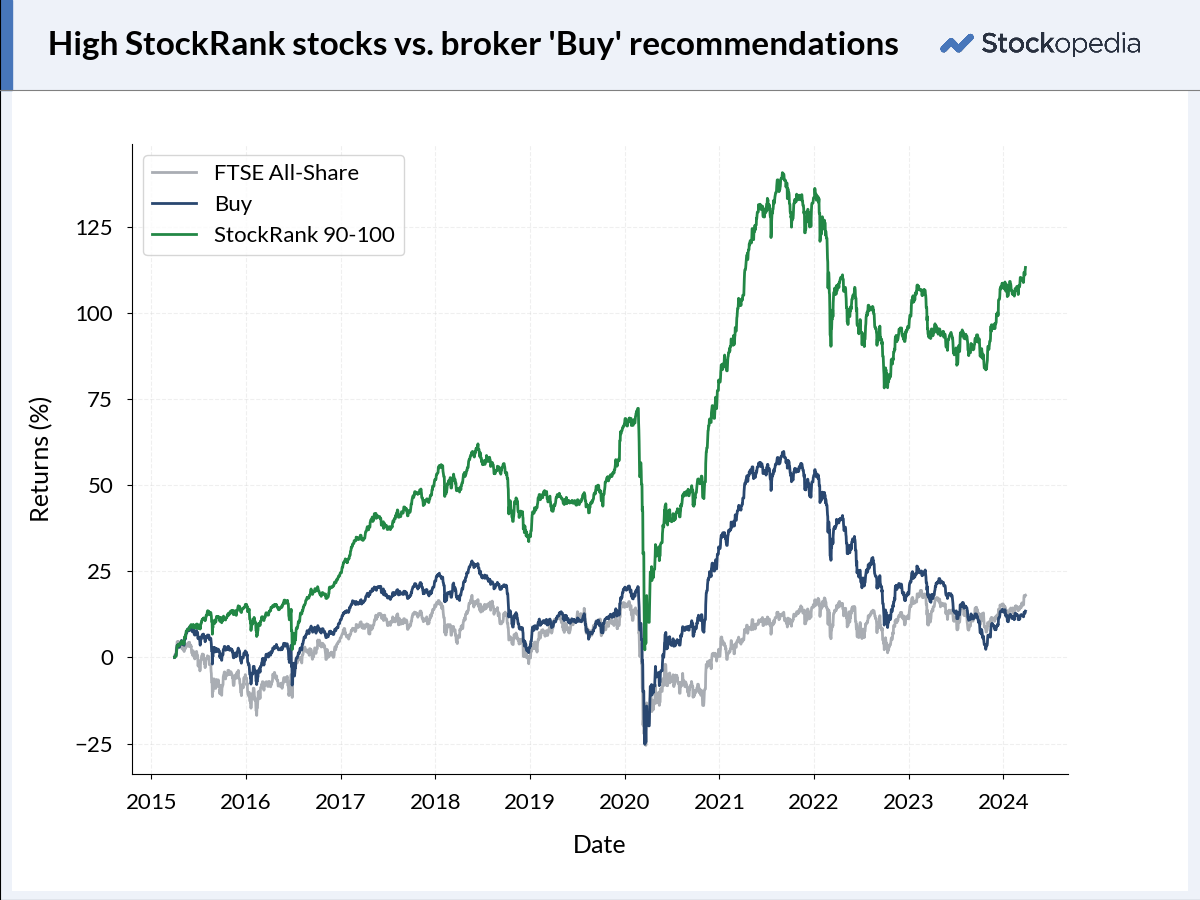
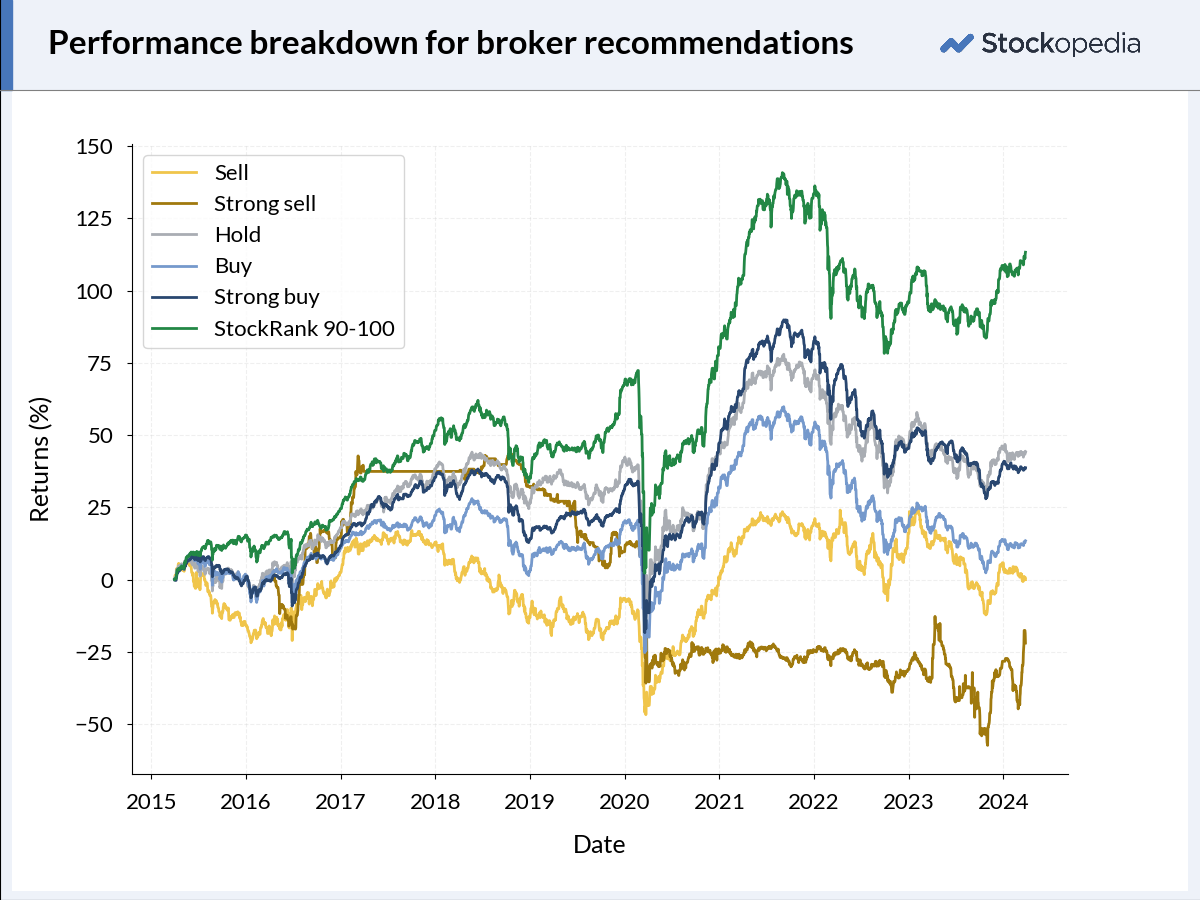
Let’s compare the results. On the bullish side, high StockRanks outperform ‘Buy’ recommendations. It is also worth noting that the FTSE kept pace with ‘Buys’ and nudged past them at the finish line.
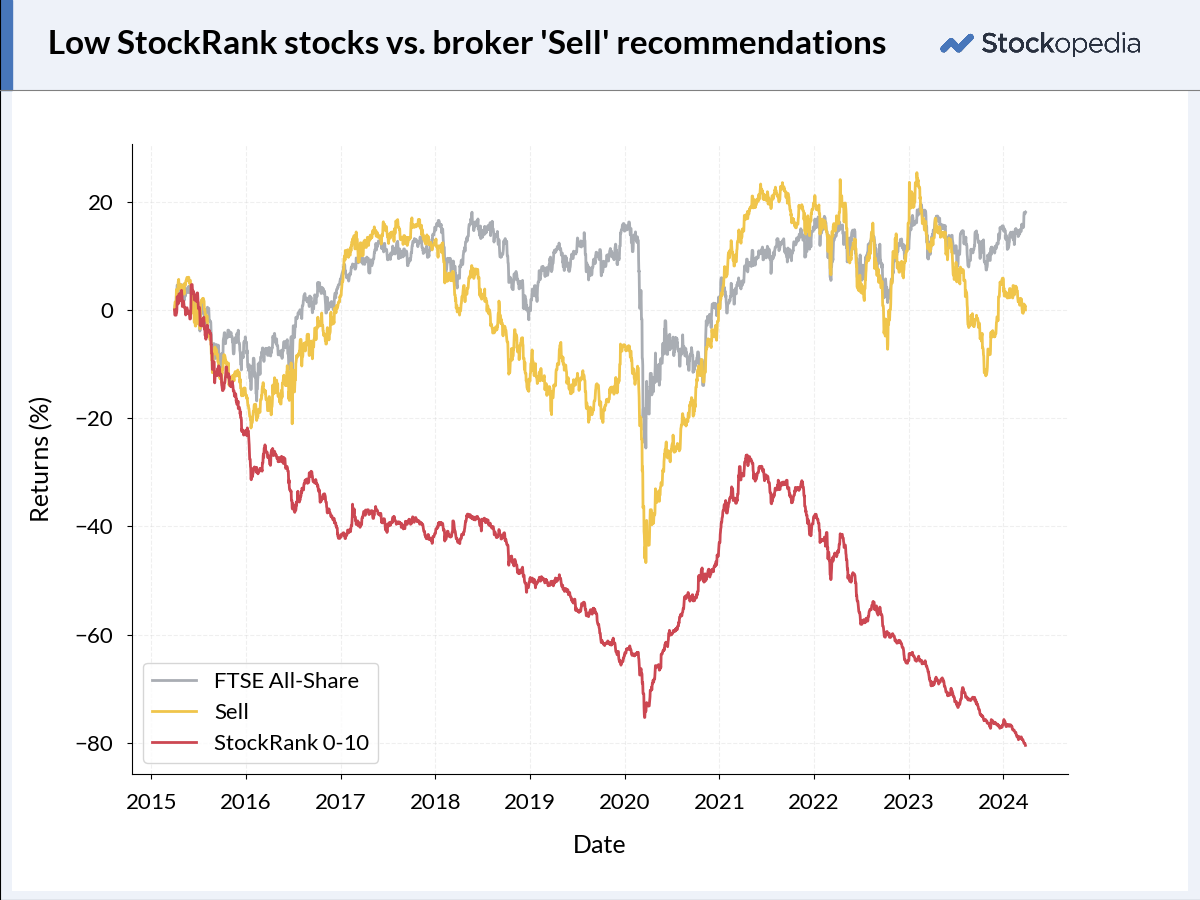
On the bearish side, low StockRanks underperform ‘Sell’ recommendations. This is what we expect. Our StockRanking system assigns a lower rank to companies which are less likely to perform well.
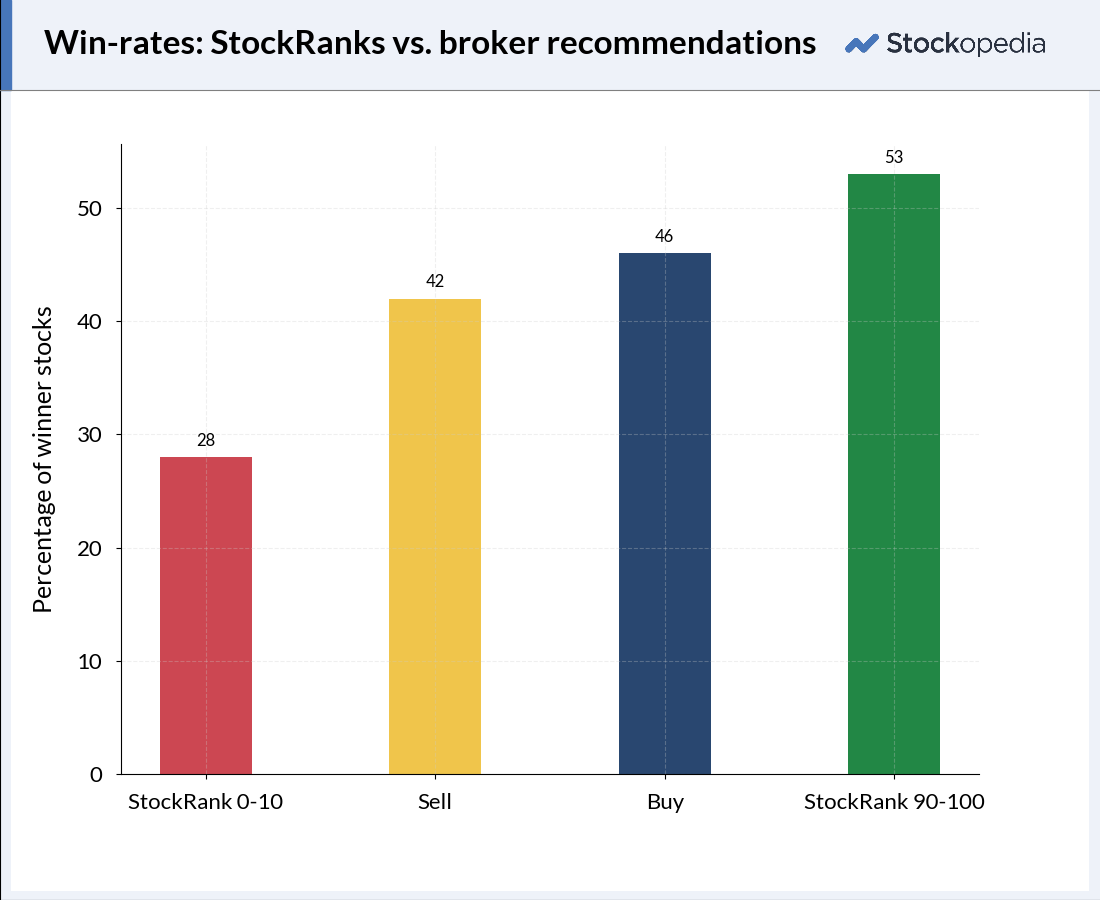
Broker ‘Buys’ are more likely to be winners than broker ‘Sells’ — i.e. they were more likely to generate positive returns. However, the StockRanks have a higher probability chance of picking winners and picking losers.
We can also see that the win-rate for ‘Holds’ was higher than the win-rate for ‘Buys’ and even for ‘Strong buys’. This suggests that analysts may be poor at identifying ‘true’ winners — i.e the stocks most likely to outperform.
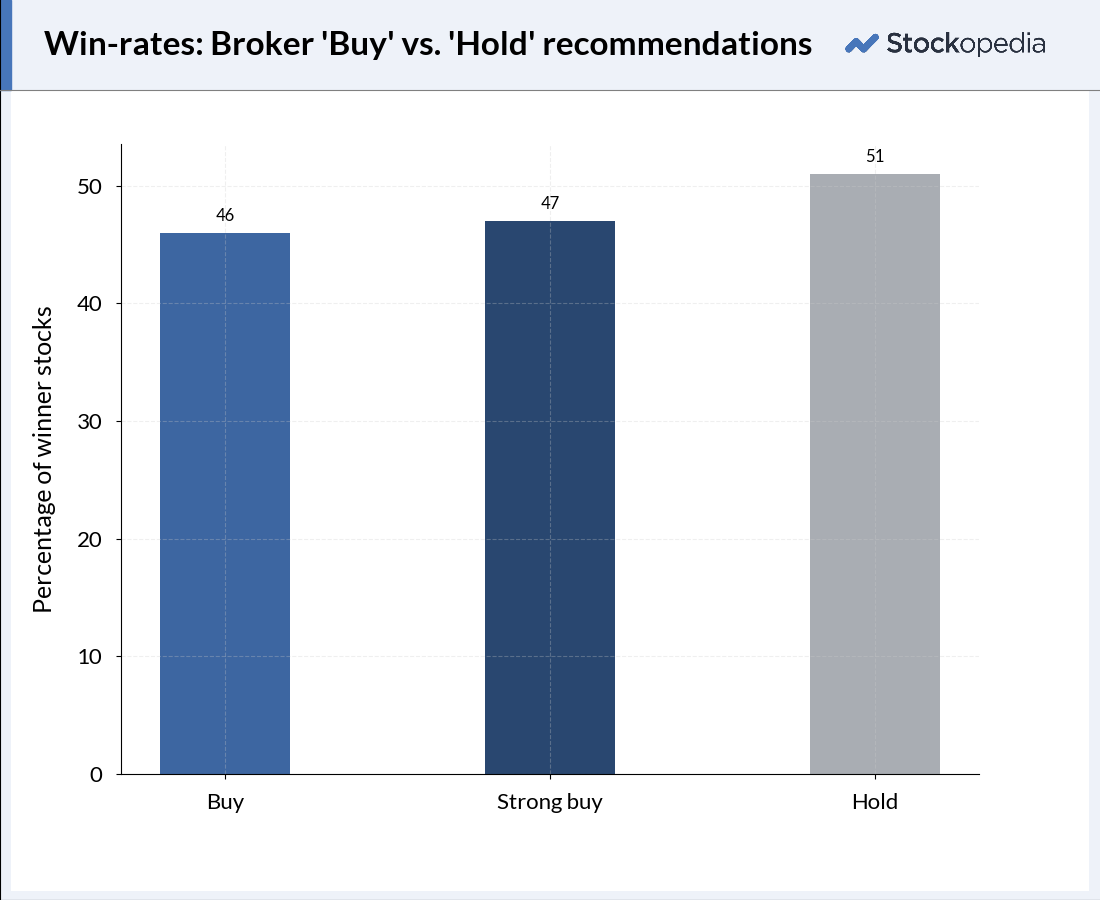
We focussed primarily on Buys and Sells, not Strong Buys and Strong Sells. This is because the sample size for Strong sells was small and could reflect misleading results. Nevertheless, the full performance breakdown is here… incase people are interested. Again, the elephant in the room is that ‘Holds’ beat ‘Buys’ and ‘Strong buys’.
Conclusions
We live in interesting times. Buzz words like artificial intelligence dominate the headlines and lead some to claim that we are on the verge of a technological singularity which will change civilisation forever. I take that with a pinch of salt, but we can at least see the limitations of human judgement. In the battle of mind vs. machine, the evidence is clear: algorithms and models have a tendency to outperform professional stock pickers. We’ve heard about fund manager underperformance many times and in many ways. James O’Shaughnessy says it clearly: ‘All money managers think they have the superior insights and intelligence to help them to pick winning stocks, yet 80% of them are routinely outperformed by the S&P 500.’ This doesn’t mean algorithms always work. The stock market isn’t fully deterministic and the models aren’t infallible. But as James Montier’s humbling experience shows, the best results often come from trusting systematic, well-researched strategies over qualitative input and gut instinct.
Disclaimer
This is not financial advice. Our content is intended to be used and must be used for information and education purposes only. Please read our disclaimer and terms and conditions to understand our obligations.

9 comments
As a matter of interest why are posts being deleted from this thread?
Nothing as far as I could see that needed some form of censorship.
I spent about 18 months being thrashed in performance terms by my own model
I vaguely recall a study of value managers. Since there are value-weighted indices, it's possible to determine if value managers add value. The answer seemed to be "no". Managers were good at spotting the duff companies but they tended to throw out too much. So they underperformed.
I had a quick scan of Terry Smith's performance. It is possible to find quality-factor ETFs. Here I found that Smith seemed to provide value.
I wonder what the results would have been if the quality was filtered by top quartile of value.
Stockrank 90-100, up about 110% in 10 is not particularly good. The Top Momentum stocks are up over 500% in about 12 years. Value on its own has not performed very well. VQ also not performed well. Anything with high momentum, has performed far better, check out QM, VM and QVM top stocks performance.
Aren't the stock rankings based heavily on momentum though so by default they would perform high/low linked to the ranking?
Hi,
Thanks for this.
We equal weight Quality, Value and Momentum within the ranking system.
I should also add that the MomentumRank is based only on data that was available at the beginning of the holding period - i.e. we assign a high MomentumRank - based on prior price performance - and then the stock (often) continues to outperform. We do not do the inverse... retrospectively.
Best,
Alex
Fascinating insights as always - how do we account for re-balancing in this side by side analysis - or is this an analysis of Stock Ranks & Broker Recs as at 2015 monitored all the way through to today?
Good question. The ranks and the recommendations are both rebalanced on an annual basis. I thought about quarterly rebalancing, but I rather suspect that most readers are not rebalancing so frequently. Annual more likely lines up with readers' holding period.