Can the turnaround momentum silence my Pearson demons?

In the writing test that I submitted when I joined Stockopedia, I wrote about my intense dislike for international textbook company Pearson (LON:PSON). “There is no reason,” I said, “why every announcement from the group irritates me to the point that I dismiss it.” The purpose of that article was to highlight the dangers of basic human behaviours when it comes to investing and to explain why biases like this play a strong role in the momentum effect. Since I wrote it, Pearson’s share price has risen almost 25%.
My prejudice against Pearson probably stems from the fact that I joined the Financial Times while the company was in the process of selling the newspaper and my first week was dominated by discussions of industrial action from the journalists. Then-chief executive John Fallon was widely criticised for his decision to sell what were then deemed the highest quality parts of Pearson: in addition to the FT, he was responsible for the sale of the company’s profitable stakes in The Economist magazine and publisher Penguin Random House. In 2015 and 2016 the company was loss-making at the operating level with no clear plans to make use of the considerable cash inflows from the various business sales.
But that was six years ago and since then the company has completed its sale of the FT and many other ancillary businesses, doubled down on its focus on learning materials and appointed an almost entirely new board and executive management team. Perhaps it is time to hang up my hang ups?
Company Profile: Background
In 1844 Samuel Pearson founded an engineering and construction company in his name. For 80 years, three generations of Pearsons oversaw major building projects while turning their business into one of the world’s largest construction companies. But the future of the company was in the media. Throughout the 1950s and 60s management acquired various newspaper, television and production companies before making their first move into education with the acquisition of Pitman Publishing in 1985.
By the 2010s, with Fallon at the helm, growth opportunities were increasingly unreliable and so in 2013, after warning of weaker than expected earnings, management announced plans to restructure the business and focus on education. The changes involved decoupling Penguin Random House into a separate arm which would eventually be put up for sale and creating three clearly defined lines of business: School, Higher Education and Professional. By 2015, the company had rebranded and announced a “100% focus on education”.
But still growth was lacking. The education landscape was undergoing a sharp change, with demand moving away from expensive text books into more online learning materials and courses. Between 2015 and 2020, company revenue ticked downwards at a compound annual rate of -5%. And in that time, sentiment suffered. From an all time high of 1490p per share in 2015, the share price had crashed to 445p by May 2020.
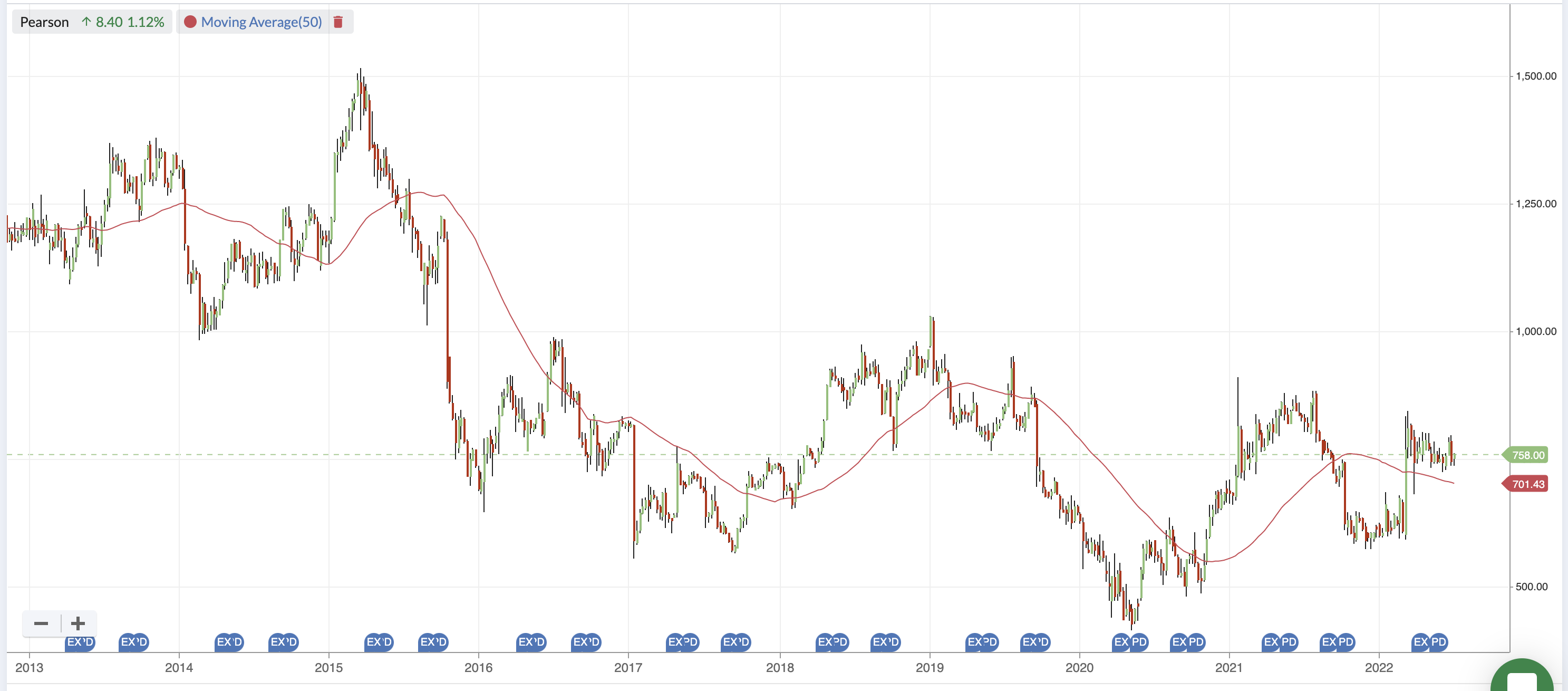
Enter Andy Bird - a former executive at Walt Disney under turnaround king Bob Iger - tasked with alleviating the company from the doldrums. At the start of this year, the company announced a refreshed strategy, focused heavily on digital operations. “This is a new Pearson,” insists the 2021 annual report.
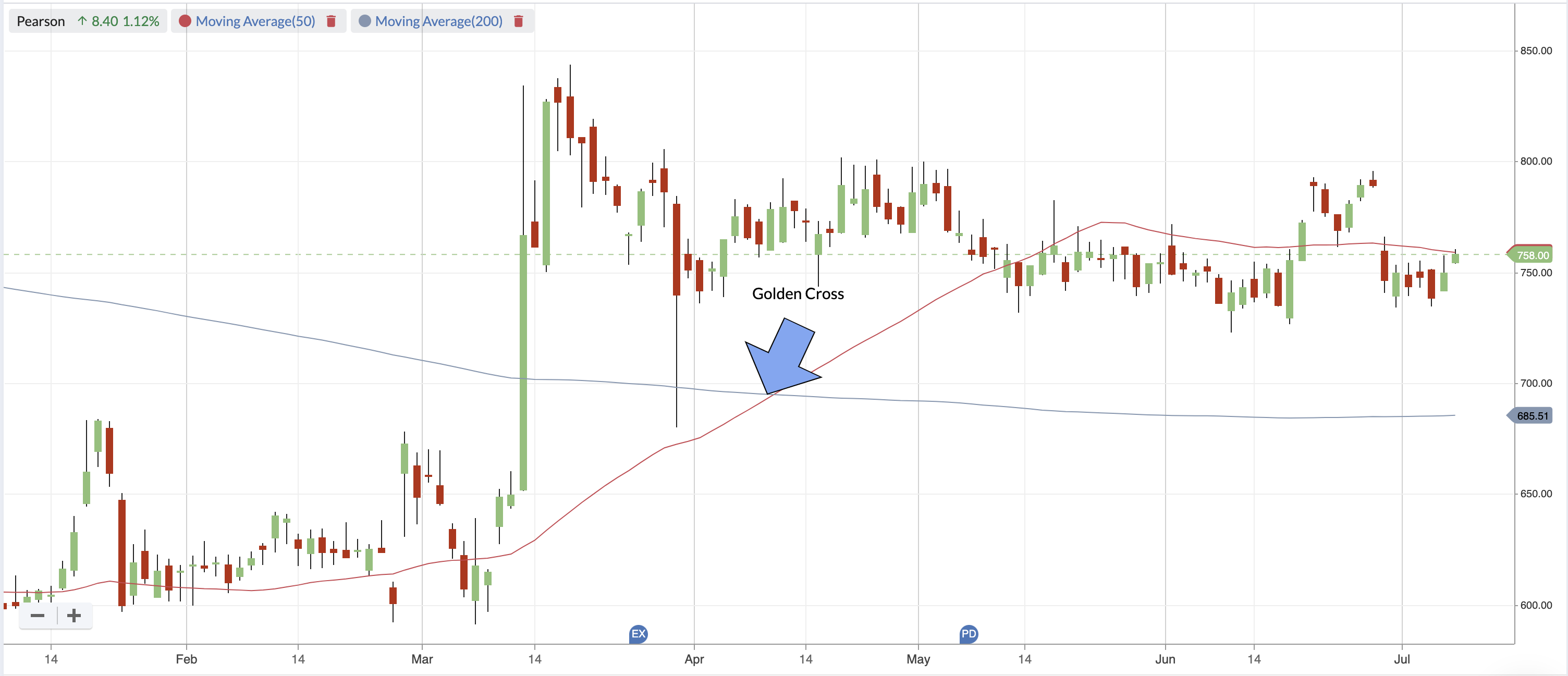
And the market is starting to believe management. Pearson’s share price up 25% in the year to date and its relative strength compared to the market +31% in the last six months. Shares are also currently trading almost 10% ahead of their 200-day moving average and have recently breached their 50-day moving average for the second time this year.
Do the fundamentals support the change in sentiment?
In 2021, Pearson reported its first increase in revenue for nine years. Sales of £3.43bn were 1% up on the previous year on a reported basis and up 8% on an underlying basis, after excluding the effects of currency exchange and portfolio changes.
The increase was driven by the strength of Pearson’s largest division, Assessment & Qualifications as well as newer products including Virtual Learning. The previously dominant Higher Education business continued to struggle, especially in the US where lower college enrolments and a shift in demand for learning materials (from expensive text books to cheaper e-books) continues to hurt performance.
But while the challenges facing the US college division are unlikely to let up, Pearson’s other businesses are in good shape. Revenues are forecast to climb to £3.64bn in the current financial year and £3.80bn in the year to December 2023.
Operating profits rose 33% on an underlying basis in 2021, after excluding the gain on the sale of Penguin Random House in 2020 and the restructuring costs which hampered the reported performance in 2021. Heavy adjustments at the operating level are not a particularly welcome sign for investors, especially when the reported figures are very weak. But the revenue and operating breakdown from Pearson’s reporting divisions shows some positive trends: from 2020 to 2021 margins improved in three of the five divisions, with the dominant Assessments business reporting operating margins of 18%.
| FY 2021 | Revenue (£m) | Adjusted Operating Profit (£m) | Op Profit Margin |
| Assessment & Qualifications | 1204 | 216 | 17.94% |
| Virtual Learning | 713 | 32 | 4.49% |
| English Language Learning | 238 | 15 | 6.30% |
| Workforce Skills | 172 | 27 | 15.70% |
| Higher Education | 849 | 73 | 8.60% |
| FY 2020 | Revenue (£m) | Adjusted Operating Profit (£m) | Op Profit Margin |
| Assessment & Qualifications | 1082 | 147 | 13.59% |
| Virtual Learning | 692 | 29 | 4.19% |
| English Language Learning | 218 | 1 | 0.46% |
| Workforce Skills | 163 | 26 | 15.95% |
| Higher Education | 956 | 93 | 9.73% |
Margins are expected to continue to be supported by the increasingly digital focus of the business. In 2021, 74% of Pearson’s products and services were digital or digital-enabled, up from 59% three years previously. The opportunity for digitalisation is especially exciting in the Assessments business, with exams for both school and higher education increasingly taking place online in the wake of the global pandemic. Pearson’s OnVUE product is designed to support secure remote assessments and here test volumes rose 43% to 3m in 2021.
Balance sheet in better shape
In recent years Pearson’s liquidity and solvency has been another concern for investors. Net debt peaked at £1.3bn in 2019, equivalent to net gearing of 30%.
But recent disposals and better management of capital have helped restore the balance sheet somewhat. The company is now sitting on just under £1bn of cash, with net debt at £463m and net gearing at 11%. The demands of current liabilities is also now under control with a quick ratio of 2x and an interest coverage ratio of just over 5x.
The company is also making better use of its cash and reported an increase in capital expenditure from £134m in 2020 to £176m last year as it upped its investment in new digital innovations.
Returns for shareholders
But profitability is still elusive. Earnings are forecast to drop again in 2022 before picking up the following year, while return on capital employed (ROCE) remains resolutely uninspiring at just 3.18%. Return on assets (ROA) were just 2.15% last year, suggesting that Pearson is currently failing to squeeze profits out of its assets effectively. But the gulf between return on assets and return on equity has narrowed and the equity multiplier has reduced to 1.76. This indicates that the company is making good use of its equity rather than its debt in the purchase of assets and in profit generation.
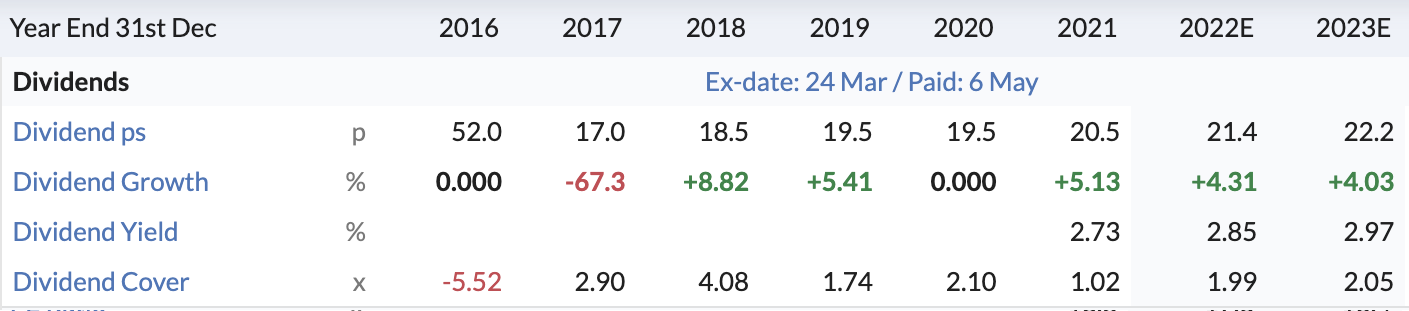
Meanwhile, dividends keep landing in investors’ pockets. The payout was halved in 2017, but since then, the company has returned consistently rising dividends to shareholders. Despite the fact that the 2021 dividend was only just covered by earnings, forecasts are for the payout to keep growing at between 4% and 5% per year. The yield of 2.91% looks sustainable for now.
Buy when you are uncomfortable
A price to earnings ratios of 17x doesn’t scream good value, while the negative earnings forecasts means there is no PEG to speak of. That said, a price to book ratio of 1.29x does compare favourably with peers in the media and entertainment market.
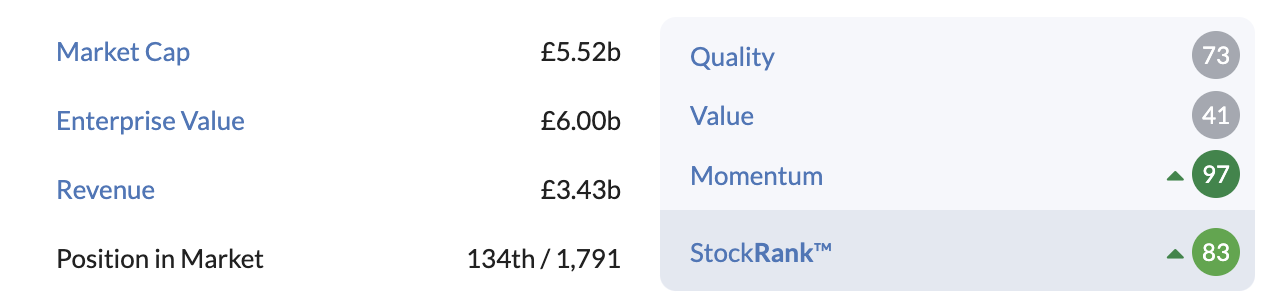
While there are undoubtedly signs of recovery at the operating level and on the balance sheet, Pearson is still lacking in the quality that it takes for me to feel comfortable about buying a stock. But perhaps that is a good thing. Momentum is a powerful factor in the stock market and buying a stock when momentum has only just turned in its favour is the best way to maximise returns.
Disclaimer
This is not financial advice. Our content is intended to be used and must be used for information and education purposes only. Please read our disclaimer and terms and conditions to understand our obligations.

3 comments
Hi Megan
£RM is my worst performing investment and I’ve naively held on assuming the return to normal schooling will result in £RM realising a return to pre pandemic profits. They have also completed a rationalisation over the last 2 years.
However the SP has more than halved in year so investors aren’t seeing a turnaround, such that it qualifies as a neglected firm. If £RM can deliver on its forecasts then it is much better value than Pearson (LON:PSON)
Clearly Pearson (LON:PSON) is a much bigger company but interesting that investors are seeing a turnaround narrative. I hope £RM follows suit.
@Revs8, RM (LON:RM.) like some other cos links up better when their period is added to the ticker but I digress from your interesting comment. I hold RM (LON:RM.) and admit it has been one of my worst choices in that it's share price is one-third of which I bought at and am hoping my other shares will carry the day. I don't hold Pearson (LON:PSON) and will continue to avoid.
Awesome analysis, in the poker world I'd say - VWP - (Very Well Played), cant to pick any holes in your presentation.
How to get from being an "engineering and construction" company to "education materials" is beyond my brain cell capabilities.... Hopefully the likes of BP (LON:BP.) and Shell (LON:SHEL) are similarly adaptable and up for the challenge and will take note of this example.