Can you beat the market using broker buy recommendations?

After a couple of minor roles in the City, I wound up at Goldman Sachs in their ultra high net wealth private client division. As is usually the case as a junior you are keen to make a good impression and find promising investments to pitch. The problem was I was rather independent minded and preferred to come up with my own ideas…. which were rejected. I was told my idea would always be rejected if it wasn’t on ‘the recommended buy list’ and I hadn’t “checked the idea with the analyst upstairs” personally. Who were these gurus upstairs, and why did their opinion matter so much? Could they really hold the secret to infinite wealth? As I was soon to find out, in the most painful way possible, their opinion was worth diddly-squat.
Understanding analyst incentives
If you are a novice you might not be sure how the City pumps out its stock ideas. Here’s how the game works. The City is split into the “buy-side” (fund managers who run the assets) and the “sell-side” (brokers who place their trades). The sell-side is always trying to pick up commission by encouraging the buy-side to trade. So their research departments write flashy research reports and their sales teams get on the phone.
If you’ve ever been given a flower by a Hare-Krishna on the street ‘for nothing’ you’ll know how this works. Whenever we receive a gift, we feel obliged to give something back in return. It’s a well-worn Jedi mind trick. So fund managers often send their trades (and pay commission) to the brokers who have most influenced their thinking.
But investment bank research departments don’t just cater for their brokerage clients, they have historically had their arms twisted by the suits further upstairs - the corporate financiers. These are the slick guys who do corporate mergers & acquisitions and raise the equity and debt capital to fund them. They really don’t want any negative research published about their clients, and they’re a bit like the Men in Black…. so most research analysts don’t dare mess.
If you consider these skewed incentives it’s hardly surprising that most sell-side research is rather biased. It’s either written as a great pitch (to encourage trading) or given a positive spin (to not upset a corporate client). Now I know a lot of people will object to the above comments (as research departments are generally more independent these days) but implicitly or explicitly we’ll see how these incentives impact reality in the numbers below.
First pitch…
Back to 1998… having scoured the GS Recommended Buy List for some time I’d made a watchlist of stocks whose stories I liked. There was this stock called CBT Group, and I can still remember the ticker - CBTSY. It was Nasdaq listed, made online educational software, and the dotcom boom as on. It had had a pretty stunning run, more than doubling over the previous year.
Everything was bullish. It had been on the ‘recommended buy list’ for most of that time. The analyst was all over it in his research reports, gushing about their prospects and business model.
But one day the stock opened down about 20% on no news. This seemed highly unusual. Was now our chance to get in on the cheap ? I drummed up the courage to call the analyst upstairs and he gave a pretty clear message… “I spoke with the CEO this morning. Business is great, there’s no change in recommendation, it’s still a buy.”
So, I’d ticked the box. I made my pitch. My bosses were impressed. We initiated an initial 1% position across all proportion of our discretionary client portfolios. We were running the best part of $2bn at the time so it was a pretty big trade. All was promising, but something felt wrong...
Understanding consensus estimates
Private investors learn pretty quickly about broker research. There are lots of these reports, normally in PDF format, flying around the web getting shared by those in the know. Normally there’s someone who knows someone who has the login details of someone who can download a research paper.
These notes have a standard format:
- The cover publishes a Recommendation. Each bank uses their own terminology… but it’s normally a four or five tiered system which spans: STRONG SELL - SELL - HOLD - BUY - STRONG BUY.
- There’s usually a clear set of detailed Earnings per Share (EPS) Estimates for the next several years. There are other estimates for figures such as sales, EBITDA, book value etc etc, but the key figure that moves the market is normally the EPS projections.
- There’s often a Target Price. The price at which the analyst believes the shares ought to be trading at within some time frame. This will often be accompanied with a detailed valuation model, with some peer comparables to justify it.
- There’s normally a good yarn attached. Sometimes they make good reading as there can be some pretty good writers employed by investment banks.
There can be anything from one to dozens of brokers publishing competing research on each stock - each with different recommendations, EPS estimates, and target prices. So data firms consolidate these into averages… called Consensus Estimates.
At Stockopedia.com, we publish the consensus of the broker recommendation in a visual way in a meter as follows:

Tom Firth, who works with me has done a great analysis of the numbers. If you take a look at the distribution of consensus estimates on the London Stock Exchange you’ll find something startling… there are barely any sell recommendations.
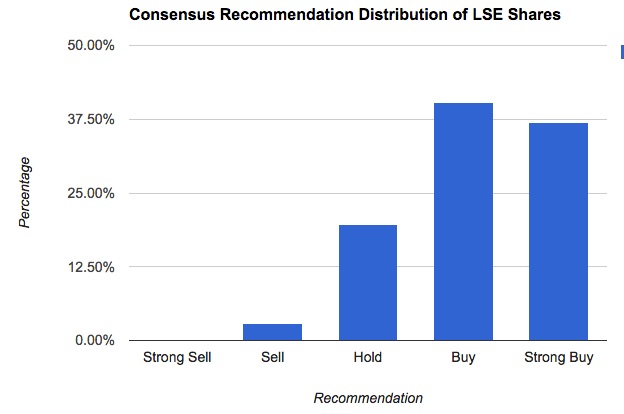
I’m not sure if there are many private investors who realise that 77% of shares are listed with a consensus recommendation of buy or strong buy. Right now there’s only a one in 33 chance that any stock you’re looking at is listed as a consensus sell.
Pear shaped…
So, the GS Technology analyst (an English chap) had reiterated his buy recommendation to me on the phone. We’d bought, and my nerves were eased when his voice started blaring out through the squawk box to the whole sales team with a similar buy reiteration later in the day. The stock rallied.
But next day it fell 40% at the open. Still on no news. I called the analyst again. Couldn’t get hold of him. Several times. Thankfully I worked for someone with a lot more market experience than me. He reversed the trade instantly. We’d lost our clients a lot of money. I felt like a chump.
The performance of broker buy recommendations
When you’ve got a distribution of recommendations that is so skewed away from “sells” it’s very hard to calculate the average performance of each type. We thought about it and split the recommendations into four buckets that are a more equally composed - sell, hold, outperform and buy. It helps to visualise the limits of these new segments against the Stockopedia.com ‘recommendation’ meter as follows:

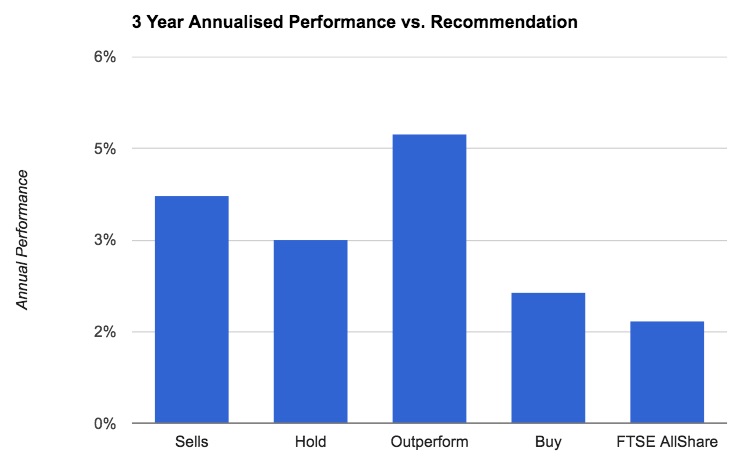
We’ve created 3 annual portfolios of stocks in each of these segments and tracked the performance versus the FTSE All Share over the last 3 years. The results are pretty startling.
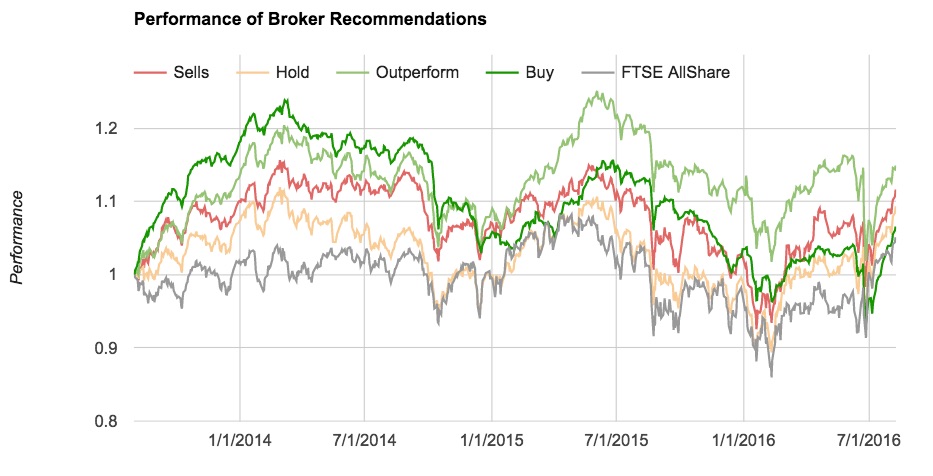
In summary:
- All segments have beaten the market (FTSE All Share), but none significantly.
- BUYS (dark green) performed the worst of all four sets.
- SELLS (red) outperformed both holds (amber) and buys.
- “OUTPERFORMS” (light green) performed best, but only beat sells by a shade.
Make of that what you will. The 3 year performance period may not be a long enough sample, but it pretty much validates what’s been found in most of the academic research on this topic. Broker Recommendations have very little predictive value.
Why are the strongest consensus buys the worst performers?
We can answer this with a little thought. If there’s only a single broker covering a stock, and they put out a ’strong buy’ recommendation then the ‘consensus’ recommendation will be ‘strong buy’. So the stocks with the highest consensus recommendation tend to be those with the fewest brokers covering them.
If there’s only one broker following a stock, it’s often either the house broker (who is conflicted), or an independent research provider paid for by the company themselves (who is also conflicted). It’s little surprise then that these buy recommendations just don’t perform… they aren’t exactly the most unbiased nor the most honest.
How to improve the performance of buy recommendations
CBTSY was a classic growth stock, and had a very expensive market rating. It was on a high P/E ratio. When it disappointed it was cruelly punished by the market. It fell much further after we sold. We bought at about $45 and we sold the next day at under $30. From memory, an insider trading suit took over and it eventually delisted at about $8 six months later. It was a very painful experience and I took some valuable early career lessons from it. Don’t fight the tape. Admit your mistakes. Cut your losses fast.
Brokers love growth stocks. Growth stocks come with exciting stories and are a much easier sell to clients. It’s hard to pitch a story about an old stodgy value stock in trouble. Perhaps, given that value investing works, amongst this blind spot there's an opportunity…
As Stockopedia regulars will know, cheap value stocks tend to beat expensive growth stocks even though they do give a hairy ride at times. So we've split the set of ‘hold’ and ‘outperform’ stocks into equal buckets according to their Stockopedia ValueRank and reassessed the performance.
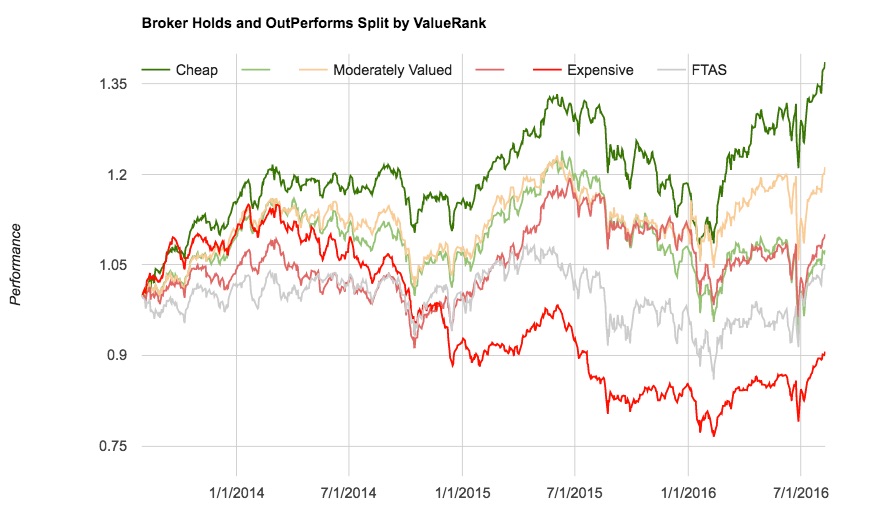
The Value Rank scores companies from zero (most expensive) to 100 (cheapest) . In the above chart the cheapest set of stocks is marked green, the most expensive red. The clear message here is that sticking to the cheaper set of buy & hold recommendations is the best way to find value in broker recommendations.. there's a 38% return over 3 years to show for it.
It does also seem that this set of high Value Rank (cheap) shares with broker coverage has significantly outperformed those that don’t have broker coverage - to the order of 10% over the same timeframe. I don’ t have a chart handy, but you can compare at the StockRanks Performance Portal and choose the ValueRank. So another message is that sticking to Value stocks that do have broker coverage may help with performance.
Conclusion…
It’s vitally important to understand that consensus estimates come from analysts who in aggregate are highly biased towards publishing ‘buy’ recommendations. They suffer from incentives which aren’t aligned with your own investment success, so it really pays off to mistrust them. This isn't to say there aren't fabulous analysts out there who do provide a huge amount of value... of course there are. But private investors often have to deal with averages, and as the statistics show, in aggregate analysts barely outperform.
The very best research comes from the buy side (the fund managers), but that research isn’t published. It’s acted upon. Ultimately, it’s what people DO that matters most, not what they say. Perhaps brokers could learn from Lao Tzu, the 6th Century BC Chinese philosopher who once mused…
“Those who have knowledge don’t predict. Those who predict don’t have knowledge.”
Hopefully these insights proves useful. Thanks to Tom Firth for his excellent research. In future pieces we’ll investigate whether the changes in broker recommendations have more value than their absolute values, but in the meantime we’d welcome any comments you might have on the subject below.
Disclaimer
This is not financial advice. Our content is intended to be used and must be used for information and education purposes only. Please read our disclaimer and terms and conditions to understand our obligations.
36 comments
I am not surprised by the relative performance of SELLS, HOLDS and others. If a share is, for example, a BUY it suggests that its value will already have been stretched by such a view and, likewise, a SELL's value will have been pushed downward, the market taking no prisoners. On the other hand the attractiveness of the OUTPERFORMERs' value is that any buying around will tend to go to the 'more attractive' BUYS thus leaving the latter shares at relatively attractive levels. Arguably the lowly ranking of the All Share's performance shown is the result of all the buying and selling interest going to the other four so the 'best value' may well be in the All Share group, the Cinderella at the party?
John Read FCA
So where do we do our "own research"?
Fascinating article, the financial services industry is pretty cynical really when you think about it. very grateful for the insight thank you.
Very well put article. Conclusions not a surprise at all, of course.
If you think about it (why IC is mainly Buys) its the same self interest aswith analysts. For the general reader a sell recommendation on a share they most likely don't own merits a brief glimpse. A reasoned buy argument merits a good read and maybe a buy. Cue kudos for the scribbler and maybe even a lunch with the FD or IR person at the company..
It is rumoured that some people made serious money from being aware of IC buy tips before the paper hit the stands-but this was some years ago.............
Yes thanks for that I can see that re tips but this is just a quick look at each company listed on Aim100 or I think they did the FT250 also. I'm no longer a subscriber so I can't see. Market makers I'm sure make a lot of money out of tips.
I have found magazines such as Investors Chronicle to be the same, when they review a market such as the AIm 100 there are very few sell tips, last time I think it was only 2, yet about 50% were buys. Why do they do that? Do they have incentives to keep tipping buys? Maybe they are all in it together.
Agree. I think one of my greatest career mistakes (and there have been many) was to not realise that after the internet bubble, nothing had changed. All the biased incentives still remained. I was not clever enough (or cynical enough?) to realise this. I wrongly believed after the internet bubble, that analysts were supposed to tell investors if they thought a company's shares would fall. But that's not what analysts are rewarded for.
See this Times article for confirmation.
http://www.thetimes.co.uk/tto/business/columnists/ianking/article4396334.ece
Bruce - I have to admit that almost everything I've read of your work has been spot on. I hope you don't take offence at my rant against the averages in the article !
Ed, not at all.
I would only say that these analysts are not stupid, they are responding to incentives. I think if the general population knew how much money buyside fund managers paid investment banks for research that is flawed (£1.4bn according to the FCA) they would be sick. Fund managers could reward analysts who publish reasoned arguments to sell a companies shares....but fund managers don't reward this behaviour.
That is one reason I really believe in what stockopedia is doing. It gives the power back to the individual investors. I'm a huge fan. Please keep going.
In my first year of physics at uni I was taught error analysis.
We learnt it was misleading to give the result of an experiment to measure the acceleration due to gravity as 9.808m/s^2 if the instruments and no of measurements did not support accuracy of 0.001. We would give as result as eg 9.81+/-0.03 m/s^2.
So an immediately and clear problem in analysts' notes is the false accuracy and lack of range for estimates. And these are not even measurements of a fixed quantity but forecasts of future performance.
For instance, Panmure Gordon f/c boohoo's 2018 EPS at 1.71p. Two years out they purport to be able to foresee to 1% or better. I credit the analyst with some insight and assume he is going along with the prevailing form in Panmure, but a far more truthful figure would be 1.7 +/- 0.3 (for example).
To a scientist the analyst appears ignorant and deluded.
MrContrarian - You've hit it on the nail. As a retired actuary, I find it irritating to read reports such as "life expectancy is forecast to improve by 3.53 years over the next decade ". It is called spurious accuracy and it is sadly too prevalent.
Another example would be someone looking at his watch and telling you the time is exactly 2:32:43 p.m.
Interesting article. What does surprise me is the performance of the "sells". There are very few of them and, as the article sets out, they go against the broker's vested interests, so they must be very strong conviction recommendations - which doesn't say much about the quality of those convictions.
Fascinating article Ed.
One interesting observation (second graph - first line graph) is that it appears that all the segments from Sells to Buy seem to outperform the benchmark average over a three year period. So it seems that being ignored by brokers is bad news.
I'm not quite sure what to make of that as a lover of neglected undervalued stocks!
It seems to rather "dampen" the bonfire of the buy-and-forget index tracker advocates. Maybe you need to buy and forget the wide basket of broker covered stocks to outperform an index tracker.
Perhaps this is a FTSE-100 vs. FTSE-ALL Share insight (assuming that the most-covered stocks are FTSE-100). Could you plot it vs. FTSE-100 instead of FTSE-All Share Ed to check?
Hi,
When I was doing the data work on this I did compare vs a few benchmarks but chose the FTSE All-share in the end as, in terms of composition, it is the most reflective of the set of stocks covered by brokers.
At each re-balancing date there were around 1,050 stocks (varying slightly from year to year) so there is far more than just FTSE 100 stocks in there. There is a market cap cut off of GBP 10m in place, though.
For reference, if memory serves me correctly, the FTSE 100 returned somewhere between 7 and 8% over the same period and the 250 actually did around 17%. Deep value and neglected company type strategies have performed relatively poorly over the last few years in general, as they often do in mature bull markets. More and more we see the market being led by fewer and higher quality/momentum shares so it is not a surprise to me that stocks with broker coverage performed better than those without.
For me the main insight here is given by the inability of broker forecasts to rank market performance - ie, split it into buckets of superior and inferior returns, suggesting that forecasts in their absolute form have added very little, if any, value to the investment process.
As mentioned by a few posters above, perhaps this is nothing new to some of us but it is important to test our beliefs on an ongoing basis. Markets do change over time and even old wisdom about the worth of broker recommendations may one day prove false... Besides, for those with less experience, insights like this can make a huge difference and that's what we're all about.
Let me know if you've any more questions about the way the tests were put together,
Tom
You are right that it's an interesting confirmation of the fact that the recommendations are utterly meaningless and should be ignored.
It is however also fascinating that all the recommendations beat the FTSE-All share though. That's all I was pointing out.
I am losing much less money now. The chili farm is the way to go.
Thanks Ed. I have printed the e-book. Some light reading ahead!
Thanks PJ - hadn't realised
If one of the Stockopedia metrics is future PE relative to stockbroker forecasts, is that forecast just as iffy as their recommendation?
I know it is only one of a number of filters, but as some measure of 'value' is attached to that, should we equally be as wary. Or have I got that completely wrong?
I am quite attracted by an apparently low value stock.
Absolutely - especially if it's from just a single broker. I recommend you read the analyst chapter in our ebook www.stockopedia.com/books/smartmoney to learn more about what works and what doesn't with broker numbers.
We don't actually use any forecasts in our StockRanks (though many have asked us to)... but we do use changes in forecasts as measures of trend. We factor in the change in recommendation, and change in estimates over recent timeframes. This is much more predictive.
Ed,
The link to the StockRanks Performance Portal is coming up with a 404 page not found error.
Crikey, I thought this was well known, there are whole books who tell us:
Never follow broker recommendations and never try to time the market. It's impossible, it doesn't work, we all know that.
Hi Ed good article , It's a bit like using directors buy-sells to decide on a stock , impossible to determine the bias so you have to ignore or at least treat with great care. Also in your article don't you mean 33 percent chance of a stock being a sell not 1 in 33 ?
Actually no - I really do mean a 1 in 33 chance. There's only 3% of shares that are listed in the range of sell or strong sell (the bottom 2/5 of consensus recommendation).
Excellent article...I learnt something !
It should be the rule that house brokers are shown in RED, so can be discounted. Then take the rest, average them and knock 10% off the target price. Helps me to decide whether to buy (usually not)
I tend to knock down a grade so I interpret it as Strong Buy = Buy, Buy = Hold, and anything else = Sell. I wonder if that helps any?
I use the two years consensus for EPS and DPS for my investment decisions and have in general found these forecasts to be reasonable particularly if the DPS is well covered. Whilst the brokers forecasts merely provide comfort if there is agreement but if not I ignore them.
Good research imo but it still doesn't answer what surely must be one of the biggest puzzles
Why isn't there a firm out there that can issue truly independent recommendations and thereby carve itself a niche. In any other market, this would be viewed as a real opportunity - so why has it not happened in the finance industry?
Yes surely as the broker would get commission on the sell too?
There are some independent research houses. I'm more familiar with quantitative research houses which offer subscription services. They don't necessarily offer buy/sell recommendations but I know that Ned Davis Research does. I prefer quant approaches as should be known by now.
I've seen various small qualitative research shops come and go over time. They tend to be bought out by a buy side firm... rarely do they last long as independents !
Hi Ed.
Interesting article. No real surprises other than that you feel comfortable 'fessing up to making a mistake with GS client funds. Better watch out for those men in black suits coming after you .....
As an albeit flawed proxy for opinions backed by stake money rather than conflicted research interests, what is your view of sites such as short tracker (http://shorttracker.co.uk/company)? These show the short interest positions over 0.5% held by predominantly hedge funds in most UK companies, in effect a pretty strong "sell" signal. I like to browse through this from time to time to get a sense of both individual companies and also sectors that are perceived as being over valued and thereby worth shorting/selling if one holds a long position. While you don't directly get the story behind the view you do at least see the direction and level of conviction which can be a useful prompt for further research.
Current stocks apparently out of favour include Carillion, Morrisons and Ocado with roughly 17-19% of their stock shorted
Best,
Gus.
They do exist.
The largest in London are Redburn & Sandford Berstein.
Their research is a cut above that of Goldman Sachs, Citibank, Morgan Stanley, HSBC & all of the other 'conflicted' houses.
Further to the above... I actually found a chart of the trade I discussed by hunting through Google. You can see an enormous amount of Insider Selling running up to the point we bought... sadly we didn't know about that. But the analyst should have... perhaps he'd been blinded by the CEO Halo Effect.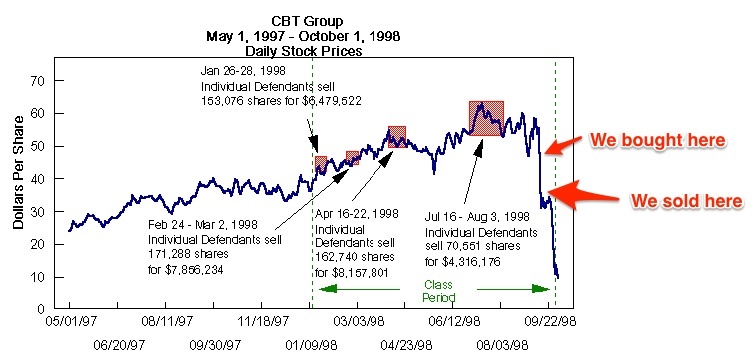
And here's an analysis of the GS Conviction Buy List performance that I mentioned. https://www.quora.com/How-good-is-the-performance-... Red Line S&P, Blue Line Buy List... I've no idea how accurate this is.
Hi Ed, I love this GS conviction buy graph vs s&p 500. Hilarious and true I bet.