Card Factory: many happy returns?

In this week's Stockopedia Strategy Map article, Ed wrote about Trending Value, stocks that have both high Value and Momentum Ranks. As a follow-up, I am looking at one of the companies that features on Ed's Low P/E, High Relative Strength screen: Card Factory (LON:CARD)
Summary
- Card Factory is a high street retailer of cards and gift accessories through over a thousand UK stores and almost another thousand partner locations in the UK and Australia. It also has an online presence, although these sales represent just 3.7% of revenue.
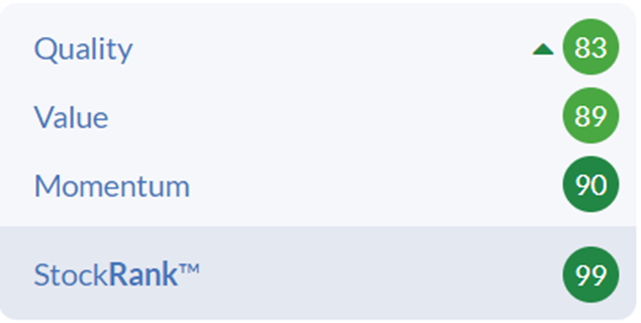
- The Stockopedia algorithms rate the company a SuperStock. High Value and Momentum Ranks, combined with an above-average Quality Rank, means that its overall StockRank is an impressive 99
- Although earnings are forecast to decline slightly, their forward P/E is just 8, and their most recent Price to Free Cash Flow multiple was a very low 3.9.
- However, most of the Free Cash Flow appears to be generated by changes in Working Capital (including re-timing of VAT payments) and lease accounting, meaning that the underlying free cash flow seems unimpressive over the past few years.
- In addition, the balance sheet looks particularly weak with a current ratio of just 0.44, which is low, even for a retailer that pays suppliers months after their retail takings. The increasingly negative working capital leaves the company exposed to any downturn in trading.
- With negative net tangible assets, there is no downside protection if things go wrong.
- However, recent trading is strong, with little sign of a downturn. Indeed, poor UK economic conditions may help the company as shoppers look for better value gifting options.
- As such, Card Factory (LON:CARD) could form part of a Trending Value investor's diversified portfolio due to its low earnings multiple. However, such investors need to be on high alert for any downturn in trading or if momentum in the stock starts to fade.
Profile
Card Factory is a Main Market-listed card and gifting accessory business with an approximately £300m market cap. Many investors will have seen or shopped in their stores, a feature of most high streets and shopping centres.
The company was started by husband and wife duo Dean and Janet Hoyle, with a single store in Wakefield in 1997. They added more stores rapidly and, by 2003, had acquired a distribution and manufacturing facility. A sale to Private Equity in 2010 netted the Hoyles what is rumoured to be around £350m. A stock market flotation followed in 2014. Today, the company operates over 1,000 UK stores and almost 1,000 partner locations split between the UK and Australia. The company also trades online via the cardfactory.co.uk and gettingpersonal.co.uk websites.
Card Factory is one of the few UK small caps that has done well in the past year, more than doubling from November 2022 lows:
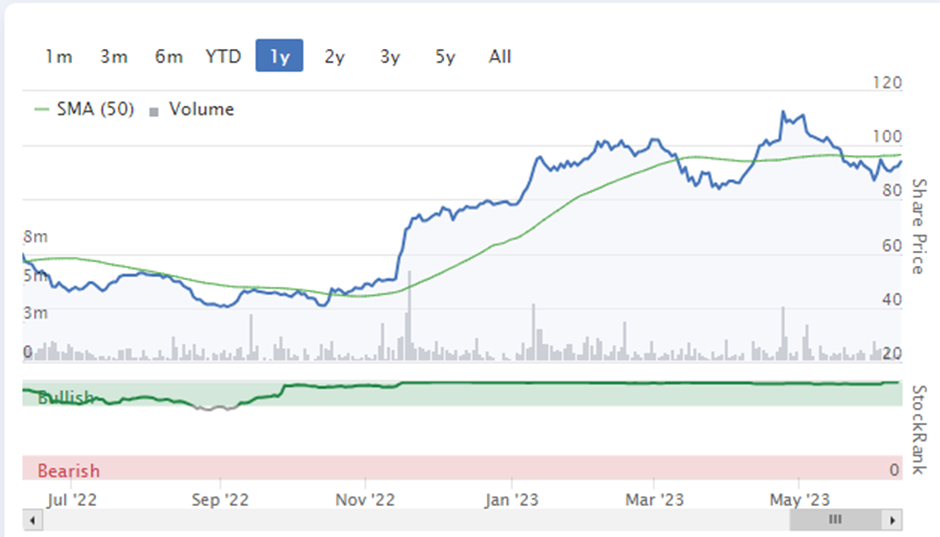
The big move in the share price occurred between November 2022 and January this year, driven by two ahead statements. On 15 November, they said:
Trading in the second half to date has been stronger than expected, particularly across our everyday ranges. This strong performance has largely been driven by our stores, which have seen year to date Like-for-Like (LFL) sales up 6.2% compared to the previous year (excluding periods of store closure in the previous year). Both our online business and commercial partnerships are performing in line with expectations.
And then, on 10 January, the company said:
Store revenue grew +7.1% on a Like-For-Like2 (LFL) basis…
As a result of the continued trading momentum, the Board now expects that EBITDA for the 12 months to 31 January 2023 (FY23) will be at least £106 million.
This meant that EBITDA forecasts for the year ending 31 January 2023 had risen around 20% during this time. This earnings momentum drove share price momentum, making the company a SuperStock with a Stockrank of 99. As you'd expect from a Trending Value company, both the Value and Momentum Rank are higher. However, they are also joined by a surprisingly high Quality Rank:
The company appears to be highly geared, with an Enterprise Value much larger than its Market Cap:
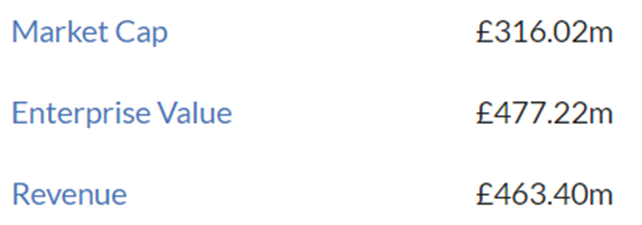
However, looking at the latest accounts, £105.4 of that debt is lease liabilities under IFRS16. These are matched by £100.5m of Right of Use Assets, meaning that only £5m of those should be counted as debt, in my opinion. If I take the £67.5m of debt, £9.5m of provisions and £11.7m of cash, then the net debt is around £70m and the EV around £385m.
Business Model
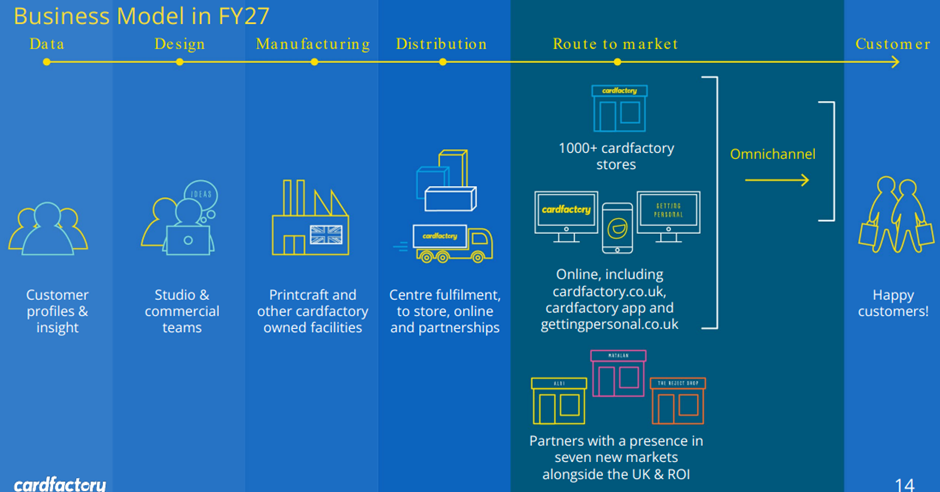
As the following slide from their recent Capital Markets Day shows, Card Factory's business model is to capture the full value chain of card and gifting accessories. Their dominant position in the UK market gives them unique insights and data, which they use to develop desirable designs. These are manufactured and distributed in-house, ensuring quality and reliability, before being sold through multiple venues, both physical and online:
Competitive Landscape
There is no shortage of other places to buy greeting cards, from independent shops to supermarkets or a National Trust shop. Data from Kantar shows that supermarkets are the biggest retailers of cards. However, apart from lockdowns, where supermarkets were open, and Card Factory stores weren't, Card Factory has been taking market share. This is presumably due to a more price-conscious consumer being willing to make a trip to a separate store:
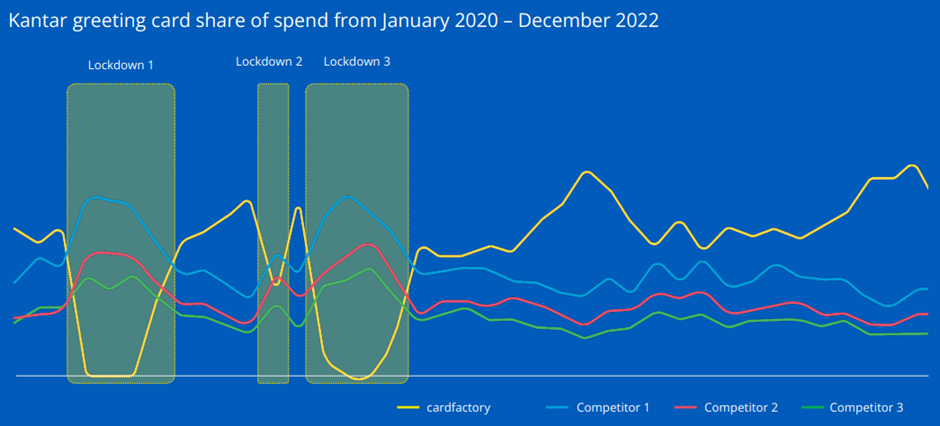
The attraction of consumers heading to Card Factory is undoubtedly price. While the savings available from a visit to a sperate store outweigh the time-cost, they will continue to do well. However, competing on price due to economies of scale is one of the weakest moats.
Strategy
The company has identified three opportunities for long-term growth. The first is adding more partnerships, where they say:
We are continuing to analyse and identify new partnership opportunities with a focus on building the right partnerships to grow the business.
The second is expanding to new geographies, where they have recently…
…completed research and sizing of international opportunities, working with Global Data. From this work [they] have identified new potential international markets in India and the Middle East.
However, this doesn't really fit with their latest acquisition, which is a South African wholesaler. And they now claim that South Africa is one of the target territories for Card Factory's partnership expansion. It may be that they are simply opportunistic. However, shareholders need to be wary of strategy shifts here.
The final opportunity is to expand their range to include more Celebration Essentials and Gifts, which the company says represents a strategic shift to a larger addressable market.
Competitive Advantage
The company has a reasonable Quality Rank:

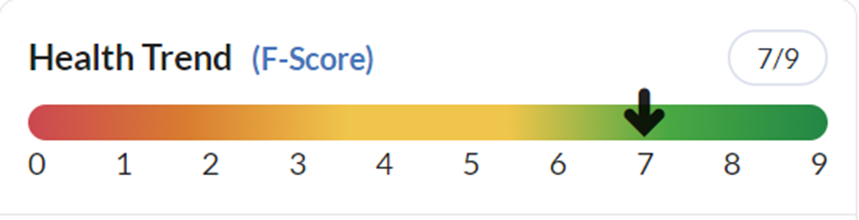
As is often the case, a high Quality Rank is helped by a better-than-average Piotroski F-Score:
In this case, the Return on Capital figure is also very good:
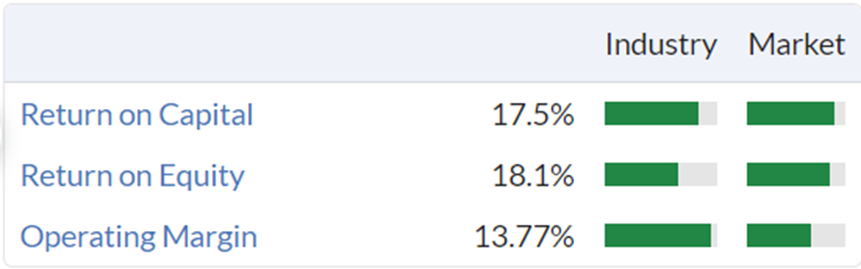
This figure is maybe a little flattered by the strong trading in FY23, which is forecast to reduce slightly in the future:
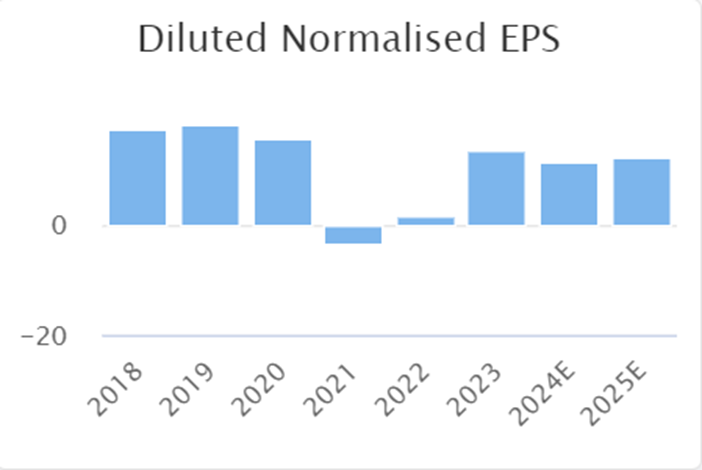
This means that we can probably expect Return on Capital to average around the pre-covid 16% level:

This isn't bad, but it is not significantly above the cost of equity for a small cap share. One factor in the company's favour is their high gross margin of over 67% for the year just reported. Given the recent cost headwinds, this is strong, even for a retail group, and may indicate a competitive advantage. However, there is nothing particularly unique about selling gift cards. In this case, a high gross margin may attract competitors seeking to capture some of these profits. What Card Factory have, however, is the scale and operational excellence to compete on price. They can manufacture what customers want more cheaply. These factors can provide a moat but are inherently weaker than other forms of competitive advantage, such as brand or patent protection.
Financials
Growth and Profitability
Since the COVID drop, revenue has recovered rapidly. And is forecast to grow further:
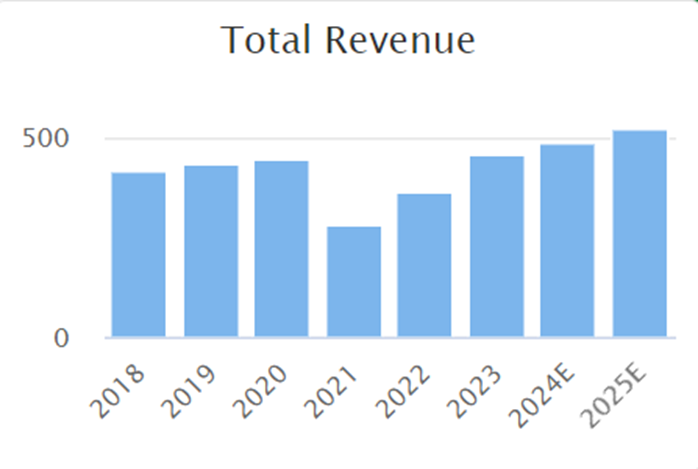
However, this only represents a long-term growth rate of around 2% below inflation. In addition, the EPS is less impressive and is forecast to remain below pre-covid levels even out to 2025.
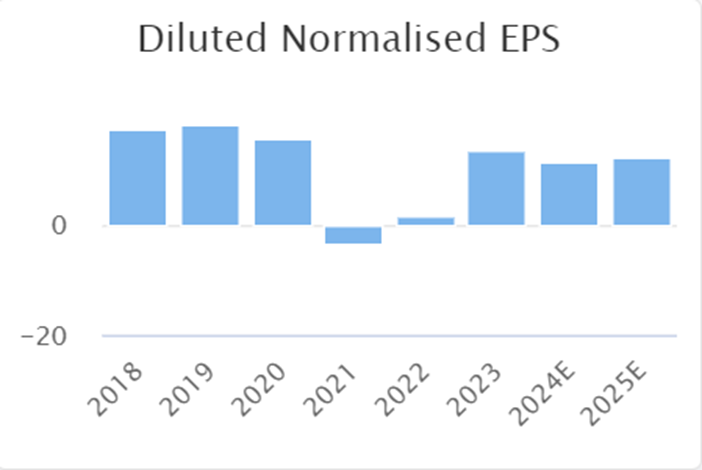
The company has a target of reaching £650m of revenue by FY27. This would represent a more reasonable 11% compound revenue growth from FY25 to FY27. If the company can achieve this growth while driving further profitability, this may cause a re-rating in the earnings multiples.
Balance Sheet
Unfortunately, the balance sheet here looks very weak, with a current ratio of just 0.44:
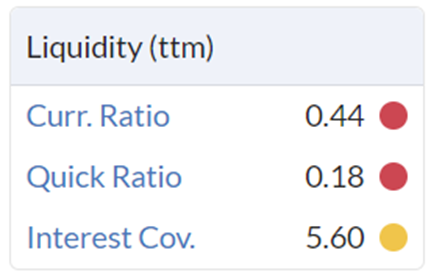
There are currently only seven non-financial companies on the UK market with a market cap greater than £100m that have worse current ratios than this. The low current ratio is caused by an increasingly negative working capital position:
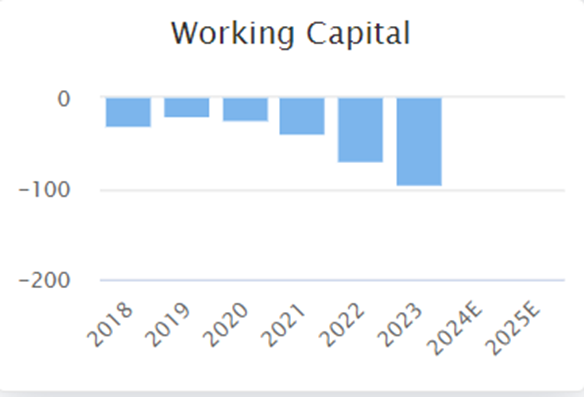
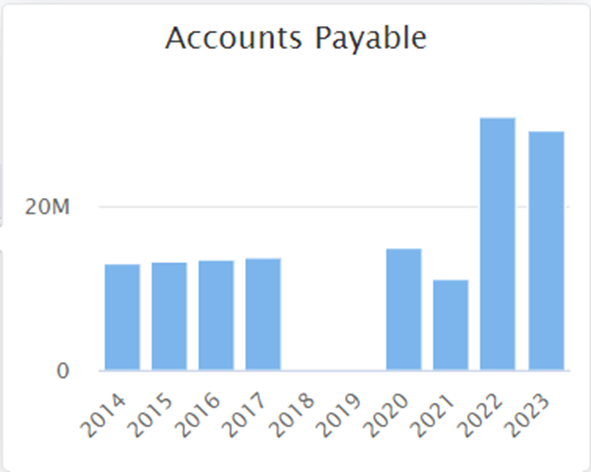
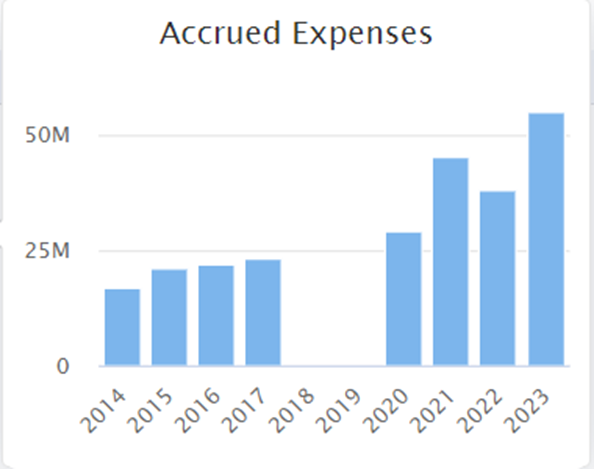
This sort of trend can indicate severe financial distress. In this case, it is caused by a big jump in accounts payable:
And accrued expenses:
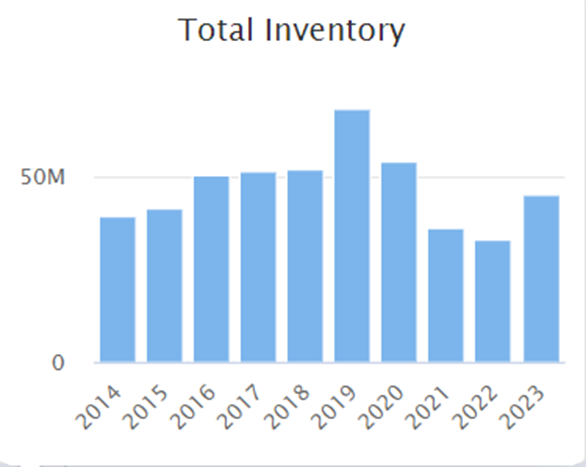
Despite the increase in liabilities, the current assets remain fairly static. Indeed, inventories are down on pre-covid levels:
These sorts of jumps need further analysis, and note 18 of the latest Annual Report gives the details:
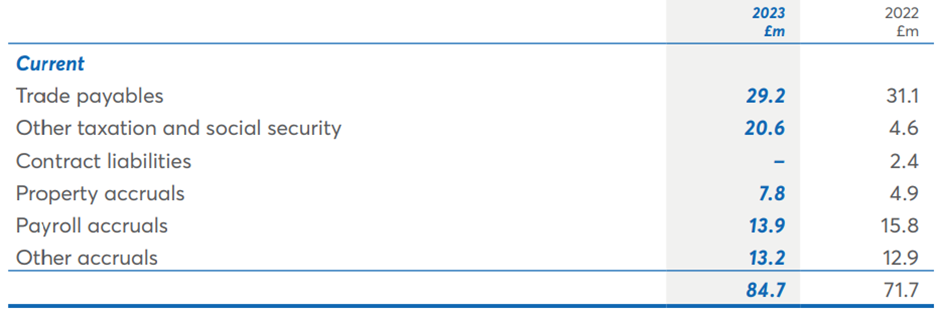
Which is explained as:
During FY23, the Group aligned its UK VAT quarters with its financial year, resulting in the final payment in respect of each year moving from January to February. As a result, payables in respect of other taxation and social security significantly increased in FY23, owing to inclusion of the full quarterly payment made in February 2023.
So, while this gives confidence that this is just the normal part of business operations, around £16m should be added to the debt to give a like-for-like comparison.
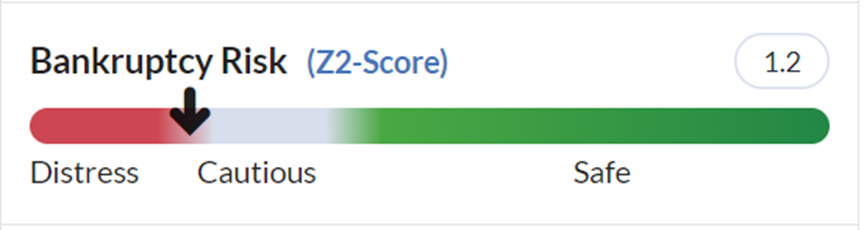
The Altman Z-score also suggests that we should be cautious about the Bankruptcy risk:
When I drill down into the details, the same concerns over working capital are the cause:
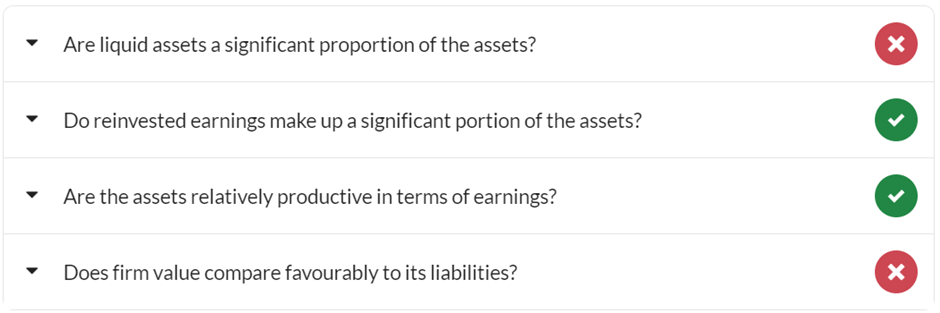
This, however, backs up the current ratio concerns. As well as the size of current liabilities, the other thing that may give investors pause for thought is that the company has a negative Tangible Book Value:

This is not necessarily an issue. However, it means there is no downside protection if the company does get into trouble. Lenders may also be more cautious about the company. It looked like the company would be forced to raise equity by their lenders. In their half-year results to 31 July 2021, they said:
As previously announced on 21 May 2021, Card Factory completed a £225m refinancing during the period. The facilities are structured to incentivise an early reduction of overall debt, with fees of up to £5m payable if pre-payments are not made in line with specified dates by 30 November 2021 through until 30 July 2022. The company is permitted to facilitate these repayments through the issue of new equity or by using funding from subordinated debt sources. The company continues to evaluate the options available to the Group and will update further as appropriate.
However, in a further successful refinancing in April 2022, they said they no longer intended to raise equity. Still, this shows that the banks may not be particularly sanguine about the risks here.
Cashflow
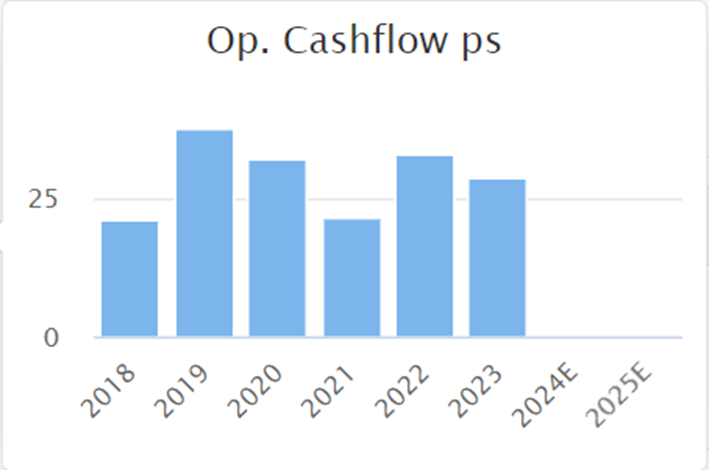
The Operating Cash Flow here appears excellent:
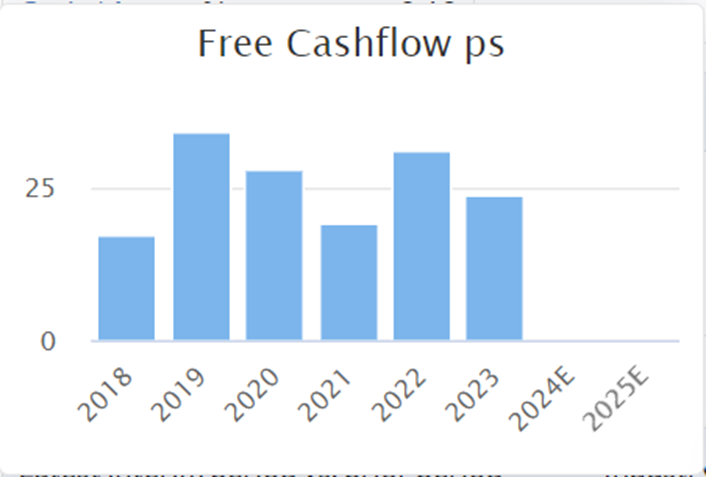
And with limited capex, this is reflected in Free Cash Flow:
Which has allowed them to pay down debt:
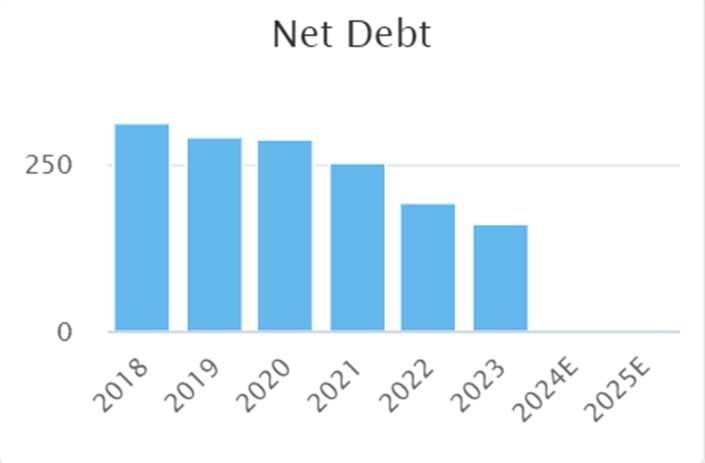
However, this figure includes lease liabilities, and when I exclude these and correct for the changes in working capital, the picture is far less rosy:
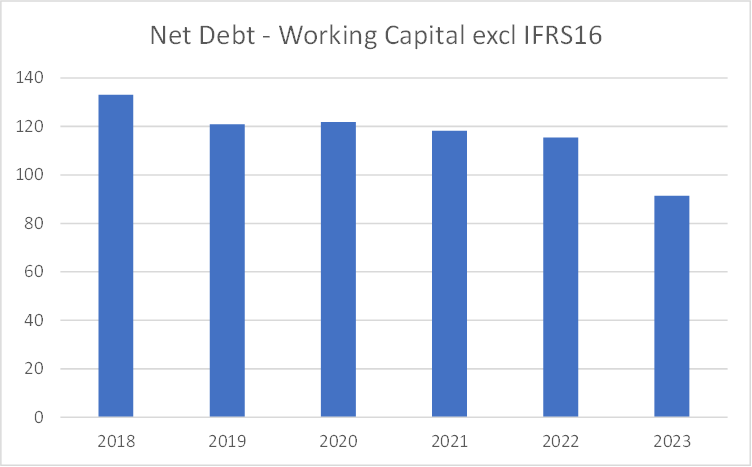
It seems almost all of the Free Cash Flow in the last five years has been generated by changes in working capital and lease accounting. Generating free cash flow from changes in working capital tends to be limited, and the company already appears close to that limit.
Dividends/Buybacks
The company is forecast to return to being a dividend payer in 2024:
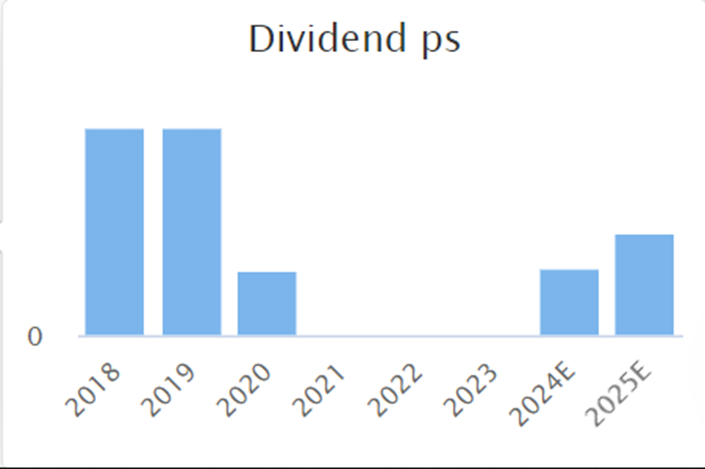
Analysts are expecting them to resume with a payment that represents a reasonable 3% yield, which will rise further in 2025:

However, no dividend has been declared recently, as the company still has restrictions in place until they have paid debt down further:
Restrictions on payment of dividends continue to apply until CLBILS facilities and the £11.25m term loan are repaid (expected 31 January 2024), subject to the Leverage ratio being 1.5x or less.
Assuming this is paid on time, the company should be able to declare its initial dividend with the FY24 Results.
Ownership Structure
As a company that has been listed for some time, the shareholder structure is a balanced institutional one. And it is notable that a hedge fund is the largest holder:
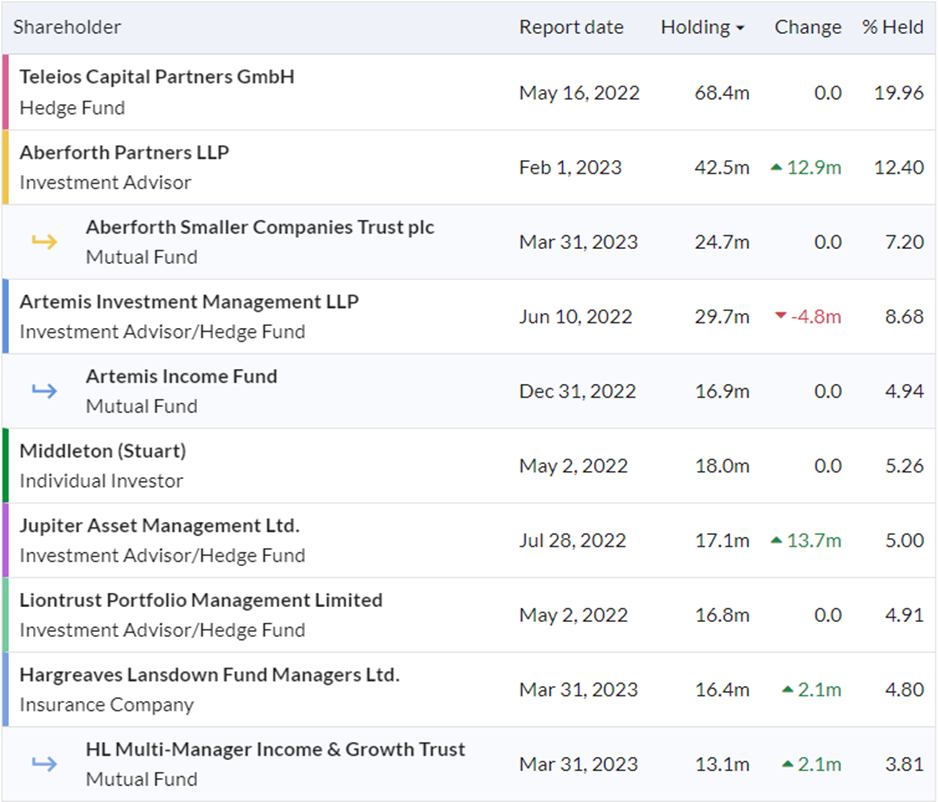
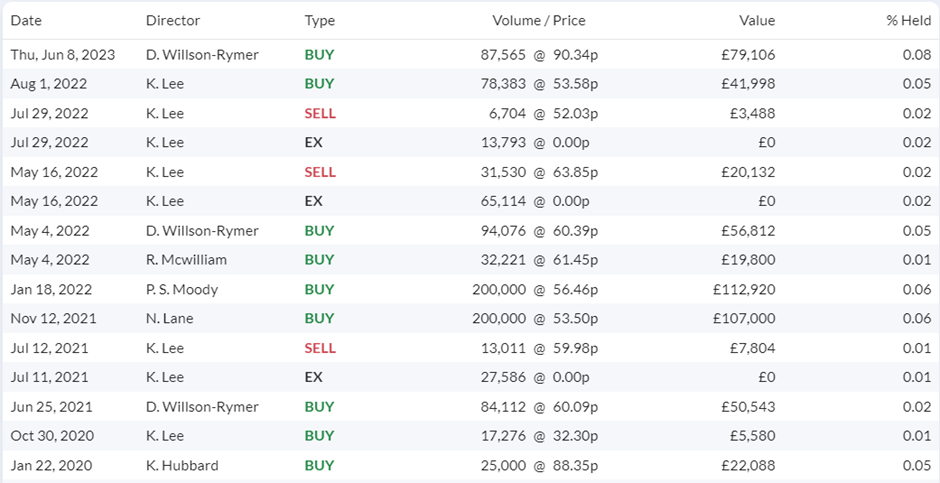
The downside is that directors don't have a lot of skin in the game. Only former Creative Director Stuart Middleton owns a notifiable stake. The holdings of the rest of the management are small, and although there has been some buying recently, this is relatively sparse:
Valuation
With a Value Rank of 89, the company is cheaply rated on a number of metrics:
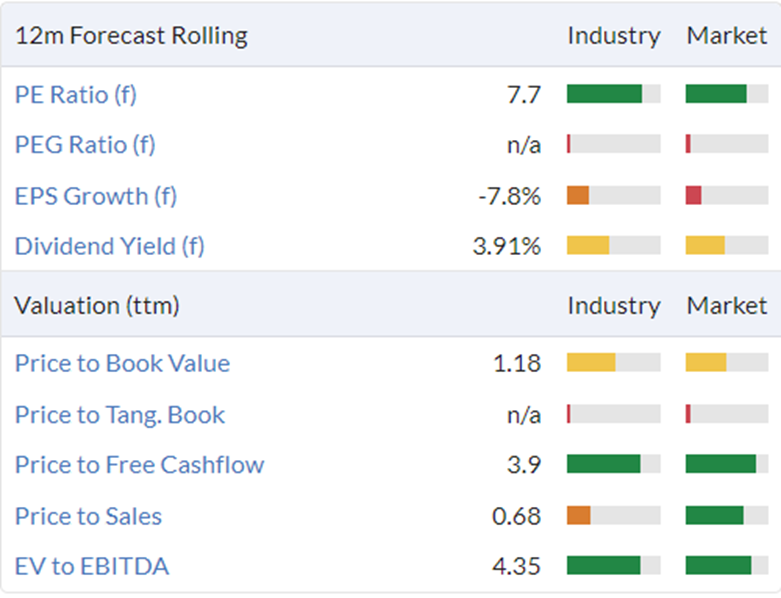
The stand-out metric is a forecast P/E of 7.7, which is low compared to both the retail industry and the general market. However, as already mentioned, this is not an asset play with a negative Price-to-Tangible-Book.
Risks
Like many high street retailers, the most significant risk is that a trading volume drop makes their store leases onerous. Lease labilities already exceed ROU assets by £5m. The balance sheet doesn't appear to be strong enough to bear any prolonged downturn in trading, and without tangible asset backing, this may make lenders more wary about extending credit.
The other risk is that supermarkets decide to compete more aggressively for greeting card sales. Although Card Factory has the advantage of in-house manufacturing and distribution, supermarkets have significant financial strength. Supermarkets have competed aggressively on products that drive footfall to their stores in the past. Any supermarket that holds an extensive range of good value greetings cards may make a visit to Card Factory an unnecessary journey for many customers.
Recent Trading
Along with the results to 31 January, the company released the following outlook statement in May:
Trading in the first weeks of the new financial year has been encouraging and slightly ahead of the Board's expectations. Both Everyday and Seasonal ranges have performed strongly across cards and gifts during this time, with our offer across our FY24 Spring seasons of Valentine's Day and Mother's Day also landing well with customers, resulting in a robust performance.
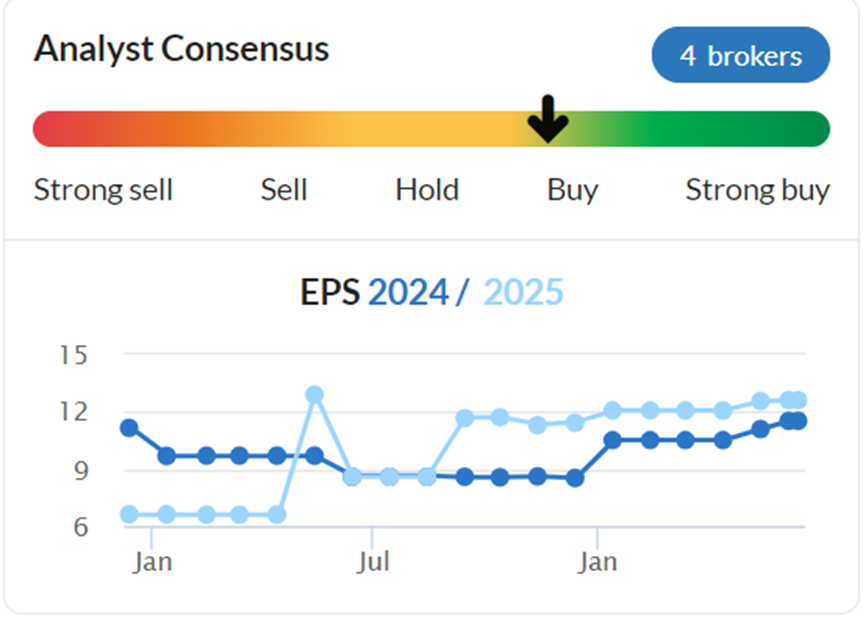
However, this was tempered by the usual concerns around cost inflation and guidance for increased capex. Overall, this led to some minor broker upgrades, with this positive trading momentum expected to continue into 2025:
Sentiment
The Momentum Rank is excellent:

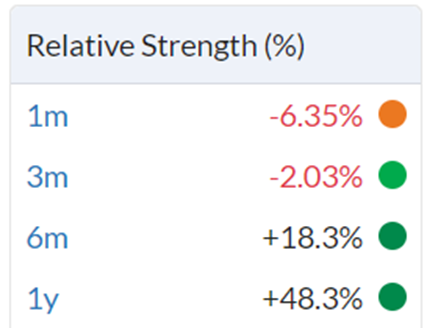
This is driven by strong 1-year relative strength:
Which is helped by recent upgrades in broker forecasts:
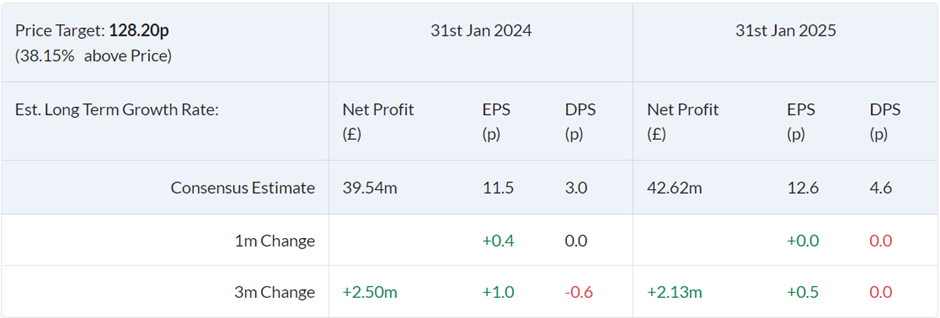
However, the stock is already some 20% below its 52-week high, which may give some investors pause for thought:
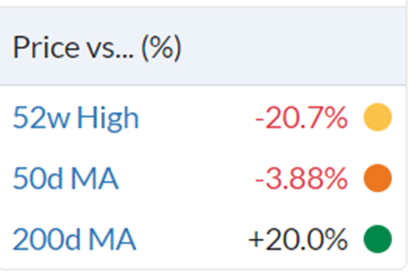
In addition, the Momentum Rank has fallen slightly over the last month. Investors should watch carefully for any further falls in this. As my look into Surfing the StockRanks showed, the momentum of the Momentum Rank can be as important as the absolute value.
Conclusion
On the surface, the low P/E and P/FCF for a company with positive earnings and price momentum look compelling. However, when diving into the details, it appears that some of these metrics, particularly around cash flow, may not be as good as they seem. The lack of balance sheet strength means the company is negatively exposed to any downturn in trading. However, in the short term, the company appears to be trading well and has momentum behind it. As such, the stock will certainly appeal to Trending Value investors. However, given the inherent risks, any position sizes should be limited. And investors should watch carefully for any further deterioration of the balance sheet, or drop in momentum, since these could indicate significant challenges ahead for the company.
Disclaimer
This is not financial advice. Our content is intended to be used and must be used for information and education purposes only. Please read our disclaimer and terms and conditions to understand our obligations.

7 comments
Just an anecdotal comment - historically I've always used Moonpig or Funky Pigeon to send cards. However for my last two occasions, I've used Card Factory's online offer. For my needs (sending personalised photo cards) it seems functionally identical to the other two, but cheaper, and so far seems to have delivered just as well too.
I didn't even realise they sold online until they came up when I was going through topcashback.
Thank you. an excellent in depth analysis. On balance, i think I will sit this one out
A good read Mark, thank you.
Strategy
The company has identified three opportunities for long-term growth. The first is adding more partnerships, where they say:
This part, I assume refers to manufacturing/supply arrangements with the competition you refer to
i.e. card retailers / supermarkets , of which Aldi is already one of their customers .
Nice article re Card Factory (LON:CARD), I think you are taking a quite narrow, dry view and there are important factors in the market background to add to your analysis.
The first is around the market size, struct and trajectory. A few years ago, it was assumed that that the card market would quickly go online (and even fully digital). Hence the initial excitement around £Moon. Hoever, and in line with the market research published before and after COVID by industry body both of them quote, this has not happened and is forecast to only happen only slowly.
The UK market for physical cards is large, only declining very slowly overall but gradually changing shape (from being driven by a move from a Xmas cards bulge to non-specific occassion cards including new, recently made up occassions through industry marketing. For instance, I recall they celebrated that something like a 'birthday card for your dog' was a big seller recently and they design ranges to specifically interest young people who (their research says continue to) find cards are added value gifts in today's digital world.
Critically, I think you take too dry a view of their instore offer and experience. Price is rarely as big a deal in decision making as people think when you really talk to people in depth (Disc. I'm an ex-Mkting Dir of low price consumer goods and done a lot of focus groups etc). Price usually comes in around 4th after things like value, brand , quality and convenience - what goods do you buy in Tesco? Certainly price is a critical attribute but one of a basket of things. That's why some poor people shop at Waitrose and Tesco.
So while I think price is important, I think that shopping for a card in a 'celebratory environment like a card shop offers a lot of hidden value vs buying the same in Asda. In one case, the shop is all about tthe emotional reward of anticipating a celebration or party or recognition of someone else ("Well done for passing your driving test"). Especially for lower income female consumers (nearly everyone buys cards but Mum's = the critical purchase base), this is a cheap, nice way to spend 20mins at lunchtime. It is possible stereotypically older, male, financially driven Stocko reader can miss this insight.
I tend to discount CARD's other aspirations. It's always tough to break into new markets and I think selling to supermarkets and as a wholesaler may be self defeating. Their efforts to break into and 'own' near adjacent markets like balloons looks very smart and may work and they are playing catch-up in leveraging their store/brand in omni-channel selling. However, I think they can succeed in this and add value to their (store) brand, helping these squeeze out independents and other specialists like perrenial basket case Clinton's. Similarly, I do not see them challenging for leadership of digital/online sales but with their high street brand, I see no reason why they cant significantly up their digital share from where it is now to the 10% they target. Frankly, it was an omission that they did not cover this move as soon as they saw Moonpig and Funky Pigeon get going.
Now we come to the stockmarket price. I agree it is financially weak still and risky (and the institutional memeory of the fact is only just escaped - so far - a dilutive share issue, means it should be lower than its glory days. However, the lease liabilities are all short term and they will be renewing leases in high street rental bloodbath. They can get stores cheaper and/or relocate to better sites cheaply.
I too would like them to use any and all their cash flow to strengthen the balance sheet ahead of even token dividends - but I see no reason why they will not be capable of generating very good returns again.
Net, net, I hold and think, having got lucky but being tarnished by recent history, they still have compelling structural advantages from production scale, market leadership /brand recognition which will come through over time - especially if they can grow share and push up prices through the inflation driven cost of living crisis and they hold these new higher prices. I had previous thought their cheap cards too cheap
The shares are not cheap any longer but probably fairly price for now but over the next 5 years may well do surprisingly well. As ever, only time will tell (I hold)
Zipmanpeter, can I point out there has been NO dilutive share issue. The circa 340m shares have stayed the same since they floated
Thank you Mark, I enjoyed the article.
I hold Card Factory (LON:CARD) in both my SIPP and in my short -term trading account. I always perform a dcf analysis based on the cashflow statement, and tend to zero out working capital movements as they can skew answers in both directions. I haven't fully got to grips with lease accounting impacts and so must research how I can refine DCF model.
Although I am glad they are increasing capX to around £24mn pa I do want to see that this generates turnover or margin improvement. It still looks good value to me, but a drop-off in sales may change that opinion. My models give around a 26% margin of safety, ie NPV versus current MV, and I don't put in a terminal value, creating another margin of safety.
I would like to see continued focus on minimising debt while growing the business, as nasty events do happen.
Happy to hold in SIPP, but considering options on trading position.
Greyster
Here's CockneyRebels's take on #CARD
https://cockneyrebel.substack....
You will probably need to enter your email address at some point. As with Mark's analysis, I believe its well worth reading.