Character Group: Steadying the Ship

Character (LON:CCT) are one of my portfolio's picks that's holding up better. They're up about 6% after fees and spread since my initial purchase, which is heartening given the state of the general market in that time, though on an earnings basis they still appear very cheap - trading on a historic P/E of just 6.4 and a forward P/E largely the same. Some of the problem, I suspect, is highlighted in the graph. Sure, they had a strong year last year, and are forecast a good one next year - but how much faith can we have in a continuation of that trend given 2 huge swings in the last 6 years?
To justify an investment, then, we have to qualify why the downswings occurred, how likely they are to happen again, and whether the price they're trading at justifies the risk we've quantified. Obviously, that's a lot of touchy-feely factors - it's difficult for me to pluck a number out of the air and decide there's a 23.4% risk of a sizable downswing in 4 years time - but that shouldn't be a reason not to attempt it. The world of finance is difficult, and the same difficulties are faced by all market participants. We're just looking to apply a solid set of principles and a little common sense to find shares that the market might be pricing incorrectly at this point in time.
With the introduction aside, then, we move on to the business itself. Character Group have a trait in common with a lot of the businesses I like - what they do is fairly simple. They design, produce, and sell toys - a growing number of which with well-known 'names' attached to them, such as Doctor Who and Peppa Pig. In this sense, they provide a route for monetising those intangible assets (brand names) that other firms hold, which makes it an attractive proposition for them; and Character hardly do badly out of it either, with a 34% gross margin most recently reported. The toys are largely produced in China to keep costs down, almost a prerequisite in this day and age, and sold both in the UK and internationally - around 18% of group sales come from outside the UK.
Why the volatility, then? To begin, I should probably note I consider the 2005 figures to be the beginning of the streamlining of the group. Character was then made up of two distinct parts - the division we know today, and a 'digital' division that was both loss making and beset with various supplier problems and margin pressures. Having trimmed down to a more solid core, we then saw an improvement in the results in the following years - only then to be hit by the start of the current crisis. The cause of the loss, though, wasn't simply a drop-off in the demand for toys and pricing competition - Character actually have a far better excuse, namely the fall of Woolworths. While my graph doesn't include the specific exceptionals related to that period, (bad debt charges related to money they were owed) there are ripple effects throughout the business which have a detrimental effect on profit but cannot be recorded as exceptionals - the loss of a major customer, for instance, leaving the business with a large amount of excess stock to shift.
Perhaps I'm erring on the side of generosity here, but I consider the current environment and the winding up of a major customer a perfectly reasonable explanation for a small loss. That doesn't mean, though, that I'm naive about the implications - as given the current state of retail, it'd be silly to completely disregard the chance of more trouble in that sector. What one can do, though, is see a picture of the underlying business and the profits they may experience if all goes smoothly. The interims gave strength to this, recording an impressive net profit of £5.0m for the period. That would leave the business on a P/E of 8 if Character do nothing but break even in the second half of the year. While sales are obviously slightly weighted towards the Christmas period just passed, though, last year only saw a 56/44 split in net profit figures between the two halves. If I simply apply the same ratio to this year's results, I get a figure of £8.9m for full year net profit, and a P/E well south of 5.
I'm wary of doing this, and it certainly shouldn't be taken as anything but curious napkin maths, but it illustrates the point tidily - the business looks like it can make good money. There's a number of reasons why that £8.9m is very unlikely, but it hardly matters given how cheap the company is anyway.
My deeply intellectual approach to forecasting earnings aside, then, we move on to the balance sheet and the company's financial position. Many cheap stocks trade at low levels relative to earnings because they look to be on shaky foundations - see Game and HMV for perfect examples of this - and it behooves any intelligent value investor to consider more than just a few earnings figures when assessing a company. Particularly with small companies, past profitability does not necessarily equal survival.
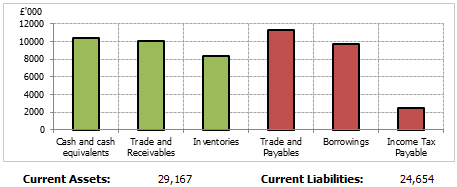
The first thing to note is how asset-light the business is. The operate with a net book value of £6.3m, around 8% of which is intangibles. This has both positives and negatives - it emphasises the flexibility of the structure they have in place, whereby they essentially outsource production and then ship it in and distribute it. It also makes for a rather unusual balance sheet analysis, largely because the company doesn't have any non current liabilities at all, and non-current assets only consisting of the aforementioned modest intangible balance, a small amount of tax benefit, and £1.2m worth of property. This means the current assets/liabs graph above represents more or less everything that the company owns, and makes it refreshingly easy to see how all the moving parts link together.
Cash and cash equivalents are kept on hand by the company for liquidity reasons. Trade and receivables represent money owed to them by customers they've supplied with product, and inventories represent stock held by Character having been paid for but not yet sold. Equally on the other side, the company does not pay its suppliers immediately - with a trade and payables balance larger than receivables, the company is essentially exploiting relationships for more liquid cash. The company's borrowings are all neatly tied to working capital requirements too - as the annual reports specifies them as forms of financing taken out against the receivables balance. Hence, considering how all the parts link together, I find the overall picture quite reassuring. The receivables and borrowings can basically be written off against each other - particularly as the receivables balance looks high quality (around 1.5% past due, none impaired) barring another retail meltdown as discussed above.
You're then left with £10.3m of cash and £8.3m of inventories against £11.3m of trade and payables. This means the only situation whereby the company would face any serious liquidity issues is if all money owed to the trade needs to be paid on short notice and sales more or less stop, leaving no cash flowing in to the business. Chinese suppliers aren't exactly in a dominant bargaining position given their numbers, and so I can't see the working capital status quo the company is sitting at changing any time soon - though China is fast becoming more of an equal partner than little brother in the east/west relationship. I therefore consider the financial and cashflow position of the business pretty safe from an ongoing concern point of view, though it should always be remembered that investors in Character are investing in very few tangible assets. The 'worth' of the business comes from expectations of continuing profitability.
The last few points to note, then, relate to management and company actions over the last few months, which are particularly interesting. Notably, the company is buying back huge swathes of its own shares - taking 10% off the open market in the last half year after even larger purchases last year. The AGM gave them rather considerable scope for further buybacks, too - with up to 5.6m shares available for repurchase, representing almost a quarter of the total business on the open market. Interestingly, the director ownership of shares is actually becoming an issue given the buybacks - as they are owning a larger and larger percentage of the business with each successive transaction. With directors owning almost half of the business, both market liquidity and questions about ownership, control and intentions come to the fore. Positively, the interim statement issued by the company did note that "Directors could be prepared to participate in any future share buy-back programmes" - a line which some read as meaning the directors were looking to slim down their holdings. Rather, I see it as a necessary step if the company is going to continue repurchases - and the directors are instead willing to participate to keep their percentage stakes in the business from growing any further.
In the midst of these share repurchases, though, the company also issued a very unusual statement, an excerpt of which is presented here:
"The Board notes the recent movement in the Group's share price. Although recent media comment has reported a difficult retail trading environment, the Board wishes to place on record that it is not aware of any new specific adverse factors that will affect the Group's performance in the current financial year and the Company expects to meet current market expectations for the year ending 31 August 2011. "
I can't say this is something I've seen before - a company intervening solely off the back of a share price decline, but it's curious nonetheless. The logic behind it could come from so many different angles that I'm loath to begin dissecting it. I will point out, though, that market expectations put the company on a P/E of 6.7 - so results in line with market expectations will be more than enough for me.
I find Character inherently interesting. Though what they do may be rather mundane, I think it may prove to be a textbook example of value investing in the next few years - or, indeed, a textbook value trap. Simply looking at the company's annual reports is enough to explain to a budding investor the relationship between cashflow and profit, an example of different forms of current assets - and how they link to liabilities - examples of different ways of distributing cash to shareholders, (dividends and buybacks) questions of director ownership and the alignment of incentives... at the very least, if I walk away with a loss, I'll certainly have learnt something! I will, of course, be keeping you updated - and with Character having just finished their financial year, the annual reports shouldn't be too far away.
As ever, comment below or e-mail to discuss Character Group or any other investment. Director ownership and the share buybacks in this case leave me a little wary, so it would be interesting to hear opinions!
Disclaimer
This is not financial advice. Our content is intended to be used and must be used for information and education purposes only. Please read our disclaimer and terms and conditions to understand our obligations.
2 comments
When I examined this company last year I came to the conclusion that the directors were being awarded large amounts of share options, and later selling previously vested shares into their buyback operations, thereby handily generating lots of cash for themselves without excessively increasing the amount of outstanding options.
I therefore came to the conclusion that the company was being run for the benefit of its directors rather than the small shareholders and did not buy despite the apparent value credentials.
Cheap for a reason? - do you think this opinion stands up?
Hi Jinjah,
Re-reading the sections on options, I wouldn't go as far as you have done; but I would say it's at the very least concerning for small shareholders.
It doesn't seem to be constant - most of the options were granted in 2006 and it looks to have slowed down since then - but it does reiterate the questions of management intent. Share options are effective for aligning management and shareholder interests if they're properly arranged. I have to say, these don't look to be.
I'm actually struggling on this one since my purchase. Directors do have a substantial interest in the common stock of the company which forcibly aligns interests, and on an earnings basis the stock looks very, very cheap. As ever, it's far from black and white - and I'm grappling with whether those share interests are enough to satisfy me about director intent for now, or whether even that and the cheap price isn't enough.
I suspect I'll wait for the next report to see the direction of trends and then reconsider, but if the stock keeps going up as it has, I may not have to!
Cheers,
EV