Communisis: A Second Look

It's been a couple of months since I first discussed Communisis, the marketing services provider, and two factors have come together to send it back into my radar. Cliffnotes for those who don't want to read the first post as follows;
Decent business, shifting from old-fashioned into modern marketing;
Still predominantly direct mail, though, so at a;
Pivotal point in the business - unsure of which way it's going.
But back to those two factors. One of which, obviously, is the share price graph to the right. Being such a thinly traded stock, individual trading decisions can have a big impact on the price in the short term - which is what I suspect happened when CMS fell off a cliff. Sure, market volatility was high, but a 18% fall in one day on no news isn't particularly normal volatility! In a rare stroke of luck, Communisis (LON:CMS) was on my watchlist already, so I dug around, found nothing worthy of any note, and bought in at 25p - marked in black on the chart.
I should note that the spread on CMS is also usually quite high - back when I first looked, CMS was priced at 32p with an ask of 33.5p. By buying at 25p, then, I grabbed the shares over 25% cheaper than they had been two months ago.
The metrics still look tempting, particularly the forecast earnings, but these haven't hugely shifted since my last post - it is, after all, what originally attracted me to the business. What has changed - and put it on my radar in the first place - is the interim management statement issued 26th July. Props to Communisis for this; the later statement is as detailed as they come, and it served to change my mind even before the share price fall. I was tempted at the 32p immediately preceding the plummet - so for once my slow reactions saved me some cash!
So what in the IMS made me change my mind? A few main factors. Firstly, a general factor - both the IMS and the presentation released a month before it gave good points of clarification on the business which I didn't previously have. Any uncertainty I have on the business is basically priced in by subconsciously increasing my margin of safety - as it makes it harder to me to forecast future performance, I demand a bigger margin of safety to compensate. The net result is me expecting the business to be even cheaper.
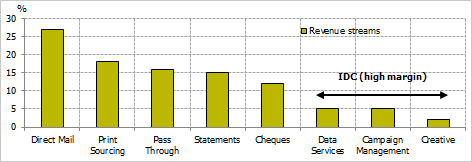
The chart below was an important one for me, as I wasn't entirely sure previously where their revenues came from. It in itself is a mixed bag, but better the devil you know and all that. As we see, there's still a fairly heavy reliance on direct mail. The higher margin sectors are fledgling (making up 11.6% of total revenues) and a decent amount of their total revenue comes from cheques and statements. I'm not a great fan of this, as at first glance I would imagine they're commoditised sectors - low margin, no space for differentiation, and hence liable to disappear off to a competitor should they offer lower prices.
Revenues are reasonably concentrated - 15 companies make up 80% of Communisis' revenue, though an upside of this is that 65% of yearly revenues are predictable under multi-year contracts. They're also been winning a good number of contracts recently - which is always a positive sign, as it shows their offer is relevant and attractive to their clients. The obvious bonus of this is that more contracts means more revenue. The slightly less obvious bonus is that the implication of relevance and quality means they're more likely to hold on to their existing ones.
But soft, qualitative factors are seldom enough to change my mind - they need to be backed up my evidence. Luckily for Communisis, they are - and it seems most of my previous uncertainties, mainly revolving around whether they'd really realigned themselves yet, have been answered. Pre-exceptional operating profit was up 27% in the first half of 2011, finance costs were down on the financial restructuring, and both of these were achieved against a rough backdrop. Results are usually weighted toward the second half of the year, but Communisis believes that this year will be even more marked, as clients have been pushing back expenditure in their higher margin sectors.
Another big positive is the restructuring of the cost base - particularly the note that 'overall sites will be reduced from 14 to 9 by the end of 2011'. These are savings that haven't even begun to flow through to the bottom line yet, and so the picture going forward continues to improve. The acquisition of Orchestra Bristol isn't expected to have an impact on full year results this year, though it is expected to in 2012 - along with £2m of savings the firm has earmarked there. Everything seems to be coming together nicely; the company's focus on more personalised, colour communications seems to be paying dividends and my previous uncertainty just isn't borne out by the revenues numbers; the aforementioned cost savings give a double-whammy of bonuses to investors.
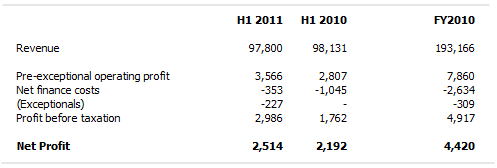
I've reproduced the important figures from the IMS above, and a quick glance at the net profit line hints that we're probably in for a better year than last. While net finance costs are unfeasibly low (volatility relating to retirement obligations) and we're likely to see substantial exceptionals relating from the ongoing restructuring, I don't have a problem with these at all. The restructuring genuinely is making the business much more profitable for future years. A number of revenue sources have only recently come on tap and will boost the H2/ H1 2012 figures, and the closure of over a third of their active sites should also help the bottom line.
The punchline is probably a familiar one to my readers. Even if the cost reductions don't kick in when the advantageous tax position reverses, marketeers continue to hold off on optional spending, and the shift towards colour/digital communications takes a few more years to materialise, Communisis are paying a dividend of over 5% and raking in an earnings yield of 11.9% on last year's figures. That is to say, if all the trends reverse in the second half of 2011 and they earn ~15% less than they did in 2010 - they will still be, by most measurements, very cheap.
I agree it's an uncertain market, and I'm sceptical of the future of direct mail - but after being shook by the rapidity of the market change (they saw a ~30% revenue fall in '09) they seem to have got back on their feet, dusted themselves down, and moved with the times. I acknowledge the risks to the sector - but if Communisis come through and deliver, in two or three years time it doesn't seem too far-fetched to imagine we'll be sitting on a business 'worth' over double what it is now. That's the kind of risk/reward I like.
Disclaimer
This is not financial advice. Our content is intended to be used and must be used for information and education purposes only. Please read our disclaimer and terms and conditions to understand our obligations.
No comments yet
No one has commented here yet! Why not be the first one?