Covid-19: A Sectoral Analysis (Part 1)

With the worst recession predicted since the early 18th century, soaring public and private sector debt, millions of job losses and a predicted 35% fall in GDP for Q2, the UK is facing an unprecedented task in getting all sectors of the economy back on track.
The Office for Budget Responsibility recently published some very insightful, but worrying statistics on the impact Covid-19 may have on the UK economy (you can view the full report here), which can be seen from the chart below. But is it all necessarily doom and gloom?

The markets may have rebounded strongly from their end of March lows, but I thought it would be interesting to assess how each of the 10 main economic sectors have performed and how Covid-19 has changed sector dynamics in the UK. This article will take a look at the strength of the sectors going into the crisis, how each sector has performed under the current circumstances and decipher some of the economic data that has been published on the sectoral impacts of the Covid-19 pandemic.
Performance prior to Covid-19
Stock markets around the world continued their impressive performances in 2019 and the UK was no exception. Despite the political turmoil and looming Brexit uncertainty, the FTSE 100 gained 12% and the FTSE All Share 14.95% over the calendar year from January 2019 to January 2020. Though this was not as impressive as some of its international peers, it meant that UK valuations were perhaps not as stretched going into the Covid-19 pandemic.

To illustrate the performances of the 10 economic sectors prior to the pandemic, I have used the FTSE All Share sector benchmarks for 2019. The FTSE All Share sector benchmarks are defined slightly differently from the Thomson Reuters Business Classifications.
For example, the Consumer Goods benchmark is more representative of the Consumer Defensives sectors, whereas Consumer Services are more associated with Consumer Cyclicals. The Oil & Gas sector is used to represent the Energy sector. Though the benchmarks and their constituents slightly differ, they still provide useful insights into the performance of the 10 economic sectors.

The chart of the 10 sector benchmarks may be hard to read but it the range of performance. You can read how each sector has performed, ranked from best to worst, in the table below.
FTSE All Share Sector Benchmark | Annual performance 2019 |
Technology | 32.3% |
Industrials | 29% |
Health Care | 23.6% |
Consumer Services | 22.1% |
Utilities | 19.5% |
Consumer Goods | 16.2% |
Financials | 15.5% |
Basic Materials | 11.4% |
Oil & Gas | -4.73% |
Telecommunication | -6.45% |
As can be seen by the chart, the overall performance of the sectors was quite impressive, with 8 out of 10 seeing gains over the last year. The top performer in 2019 was the Technology sector (32.3%) followed by the Industrials (29%) and Health Care (23.6%) sectors.
These sectors far outperformed the FTSE All Share return of 14.95%. In fact, 70% of the sectors outperformed the index. The Basic Materials sector, which includes metals & mining companies and chemicals manufacturers, underperformed the market. The Oil & Gas (-4.73%) and Telecommunications (-6.45%) sectors were the only sectors to witness declines over the year.
Overall, most of the sectors went into the new year in a position of strength.
Performance since Covid-19
Despite previous strong performances in 2019, we can see that the pandemic has left no sector unscathed. Since the start of this year, the FTSE All Share has dropped 22.9% (as at the end of April 2020). Some sectors have inevitably been harder hit than others, although the disparity of the performances is striking.
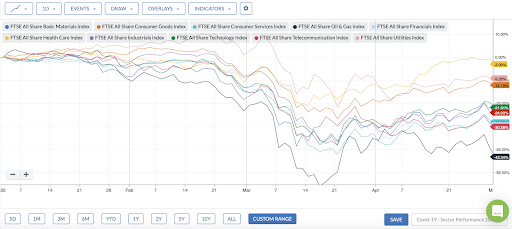
FTSE All Share Sector Benchmark | Performance from 01/01/2020 – 30/04/2020 |
Health Care | -3.09% |
Utilities | -9.26% |
Consumer Goods | -12.2% |
Technology | -21.9% |
Basic Materials | -24% |
Industrials | -24.2% |
Consumer Services | -28.4% |
Financials | -29.6% |
Telecommunication | -30.3% |
Oil & Gas | -43.3% |
The Healthcare sector has been the least affected by the pandemic, falling by just 3.09%. Indeed, some industries within the Healthcare sectors, such as Pharmaceuticals & Biotechnology, have seen positive performances. The need for testing & diagnostics kits, Personal Protective Equipment, disinfectants, treatments and the search for a vaccine in order to contain this pandemic means that demand is unlikely to abate anytime soon. As the Healthcare sector adjusts to demands and expands productive capacity, the performances of companies operating within this sector may improve.
Utilities and Consumer Goods have also performed relatively well when compared to the overall performance of the market, falling by 9.26% and 12.19% respectively. As with every crisis, people will always continue to demand the basic necessities in life. Though Utilities may suffer from a lack of electricity & water usage in industry, there should be an uptick in home usage due to the lockdown. Many Consumer Goods also have a negative income elasticity of demand, meaning that demand for these products should rise as incomes fall.
Those most affected by the pandemic have been the Oil & Gas (-43.34%), Telecommunications (-30.28%) and Financials (-29.59%) sectors. It is interesting to note that the worst performing sectors of 2019 have continued, and exacerbated, their poor performances during the pandemic.
Despite the deepest ever OPEC production cuts, which were backed by further production cuts from many of the biggest oil producing nations around the world like Russia, the US and Norway, oil prices have plunged to historic lows. The reduction in road, rail and air travel combined with a fall in commercial usage due to factory closures, has caused demand for oil and thus Oil & Gas related companies to plummet.
Telecommunications companies have also suffered, with many in already precarious positions prior to the crisis. The telecommunications industry has been one of the worst performing sectors over the past 5 years. The high capital requirements and failed bets placed over the years have left the balance sheets of many of the telecoms’ giants vulnerable and the current pandemic has not helped to alleviate this pressure.
The financial sector, although not the root of the crisis this time round, will again be one of the worst affected. There is only so much support governments around the world will be able to give to prop up national economies. There is not an endless supply of cash that can be made available to individuals and to both small and large business alike. As this crisis unfolds and insolvency becomes more frequent, financial institutions will have to set aside larger sums to account for loan defaults, greatly impacting upon their profitability.
Analysis from the OBR
In the report published by the Office for Budget Responsibility, the potential impacts of Covid-19 were disclosed for sectors in the second quarter. These have been based on the assumption of a 35% GDP contraction and have taken into account variables such as: the ability of workers in each industry to work from home, absences due to illness and childcare responsibilities.
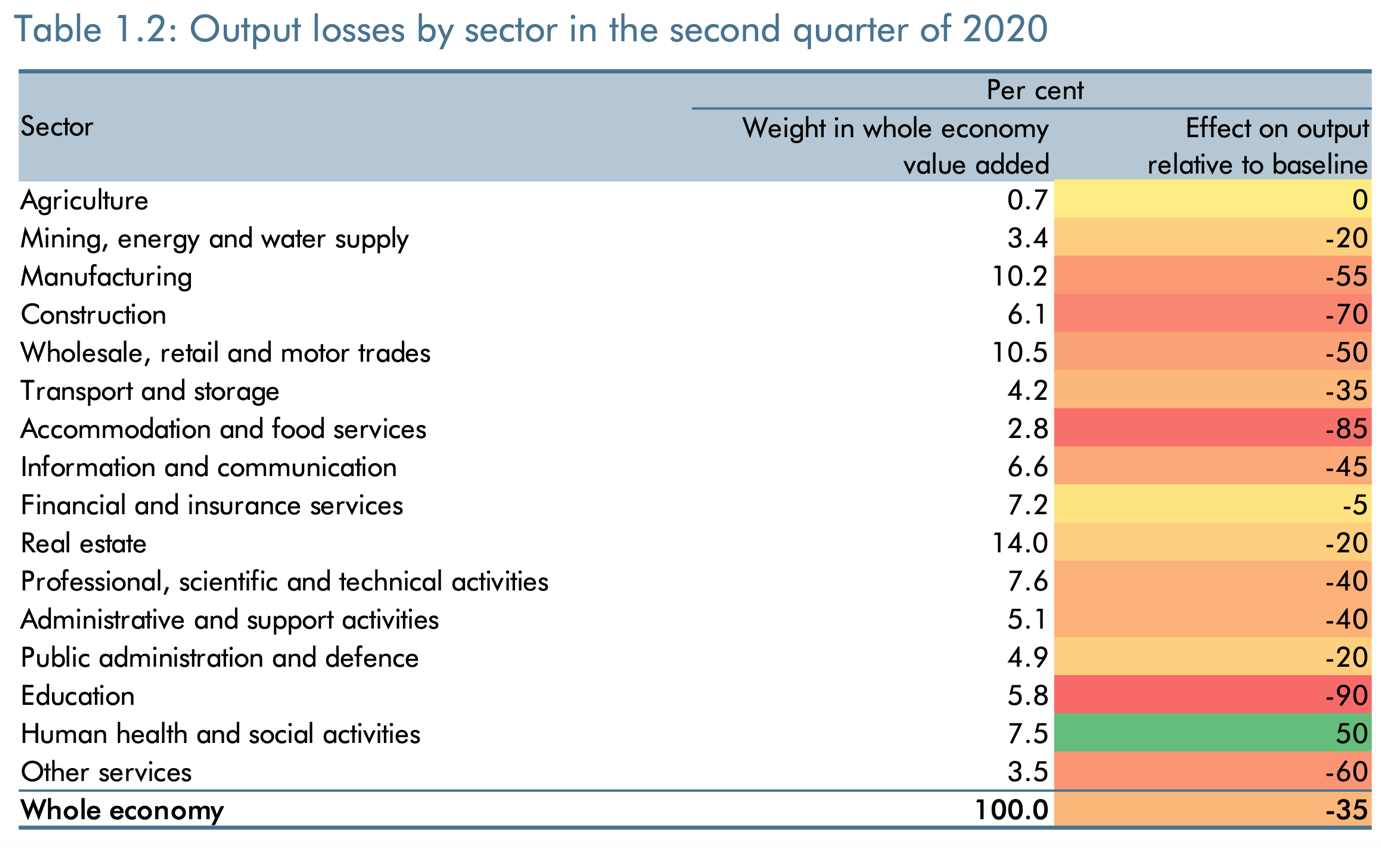
As can be seen from the table above, the lion’s share of losses is mainly split between the Education (-90%), Accommodation and food services (-85%) and Construction (-70%) sectors. These all typically fall under the broader Consumer Services or Consumer Cyclicals sectors. Although these are predicted to be the hardest hit sectors, all sectors of the economy are expected to be adversely affected, with the exception of Human health and social activities (+50%) and Agriculture (0%).
It is worth mentioning that the report also notes potential long-term supply impacts as a further damaging factor on sector output. Whether this is due to lower levels of investment, which over time, reduce the productive capacity of the sectors, or due to international trade restrictions, it could further curb output in the future. This will likely impact manufacturing industries more than services and research-based industries.
Analysis from PwC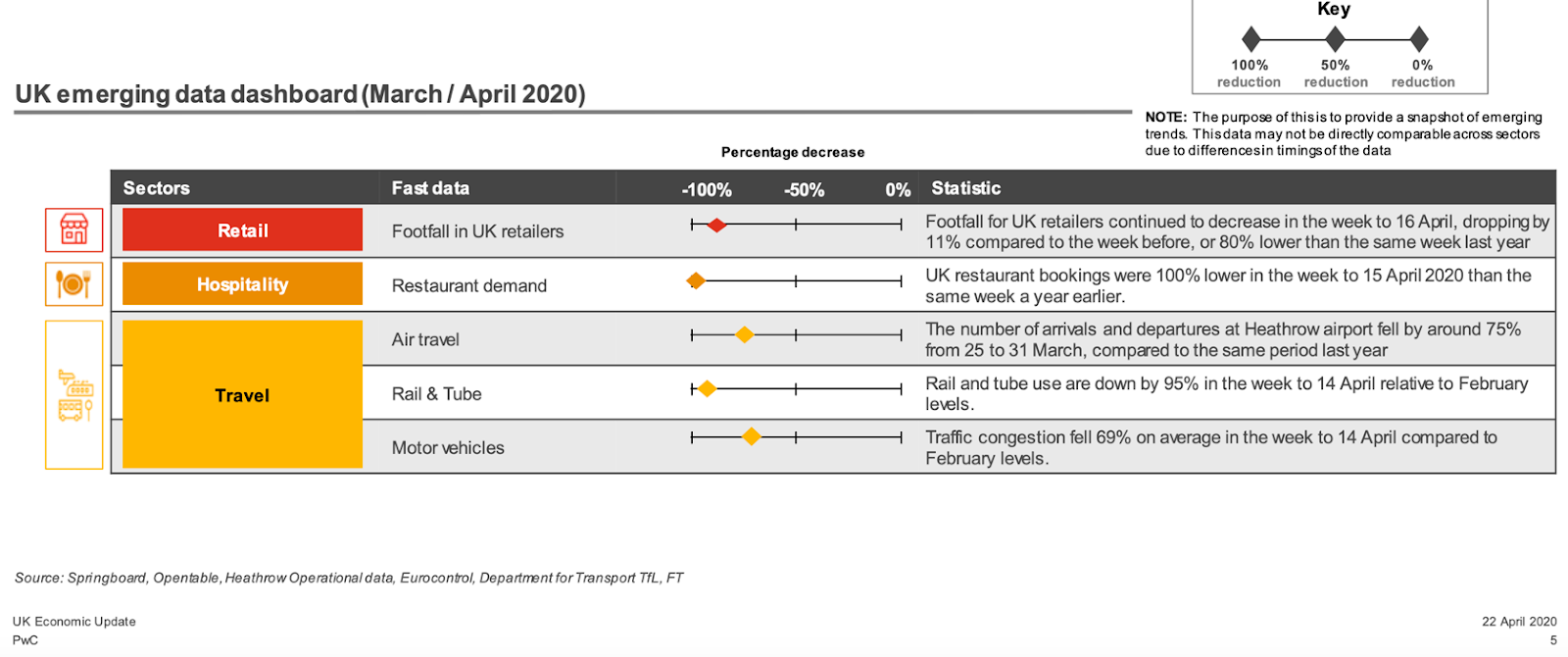
Once again, the recurring theme is that retail, hospitality and travel have been most affected by the current pandemic. Footfall is 80% lower when compared to this time last year for retailers, restaurant demand has completely disappeared due to the closures and the need for travel has mostly vanished, with rail operators ceasing most operations, car sales plummeting and several airlines in dire need of bailouts.
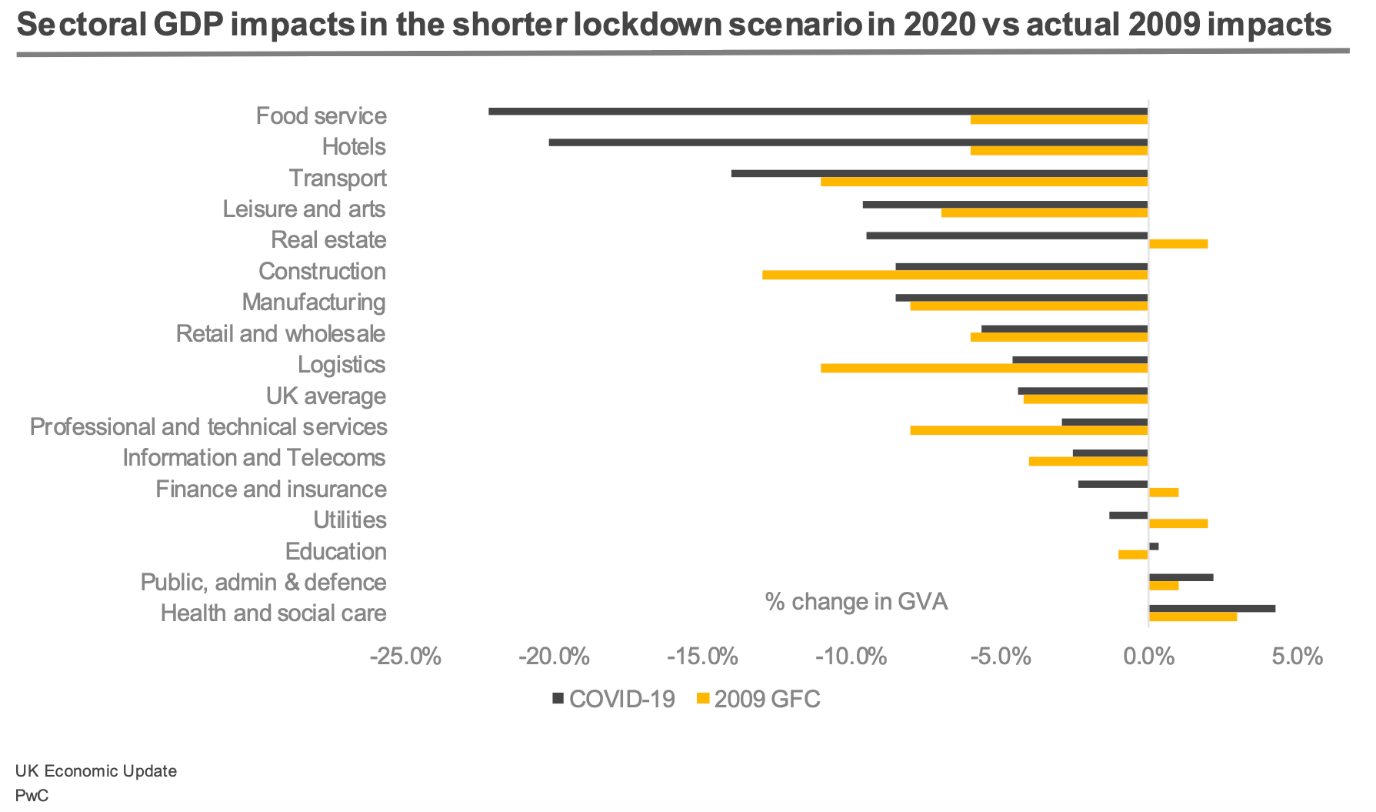
Analysis carried out by PwC provided further confirmation as to the extent of the damage to be expected by the food service, hotel and transport sectors. To put the severity of the contractions into context, the Gross Value Added (GVA) output losses of the sectors (assuming a shorter 3-month lockdown) are compared against the recordings of the financial crisis in 2009.
From the table below we can see the distinction between the varying levels of sectoral impacts from Covid-19 as opposed to 2009. Due to the current severity of the lockdown and restrictions on business openings, the impact on food services, hospitality, transport and leisure activities is inevitably far greater than in 2009, when there were no restrictions on the kind of businesses that were still able to remain open. Even though sectors such as finance, insurance and construction are expected to be better off than they were in 2009, the overall impact is overwhelmingly negative for the majority of sectors.
Analysis from OECD
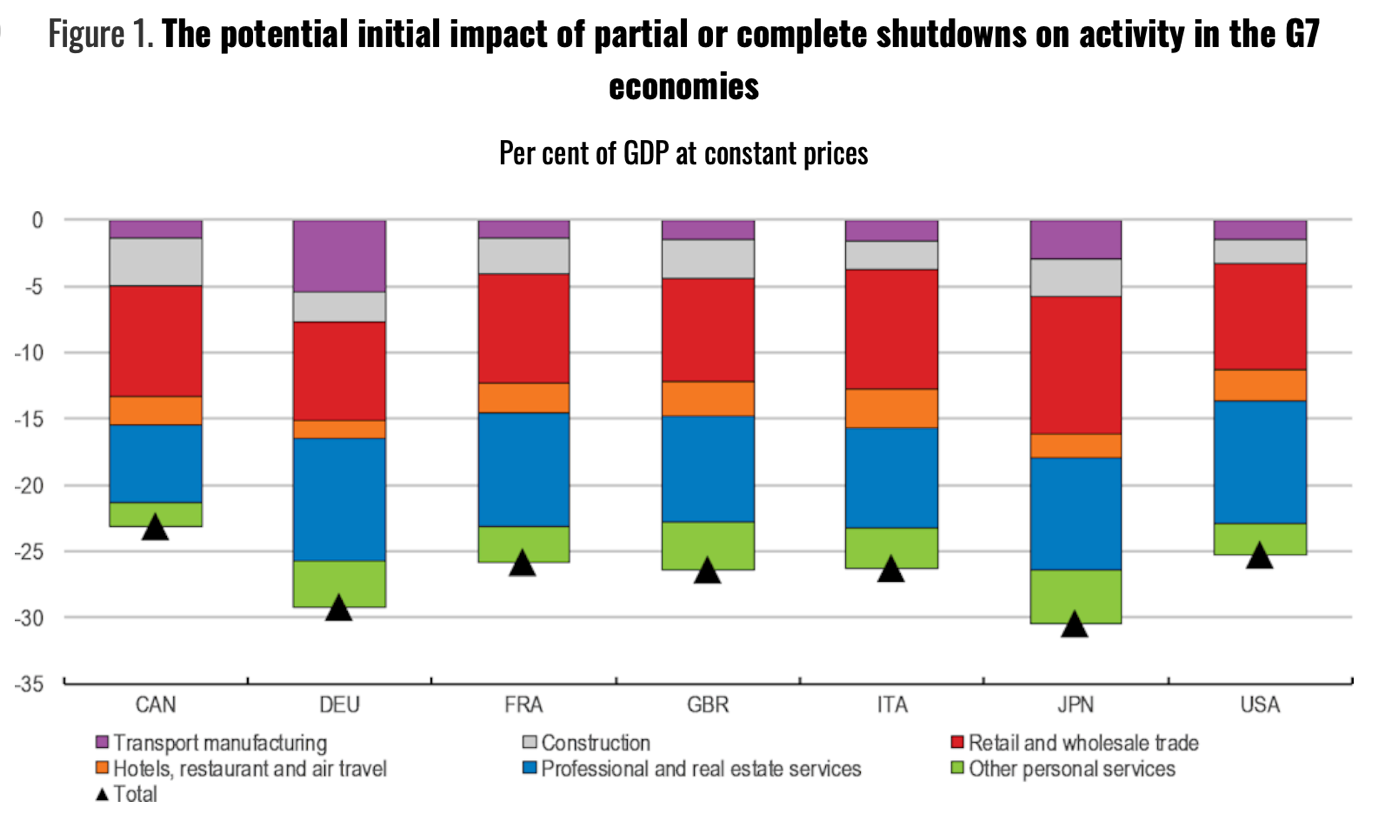
Research carried out by the OECD estimates that for every month of the lockdown, GDP is expected to decline by 2 percentage points. The analysis takes into account the initial direct impacts that each of the sectors may experience as a result of the lockdown, but does not factor in the indirect impacts, which are more difficult to quantify.
The OECD study again highlights that the most profound impacts have been and will be felt in the services sector, especially those that rely on social contact such as traditional retailers, entertainment venues and tourism related activities. Although, takeaway and online sales are expected to relieve some pressure.
The impacts on manufacturing sectors are not expected to be as severe. This is due to several factors, but largely down to the rise of automation in manufacturing, which requires less manual intensive labour to contribute to output. Nevertheless, the OECD does still note that certain manufacturing sectors such as transport equipment will most likely experience a decline in output due to supply side issues, with international trade being limited, manufacturers may find it harder to obtain the parts/raw materials that they need.
According to the OECD, although certain sectors may seem relatively unaffected at first, there may be delayed reactions on output and demand. For example, primary sectors, which includes agricultural production and the extraction of raw materials will potentially face more significant issues as time goes on, as consumer habits change, and businesses adapt to the new environment.
What does the PMI have to tell us?
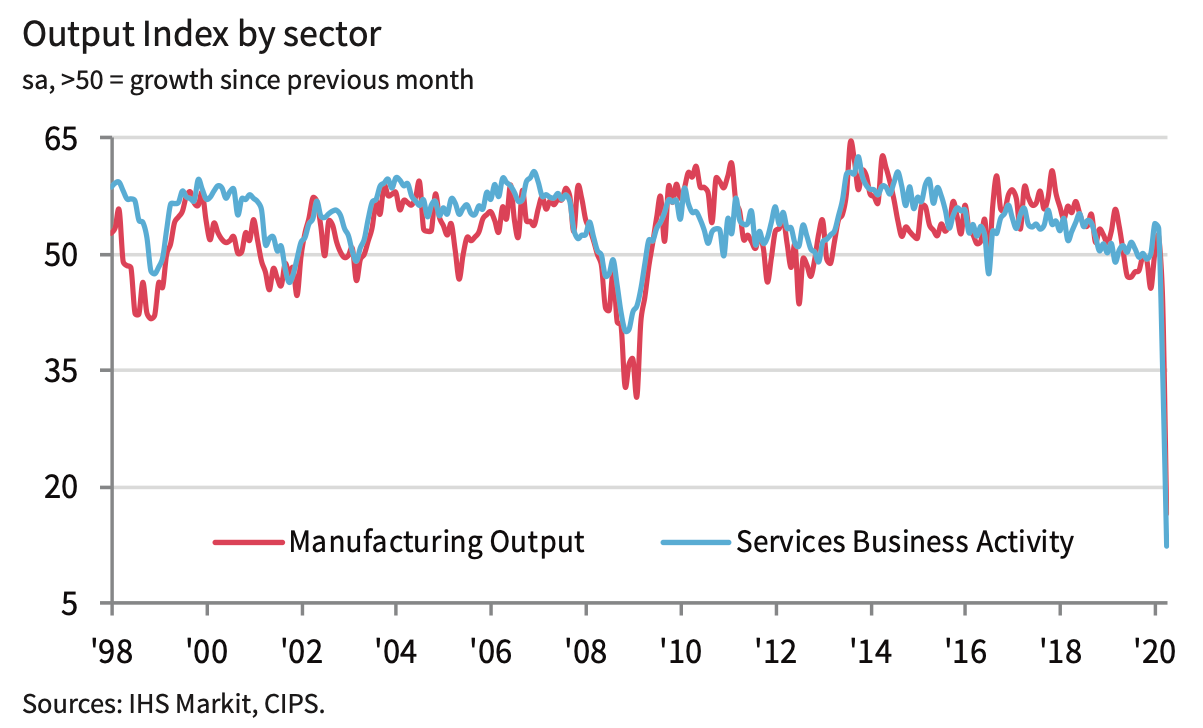
The Purchasing Managers’ Index is a good barometer of how the manufacturing and service industries in a country are performing. The Index uses calculations based on items such as: new order intake, production rates, inventory levels, input and output prices, suppliers’ delivery times, employment numbers and future output. A level above 50 indicates an expansion of activity when compared to the previous month. Conversely, a level below 50 implies a contraction.
The most recent report by IHS Markit, which compiles PMI data for over 40 economies around the world, highlights the extent of the contractions experienced by both the manufacturing and services sector in the UK.
The seasonally adjusted Manufacturing PMI has seen a fall from 47.8 in March to 32.9 in April. The number of new orders, production levels and employment rates were the main contributing factors to this decline. The steepest falls were seen in the textiles & clothing sector, with retailers suffering a great deal and in the transport sector, where car production also witnessed a profound slump. In the rare instances of manufacturing output expansion being recorded, this was by medical suppliers and food and beverage producers.
Much more alarming were the falls witnessed for the seasonally adjusted Services PMI, falling from 34.5 in March to just 12.3 in April. Inevitably, it has been businesses, which deal with customers directly, which have been hardest hit. The hospitality industry, in particular hotels and restaurants, have felt the full effects of the lockdown, with many ceasing operations altogether. Financial services seem to have been the least affected so far, although the deterioration in activity has never been witnessed before. In fact, Duncan Brock, Group Director at CIPS reports that “Around 81% of UK service providers reported lower business activity in April, which compared with 38% during the worst single month of the global financial crisis.”
Only a handful of companies in the services sectors have experienced growth over the last month. The report identifies companies with a significant online presence and companies whose clients are primarily public sector institutions (pharmaceuticals and biotechnology firms) with growing operations.
Due to the weighting of the services sector on the economy, the seasonally adjusted UK Composite Output Index fell to 12.9 in April, from 36.0 in March, far eclipsing the previous record low of 38.1 in November 2008.
Conclusion
As more and more economic data gets released, the far-ranging impacts of this pandemic are becoming clearer. Every single sector and industry will have to make changes going forward if it wants to survive. Our economy as we know it will have to adapt and evolve to transform itself if it wants to bounce back in a post-pandemic world.
A lot will depend on the range of measures taken by the government to alleviate pressures on the most affected sectors of the economy and the extent to which it is able to restore consumer confidence. If the marginal propensity to spend significantly drops after this lockdown, as people remain cautious about going out, then the V-Shaped recovery that has been touted would seem unlikely.
In a lot of sectors, it may take years for consumer and business confidence to return, although many will be raring to go out again, there will also be plenty whose lifestyles will permanently change as a result of this pandemic.
It is impossible to accurately predict how long this lockdown will last for, which restrictions will be eased first, which regions will be let off first or which areas of the economy will experience the most long-lasting effects. However, with plenty of due diligence and patience there are always opportunities which the market offers in circumstances such as these.
The next series of articles will take a closer look at the valuations of each of the 10 main economic sectors and how each will have to adapt to an ever-changing environment for the future. These articles will also focus on how each of the industries within the sector groupings have performed and how individual companies within these industries are positioning themselves for a recovery.
Stay safe and safe investing!
Disclaimer
This is not financial advice. Our content is intended to be used and must be used for information and education purposes only. Please read our disclaimer and terms and conditions to understand our obligations.
18 comments
Well done Keelan, very interesting; keep it up.
Brilliant article, really good read
Very timely, sector analysis - well done
Great stuff Keelan... Excited to see what you can uncover by looking at the various sectors over the next few weeks.
Agree.. Your Volex piece was v good btw.
A very informative though slightly depressing analysis of where we currently find ourselves
Very informative and well presented Keelan. I enjoyed reading it. Thank you.
An Excellent Article.
Great article, Keelan. Thank you also for the honesty that you show in your biography, you have certainly packed a lot of learning into your early investing years! Your story shows such commitment and enthusiasm I can see why Ed and the team were keen to have you for an internship and then invited you back.
Hi Whitbourne,
Thank you for your words of encouragement! I am very grateful for the opportunity Ed and the team have given me.
A very enlightening article, thank you. It's only a pity that technology dropped out of the analysis around half way through. A further article on how the UK compares with the US &/or Europe would be very welcome.
Hi RichardEllis,
I'm glad you enjoyed the article! I will be taking a closer look at the Technology sector and analysing its industries in the coming weeks. An international comparison would be interesting, it is something I may look into at some point in the future. Thank you for your suggestion.
Well done, Keelan. This is a first rate piece of research, lots of valuable and well presented information. At first glance, finance and insurance seems a promising sector in which to invest.
Thank you.
very well articulated. this was certainly one of the more comprehensive and clear articles on the impact of the pandemic. I wish that we can as part of the article also try and see where the opportunity sets will lie as the markets find the correct levels over the next few months.
This is a fantastic piece of work, incredibly informative. Many thanks for sharing it.
Great stuff -thanks and congratulations. Really looking forward to reading the follow up articles.
Congratulations and well done for all your hard work...
very good read and research carried out. Good to see the comparison in sectors with a typical downturn and this one. Thank you for sharing.