CPU: Narrowing their focus

Computershare (ASX:CPU) is one of the highest quality stocks on the ASX with a Quality Score of 99. It began life as a share registry business in Australia, but now derives most of its income from the USA. They listed in 1994 with a market capitalization of $36 million and over the last 30 years have grown to be the 33rd largest stock on the market with a market capitalization of $15.6 billion. Whilst still deriving a large portion of their revenue from share registries, they also offer employee equity plans, stakeholder communications, corporate governance, fund services and deposit protection.
The high Quality Score is a result of high returns on capital and equity, high margins, and a perfect Health Trend score. FY23 was a particularly strong year for CPU however they have been a consistently strong performer for a long period of time.

As demonstrated by their growth over the years, they have also been a solid compounder of returns. More specifically, looking at the Quality Compounding screen as devised by Roland Head, CPU doesn’t quite make the grade, however it meets 12 out of 15 criteria, and of those it misses, it is only by a small margin.
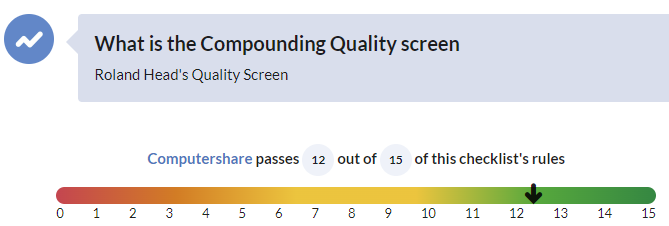
Digging into the details (as shown in the table below), we see that margins, cash flow and sales growth are strong. Long-term return on capital employed is below the threshold of 18% but still very healthy at 11.5%. The long-term average cash flow yield also fell short of the 8% threshold but given that for most of the last five years we were in a very low interest rate environment, a return of 6.6% is still solid. In terms of the balance sheet and debt servicing, whilst it is not as conservatively managed as some companies, an interest cover ratio of 5.7x certainly does not set off alarm bells.
Criteria | Threshold | CPU |
QualityRank | 80 | 99 |
Long-term ROCE | 18% | 11.5% |
TTM ROCE | 15% | 15.2% |
Operating margin 5 yr avg | 10% | 18.1% |
Operating margin TTM | 10% | 23.0% |
Net margin 5 yr avg | 8% | 11.8% |
Net margin TTM | 8% | 13.9% |
OCF / EPS | 0.8 | 0.9 |
Avg FCF (long term) / Assets | 8% | 6.6% |
Sales CAGR 5 yr | 0% | 6.9% |
Sales TTM / Sales Prior TTM | 5% | 24.8% |
Debt to assets | <50% | 41.2% |
Interest cover | 10x | 5.7x |
Computershare’s revenue is broken down into three broad categories:
Core fee revenue: 53%
Event and Transactional fee revenue: 23%
Margin Income: 24%
Core fee revenue is the largest component, and as the name suggests, this revenue is fairly consistent. A lot of it comes from maintaining share registries. Event and Transactional fees can vary in line with corporate activities. When companies undertake more corporate actions these fees will increase. Margin income refers to interest income earned on client cash balances. It increased by 323% in FY23, due mainly to the rapid increase in interest rates.
Geographically, the breakdown of revenue is shown in the chart below:

Source: Computershare, FY23 Full Year Results Presentation, 15/8/2023
Note: UCIA includes the United Kingdom, Channel Islands, Ireland and South Africa.
Overall, revenue grew by 23% in FY23. Growth was driven by margin income and core fee revenue. Detracting was a decline in event and transaction based revenue.
Just 10 days ago, the company announced the sale of their US Mortgage services business for total proceeds of $US720m. This had been foreshadowed and is part of their simplification strategy which aims to drive an increase in the quality and consistency of earnings. CEO Stuart Irving stated, “The divestment of US Mortgage Services allows us to focus our efforts on our core businesses which have high levels of recurring revenues, long term growth runways, low capital intensity and attractive returns through the cycle.” (Divestment announcement, 3/10/23)
The table below outlines the impact on the FY23 results were the contribution from the US Mortgage services business to be excluded.

Source: Computershare, Divestment announcement, 3/10/23
The divestment should lead to a strong improvement in ROIC. This will add further support to the Quality score as will the improvement to free cash flow and management EPS. (Management calculate what they call Management EPS. They remove abnormal expenses. They also remove the amortisation of intangible assets from acquired businesses. This is similar to normalised EPS.)
They also sold the Bankruptcy and Class Actions business on 1 May 2023. This contributed about $95m in revenue.
Market analysts are forecasting revenue to grow in FY24, but decline in FY25. This reflects the loss of revenue from the mortgage business from Q4 FY24. Margin income is expected to grow a further 8%.
Turning to the bottom line, EPS grew by 95% in FY23. Stripping out the non-recurring items, normalised EPS grew 76%. The EBITDA margin was 37.8% and the EBIT margin was 32.1%. These are very strong numbers, driven by the strong revenue result. The impact of inflation did weigh on the result somewhat.
The market is forecasting EPS to grow by 6% in FY24. This compares with a slightly more optimistic forecast from management of 7.5%. For FY25 analysts predict EPS to grow by a further 6% without the weight of the less profitable mortgage business.
The strength of the balance sheet and cash flow has enabled CPU to implement a buyback. The dividend yield is 2.8% based on the FY23 result, and 3.9% based on the forecast DPS for FY24. Dividends are unfranked due to the fact that the majority of earnings are derived overseas.
High quality, compounding companies, rarely trade at a highly discounted price. This is true of CPU, however the valuation metrics are quite reasonable. In particular, the 12 month forecast rolling PE ratio of 13.8 compares favourably with the industry and the market.
Computershare is an Australian success story, but to continue growing strongly they will have to deliver on the world stage. Their strategy is to focus on their core strengths.
Important Information: Stockopedia Ltd ABN 39 757 874 670 UK business registration number 0637267 (“Stockopedia”) is an Authorised Representative of Daylight Financial Group Pty Ltd ABN 77 633 984 773 (“DFGPL”) which is the holder of an Australian Financial Services Licence (AFS Licence No. 521404).
Information in this commentary is current as at date prepared unless otherwise stated. However, please bear in mind that investments can go up or down in value, and that past performance is not a reliable indicator of future performance. For more Important Information please refer to the Disclaimer section of this website.
This communication may contain general financial product advice. It has been prepared without taking into account your personal circumstances, and you should therefore consider its appropriateness in light of your objectives, financial circumstances and needs before acting on it.
If our advice relates to the acquisition or possible acquisition of a particular financial product, you should obtain a copy of and consider the Product Disclosure Statement (PDS) before making any decision.
Disclaimer
This is not financial advice. Our content is intended to be used and must be used for information and education purposes only. Please read our disclaimer and terms and conditions to understand our obligations.
No comments yet
No one has commented here yet! Why not be the first one?