Creston: Growth at a Fair Price?

Though the above certainly wasn't my first thought when coming across Creston (LON:CRE), I think it's a fair tagline for the company and what they're trying to do. How much growth, whether they can achieve it, and if it's still a good investment even if they flatten out and settle down are the questions it leads me to ask, as I certainly don't consider myself a growth investor. I approach stocks conservatively and with the mindset that the future is near-impossible to predict, so one should be very careful in applying a big premium for the expectation of growth. Hence it's rare that I find a company in such an exciting industry - marketing, particularly social media, web-based platforms etc. - falling in my screens, which far more often turn up companies which investors instead think are dying breeds - take Communisis. The group itself is a ~ £66m market cap, diversified marketing and communications company, and an amalgamation of 3 different sectors which within themselves have a number of different brands. The first division, Insight, seems to be a sort of marketing and general consultancy business - services they provide include 'new product development problem solving', 'PR generation', and 'competitor analysis'. Oh how I love marketing firms! The second, Communications, is a more 'catch-all' branch - this encompasses advertising, both digital through mobile, social media and general web platforms, offline, and in-store/promotional activity. Finally, health focuses on providing what seem to be similar services to the above, but more specifically to the health sector - medical education, PR, branding etc. It should be noted the chart to the right is influenced by the disposal of a big business in 2010 - hence the sharp reduction in revenues.
41% of their revenues are generated online, and this number is growing ever larger - this year the company targets 50% of total revenues from online forms of marketing. In addition to shifting company focus towards the higher margin segments, Creston has also been proactive in disposal and acquisitions as it shifts towards growth sectors; notably their £28m disposal of DLKW last year. DLKW was a more traditional off-line marketing business, and I buy the management line on the sale. They noted that "... structural change driven by media fragmentation and the impact of the internet and digital channels on media consumption has caused a decline in mainstream mass audience advertising spend... ...the next stage of DLKW Group's growth would be to seek to grow its international operations and client base... [this] would need offices in several geographies worldwide, requiring a disproportionate amount of investment by Creston." This seems perfectly reasonable to me - and it's corroborated by the fact the buyer was a £2.6bn market cap media behemoth. The price achieved also looks to be good for the business - £28m representing a multiple of 9 on its operating profit. The entire current company, one should note, is trading on a multiple of around 6.
This influx of cash was used to pay off the outstanding term loan, leaving the business with instead a healthy revolving credit facility, and to fund acquisitions. As with my view on Plastics Capital (LON:PLA), I generally don't mind acquisitions in small cap businesses. To institutional investors mainly following the FTSE 100, they are often anathema - the coming together of two bloated businesses, usually expensive, and nearly always bringing along additional problems to detract from shareholder value. But smaller businesses have more to gain from synergies and economics of scale. In Creston's case, the purchase of Cooney/Waters is a difficult one to gauge - though I like the terms on which they completed - an initial consideration of £5.9m with further considerations of up to £13.6m, dependent on profitability in the purchased businesses. Though we're only provided with 3 years history for Cooney/Waters, we do see some points of interest - revenue has grown from 2007-2009, which seems positive given the macro situation. Profit averages over the three years at the rather feeble £293k per annum, though this is dragged down by a hefty ~£700m loss in '09. But the point Creston make, and is particularly pertinent in these small businesses, is the cost of paying the directors in relation to that profit. If I strip out directors' emoluments from the profit figures, we have a business making an average of £2m per year, on an upward trend. This is a rather rough slapdash analysis, but it illustrates the point - that small caps can gain significantly from consolidation. Should all go well in the next few years and Creston pay the full, capped price, they will have paid roughly 8 times my pre-director earnings for a growth business. Still, that's a lot of 'ifs' for my liking, and there are far too many assumptions I have to make as an outsider to come up with any fully reasoned conclusion. I'll give it a resounding vote of ambivalence. One positive factor, though, particularly related to acquisition activity, is the CEO's ownership of 1.9m shares, worth around £2m. This sort of activity always raises questions about shareholder value, but with a substantial interest in the company like this, he should care about the share price. Still, as I've said before, share ownership should always be compared to the director's salary as a rough proxy for the 'importance of the money' - and with Elgie taking home nearly £700k last year, it's not a ringing positive. I should note that there any only 2 executive directors listed who are paid so lavishly - the other 4, non-executives, have far smaller salaries. Hence, the overall wage bill is lower than similar size companies I have looked at, even given his generous allowance.
Drawing a line under that, the most important thing to consider is the performance going forward for the bulk of the business, and on this I'm positive. As I say, they are in a strong growth sector, and also have the benefit of already working with a huge number of blue chip clients. Generating new business is substantially harder than increasing receipts from existing customers, so the fact that they already have feet in the door at so many big companies means they have a ready-made growth platform. Octopaeic tendencies aside, the real question I have to ask is whether they can capitalise on the opportunities - if their product offering is stronger than competitors. While it looks good (the recent Lynx campaign was one that stood out as a particularly multi-channel, well developed offering) I'm not a marketing expert, and so I can only go on what the numbers give me. This, once again, explains my reluctance to put much faith in growth. Still, like for like revenue was up 7% last year (10% in Q4) so there is endorsement of their product from the industry. The chart above left is reproduced from management communications, and chimes with this point.
The average tenure of their top 20 clients is 9 years, and these 20 account for around 55% of group revenue. This provides some forward visibility of revenues if we assume the majority of these are likely to stay - which seems reasonable, given their long history - without putting too much stock in one particular client. However, it's difficult to be particularly specific without a more detailed breakdown, as an equal split (leaving each of those 20 companies providing ~2% of group revenue) is a different story entirely from what is far more likely to be the case - that is, that their top 3-5 clients provide a disproportionately large amount of this revenue. Positively, though, those top 5 clients have been with their respective businesses for an average of 16 years, and ingrained relationships always carry value simply due to the period of time.
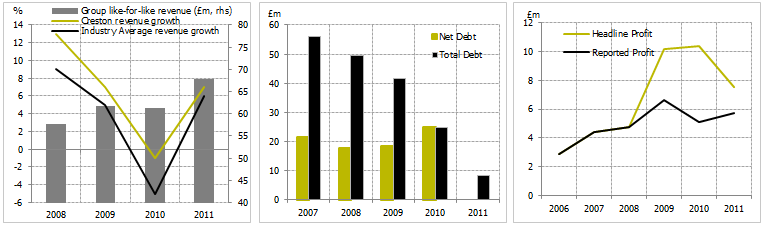
Margins are strong, as you'd expect with this sort of business - 16% last year, with the Insight and Health divisions sitting at ~27% and ~30% respectively (before deducting unallocated costs) and the larger communications segment dragging the average down. These look like historically reasonable levels, so I have no particular concerns with regard to margin - the inexorable downward pressure may be counteracted by the constantly increasing size of the group, and the efficiency that brings. The company this year also posted a far more resilient balance sheet than had been seen in the past, mostly due to the £28m from the disposal, and thus presents a much smaller risk than had been present. The ratio of current liabilities to current assets sits at about one, with no long-term debt but equally very few fixed assets. I've shamelessly grabbed the chart (above middle) also from a management report as it nicely demonstrated the point Creston are making - on a historical basis, their current situation is rather comfy indeed. Their book value of £96m is exceeded by the value of intangibles - £102m, but this is neither particularly surprising nor worrying given the type of business; what it does do, however, is ensure that the downside risk to the company is essentially 100%, and so one must be particularly certain of the company's prospects going forward. The company also has an unutilised £25m banking facility giving them a large degree of flexibility, but it should be noted that the feed through of profit to cash-flow is strong, and as such big working capital balances don't seem necessary. The last point is illustrated by 3 years of cash conversion which average over 100%.
Finally, I should point out the chart on the far right above, which shows the differences between headline profit - which the company obviously likes to use (as it's higher!) and reported profit, which includes a wide variety of exceptional items. In Creston's case, these are particularly numerous as they've been reorganising their business - acquisitions, disposals, new start-ups and the like all result in 'exceptional' charges. At the top of this post my chart uses reported (lower) profit figures, but in actuality I think these probably understate (in a P/E context) the 'worth' of the business. Still, the sheer number of exceptionals does pose the question as to whether there's an end in sight, and as such using the headline figure should be treated with caution. The difference is material - the group trade on a ~12 P/E using reported, and a ~9 P/E using headline.
Either way, I think Creston are cheap, and I like the visibility of revenues. Growth prospects seem good but not necessary at this valuation, and I don't mind their 'fantasy' balance sheet comprising mostly of goodwill. I'll keep poking my nose around, as in particular I'm interested in a few of their competitors to give me a broader view, but Creston may well find themselves in the EV fund.
NOTE: Since originally publishing this article on the blog, Creston have fallen ~20% on general market volatility and also released a generally upbeat IMS, reporting revenue growth of 12% YoY. The price drop reinforces the 'value' side, and the strong growth is another bonus!
Disclaimer
This is not financial advice. Our content is intended to be used and must be used for information and education purposes only. Please read our disclaimer and terms and conditions to understand our obligations.
4 comments
Hi EV. Lots of detail there. I just sold these guys recently for a nice profit, but of course that doesn't mean they are or aren't still a good investment. It'll be interesting to see your intrinsic value, if that's what you're going to calculate.
Hi UKVI,
Intrinsic value is a whole can of worms for me! I tend to hold the line that any sort of DCF isn't worth the time and hassle - invariably I feel people tend to end up subconciously tweaking the numbers to get the result they think it should show. I suspect, since I'm bullish on Creston, I'd basically come up with figures to justify my bullishness.
It is certainly something I'm considering, though - if Creston stay this cheap for a while and I end up with a hole in my portfolio to fill, maybe part two on them will take that idea into account.
I've been watching a few Youtube vids with Bill Ackman. Interviewers have asked him in the past the kind of prices he would sell some of his stocks at. He evaded the question. I get the impression that instead of couching it in precise terms of "I think this company is worth X per share", he looks at companies and sees whether he thinks they're worth a lot more than they're selling for, and buys on that basis. I could be wrong, though. Maybe it's like one of Ben Graham's sayings: you don't have to know a man's weight to know that he's fat.
Thanks for the comment Mark,
That's more or less how I tend to think of it. 'Target prices' in particular I tend to avoid - if I make the assumption that the market is irrationally pricing the stock, which is probable if I'm a buyer, I should equally acknowledge that the market may well never come to agree with my view. It may even swing too far the other way - and start valuing it at well over what I believe it's worth.
I don't mind using target prices to compare invesmtents, but in reality there's so many risk factors - so many different possible outcomes - that I don't think slapping a number on it really achieves much beyond clarifying my thoughts.
There's definitely an argument that my thoughts could do with some more clarity, though!
EV