Daejan's vintage real estate year

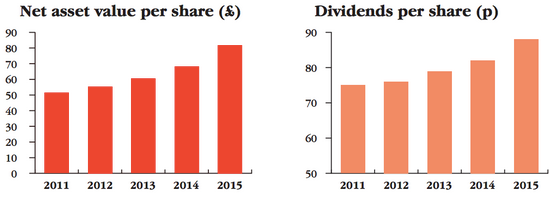
Real estate investor Daejan Holdings saw a record improvement in its Net Asset Value in the year to March 2015. The net revaluation gain came in at £229.7m and helped push the NAV per share up by 20% to £81.84. With the company family controlled the share price stands at around a 20% discount to NAV.
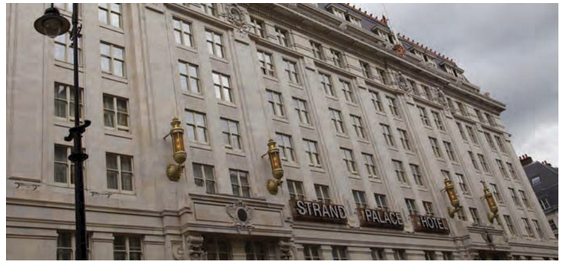
Daejan’s 2015 Annual Report makes for impressive reading with another year of solid NAV and dividend growth. The refurbishment of Africa House in London provided a boost along with a successful rent review at The Strand Palace Hotel.
The property assets in the USA also saw a tailwind given the strength of the dollar against sterling. As such 2015 was a vintage year and going forward rental and valuation gains are likely to be more in-line with market trends.
The Strand Palace Hotel in London
Source: Daejan Holdings annual report
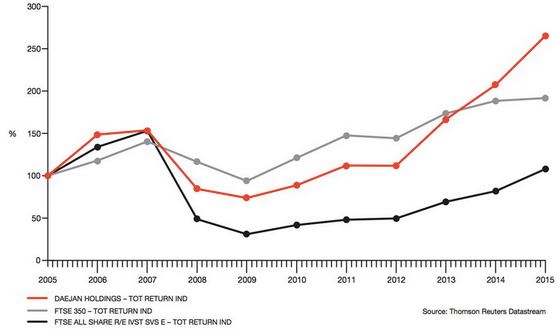
Daejan Holdings has a strong long-term track record with its dividend not having been cut since 1993. This is in part due to having low gearing with borrowing over assets at 16.4% at March 2015 versus 17.6% at March 2014.
Source: Daejan Holdings 2015 annual report
The Freshwater family owns just under 80% of the shares and two Freshwater’s, Benzion and Solomon lead the company. These are the sons of Osias Freshwater who started Daejan Holdings after moving to London from Poland in 1939.
Two of the next generation of the Freshwater family have joined the board as non-executive directors. However, they are both pursuing careers in other fields and so it is not clear if the family management of the group will continue.
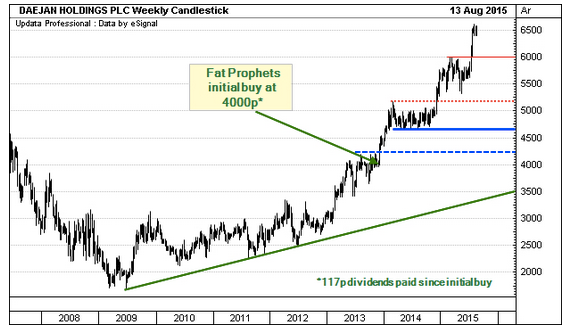
Family ownership and the illiquidity of the shares appears to be responsible for the circa 20% share price discount to net asset value. However, the structure has also delivered strong long-term performance for investors.
Daejan’s strategy and asset base
Daejan’s objective is: “the long-term, low risk growth in net asset value and in prudently our rental income and dividends.” The strategy to achieve this is three pronged with the first part being the management of assets to maximize rents.
The second part is to identify value enhancing development opportunities within the existing portfolio. Lastly, the group seeks out new property acquisitions that have the potential to enhance the long-term asset value.
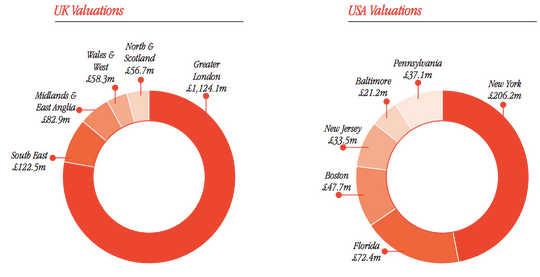
Daeajn had 77.5% of its asset base at March 2015 in the UK with the remaining 22.5% in the eastern seaboard of the USA. Over three-quarters of the UK assets are in Greater London while nearly half of the US assets are in New York.
As such Daejan is focused on global cities that have diversified economies and resilient property demand. By property type the group has just over half of its assets base in residential property with the remainder in commercial property.
Daejan Holdings geographic exposure
Source: Daejan Holdings investor presentation
Acquisitions and developments
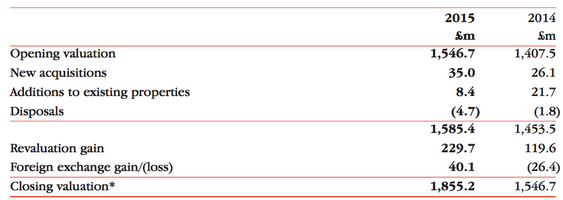
Daejan Holdings had £1.546bn of investment property assets at March 2014 and spent £30m on acquisitions in the financial year to March 2015. The group also spent £8.4m on additions to properties and realized £4.7m from disposals.
As such around 2% of the value of the assets was spent on expanding the real estate base. In the previous year the group spent 3.3% of the opening asset value and as such investment has been a source of asset value growth.
Daejan’s investing over the last two years
Source: Daejan Holdings annual report
Acquisitions over the last few years have included the eastern end of Oxford Street in London. The final property purchase this year gives the group contiguous holdings along Wardour Street, Berwick Street and Oxford Street.
This puts the group in a strong position to benefit when the Crossrail transport system starts in 2018/2019. Central London property is also likely to remain in strong demand due to limited supply.
The group is now considering a “number of significant redevelopment schemes” in the UK which should complete in the next few years. The most advanced is a 395-hotel development for Travelodge on the eastern fringes of the City.
Summary and valuation
The second-generation brothers running Daejan Holdings are aged 64 and 67 and it is not clear who will succeed them. The two third generation non-executive directors are pursuing careers in the legal and academic worlds.
In any event the ownership of the business is dispersed among different family members. As such there should be meaningful oversight to ensure that executive management remains suitably qualified.
In our view, the ownership structure has provided a benefit to date given that a low level of financial gearing has been maintained. This is likely to remain the case going forward and will enable the business to withstand downturns.
Daejan picks up the pace
Source: Daejan Holdings annual report
In the coming years we are set to see more moderate NAV increases but the focus on acquisitions provides support. Redevelopment opportunities and the introduction of Crossrail will also support valuation momentum.
Daejan Holdings continues to provide an attractive exposure to real estate in the supply-constrained markets of New York and London. In our view, the near 20% discount to NAV makes the valuation undemanding.
This report was produced by Fat Prophets Senior Research Analyst, Andrew Latto
Disclaimer
This is not financial advice. Our content is intended to be used and must be used for information and education purposes only. Please read our disclaimer and terms and conditions to understand our obligations.
7 comments
ATB
Just looking at the valuation and CLI is roughly in like with its EPRA net asset value per share. Does that potentially make it less compelling that Daejan? Also the euro weakness will make the European assets worth less in sterling terms. Definitely one for me to research more. CLI looks like a well run business. Mainly commercial though whereas Daejan offers half residential.
I agree on the point about CLI having the advantage on succession. Clearly the CEO and CFO are non family members and so it is already being run by professional management with family oversight. That is an advantage over Daejan which is run by the sons of the founder.
If I research CLI further I'll post here on it. Thanks for point it out.
Hi ratioinvestor,
Thanks for the feedback !
The cynic in me thinks that CLI is 'off the radar' - maybe 3 or 4 posts a year on the BB ! - because there's little institutional/brokerage coverage : instead of paying an easy-to-understand 'dividend', CLI announces a tender offer to buy back 1 share for 35, 40 or 50 held.......but at a significant premium to the current s/p.
So the individual can either accept, take cash and book a capital gain or just hold /decline and watch NAV per share (and, usually/eventually share price) move up.
Suits me !
ATB
extrader - Just had a look at CLS Holdings. I looks to me as more of a founder influenced/led company than a family company. So Sten Mortstedt, the executive chairman, owns just over 50% and Bengt Mortstedt owns 6.84%. Interestingly one of the founders sons is a non-executive director so perhaps it is shifting into a family type company.
Probably a fine line and I guess you could consider it to be a family company given that the founders were from the same family and control the majority of the shares. However, once you start saying the founder controlled and/or run companies are also family companies then you have loads of companies which are family groups. I.e. Wetherspoons etc.
Probably, though, I'd agree with you that CLS Holdings is probably a family company. Certainly a long pedigree of the management in running the group and I wish I had of come across it sooner!
extrader - could be right on that I haven't looked at CLS Holdings. Only thing about Dajean is just over half is residential property which makes it somewhat unusual. Also stock is at a 20% discount to NAV. So horses for courses. Probably both will do well. I'll have to look more closely at CLS Holdings.
Hi all,
In the commercial property sector, my preference would be for CLS Holdings (CLI), which
- is up 4 x since 2011, vs DaeJan's 3.5 x;
- is 'only' 50 % family controlled (Morstedt) vs 80 %;
- doesn't have management succession issues;
- has a more generous , although less transparent 'dividend' policy (by way of tender /buyback. for Morstedt tax reasons);
- has a portfolio split roughly 50% UK, 25 % Eurozone, 25% Europe nonEurozone., on fairly long leases and a preponderance of state/parastatal/multinational co tenants
ATB
billytk - Reading their annual report and they emphasis dividend stability and growth. So they invest in new acquisitions and existing property redevelopment. Daejan isn't a REIT and is family controlled so the dividend policy is for them to control. I think given that family members rely on the dividend income they want to have a dividend level that is sustainable - it hasn't been cut for decades. Agree shares are illiquid but it is around a £1bn stock so it should be possible to pick up a reasonable amount.
Good company but they should hike their dividend. I nearly bought within the last year but they are fairly illiquid and decided not to. Good call at £40 though.