Daily Stock Market Report (Fri 14th August 2026) - AV., GBG, WKS, CHRT

The US is now focusing on how to punish Iran with economic isolation, rather than outright military force. “We are just watching Iran with its huge inflation and the fact they have no money”, said President Trump. Iranian inflation is running at 77%.
Elsewhere, anonymous sources have told Bloomberg that OpenAI’s revenue run-rate has reached $40 billion. A few months ago, Anthropic said that it was at $47 billion. The companies are thought to be targeting IPO valuations of around $1 trillion and $2 trillion, respectively.
Anthropic’s success in creating tools for coders could therefore see it achieve a price to sales multiple of around 40x, and an IPO valuation even higher than SpaceX!
Overnight market movements:
The FTSE is up 0.3% at 10,790
S&P 500 is unchanged at 7,800
Brent crude (November) is up 1% at $86.05/bbl
Gold is down 0.4% at $4,335/oz
Bitcoin is down 0.1% at $63,300
Companies Reporting
| Name (Mkt Cap) | RNS | Summary | Our view (Author) |
|---|---|---|---|
Aviva (LON:AV.). (£21.4bn | SR67) | Operating profit +24% (£1,326m). Return on Equity 20.3% (H1 last year: 18.2%). “Very good progress” with the integration of Direct Line. “We are confident that we will meet our three-year financial targets in 2028 and expect 75% of our earnings to be capital-light by that point.” Operating EPS growth in 2026 to be “broadly in line with the 11% target rate”. | AMBER/GREEN = (Graham) | |
Cohort (LON:CHRT) (£636m | SR53) | SP +5% German subsidiary ELAC (Sensors and Effectors Division) has been awarded a contract with a value of €140.7m. ELAC will collaborate with Saab to deliver integrated sonar systems for the Polish Orka Submarine Programme. Delivery to continue out to the mid-2030s. | AMBER/GREEN = (Graham) I still think the valuation here is rfairly punchy, but it keeps issuing good news and the stock price continues to press higher, working towards that 1450p-1500p resistance level where it looks like people have been taking profits. Today's news has been greeted by a further 5% increase in the share price. The new order "confirms ELAC SONAR's position as a world-leading provider of advanced digital sonar systems for submarines." The financial implications aren't immediately obvious but will last for up to a decade, judging by the reference to the "mid-2030s". Equity Development have helped by publishing a note today, in which they leave FY27 estimates unchanged, but they boost FY28 and FY29 revenues by about 3% each. Consequently, FY28 adjusted EBIT gets a 2.1% raise (to £47.7m) and FY29 adjusted EBIT gets a 2.9% raise (to £53.7m). They also say that the revenue contribution of this contract is expected to peak in 2030. So it's very nice news for Cohort shareholders. Arguably I should be GREEN on this, but the StockRank is only 55 and I do consider it fully valued, so I'll leave our stance unchanged. | |
GB (LON:GBG) (£532m | SR59) | “...growth has not improved in the second quarter as we have seen higher than expected volume attrition on a few material customers.” Total group revenue growth for FY27 to be within the range of 1-3% (having previously guided mid-single digit). | BLACK (AMBER/RED ↓) | |
Arrow Exploration (LON:AXL) (£79m | SR76) | Acquisition of 100% working interest in 550 boepd oil producing property in Thorsby, Central Alberta Canada. The $12.15m CAD (c. $8.9m USD) cost is funded directly from on-hand cash reserves. | ||
Winking Studios (LON:WKS) (£54m | SR46) | Revenue +21.1%. Adjusted EBITDA down 49% to $1.2mm. Adjusted loss $0.2m. Statutory loss $2.5m. “Board expects a modest Adjusted EBITDA loss for FY2026, reflecting the increased second-half investment to create new revenue streams, strengthen the Group's competitive position and deliver more significant long-term returns.” | AMBER/RED (Graham) [no section below] We haven't looked at this one previously; it's a recent listing from late 2024. WKS is an art outsourcing and game development company, providing outsourced capabilities to publishers. The first thing I've noticed is how illiquid the shares are; it turns out that there is a majority shareholder in the form of Acer (the well known Taiwanese laptop manufacturer). Winking Studios themselves are headquartered in Singapore, and this is is a dual-listed stock, as it has been listed in Singapore since 2023. China and Japan account for more than half of its revenues. These interim results aren't too bad: organic revenue growth is 8.9%, and total revenue growth of 21% is impressive following a Canadian acquisition. However, the low adjusted EBITDA margin of just 5.3%, down from 12.6% last year, reflects the service-based nature of the work done. Additionally, the company says that some temporary factors impacted margins in H1, including investment in AI and some upfront costs to expand in North America. Even so, I would treat these shares cautiously. The company hasn't made any significant profits in recent years and it's always a little dangerous when there's a majority shareholder involved (even when it's a highly reputable organisation like Acer). I do think this will be worth keeping an eye on for signs of progress, but for the time being I'll adopt a moderately negative stance. | |
Touchstone Exploration (LON:TXP) (£36m | SR52) | Funds flow from operations increased to $7.13m from $1.85m in the prior quarter, primarily driven by a $4.07 million increase in operating netback. Net income of $2.34m, reversing the Q1 net loss of $2.38m. Production 4,433 boe/d, down 5%. | ||
Kelso group (LON:KLSO) (£16m | SR42) | Encourages shareholders to vote for the appointment of Graeme Coulthard as Director. | ||
iomart (LON:IOM) (£16m | SR49) | Matthew Waymark was CFO at a start-up bank. Previously held various roles at Natwest including Finance Director of the Commercial & Institutional Division. |
Graham's Section
Aviva (LON:AV.)
Up 0.5% at 717p (£21.5bn) - Graham - AMBER/GREEN
Avivaa is bigger than what I usually study here, and this is going to have to be a fairly high-level overview.
The insurance giant has posted a nice set of interim results this morning.
Headlines:
Operating profit +24% to £1,326m.
Return on equity 20.3% (H1 last year 18.2%).
The comment from Amanda Blanc, CEO is exceedingly confident on the company’s long-term prospects:
We have now achieved six consecutive years of excellent financial performance, with much more to come…
We are making very good progress with the integration of Direct Line. We have quickly improved Direct Line’s profitability, grown price comparison website sales, and maintained excellent levels of customer service. We are well on track to deliver all the financial benefits of the acquisition.
We are confident that we will meet our three-year financial targets in 2028 and expect 75% of our earnings to be capital-light by that point. Beyond this, Aviva is in a great position to sustain strong earnings growth over the longer term, particularly in the high growth areas of Wealth, UK and Canada General Insurance, Global Corporate and Specialty, and Health and Protection…
Checking the numbers in a little more detail, there are complications worth highlighting.
Indeed, I’m reminded of why I don’t study this one very often - a separate “financial results pack”, 95 pages long, is needed to analyse the company’s financial performance properly!
Operating profit vs. adjusted earnings per share vs. statutory profit (“IFRS profit”)
While adjusted operating profit was £1,326 (up 24%), adjusted operating earnings per share only grew by 10% (to 31.8p).
And the statutory profit figure fared much worse, falling by nearly 50% to £418m.
These are enormous discrepancies between profit figures. Let’s explain them, if I can!
Firstly, weak growth in adjusted in EPS can largely be explained by dilution from the acquisition of Direct Line:
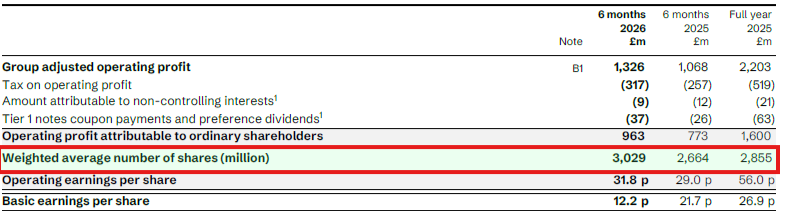
I think Direct Line shareholders were given shares representing ownership of about 12% of the entire group. 378 million shares were issued.
That’s a serious level of dilution and it makes the growth in adjusted earnings somewhat misleading, if it were to be studied in isolation. The growth in earnings per share is what really counts, and on an adjusted basis the growth is 10%.
But that’s before we consider all of the adjustments that are involved here.
The huge one is “investment variances and economic assumption changes”, but “integration and restructuring costs” are also worthy of mention.
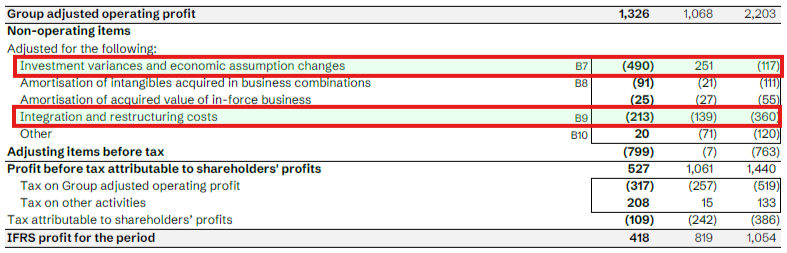
The swing in “investment variances and economic assumption changes” compared to H1 last year is approaching £750m (H1 last year: £251m benefit, H1 this year: £490m cost).
The company’s commentary says these costs are “primarily driven by the impact of hedging for interest rate and equity exposures”.
The “integration and restructuring costs” of over £200m are also worth focusing on. The company put £360m of costs into this bucket during the previous financial year.
Graham’s view
I could spend all day studying Aviva, but I don’t think it would benefit me or you, the readers, very much!
Roland has been AMBER/GREEN on it (e.g. here) and I’m happy to leave that stance unchanged today.
It trades at a moderate P/E multiple and offers a high yield:
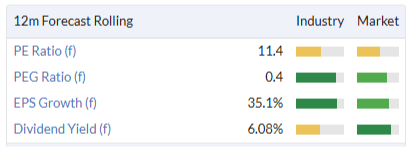
There’s a high degree of trust involved. Rather like when we study the major banks, I don’t believe that outside investors can ever really understand what’s going on under the hood here.
For example, Aviva explains its huge loss on “investment variances and economic assumption changes” like this:
The loss of £543 million in relation to investment variances and economic assumption changes on Life business was primarily due to UK long-term interest rates rising and losses from hedging against gains on equity markets.
The losses from hedging should be reversed over time - a hedge is supposed to reduce risk, and the benefits from rising equity markets will be felt in future years, even if hedging against the company's equity exposure has caused an accounting loss in the short-term.
So I’m pretty relaxed about the adjustments, because personally I do trust Aviva. But I wouldn’t ever have conviction in Aviva stock in the same way that I could when it comes to a smaller, more easily understood business. Even small financial stocks are much easier to understand than something like this, in my view.
Stockopedia rates it as a Turnaround (a winning style) and I’m inclined to think that a moderately positive stance does continue to make sense for us.
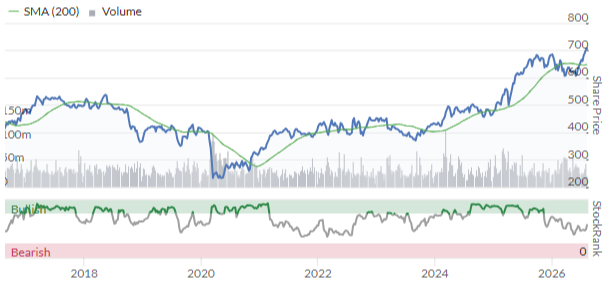
It passes five stock screens, covering the gamut of growth, income and quality.
So yes, one thumb up from me when it comes to Aviva.
GB (LON:GBG)
Down 29% at 165.6p (£379m) - Americas Identity Trading Update - Graham - BLACK (AMBER/RED ↓)
Sorry to anyone holding shares in this identity verification business overnight; it’s a remarkable fall today on a profit warning.
First quarter revenue in Americas Identity was only marginally below our plan, but growth has not improved in the second quarter as we have seen higher than expected volume attrition on a few material customers. While our sales pipeline remains strong, the time required to convert opportunities into recognised revenue given our normal sales cycle means the impact of this attrition is unlikely to be mitigated within the current financial year.
The USA accounts for 33% of GBG’s revenue (source: 2026 Annual Report), the largest single region, and so attrition at Americas Identity do have a very material impact on overall group performance.
New guidance: FY March 2027 revenue growth of 1-3% (previous guidance: mid-single digit).
The FY27 adjusted operating profit margin is now expected to be 21% (FY26: 23.7%).
Executive departure: the Chief Revenue Officer, Americas has left the building.
Graham’s view
There’s not much else in today’s RNS, so let’s start wrapping up this section.
Roland was neutral on GBG in June, noting that the company was borrowing money in order to buy back its shares. That’s an unusual decision in the best of times, but GBG wasn’t performing very well: profit expectations for FY27 appeared to be receding, revenue growth was unimpressive, and a large impairment charge had been suffered.
There are general principles when it comes to buybacks: they should only happen when a) the company is financially very healthy, with surplus cash, b) the company’s shares are attractively priced, c) there aren't any more attracrive investment opportunities available.
GBG appears to have failed on a), and probably also on b).
I’m clearly going to have to downgrade our stance on this today. The question is whether I might go fully RED, or only halfway.
The share price reaction to today's news is fascinating: sales growth guidance has been reduced by only a few percentage points, but the stock is down by nearly 30%.
Net debt at the full-year results was £80m. The leverage multiple at the time was 1.15x, according to Roland.
That shouldn’t be an excessive debt load, given the size of the business.
Therefore, I do not think that today’s aggressively negative share price reaction is about the company becoming financially distressed.
Instead, I’d wager that it reflects investor disgust at the company buying back its own shares and then missing guidance, on top of being unable to meet its modest revenue growth targets.
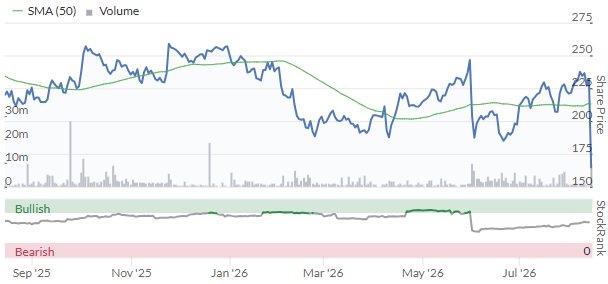
Perhaps today is the capitulation, and it can only go up from here? This software group should have the makings of a quality investment, but it's not showing it.
As things stand, there are enough red flags for me to go moderately negative on this for the time being.
Disclaimer
This is not financial advice. Our content is intended to be used and must be used for information and education purposes only. Please read our disclaimer and terms and conditions to understand our obligations.

53 comments
US bond yields currently rising and heading towards dangerous levels, warning investors of a huge drop in stock prices around the globe.
Everyone should be very careful from now till midterms, preferably holding a good chunk of cash in their portfolio.
All the best.
Interesting comment from you yiannos. I had you down as a momentum investor with a fairly large risk tolerance.
Obviously you don’t know me :-)
All the best
Agree Yiannos.
I posted similar on another thread. Some commentators are very bullish ATM based on a good run in recent weeks. Not worth chasing IMO. Better to wait and see how the Treasury / Bond scenario unfolds. The Japan carry trade is all entwined in this too.
If the UK 10Y chart below were a stock I’d expect it to break higher.
On the flip side Trump will pump the markets into the mid terms so we shall see. As you say - plenty of cash is a good insurance policy.
Yiannos- Your right to raise concerns.
Investors might want to sell out of Hi Tech/Growth and look at Financials and high dividend stocks( as long as covered) . REIT's can be exposed, I hold a few, but most have decent borrowings at lowish rates. Money market funds are a safe haven.
I mainly use Investment Trusts and ETF's and have recently reduced exposure to High Tech in ASAI. I have limited US exposure other than Invesco S&P 500 Equal Weight Swap UCITS ETF Acc (LON:RSPB) which reduces exposure to the largest companies in the index.
Simple AI Summary :
"When risk-free government debt offers attractive returns, it changes the financial math for every other asset class:
Bond yields move upward primarily due to a combination of macro drivers:
The first thing I will avoid, if yields continue to rise, is financials and high yield stocks!
All the best
HY with well covered dividends and progressive will be fine
according to a well known commentator GB (LON:GBG) is losing market share to a competitor, which is growing its revenue at 14% and upgraded the revenue expectations to 19% (MITEK SYSTEMS)
GB competitive moat is reducing and they are losing market share. I'd like to know why and what GB are doing about it!!!
Currys (LON:CURY) Rockwood Strategic (LON:RKW) Kenmare Resources (LON:KMR) Central Asia Metals (LON:CAML
The next Yellowstone Advisory Private Investor Evening will take place on Wednesday 16 September at 5.30pm.
We are delighted that Currys, Rockwood Strategic, Kenmare Resources, Central Asia Metals
will join us to introduce their companies and explain the investment case. The presenters are as follows:
Currys: Dan Homan, Director of Investor Relations
Rockwood Strategic: Richard Staveley, lead fund manager
Kenmare Resources: Tom Hickey Managing Director
Central Asia Metals: Gavin Ferrar, CEO
This is a chance to meet management teams and fellow private investors face to face in a relaxed environment. Listen to company presentations and then take the opportunity to ask your questions over drinks and canapes.
The event starts at 5.30pm in EC1 and doors open at 5.15pm.
If you would like to attend please register below.
Register: Join Webinars & Events | Yellowstone Advisory
Peel Hunt (LON:PEEL) As its so quiet today - wonder what thoughts are - Peel are always in the news and must be doing profitable business with all these mergers etc yet the shares continue to fall. Even the EBT has sold down this month - what's going on ?
Long term holder
Peel Hunt (LON:PEEL) I've seen that too Bohemia. IMHO its just a lack of news from a relatively small ish company . As mentioned before the forecasts would appear to be out of date (but maybe they aren't). We'll just have to see come results. Quiet times can give one a great entry / top up point.
Buy when everyone is selling and sell when everyone is buying is the famous phrase , well until all this Momentum investing came along! lol
I have alot of these so lets hope Im right.
I have bought and sold GBG(LON:GBG) for over 10 years.
In early 2020 it traded at 738p. The US.merger has been a real disaster which ever way you look at it.
The Board clearly overpaid hence the huge write down within 2 years or less of the merger. I am reluctant to sell as for many years I did very well in and out 31 times! Not my usual trading style.
I will be very interested to hear what the experts have to say today.
Nichols (LON:NICL) must be hitting it out of the park at the moment, with the summer we are having. I like the latest acquisition of Vit-Hit and gave it a try yesterday as part of a meal deal. (Boost - Summer Berries, Ginseng + Rooibos Tea) and I must say it was excellent. Most of their cash has gone but Vit-Hit is cash positive and the cash balance should start to rebuild quickly.
That's why I've continued to hold Nichols (LON:NICL) , H2 is likely to come out as a beat.
You then add on the extra EPS from VitHit, and the H2 numbers are going to look very rosy....
And then there's the continued tailwind that Ramadan is one week earlier next year, so continue to push some more "orders/revenue" from distributors into H2. Especially as stocks are likely being ordered in advance, in light of Middle East uncertainties.
Next year's growth - sorted by the Senegal + Ivory Coast (upcoming) manufacturing facilities, unlocking further distribution growth across African markets. Starts to become a meaningful % of total revenues, so the 15-20% growth rates there actually will meaningful to Group-level growth.
I'm still on the fence about whether VitHit was a good acquisition though. I did quite like the comfort blanket of that £60m+ cash pile. I did listen to the management webinar yesterday and was somewhat reassured by their repeated reassurance that double-digit (10%?+) revenue growth from VitHit was a comfortable target. And that all they really need to do to hit that is drive growth in the UK. Which is Nichol's strength (in distribution network, marketing nous, etc).
My conviction here is still that this should be worth 1400p+, so still holding out for that extra 30%+ gain. It has hit that SP before, so its not like I'm asking for a new record market cap.
It is the largest position in The Boon Fund.
What a shocker of an acquisition that was for GB (LON:GBG) in the US a few years back. Nothing but write-offs and downgrades from it since purchase. It probably shouldn't be just the US Chief Revenue Officer losing his job for this. What were the UK senior management doing talking up revenue growth acceleration after the first quarter without being aware of client losses coming through in Q2? This has been a very disappointing hold for me. A 'jam tomorrow' stock never delivering (and wasting our money on share buybacks unjustified by the company's performance).
100% agree sparkler, but just trying to decide whether the numbers justify it being a 24% worse company than yesterday and/or if its a ' jam tomorrow '... hoping that more knowledgeable brains than mine might opine :)
Even the directors have bought along the way, and recently, so they really don’t know what they’re doing
As things seem slow today could some of you knowledgeable folk explain why Primary Health Properties (LON:PHP) always seem to announce 2 dividends on the same day please?
As things seem slow today could some of you knowledgeable folk explain why Primary Health Properties (LON:PHP) always seem to announce 2 dividends on the same day please?
One is a Property Income Distribution (PID) the other a normal dividend. PIDs are rental profits generated by the property portfolio of which 90% must be distributed to shareholders to retain REIT status. PIDs aren't treated as normal dividends for tax purposes.
timarr
Thanks timarr. Primary Health Properties (LON:PHP) is the only REIT l hold but wasn't aware of this feature. Does this mean PIDs are taxable, although hopefully it doesn't matter as they are in my ISA.
Does this mean PIDs are taxable, although hopefully it doesn't matter as they are in my ISA.
Makes no difference in an ISA. Outside it's treated like property income, not a dividend.
timarr
So kind timarr. I think this site is brilliant. It is not just the staff but so many people willing to share their knowledge and opinions. Everyone doesn't always agree but that's what makes a proper discussion. I've learnt so much here
Aviva (LON:AV.) results look good from a very superficial skim, plus they expect 11% CAGR on EPS for the next few years which would put this on a reasonable rating. We also had recent positive results from Legal & General (LON:LGEN). Insurers are very far outside my comfort zone but looks interesting - would welcome your thoughts on Aviva (LON:AV.) Graham!
Cheers Tortoise, will take a look! Quiet Friday so plenty of latitude in what I cover today, if anyone has requests.
Any insight on why the stocko rating is low would be interesting. Have held 8 years in dividend portfolio and only recently joined stocko, but very hesitant to sell on rating alone as it continues to do well and pay a good yield, yet rating on stocko is low
From my experience, Stocko ratings don't seem to work well for life insurers - the accounts are completely different to conventional companjes and this appears to trip them up.
Any other industries where rankings seem to struggle? I would think the momemtum ranking would the only one that maybe translates regarless of industry as its tracking share price movement, and less concerned with the balance sheet.
Any insight on why the stocko rating is low would be interesting.
It's a technical issue to do with how Quality Ranks are calculated. Insurers have unusual balance sheets - lots of assets, lots of liabilities, big regulatory capital requirements and actuarial assumptions driving earnings. The net effect is that ROCE often looks low - and that drags down the Quality Rank, which impacts the overall StockRank.
If you look back over the last five years while I've held, the Aviva StockRank has rarely got much over 70. In that time it's been a fantastic investment, throwing off huge dividends while the share price has nigh on doubled. The same is true for M&G (LON:MNG) which has done even better.
Factor based investing is an excellent way of removing human biases but it's not foolproof - investors need to understand what the ranks are telling them and why.
timarr
ROCE in banks and insurers looks low because it is low. ROE for shareholders is usually much higher and that's because of high gearing. The nature of the beast. Shareholders benefit from piggy backing on depositors/insurees capital but can get wiped out when things go wrong.
Standard life had a stockrank in the 50's then went from £5 to £9 whilst paying a dividend of 6+% and still only has a stockrank of 63. Using stock ranks alone can mean missing some great opportunities.
My approach to Aviva (LON:AV.) is old school simple (I hold) - the current yield does not seem to discount growth and the fact the M&A would appear to have pushed a degree of control to the Plc with integration going well. Financials are trading well but the life stocks faired less well and my guess is macro, oil and inflation prospects cloud the outlook for bonds ....and life stocks (ditto Ins) hold huge bond portfolios. More recently prospects for resolution and some ok inflation data in the uk has firmed up the bond market. The yield of Aviva (LON:AV.) would appear to have found favour. Longer term prospects for motor insurance in the uk are unclear but could well be not as bad as feared ....if technology reduces accidents and claims. I have no firm view on motor but note Direct line was always treated harshly by the UK market in terms of rating...so beating the fade my well be a reward Aviva (LON:AV.) capture. Today's results seem to cover the dividend growth easily and if recent trend EPS. growth supports a near 10% increase in dividend then a lower yield is justified.....which makes it all an ok hold to me. Not the most exciting stock but should generate sleep at night returns unless bond market prospects really deteriorate.
Interesting that you think the Aviva (LON:AV.) yield seems to have found favour. I’ve held long term and the yield (with promises of annual increases that have been kept) was then well over 10% and didn’t “find favour” for several years. I bought my stake at an average £3 or so with one average down at just 255p. The price seemed crazily low for so long before at last roaring up.
Exactly the same with others I bought like M&G (LON:MNG) , Legal & General (LON:LGEN) Chesnara (LON:CSN) and Standard Life (LON:SDLF) . Chesnara (LON:CSN) is up around 60% and the others have more than doubled. And those gains exclude dividends.
I know timarr (see his posts today) also bought at what he saw as “silly prices” and also stayed patient, and collected the 10% or more annual dividends while waiting for the eventual upturn. The yield on my 255p top up is now about 18% …and still rising.
Aviva (LON:AV.) might well be a potential buy now, but why don’t more investors buy when shares are such obvious bargains, instead of after the big gains?
Agree that Aviva (LON:AV.) ”is not the most exciting stock” now. It and so many similar(including some Investment Trusts) were an exciting stocks before the share price more than doubled.
Aviva (LON:AV.)
Interesting that you think the Aviva (LON:AV.) yield seems to have found favour. I’ve held long term and the yield (with promises of annual increases that have been kept) was then well over 10% and didn’t “find favour” for several years. I bought my stake at an average £3 or so with one average down at just 255p. The price seemed crazily low for so long before at last roaring up.
Aviva was a different beast up until the point they sold many of their units and did that big share reorganisation thing.
Its probably a more streamlines company now where its easier to focus on the core business.
Must admit a took my money and ran at that time as basically i thought the value had outed with the mior pop in sharprice - and i wasnt over confident in management having a cunning plan for what was left. Looks like my decison to run for the hills was pretty silly withg the wondeful benefit of hindsight- there ya go.
Well base rates are 3.75% and gilts yield 4% - 5.7% depending on duration.... and although they have fixed redemption values I would expect a growing dividend to be lower...since a growing dividend should not be cut and also underpin value. So I would suggest 5% or lower but all this depends how sustainable growth really is. On that management confidence seems quite high. Sadly we can't go back in time and measure yield on historic prices but today's yield still seems attractive even if less than in the past. Well done on your purchase lower.... in my world your yield remains the current yield however attractive those levels were....
Re
“in my world your yield remains the current yield however attractive those levels were....”
That only applies if buying Aviva (LON:AV.) now.
My yield is obviously the yield at my buy prices and not the price now.
hmmm we can agree to differ but I guess that you value your assets at current prices not acquisition prices - and yield is current income over current value. Historical yield offers no value.
“Historic yield offers no value.”
Do you think that applies to Lord John Lee (the first ISA millionaire) who now gets over 100% a year yield on some of his holdings? I.e more than his original stake back every year just in dividends.
I fail to see your logic, just as I fail to see the logic of buying after huge share price gains, instead of before them. But agree…..we can agree to differ.
Ken,
whilst I dont want to get into any argument here, my take on historic dividend would be as follows;
If you bought an instrument for £10,000 yielding 5%, you get £500 pa. After a number of years that instrument is worth £100,000 and still yields 5%, so you get £5000, a 50% yield on your original £10,000 investment, great! However in that mindset the other £90,000 of your holding is not yielding anything .
It's hard for me to get my head round this logic, I think what counts most is how the dividend is deployed. I no longer hold Aviva (LON:AV.) as I sold the last of my shares last January. I may have bought at low prices in 2011 and 2012 and buying in subsequent years at higher prices meant that dilution changed the percentage of dividend to a smaller figure each time. Looking at what I did with the capital return I would have been better off now had I stayed.
It doesnt really matter as the cash return is the same, I did make a mistake in my original post as I said £95,000 of your holding was yielding nothing when it should be £90,000 obviously!!
My point was, I think, the same as RD's, that it is fine to claim that you have a holding yielding 50% on your original purchase price but you should also admit that this would mean the rest of that holding yields nothing at all.
Yield is valued on what your investment worths today, the rest is just nonsense.
All the best
Lord Lee will most certainly not be making any financial decisions based on his historic cost price yield - he will be basing all his financial decisions based on the real current yield - the historic yield is jus ta fancy soundbite - it can evidence a point that "long term buy and hold of great company will do a good job" in the real world historic yield should play no impact on the decisions you make - its oftena clue that you haev been holdinga "good un" - most of the time thats plainy obvious from what is normally share price appreciation too.
I have the impression that Ken probably has never heard the phrase ‘opportunity cost’ -:)
All the best
Ah yes, "the cost of opportunity". The idea, based on hindsight, that you should sell a stock that hasnt "performed" and buy in to the "right" one which would have made you money & forgetting you had no success doing that in the first place when you bought the original stock. Whenever people tell me I have lost money through the cost of opportunity, I always check my bank account to see if there is any money that I have lost. Funnily enough, there never is. Momentum investors have their systems, value investors have theirs. Minervini & Graham are/ were both extremely successful investors but you wouldnt have got them agreeing on any single stock to buy. Plenty of ways to skin a cat, I wish you continued success using the method you have chosen to employ.
We were talking about yields!
All the best
My apologies, I must have misread your last message. I tend to view dividend yields as an alternative strategy to what I mistakenly thought you mentioned - I am happy to be paid to wait. Regards.
My yield is obviously the yield at my buy prices and not the price now.
thats a completely illogical way to look at it though when making financial decisions.
you may have something yielding 3% that in your head you are calling 20% that 20% number has no relevance other than in you head.
if you concentrate on the real world 3% you are getting and say well - if stock B is similar and pays 6% - well you could sell your "20% yielder" and double you "real world cash payout and actual yield " - if you are defaulting to the 20% number and ignoring the reality - well the 20% is just highly misleading when trying to crunch any numbers.. Ok i get you probably look at the real world numbers too and make decisions on that - but really the 20% number has no relevance other than perhaps making you feel good about that stock.
I would caveat the next paragraph with the admission that I personally find value / bargain buying easier and momentum trading harder, but ... to answer your question Ken ...
The research suggests that momentum trading outperforms , as money left in value stocks can take years to see capital gains ... momentum traders would be hoping to achieve more than the 10% dividend yield... not something that I can necessarily achieve, but the academic answer to your question...
Would be super grateful for a look at GB (LON:GBG) please Graham... 24% drop on a change from mid single digit growth to 1- 3% seems excessive and potentially a contrarian opportunity... but disclosure I hold a starter position:(
Many thanks indeed
I'd still be very interested in your thoughts on IGG, both as an investor and customer.
FWIW I still hold but will probably move as a customer, and I'm a much weaker holder now too.
Thank you v much Graham! Hope you have a lovely weekend when it comes
Aviva (LON:AV.)
Hi, I don’t post but read comments and the talk about dividends and when to sell are interesting. I have all the big insurers and all have done well, so much so that they have doubled from my original buy price.
I invested 50k and now worth 100k.
The current yield on the 50k is 10.5%, the yield on the 100k is 5.25%. If I sell half I lose 5.25% in income but have 50k to invest but I would need a yield higher than 5.25% to break even and as we all know there are less high income stocks than before. I have this situation in 5stocks and I am not sure if I can find enough UK stocks to compensate. I hope this example made sense?