Daily Stock Market Report (Fri 3rd October 2025) - Warning signs are everywhere? - JDW, TFW, HEAD

Good morning everyone - Happy Friday! It looks like the City has packed up and gone home for the weekend.
All done for today, thank you.
Companies Reporting
| Name (Mkt Cap) | RNS | Summary | Our view |
|---|---|---|---|
J D Wetherspoon (LON:JDW) (£752m) | LfLs +5.1%, adj. PBT +10.1% (£81.4m). As previously indicated, higher NICs/labour to cost £60m p.a. “The company currently anticipates a reasonable outcome for the financial year, although government-led cost increases in areas such as energy may have a bearing on the outcome.” | AMBER (Graham) As I have no confidence in EPS forecasts for the current year, I can’t be positive on the stock, but I’m also resistant to being negative on it, due to its inherent balance sheet strength and the resilient performance it has achieved over many years. I’m therefore going to leave our AMBER stance untouched for now. | |
FW Thorpe (LON:TFW) (£357m) | SP -2% Revenue -0.3%, PBT +5.9% (£31.6m). Solid start to 2025/2026, with operating performance in line with prior year. Cash reserves grow to £62m. | AMBER (Graham) [no section below] Mark was AMBER on this in March at a £352m market cap. The market cap after today's movement is £351m. And there is little change at the business, as FY 2026 starts off in line with the prior period. The modest increase in profits has come "primarily" thanks to cost reductions, as revenue decreases slightly. It's a conservatively-run family business and so I'm inclined to take a positive view, but I struggle to find anything in today's results to light up some excitement for investors. We are at least told that management teams are "targeted with finding growth" despite having similar revenues and a similar order book at this stage of the new financial year. I am left with the conclusion that it's fairly valued at this level (P/E ratio 14.6x, ValueRank 53). | |
RWS Holdings (LON:RWS) (£350m) | CFO has decided to step down. It has been agreed she will stay until end of 2025. | ||
Headlam (LON:HEAD) (£44m) | CEO steps down with immediate effect. The Chair becomes Exec Chair while the Board runs a formal CEO succession process. “This leadership change positions us to move forward with greater pace and focus.” | AMBER/RED (Graham) [no section below] The outgoing CEO is thanked for his efforts but it sounds very much like the Board at Headlam have grown impatient for progress. Half-year results published in September showed a large underlying loss (£17m), compared to a £12m loss in H1 of the prior year. The statutory pre-tax loss was enormous at £32m. Meanwhile the outlook could only reassure investors in relation to the medium-term; short-term market indicators were poor with "a slight deterioration" in the previous three months. Earnings estimates are negative here for the foreseeable future, and accordingly I'm downgrading our stance on this stock by one notch. |
Graham's section
Market comment: "pleasant conditions in which to invest"
After the webinar by Ed and myself, and the webinar review in which I suggested that these were very pleasant investing conditions, it was noted in the comments that not everybody agreed. In particular, Alex Brummer (City Editor, Daily Mail) had written an article with the following totally reasonable headline:
In 50 years as a City writer, I’ve almost never felt so worried a terrible crash is coming. Warning sings are EVERYWHERE.
He began the article by noting that a NYSE-listed company, that owns stakes in small football clubs, announced an intention to buy crypto tokens last week. Its share price subsequently increased by 225%, after peaking at a 600% increase.
As another example, he notes Nvdia’s $100 billion investment into OpenAI,
Given the extent of the mania, he writes:
We are very possibly heading for a historic crash, one that could presage all manner of impoverishment, ruined careers, decimated retirement prospects and more.
Other observations from Mr. Brummer:
Almost all stock market indexes are at or close to all-time peaks (even including the FTSE)
Gold price up 44% this year
Bitcoin has no intrinsic value, and is just below its $124k all-time high
Economically, he notes that UK government bond yields are at their highest level since 1998, with debt to GDP at close to 100% (highest ever level in peacetime), and that the number of unemployed is on the rise since the last Budget.
And he draws parallels between Trump’s tariffs and the tariff wars of the 1930s, contributing to the Great Depression.
Where I agree
Firstly, I respect anyone who’s been in the City for 50 years. You get less than that for murder, as the saying goes…
And I do agree with Alex on numerous points - except where he describes ARK Invest founder Cathie Wood as “serious and respectable”. She is extremely successful, yes, but her funds have not consistently outperformed the S&P 500 over the long run. She has proudly and confidently invested in some of the most speculative US stocks of the past decade, and due to the publicity and following she achieved during market bull runs, I would argue that she is personally responsible for more value destruction in the stock market than almost anyone else during this period.
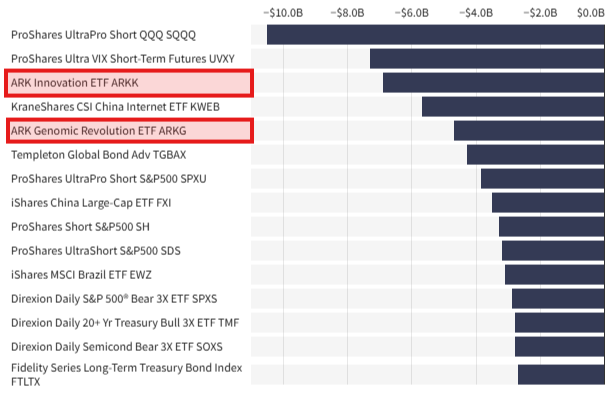
Here is a list of the biggest ETF losers over the past decade, from Investopedia. If someone bought the ARK Innovation ETF at inception (2014) and held it, they would have enjoyed returns similar to the S&P. But due to the nature of markets, most retail investors buy into this sort of ETF when it’s horribly overvalued:
But let’s turn back to where I agree with Mr. Brummer!
Readers will know that I completely share his opinion that Bitcoin Treasury Policy companies are a speculative bubble - here is my article on the topic. Many of these companies are close to worthless, if not actually worthless, in my view.
AI is also a bubble: for years, I’ve been quick to point out whenever I’ve found a company dubiously claiming to be involved in AI, in order to attract investor interest. I’ve been instinctively cautious whenever I find a micro-cap that claims to have the next big idea in crypto, machine learning or AI.
I’ve also been fairly sceptical of Nvidia’s valuation (wrongly, so far).
And when it comes to the economy, the UK’s debt to GDP is of course a very legitimate cause of concern, and international tariff wars are still a major source of risk. At least we are no longer in a "ZIRP" environment - the era of zero interest rates forced investors to take on excessive risk, whereas now there are some fixed income alternatives that do offer a reasonable return.
But I agree substantially with nearly all of Mr. Brummer’s points: there are many warnings signs, and many potential causes of concern.
Where I disagree
I think the danger with a view like Mr. Brummer’s is that it could tempt (or scare) some people to sit in cash, earning little, in an attempt to avoid the inevitable crash.
The problem with predicting crashes is that you never know when they are going to happen. It may be perfectly obvious that a stock, a market or a commodity is overvalued - but it can take years for the bubble to pop.
So from a portfolio management point of view, it’s not enough to say “markets are overvalued” - you still need a reasonable choice for what to do with your money.
Why I said that these are pleasant conditions in which to invest
My day-to-day focus is on UK small-caps, and I believe that we are very far from being in a speculative bubble in this niche.
Ed showed us a slide at last week’s webinar which showed the UK market as a whole being the cheapest (relative to earnings) against a set of comparable national indices.
If we focus specifically on the AIM All-Share Index, we find a forward P/E ratio of 12.76 - hardly in bubble territory.
Note also that its PEG ratio (P/E ratio divided by EPS growth) is less than 1x, on a forward basis:
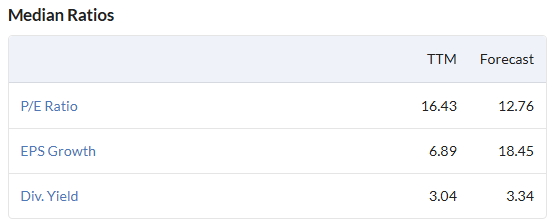
The FTSE Smallcap Index, which is higher-quality than AIM, offers even more value (forward P/E 10.5x), a lower PEG ratio, and a higher forecast dividend yield (4.5%).
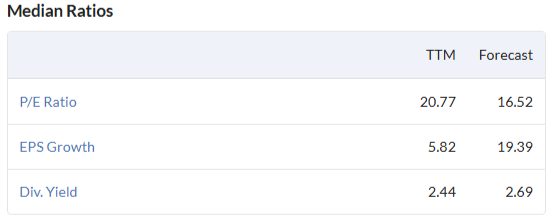
Turning to the United States, the NASDAQ composite is, unsurprisingly, much more expensive. But even there, the forward PEG ratio is less than 1x:
Where I think that the real danger lies - and my solution
For me, there are two main sources of danger in current markets.
The first is the crypto mania, where I think that the proliferation of Bitcoin Treasury companies is a sign of speculative frenzy. Bitcoin itself might be a great investment, but I cannot be convinced that a company is worth something purely because it intends to buy some Bitcoins!
The second main source of danger is the concentration of the S&P 500 into a small number of mega-caps. Note that in the figures above, I was looking at median valuation multiples, because these provide useful yardsticks for stock pickers who are willing to look at companies of all sizes.
For ETF investors, however, the value of an index - or an ETF - is determined by its biggest companies, not by the median.
Index concentration does set the stage for a potentially dramatic collapse, in my view:
Nvidia: 7.6% of the S&P 500 (forward P/E 33x)
Microsoft: 6.3% (32x)
Apple: 6.3% (32x)
Amazon: 3.9% (30x)
Meta: 3.0% (25x)
That’s 20% of the index in the top 3, and 27% in the top 5. And the cheapest one is at a forward earnings multiple of 25x!
This does scare me.
I think the strong performance of these mega-caps is a symptom of the ease with which anyone, globally, can invest in an S&P 500 tracker.
But I also think that their strong performance is a cause of increased interest in buying S&P 500 trackers.
So I think Michael Burry was right when he said:
Passive investments are inflating stock and bond prices in a similar way that collateralized debt obligations did for subprime mortgages … When the massive inflows into passive vehicles reverse, ‘it will be ugly.’
But note that he didn’t say this last week, he said this six years ago. Isn’t there some well-known phrase about markets remaining irrational for a long time?
My solution
As in all things, I think it’s good to have a balanced perspective.
I personally own some of all of these:
UK small-caps and mid-caps: my main focus. I don’t believe that the stocks I own are particularly overvalued.
Berkshire Hathaway: diversified US exposure in a single stock.
Global tracker, including the S&P 500 (in a pension fund, which I can’t access): just in case Michael Burry and Alex Brummer are wrong. I don’t get to touch this money for a few decades anyway.
Global high dividend yield tracker (in a pension fund, which I can’t access): similar to the global tracker, but it excludes companies with a low dividend yield. It doesn’t own any of the Magnificent 7, is much better diversified than the global tracker, and is much less US-weighted.
So I’m going to stand by my words that these are pleasant conditions in which to invest: I’m happy continuing to plough money into the above categories, whenever I can afford to. It’s responsible to hold some cash too, of course, but there is a point at which holding too much cash becomes inefficient. I do not believe that investors with a reasonably long time horizon (5 years+) will face good odds if they avoid market risk at all costs, for fear of a crash.
At the same time, I’m going to agree with Mr. Brummer that there are several worrying signs of speculative mania in the markets, and that there are plenty of economic reasons to be fearful. But there are always things to worry about - the trick is to position your portfolio so that you can sleep at night.
J D Wetherspoon (LON:JDW)
Down 5% to 633.5p (£716m) - Preliminary Results - Graham - AMBER
These are fine results, but do bear in mind that they only go to the end of July, i.e. including three months of higher National Insurance contributions.
We did get a preview of these results with a trading update in July, covered by Roland.
There is a 10% increase in adjusted PBT, and a 4.5% increase in adjusted EPS.
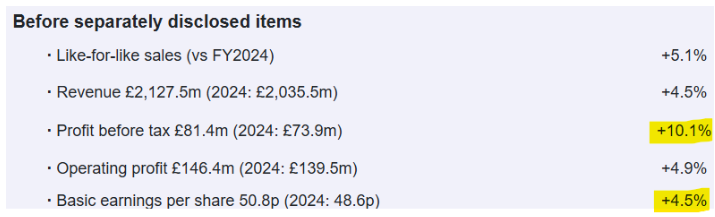
I think this difference between PBT and EPS growth is purely to do with taxes: there was a 29% tax rate on adjusted PBT this year, vs. 21% last year.
The weighted average number of shares is down by 4%, which all else being equal would have meant EPS growing faster than PBT.
Also of note is that “separately disclosed items” are positive, i.e. the statutory numbers are better than the adjusted numbers. In the footnotes, I find mention of £10.3m worth of impairment reversals on pubs, and £12.7m income relating to hedging trades on interest rates.
Let’s check out the always-colourful commentary by Tim Martin.
On recent trading:
"In the last nine weeks, to 28 September 2025, like-for-like sales increased by 3.2%. The latest 'CGA RSM Hospitality Business Tracker', for August 2025, said industry like-for-like sales were +0.5%. During this period, Wetherspoon like-for-like sales were +3.7%. This was the 36th month in a row that Wetherspoon has outperformed the tracker.
Great news, but the impact of NICs on profitability is what I’m most worried about when it comes to this stock. Tim Martin addresses it in a similar manner to before:
"As previously indicated, increases in national insurance and labour rates will result in cost increases of approximately £60 million per annum, and non-commodity energy costs will add £7 million… Cost increases such as these will undoubtedly add to underlying inflation in the UK economy, although Wetherspoon, as always, will endeavour to keep price increases to a minimum….
"The company currently anticipates a reasonable outcome for the financial year, although government-led cost increases in areas such as energy may have a bearing on the outcome."
This mirrors what the company said about FY 2025, e.g. in March they said:
"The company currently anticipates a reasonable outcome for the financial year, subject to our future sales performance."
And back in January they said:E
"The company is confident of a reasonable outcome for the year, although forecasting is more difficult, given the extent of the increased costs."
So this is what they do: they tell us there will be a “reasonable” outcome, usually with some form of basic disclaimer.
In this case, the warning that “government-led cost increases… may have a bearing on the outcome” is already known. So unfortunately the outlook sheds little light.
But it’s clear that cost increases of £60m (NICs/labour), energy (£7m) and packaging (£2.4m) are significant in an industry with small margins, and where adjusted PBT for the year just gone was £81m.
The £7m energy charge is new:
Wetherspoon has just been informed that the "non-commodity" elements of our electricity charges (in effect, taxes or "levies" which are added to electricity bills) will rise by an annualised £7 million, starting this month, so that the non-commodity element will be approximately 62% of our overall electricity costs.
The increased cost is partly due to two new levies: one is a nuclear power subsidy, the other is a subsidy, as we understand it, for energy intensive industries.
As indicated, this substantial increase in levies, applicable to most consumers and businesses, will inevitably add to inflation in coming months.
Balance sheet: I’ve noticed some excellent comments under this article re: JDW’s use of cash and buybacks.
As per the cash flow statements, these are the major cash movements for FY July 2025::
£193m cash inflow from operating activities (arguably we should deduct from this £38m of lease-related payments that are classified elsewhere).
£108m cash outflow for investing activities (includes £24m of growth capex).
£67m outflow for buybacks.
£23m outflow to buy shares for share-based payments (staff bonuses).
£19m outflow for dividends.
£19m outflow for freeholds/investment properties.
Net debt increases from £660m to £724m.
Including leases, debt increases from £1.07 billion to £1.13 billion.
Net assets (almost fully tangible) are £361m.
Graham’s view
I don’t have any real objection to the company’s use of cash this year, although it's fair to question the buyback is profits subsequently come under pressure. To my eyes, using the figures shown above, they made a cash income of £48m (operating activities minus investing activities, adding back growth capex and deducting share purchases for SBPs).
The company's own calculation comes up with a free cash flow figure of £57m.
In that context, spending £86m on buybacks and dividends combined might seem excessive, but they are starting from a strong position in terms of freehold properties and tangible net assets. I note “the company's freehold assets have not been revalued for over 25 years.”
The bigger question to is what is going to happen with profits, and on that front I remain deeply concerned about the impact of higher NICs, and other costs.
There are winners under the current government, but there are also losers, and JDW stands in the firing line.
As I have no confidence in EPS forecasts for the current year, I can’t be positive on the stock, but I’m also resistant to being negative on it, due to its inherent balance sheet strength and the resilient performance it has achieved over many years.
I’m therefore going to leave our AMBER stance untouched for now.
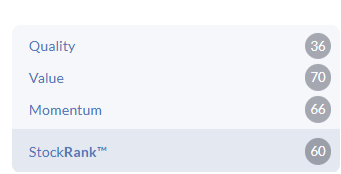
I’m in good company with my neutral stance:
Disclaimer
This is not financial advice. Our content is intended to be used and must be used for information and education purposes only. Please read our disclaimer and terms and conditions to understand our obligations.

89 comments
Interesting graphic in this weekend's Pensioncraft free email. Unfortunately, it doesn't surprise me. Blame whatever you like.... Brexit, Covid, GenZ, LSE takeover of Refinitiv. It's a depressing trend in the UK Stock Market that for once (in my opinion) is reflected in the wider UK economy.
Interesting, but sadly, not surprising.
A good chunk of my portfolio is invested on the Nordic Exchanges: Norway is a dull market unless you are into shipping companies, O&G, or fish farming. The only Norwegian stocks I own are Kongsberg Gruppen ASA (STO:KOGo) and BORREGAARD ASA (STO:BRGo) (which Alex Sweet wrote up on his old sub-stack on my recommendation - he also bought a position).
(1) Borregaard – an economic castle protected by an unbreachable moat
However, Denmark and Sweden have very dynamic world-class companies. Many have CREST certificates and are thus tradeable and eligible for ISA's and SIPPs. There are World-Class Danish and Swedish medical and pharma companies which are accessible to a UK investor. I own Alk-Abello A/S (CPH:ALK B) Genmab A/S (CPH:GMAB) and BoneSupport Holding AB (STO:BONEX)
If you just want Nordic exposure, buy the Wallenberg Family's holding company, Investor AB (STO:INVE B). They hold strategic stakes in SAAB, ABB, Atlas Copco, Husqvarna, NASDAQ, Ericsson, Electrolux, SEB, AstraZeneca, Wärtsilä, Sobi, and Epiroc. They also have an interesting private equity arm which mostly invests in medical tech. They were also a funding shareholder in investment management firm EQT. For those that do not know of the Swedish Wallenberg family, they are the most influential and wealthiest industrial family in Europe.
There is more to a comfortable retirement than the UK or US markets.
Good to see some mention of Nordic names here. And to encounter a fellow BoneSupport investor. Scandinavia is well-represented in the BnB fund with names like Addtech, Assa Abloy, Atlas Copco, Alfa Laval, Mycronic, DSV, Epiroc, HMS Networks, Invisio, Norbit, Smartcraft, Tomra Systems. Some interesting small and mid-caps there.
I nearly invested in Alfa Laval AB (STO:ALFA) but went for the smaller German competitor GEA AG (ETR:G1A) instead on the basis of the accelerating rate of patent applications and the lack of exposure to the US tariffs as they manufacture in the US as well. I also own Atlas Copco AB (STO:ATCO B) and Abb (STO:ABB) ... both excellent companies, but not cheap.
Hi James
FirstNorth, run by Nasdaq, is everything AIM should be but isn't.
I was looking at the region the other day but am struggling to find good places for research. Do you have any suggestions?
Thanks
Tim
Hi Timarr
My go-to place once I find a Nordic company that looks interesting (usually on Stockopedia) is Redeye.
They have videos + research on a plethora of companies in the region and I often find myself discovering amazing companies that I knew nothing about.
Here's a link to one of their events that I watched recently, including a presentation by Addtech AB (STO:ADDT B) which was mentioned by BnB earlier:
https://www.redeye.se/events/1...
There are times when I baulk at the valuations, but the returns for many companies in the region have been truly spectacular over the years and easily rival well-know US names e.g. Lagercrantz AB (STO:LAGR B) ,Lifco AB (publ) (STO:LIFCO B), Kitron ASA (STO:KITo) , which have been wonderful holdings for me.
----
Jamesalastair
Thanks for sharing that link on BORREGAARD ASA (OSL:BRG) , it's much appreciated.
A
My go-to place once I find a Nordic company that looks interesting (usually on Stockopedia) is Redeye.
Thanks, abtan.
Thanks Abtan. Looks an interesting resource.
One name that stands out on there as potentially very good value - or a nasty value trap - is Sdiptech AB (publ) (STO:SDIP B) . From a cursory glance, it appears to be a serial acquirer along the lines of Lifco, Addtech etc - but without the same impressive returns and struggling currently both operationally and under too much debt. It probably doesn’t help that the portfolio is heavily exposed to the UK! I’d want to see an improvement in operational performance that could well eventuate under a new CEO given its exposure to attractive market drivers.
The other highlight from my brief review of the Redeye site was RaySearch Laboratories AB (publ) (STO:RAY B) which looks like a classic software compounder with a not too intimidating forward valuation. At a FCF yield of 3.8, this looks not exactly cheap but compares favourably to Craneware (LON:CRW) and Veeva Systems (NYQ:VEEV. I can see how this product would become very deeply embedded in a hospital’s processes for a need that keeps expanding.
Hi BnB
I looked at Sdiptech AB (publ) (STO:SDIP B) a couple of months ago and came to the conclusion that it was overleveraged.
That link I sent through was 1 event for many serial acquirers, mainly based in the Nordics, although there were presentations by an Italian company (SYS-DAT SpA (BIT:SYS), a German company CHAPTERS AG (FRA:CHG) and a Swiss company Cicor Technologies (SWX:CICN).
In case any are interested the Nordic companies that interested me the most from here were:
A
Hi Tim
I do my own research and stay focussed on the areas where I feel I have competence or an interest - engineering, chemistry, medical tech and defence. I have family in Sweden, and Finland (and Germany) who work in these fields which helps, and I have friends who work in fund management in the Nordics. I have toyed with the idea of starting a free Substack on investing in the Nordics and Baltics if, for nothing else, to force a more disciplined approach on my investing process! I think it might be a bit too niche though.
I think Woodlock House is invested in Lifco Ord (STO:LIFCO B) and there is also Lagercrantz AB (STO:LAGR B) which has been mentioned in the Citywire Elite Investors report. I own neither, but they have similar business models and both would give you broad exposure to the small cap private equity end of the Nordic market. Performance has been stellar.
Home | Woodlock House Family Capital
Chris is a very generous man and you should reach out to him as he has extensive exposure in his family trust to Scandinavia (he runs money for Bill Bonner). He runs a highly concentrated portfolio for which I would not have the stomach. I prefer to run 25 to 30 positions of which 10 are in Scandinavia.
I cannot recommend Investor AB (STO:INVE B) enough as a low risk and focussed way of gaining exposure to the Nordic countries. They have compounded capital at 16% a year for more than 30 years and pay a small 2% dividend.
Thank you Abtan for your suggestion of Redeye below. I was not familiar with this and will go and read. These little discourses are the true value of Stockopedia and I greatly enjoy my morning read ... there is always something to learn from someone.
I have toyed with the idea of starting a free Substack on investing in the Nordics and Baltics if for nothing else, to force a more disciplined approach on my investing process! I think it might be a bit too niche though.
Maybe, maybe not. I'd be a subscriber though. I've spent a lot of time in the Nordics involved in fintech, and the level of innovation far outstrips anything in the UK.
Thanks for the response, I will go digging.
timarr
Talking of the Nordic region there is also the Podcast: In Good Company by Norges Bank (Pension Fund) - which can be interesting at times
https://www.nbim.no/en/news-an...
J D Wetherspoon (LON:JDW)
The bigger question to is what is going to happen with profits, and on that front I remain deeply concerned about the impact of higher NICs, and other costs.
As I have no confidence in EPS forecasts for the current year, I can’t be positive on the stock
seems a little hasrh here bearing in mind they seem comfortable themselves - i have alwasy found that spoons are minded to be cautious ref their forecasts unlike many companies who may take more positive spin.
specifically ref the NI increase - this is old news - the higher rate has been in place sinnce april - is fully reflected for 4 months of the eyar just finished. imho it would be nonsensical to suggest they havent factored this "higher cost" into their curent buisness plans.
Note the NI increases were announced in october 2024 - so we are a full year into the planning here.
Look at the proof of the pudding - these extra costs were announced last october and they have maanged to hit the forecasts for ye July 2025 - and they have kept the 2026 forecasts intact.
if they are saying they are comfortable today and the NI and rates stuff has been known about for a year and they have delivered to me it makes no sense not to believe what they are saying UNLESS you think the economy will tank and people will stop going to spoons.
The good thing is everyone who knows spoons knows the prices are still cheap enough that they can raise prices from current levels in targetted manner and it shouldnt affect sales overley. It is to great credit of wetherspoons - that they alwasy try and put soem value fair on the table for cost conscious customers .
In tough times i expect spoons to be net gainer here in that people may dopwngrade from elsewhere to spoons if they have more limited funds when they go out. imho if everyone in inreasing prices spoons have the most flexibility to pass on costs due to low base prices now and also the high throughput of their customers - its easier to pass on cost increases when you have more customers visiting your locations athn competitors.
In summary i think if they need to raise prices to hit taregts they can do that.
Hey ho its hard to predict the future and the costs may continue to be burdened onto them - but i dont see any reason to second guess a company that has deliveerd as promised in the last 12 months - the market is littered with companies that have not hit targets.
proof of the pudding will be there to eat this time next year.
Thank you for the balanced intro Graham. I agree with you that it is a rather pleasant backdrop to invest - very much helped by ok bond yields to compare to equities. The macro backdrop is unusually complex and also, unusually important due to higher debt levels of governments. Personally I prefer to focus on how attractive my investments and opportunities are than the macro backdrop. However with strained fiscal positions everywhere a slower economic outlook could easily transpire. In truth I suspect all the data we watch so carefully is still contaminated by Covid and the fiscal response.
The US economy in particular held up rather well in 2025 despite gloomy forecast influenced by tariff concerns. The TACO trade delivered but recently tariff implementation has stepped up. Surprisingly Investor US economic confidence seems to be rising. This would worry me. In 2001 and 2002 interest rate cuts had next to no impact in stimulating the economy and the markets remained out of favour until the Iraq war commenced. It's quite possible the economy does not react to monetary stimulus again and could well disappoint as labour data appears to be softening.
So whilst I continue to see value in UK equities I am happy to allow my cash levels to rise as investments mature or reach my target. Risk measures like volatility are very subdued at the moment and it would not take much to push these higher. The result being risk books need to be reduced presenting opportunities. I would like some firepower for this for sure. I am happy to accept it isn't perfectly efficient in hope of a much richer opportunity set.
.
Graham, I'd be interested to know where you got the P/E figures you mention for the Nasdaq Composite Index. They look to me to be far too low.
By comparison the iShares NASDAQ 100 ETF factsheet (Aug 2025) states a P/E ratio for the fund of 38.67.
Hi System, I refer to the median figure, which you'll find on Stockopedia here:
Nasdaq Composite Index (NAS:COMP)
The median is useful for stock-pickers, but the average (weighted by market cap) is how indexes and ETFs are valued in general.
Graham, I'm afraid you can't always take Stockopedia stats at face value. The median figures you quote appears to be an average of the companies that actually have earning i.e. are profitable. [Ed will correct me if I am wrong.]
If you filter for positive earnings yield (historic) you find that only 1829 of the 3119 companies on the Stockopedia database which are components of the NASDAQ Composite index have a positive earnings yield. In other words c.59% of the NASDAQ Composite composites do not have a P/E ratio because they don't have any earnings. However they appear to be excluded from the average, which rather skews the resulting figure.
I'll raise this issue System! Thanks for that.
Yes - that's right. We take the median of companies with active values - excluding null values.
I don't believe there's any sensible way to include the nulls. If you included them as zeroes you would end up reducing the median P/E - by up to half - which of course would be nonsensical and no use to anyone!
Ed, If the stat is meaningless or misleading you should not state it as it will mislead readers, even Graham with a CFA. You could include the earnings yield of the loss making companies and calculate a median earnings yield, which would of course be a negative figure.
Firstly, it's never a good idea to compare apples with oranges.
You have compared a market cap weighted mean of the Nasdaq 100's P/E (38 as you say) against the Nasdaq Composite Index's median as we compute it (20).
It's not a fair comparison to imply that the latter figure is far too low in relation to the former you quote, as it's an apples and oranges comparison.
For a better point of comparison, if you look up the Nasdaq 100 Index (NAS:NDX) on the site - you will see we calculate a median current P/E of 31x and median forecast P/E of 26x. (The forecast mean is 30x in our database).
Secondly, I didn't imply our stats were misleading - quite the opposite. I said it would be misleading (nonsensical) to include null values (i.e. stocks without earnings) when computing the median P/E.
Most of our subscribers are investing in profitable, or near profitable, companies. The P/E is a valuation yardstick... and knowing the median P/E ratio of profitable companies (by index or sector) is valuable to understand if the company you own is under or overvalued.
We certainly won't be removing it!
Audioboom (LON:BOOM) exploring sale after receiving interest.
Sky exclusive again!
https://x.com/MarkKleinmanSky/...
Pleasant conditions ... but (as always) clouds on the horizon.
Bitcoin/ Some stablecoins
When I first heard about BTC, when it was ~$20, I decided it was for nerds, drug dealers, blackmailers, tax dodgers, bribery etc. My opinion has not changed much, but would have liked to have bought a few. What seems to have changed over the years is that the economy has become more globally interconnected and governments *appear* to have become less trustworthy and phased out high denomination cash - (india, canada, singapore, soviet union, zimbabwe, parts of south america) or imposed currency controls (south america, cyprus, greece, egypt, nigeria) - not that they necessarily have got less trustworthy, but more people are impacted.
I think BTC has reached the status of digital gold. But if the indians and chinese blocked their citizens from dealing in it, the value may well fall towards its intrinsic value (negative).
Crypto - Memecoins
Terra and FTX made ~$50bn go up in smoke. Many memecoins are worth v. little. A multibillion - possibly even trillion dollar swamp. Not too visible because a few trees fall in a growing forest. But at some point the world will notice.
War in europe
...
Demographic collapse
one of the 'big things happening slowly' likely to hit Germany / Italy / S Korea / China over the next 10 years and has hit Japan (economic stagnation, shortage of people to run the health service / social care / the army / pay taxes to fund pensions). The uk avoided this because we had a lot of immigration. That triggered other issues and is changing.
Climate change
one of the 'big things happening slowly'. It turns out that the IPCC removed the 'outlier' climate warning estimates because they were too alarming. It turns out those estimates are a good fit to the data. In the UK probably hotter, drier summers and wetter warmer, stormier winters.
Deglobalisation
The US is not protecting international shipping lanes as they used to. Chokepoints like the gulf of hormuz may well become ... choked from time to time. This doesnt help with JIT manufacturing carried out internationally
AI / LLMs
I was doing an MSc in intelligent systems (AI) in the last AI winter. It was a sad old time shortly after the promise of AI had outstripped the reality. So I didnt move into AI for my $job. Recently participated in piloting some copilot agent implementations and am not seeing any likely revolution across a broad swathe of society in the near future. Not that it isnt super-whizzy, but, real life is complicated. most of it is not written down and neural networks arent great when exposed to questions the haven't been trained on. Basically if the "world" you are showing the AI is bounded/limited/finite and everything that world does in written down, good results otherwise meh to waste of time. The world moves slower than the AI supporters - my sister in law (podiatrist) adds up her receipts with a casio calculator and a pen - shortly before she retires I may persuade her to use a spreadsheet.
If someone comes up with a may to make a profit out of LLMs, I will wake up. In the mean time I await the next AI winter.
You cannot run an advanced economy on lies
Getting past the clickbait, I think an advanced society runs better where there is a high degree of trust. I came to that conclusion after watching Boris Johnson's career. The recent court judgement (Firm linked to Baroness Michelle Mone must pay £122m after breaching Covid PPE contract, judge rules) shows that lies travel much faster than the truth. He had nothing to do with it but was the PM when the 'VIP lane' path was implemented and should have known better and provided a better example.
My main concentration is really on the US where the current govt is busy trying to prove me wrong. This gives me a headache - i need a paracetamol :). I dont see this ending well and would note that Buffet has built up a lot of cash recently.
And reading the ft today (4 oct). Another one: the supreme court will rule on the legality of the trump tariffs on 5 Nov.
If they rule against, there will be chaos as the govt will have to pay $ billions back and will try to replace the tariffs with something else very similar.
If they rule for, it will be chaos, as the government will probably seek to implement more tariffs.
Why does FW Thorpe (LON:TFW) have a target price of 4p???
Why does FW Thorpe (LON:TFW) have a target price of 4p???
A very good question. There was none until somewhere between the 18th and 25th May 2019 when a TP of 5p was introduced. It remained that until 29/4/21 but by 5/6/21 it was 3.5p! On 29/6/21 it was 3.6p but at some point in August 21 it became 3.7p. In September it moved back to 3.6p but 3.7p was restored by November. After a brief lift to 3.8p it was back to 3.7p by the end of 2021. In the middle of Feb. 2022 it moved to 4p and I assume it has been there ever since (I am too tired to check any more).
This whole rubbish story is rather typical of Stocko's quality control over its figures. I have had a battle in particular over the non-removal of figures when forecasts are suspended (usually because the company is in difficulty) but I lost.
So if you are looking for a good dividend yield from your investment how about:
Thor Energy (LON:THR) or Grit Real Estate Income (LON:GR1T)
Sharw. "This whole rubbish story is rather typical of Stocko's quality control over its figures. I have had a battle in particular over the non-removal of figures when forecasts are suspended (usually because the company is in difficulty) but I lost." This is very disappointing. I used to rely a lot on forecasts, but lately am paying much less attention to them because I have generally found forecasts to be very unreliable. If a forecast has been suspended I would much rather be correctly informed about the situation than be mislead by out of date information. What do you find is the best way to discover when a forecast has been withdrawn?
Imo the biggest market risk that concerns me is geopolitical. If China looks set to blockade/invade Taiwan then I'm selling everything. There will be warning signs. Troop build up will be easily observed and preparations will take approx 30 days. Remember, Xi has set a deadline of 2027 to 'reunify' Taiwan with China. We're already in Cold War 2.0 and it's only going to get worse from here.
Re: Geopolitical Investment Risk Concerning Blockade/Invasion of Taiwan: I agree with this as a serious risk that would have very significant investment consequence worldwide. Point of order though: Xi has instructed his military to be READY to take Taiwan by 2027 - he has not committed to doing so on those timescales.
The other telltale sign of China preparing to invade Taiwan is that the Chinese stock market will be heavily shorted. At that point it will be time to sell everything, in my opinion.
Should China invade Taiwan, don't be surprised if most of the countries throughout the world stop buying Chinese made products and accelerate autarky. This is something Xi will have to weigh up because it will affect China's balance of payments and GDP.
David.
Personally, I think it's highly unlikely China will invade Taiwan. Their recent history isn't one of military conquest, unlike western countries. It's far more likely they will work from within Taiwan (presumbably they have been doing this already) to achieve reunification.
Even if there was an invasion, with only 12 countries (all very minor nations) currently recognising Taiwan as a soverign nation it's hard to foresee a major boycott of Chinese goods, especially as most countries have outsourced their manufacturing to China and have no other source.
The biggest geopolitical risk as far as I'm concerned is if the U.S/Israel launch another attack on Iran. I have no doubt that Iran will shut off the Straits of Hormuz this time around to western oil shipments should another attack occur.
Iran will starve if they shut it as they will lose about 50% of their GDP.
Just reminding all the experts that the strait of Hormuz has never been closed!!
All the best
Have a look on what actually happened to the stock markets during the World War II
What a lot of nonsense.
All the best
During 1939-1942 stock markets fell during the first 3 years. Once the Allied Forces realised the tide was turning and they were starting to have some successes on the battle field then the stock markets started to recover.
All the best David.
Misleading…..
1939 lost about 2%
then 1940-1941 whatever it was lost it was more than covered in 1942 and then a new bull market emerged.
All the best Yiannos.
Hi Graham
I do not agree with your analysis on Microsoft (NSQ:MSFT) and the rest. For 2028 Microsoft (NSQ:MSFT) (and the rest) will grow their revenues and NET INCOME by 50%!
I do agree with the BTC treasury companies and that most of them will end up worthless for current shareholders BUT not because BTC price will go down. BTC is here to stay. As for Michael Burry his track record is there-he got something correct in 2008 and nothing else!
Yes at some point a crash will happen and will happen for the reasons no one knows at this moment and that’s always the case with stock market crashes.
All the best
'As for Michael Burry his track record is there-he got something correct in 2008 and nothing else!'
if you are referring solely to his predictions re. market crashes then i agree with you! see also: ray dalio
but if you mean in general? this is simply incorrect. for those unaware...
burry returned 29% a year for 6 years after scion's inception in the early 2000's while the S&P500 returned 2% over those entire 6 years!
he then went into the big short, which he was losing on for a year (as the movie illustrated quite well) before his analysis and conviction was proven correct. an investment so famous and successful that they made a movie about it...
he re-opened scion in early-mid 2010's (IIRC!) although he wasn't required to file for a few years. since 2017-2018 scion has been tearing it up and has trashed the S&P 500 once again
you can mock burry's predictions, and you can disagree with his approach, but you cannot disagree with his results. he is factually one of the best investors to have ever done it
Should study and research in detail in how many funds he has shut down…….between the years you are referring and how he manages to raise extra money all the time!
Obsessed with market crashes…
All the best
I find the article in the Daily Mail laughable (the least).
Why?
1. The writer does not understand the liquidity dynamics of the US market.
2. The writer does not understand the growth of the US market.
3. The writer does not understand the BUYBACK concept and that this will be close to $2 TRILLION pa in the near future!
4. The writer does not take into consideration that we did actually have two market crashes in the last 5 years.
5. The writer does not take into consideration the spreads iShares iBoxx $ High Yield Corporate Bond ETF (PCQ:HYG) and that these are normal showing no defaults at the moment.
6. The writer does not understand that the real rates along with the mortgage rates are falling………..
7. The writer does not understand that the US just has to grow by 3%+ pa…….. and this is what matters to the US stock market.
Could name another 20 points……..
All the best
I find the article in the Daily Mail laughable (the least).
it completely is
like bitcoin has no intrinsic value - well thats nonsense - thats his personal opinion - at soem stage it could trend there.
like worries over nvidia and ai - proof of the pudding is that nvidia is delivering and the future is very much AI.
muist admit i thought a while back that there may be a temporary upping of chiop manufacture and that then might create excess supply - hey it might do when china chips out compete the us - and it might do anyway.
but seems to me this guy hasnt got the foggiest clue about the stuff he is dissing.
Note yes some tech startups will be overated and there will be soem dross in there
One thing about Alex Brummer is that he is very predictable. For the last few years he has banged on and on about his favourite topics:
1. BTC - it’s a scam , has no value, blah, blah, blah
2. WFH - get them back in the office
3. interest rates - need more cuts and faster
He’ll churn out articles in the DM on those very topics every few months, it’s as if he has an hidden agenda. I’m sure he hasn’t, but I wouldn’t trust him or his opinions as far as I could throw him.
I do agree that crypto is worrying. I don’t understand it though so I don’t invest in it. Bitcoin treasury policy is nuts, why would anyone pay 10x the NAV of a company that jut invests in bitcoin- why not just buy bitcoin yourself, if that’s your thing. I don’t agree that AI per se is a bubble. We hear it all the time but when you see how companies across all walks of life are embracing it, it is real and it only just beginning. Sure, a micro cap promising their AI strategy is the next big thing is to be avoided, but that’s not at AI issue, investors need to be really weary of any micro cap stating they are the next big…anything.
AI itself is an overused term, I think that's the issue more than AI being a bubble. AI will, almost without question, make a huge difference to the way we live our lives.
Unfortunately there are lots of companies waving the AI banner that are very little to do with AI, and there are others massively overhyping what AI will be able to do in the near future. If anyone watched Dragon's Den yesterday there was a guy claiming his smart device which monitor cookers was AI, the Dragons were lapping it up; don't get me wrong it was a clever solution, but in no way requiring anything which could realistically be considered AI. Effectively AI is trained from fixed data, some of which is incorrect, and so called learning plots a point between 2 lines without any intrinsic knowledge (I'm simplifying this somewhat). Without AGI (Artificial General Intelligence) then AI is highly likely to be incorrect for anything it hasn't been trained in, AGI is very unlikely to be developed in the next decade or so.
In terms of investing I'd say a lot of these so called AI companies will be the equivalent of dotcom companies, there's really nothing to them, however the ones that really do stick will almost certainly make you rich if you're lucky enough to invest. Personally, I think ETFs covering a variety of companies would be the best option, even with decent knowledge of the industry and the potential implementations it's difficult working out which companies will live up to the hype.
“the trick is to position your portfolio so that you can sleep at night” I think this is the key point. An asset allocation book I read some time ago, one of these two, can’t remember which, https://amzn.eu/d/alrOmmg or https://amzn.eu/d/4aiN5UW had a section about stress testing your asset allocation.
This took a historical bad run for stocks and showed how much you would have lost (and had to rebalance) in dollar terms. Basically, to see if you could stomach it and stick to your allocation. It allowed me to be honest with myself on what I could stick to, rather than what an advisor, book or risk questionnaire said (all advised a higher allocation to stocks). I’ve held to the same allocation rules through a few really bad times and so far I’ve been able to stick to it (and rebalance) and it’s served me well. I still felt under invested in good times and over invested in bad times but not to the extent that I made rash decisions. I’m sure it would have been harder to weather the storms if I’d gone with the higher allocation as it was hard enough with the one I have.
I rebalanced in July this year, selling some stocks to bring me back down to target as I was at the upper end of my allocation range. Of course the market has gone up near vertically since then and I’ve gained less. However, if there’s a crash around the corner I’ll be rebalancing and buying back at a lower price. If not, I’m still gaining, just a few tenths of a percentage point less. At least I can sleep at night and stick to my plan, which to me is the most important aspect.
I completely agree about everyone finding the balance in their portfolio that lets them sleep comfortably at night. I think after many years I have finally found that but it will be subjective for every individual, with no right or wrong.
In terms of where we are in the cycle, and what may lead to a downturn, I recently watched a hugely informative and interesting YouTube video where Michael Howell of Cross Border Capital - who focusses on liquidity and is often quoted by John Authers in his Bloomberg column - gave his views. It's a long watch at almost an hour and twenty minutes - but I found it so interesting I stayed the course and watched the entire video! Here is the link for anyone interested:
Richard
Im currently reading 'How not to invest' by Barry Ritholtz. The first few chapters are all around how we focus far too much on forecasts and black swan type events, citing the pretty dire record of most forecasters over a period of time (even those who have had big success in outliers like Burry). Its helped me focus again on what matters, well worth the read.
We might be in a bubble, but I won't be putting any weight on a Daily Mail article. Its just sensationalist, inaccurate and politically motivated nonsense.
Excellent article Graham.
I agree that UK stock is not in bubble territory and that tech stocks are. My worry is captured in the saying "When america sneezes the world catches a cold". If the bubble bursts on AI, tech, and crypto, I can't believe us UK investors won't get hit. Hopefully it will be a short term plunge and a recovery like from Trump's "Liberation day".
I agree with you. When the US market does well the UK market may or may not follow. When the US market crashes the UK market is pretty sure to follow. I have about 30% of my holdings in S&P500 tracking ETF for this reason. I also like the fact that if there was a sustained crash the ETF can easily be sold whereas illiquid UK small caps can't be. I probably started investing in S&P500 about 5 years ago and was worried about the apparent 'overvaluation' of US stocks but the tracker I have has more than doubled in the time which I'm pretty sure is better than the UK equity part of my portfolio!
It was Keynes who said "Markets can remain irrational longer than you can remain solvent".
Excellent write up Graham, many thanks. Which High dividend yield tracker do you use? if you don't mind me asking - VHYL?
Graham, your discussion of the risks of investing currently is interesting. There has been some earlier discussion here on the performace of shares in different months, so let me remind you that
"October. This is one of the peculiarly dangerous months to speculate in stocks." Mark Twain.
Bur I should also complete the quotation:
.....The others are July, January, September, April, November, May, March, June, December, August, and February." (Puddnhead Wilson, 1894).
Wikipedia reminds us that
",,,,the stock market crashes of 1929 (record trade volumes on October 24 and then October 29), 1987 (biggest losses on October 19) and 2008 (October 6-10 was the worst weekly decline ever on both a points and percentage basis of Dow Jones Industrial Average. On October 24 many of the world's stock exchanges experienced the worst declines in their history.). "
So far October 2025 has been kind to me (2.5 days in!) but I am not going to spend the gains yet.
Richard
Sizeable jump in the Polar Capital Holdings (LON:POLR) price today, for no apparent reason. Graham has long been arguing that this company, and the sector generally, are undervalued. Anyone have an idea why the jump today?
2 x broker upgrades
Thank you
Polar Capital Holdings (LON:POLR) Yes: " DEUTSCHE BANK RESEARCH RAISES POLAR CAPITAL TO 'BUY' (HOLD) - PRICE TARGET 600 (550) PENCE
RBC RAISES POLAR CAPITAL PRICE TARGET TO 640 (560) PENCE - 'OUTPERFORM"
It's because Graham was bullish on it in the webinar last week!
Excellent article by Graham today, on which i agree with most points. But...one glaring omission.
Why no mention of gold and silver as a store of value in times of trouble? They have a 5,000 year pedigree. Prices have skyrocketed this year simply because a lot of smart money has recognised the dangerous situation the global economy is in.
Retail investors in Europe and America have not yet cottoned on to merits of the physical metal. Although the price of many mining stocks are up over 100%.
Morgan Stanley this week recommended a 60 /20/ 20 portfolio. Equities 60%, bonds 20% and gold 20%. Personally i think they missed silver. This also needs to be added at 20% by reducing equities.
Agree, you need a bit of gold in your portfolio in the current environment (won't go into all the reasons as that would be a whole essay in itself) - my portfolio is up 29% YTD with gold, silver and gold miners doing the heavy lifting.
I also agree that equities ex-US do not look particularly expensive - as well as the UK I am also keeping a decent chunk in Asian equities through a variety of investment trusts. For ballast, I'm also holding a few global infrastructure ITs such as 3i Infrastructure (LON:3IN), while keeping about 10% in cash in case we do get an autumn sell-off. Basically, I'm trying to keep my portfolio as well-balanced and resilient as I can, while remaining largely fully invested.
Re" Market conditions"
Crashy Woods strikes me as a gambler. It's great when the market goes risk-on and chases momentum, disastrous when the mood changes. She's loaded up on "tech", and has a 13% holding in Tesla. Musk is erratic. The $56b proposed (did that go through?) pay deal should ring alarm bells about corporate governance. This all has to end in tears, surely?
Prof Damodaran has argued that market valuations should be based on medians rather than means. A few highly-rated megacaps will distort the overall view of the market. This is certainly the scenario we're facing here.
I don't know what the median for the US is now, but near the start of the year, IIRC, it was at an elevated level, but not outrageously so.
I heard that the Russell 2000 consists 40% of companies that don't make a profit. People should be concerned about the low quality of the constituents and what it says about risk tolerance.
Agree with holding something like VHYL- massive range of holdings internationally, pays 3% plus modest capital appreciation, my biggest position …..
As it's a slightly quieter Friday I'd just like to say many thanks to Graham and the team for your excellent coverage recently. I'm really appreciating the breadth of your work and I think new boy Mark has added tonnes of value with his detailed analyses (also enjoying the charts he pulls out). Combined with the Stockopedia stock data, stockranks, webinars, and detailed posts I continue to think Stockopedia is offering a fabulous and invaluable service for a retail investor. I hope Ed reads this - he should be really proud. While it isn't a competition and as investors we rely on multiple sources for information, no other site or subscription is able to properly rival Stockopedia in my opinion.
Agree 100%; the market commentary and use of tables is so much better.
Agree 100%, I'm a relative newbie to individual stock investing and have now been with Stockopedia for 4-5 months. I find it absolutely invaluable, a really top quality product that's worth every penny.
While I'm hear I'd like to make one cheeky request. I'd love to see a DSMR for the US market, I get so much from the current UK service and can't seem to find anywhere online that offers anything similar for the US. Obviously it would be at a cost, but I would happily the additional subscription fee and I'm sure other users would agree.
Beauty tech IPO. I despair. Any company that floats .. it should be mandatory to list balance sheets for last 2 years or at the very least pre-tax profits for last 2 years and a forecast for next year, plus a likely net cash or debt forecast. But all we get is a story. Its website appears full of fluff. It's all story and no facts.
When it's hard work to find the figures, you know it's overvalued. I found pre-tax figures of just over £5m. The float pays off the debt.
So, I have a challenge. First person to justify a £300m price tag for profits of £5m wins a fresh Swedish Plopp bar. Seriously, I will put it in the post to you today.
Even if it doubles to 10m it is still overvalued. I wouldn't pay a penny more than 180p for it.
Anything with the word tech in the name automatically justifies a PE ratio of 100 and above. Do I win?
I think you’ll find in appendix 3 point 2b of the prospectus somebody accidentally mentioned a GCSE AI project
When I was working at the office, the consultants often went abroad and bought back some confectionery from a foreign country. Experience has taught me to never sample these sweets.
Especially - and I really can't emphasise this enough - if it's called "Swedish Plopp" :)
(OK, admittedly I've never tried it)
Plopp bars are good - my Swedish neighbours brought me 10 bars back. Probably why I have to stump up another 4k for a tooth implant.
I have offered Plopp a great slogan:
"There is nothing like a good Plopp"
You could wash it down with a glass of Pshitt.
Perhaps Plonk
Beauty Tech (LON:TBTG)
Any company that floats .. it should be mandatory to list balance sheets for last 2 years or at the very least pre-tax profits for last 2 years and a forecast for next year, plus a likely net cash or debt forecast. But all we get is a story. Its website appears full of fluff. It's all story and no facts.
Robbie i think you must have neglected to look at the prospectus that is avaialble - pretty sure nearly every repltable company listing wioth a trading history to view provides the basics of what you want eg the hitorical balance sheets and profit and loss and for this company that info is very much present here. ref forecasts - well hopefully they may have a broker that helps in that regard if there are no forecasts in the listing document itself - havent really dug into other that confirm the standard stuff is mostly certainly available to view.
available here on the right hand side of the page.
https://www.hl.co.uk/shares/ip...
Yep agree Robbie but you did say similar thing about fevertree when that listed and it did pretty well
Princes to float. Received this notification this morning . Interested see flotation price and valuation for multibillion turnover Tuna tinner
Also we got a new dual list - Fermi America LLC (LON:FRMI) - here and Nasdaq today
Shawbrook rumoured to be announcing IPO next week. Valuation could be £2bn
J D Wetherspoon (LON:JDW)
Solid update this year reg earnings - note it’s a super tough sector and the eps here is still below pre covid peaks. Other than the obvious profit and loss stuff the other material item is the net debt - they are still going backwards here - that’s up from 660 to 723 million - to be fair here I would fully extract freehold reversion costs (buying property will reduce future rent expenses) that’s 19 mill - and probably 15 mill net invested in new pubs extensions net of sales proceeds - so on pure cash flow to keep that stays who that’s 29 million extra in debt - so clearly they are having to invest more cash here at present - I would have liked to think this number would be at break even at worst here - one could look at it in the same way as the government do - if debt doesn’t increase in real terms is it actually going up - even then it’s still up though.hopefully at some stage soon the debt will trend towards plateau on reasonable adjusted basis but deffo not there now. I would rather have debt and freehold than lease obligations - but it would be nice to think company was on top of this.
Quite agree Rmillaree, the debt is the stand out figure here for J D Wetherspoon (LON:JDW) accounts. With increasing sales why is it not going down is the key question? If not now then when.
Apart from that looks a very well run company and a good set of accounts. But the debt level can't be ignored from an investment point of view.
£JDW
Ahhhhj I have ignored the share buybacks here will update for those numbers soon that explains the debt increase fully I think
J D Wetherspoon (LON:JDW)
Ok I had completely ignored the fact they had spent £65 million buying Back shares - so on that basis that’s much more in line with what I would have hoped for adjusting for this and other items mentioned although debt has gone up I an happy that’s only due to buybacks and freehold purchases - so on proper lfl basis I am happy that debt would be reducing if these items were not present
Surely a company wouldnt increase its debt to buy back its shares? Freehold purchases I understand.
J D Wetherspoon (LON:JDW)
Surely a company wouldnt increase its debt to buy back its shares? Freehold purchases I understand.
On the face of it thats exactly what they have done for half the value (based on my adjusts below being the other half of teh debt increase) - although the order you allocate stuff could mean you could argue otherwise perhaps.
As a shareholder i am 100% happy and comfortable with sharebuybacks at present - during covid we had to give away part of the business to keep the lights on so i think its brilliant that the company is putting long term shareholders back in the position they used to be by moving towards buying those shares back.
its up to others to judge whether they think that is sensible now - on my calcs debt could have reduced £30 mill without these buybacks (without freehold purchases and property expnansion) - so they can pay for this in 2 years on lfl standalone basis ignoring savings on future divis.
Note J D Wetherspoon (LON:JDW) have been in a very capital intensive position for many years now buying back freeholds so that they own higher % of their pubs than they did back in the day. Note these pubs have not been revalued upwards in 25 years so balance sheet values should be conservative. So debt level have to fcator this fact in.
facts are p/e of 12 for this company is pretty cheap - so if they feel its sensible to be buying back shares i am 100% happy to support them - they know what they are doing ref the finance and can see the long term picture. Its very much not an instant payback but remember if they have bought back close to 10 million shares this year - thhne although finnace costs go up with extra debt - theyt save cashflow on future dividend payments - at present dividends are faily low so probably only 25% of extra finance costs saaved immediately - but the future savings could be material if they move towards paying higher dividends once they have all the freholds they need or want.
Note their actions here investing for the long term in freeholds and other stuff (they look after staff pretty well £35 mil ish on staff shares spent) may not make the numbers look that appealing with debt rising - but i can see the long game here and i am happy holder.
Note they have to work hard to make profits here and its a tough sector - but at present i think the shares are very reasonable value for a quality outfit - thats not to say that shares may not get cheaper.
Note if they get to position where they can start paying down debt quickly then that could turbo charge the inrease in eps as the debt finance costs are very material at present. They could start doing that right now if they were not investing further for the future.
We have a new IPO dealing today (finally).
The Beauty Tech Group (TBTG)... 271p £300m cap.
Press release here...
https://www.stockopedia.com/sh...
We're still waiting on stockreport data. My analysis last week suggests it's high flyer-ish - growing fast, profitable, pricey.
It's trading a few percent up at 284p - Beauty Tech (LON:TBTG)
What are the views in the mkt place? Worth getting a few considering it's quite pricey? Beauty Tech (LON:TBTG)
Perhaps we should remember the loosely-formed rules regarding IPO's and PI's before diving in.
Think I'll adhere to Graham's IPO rule - what was it, think I'm correct in saying........don't touch until it's been on the market two years or has dropped 30% below the IPO price.
£220.7k PMDR buy at S4 Capital (LON:SFOR)