Daily Stock Market Report (Mon 17 Feb 2025) - MONY, SPR, FRP, AGR, HVO, WIL, EBQ, TEK

Good morning! We've finished the Agenda now
1pm: all done for today! Thank you.
| Name (Mkt Cap) | RNS | Summary | Our view (Author) |
|---|---|---|---|
Assura (LON:AGR) (£1.3bn) | Possible Offer | KKR says it made four proposals to buy AGR, latest at 48p. All were rejected by AGR board (SP: 39p). | AMBER/GREEN (Graham) |
MONY (LON:MONY) (£1.0bn) | Final Results | 2024 rev +2% to £439m, adj EPS +5% to 17.1p. 2025 adj EBITDA to be “broadly within” consensus. | GREEN (Graham) Top-line growth is limited and the company has a big exposure to rising advertising costs. But almost everything else about MONY looks perfect to me, so I maintain my positive stance. Also please see my 12 Stocks of Christmas article. |
Oxford BioMedica (LON:OXB) (£414m) | Full Year TU | 2024 was in line. Organic revenue growth 78-81%. EBITDA profitability in H2. Outlook in line. | |
Frp Advisory (LON:FRP) (£344m) | TU & Dividend | FY April 2025 will be ahead of expectations. All service pillars ahead. Q3 divi 0.95p (LY: 0.9p). | GREEN (Roland - I hold) |
Wilmington (LON:WIL) (£336m) | Half-year Report | Trading is in line. Net cash £31m. Organic revenue +3%, total revenue +16% (acquisitions). | AMBER/GREEN (Graham) This group of training businesses doesn't strike me as particularly cheap and there is some complexity to be digested, so I'm downgrading it from GREEN. |
hVIVO (LON:HVO) | £2m contract win | New client has signed contract for a hMPV trial following hVIVO/s successful recent hMPV pilot. | AMBER (Roland) [no section below] |
Springfield Properties (LON:SPR) (£117m) | Interim Results & Land Sale Agreement | £64m land sale to Barratt. H1 adj PBT up 90% to £3.8m. FY25 profit to be sig. ahead of exps. | AMBER/GREEN (Roland) |
Creo Medical (LON:CREO) (£78m) | FY24 TU | 2024 revenue exp £30.4m, flat YoY. 2025 trading “positive” and in line with mgt expectations. | |
Ebiquity (LON:EBQ) (£30m) | Appointment of NOMAD and TU | Appoints Cavendish. TU: 2024 was in line. | AMBER (Graham) [no section below] I’m leaving our neutral stance unchanged after an in-line trading update. The company trumpets 2024 year-end net debt of c. £15m being better than expectations, as it previously announced in December, while glossing over the fact that the trading update in December was a profit warning. In that sense, this is a very unhelpful update. |
Tekcapital (LON:TEK) (£20m) | 2024 TU | Net assets $65.1m at year end, +36% YoY. NAVps of 25p. | AMBER (Graham) [no section below] This investment group says that its portfolio is valued at $64.2m, equivalent to £51m. Four of its five portfolio companies are publicly listed and the fifth is preparing for a NASDAQ float this year. The unlisted company was valued at $18m as of June 2024. TEK's investments are too early-stage for me but maybe it is trading cheaply at this level, especially as all of its holdings will be publicly-listed soon. Could there be a way to arbitrage this? |
Touchstar (LON:TST) (£7m) | TU & Conclusion of Strategic Review | 2024 better than management expected. Positive outlook. Will remain as stand-alone listed co. |
Graham's Section
MONY (LON:MONY)
Up 5% to 199.1p (£1.06bn) - Preliminary Results - Graham - GREEN
I last looked at this one at its Q3 update last October.
Then it said that full-year adj. EBITDA was heading for £135.8 - 142.1m, in line with expectations, with an average estimate of £140m.
The actual result is at the top end of this range: £141.8m, up 7%.
Conversion from adj. EBITDA into actual profits is excellent: there is £80m of after-tax profits, up 11%.
The most impressive aspect of this profit growth is that it came from revenue growth of only 2%.
The company points to “robust cost management” to explain the growth in the adj. EBITDA margin.
Balance sheet: the company moves from net debt of £20m last year up to net cash of £8m, and announced a share buyback for £30m. There is also a small increase in total dividends for the year.
It doesn’t particularly concern me in this case but I should mention, as I do for many companies, that MONY has negative net tangible assets. The deficit isn’t huge, but it is there - tangible assets are £150m, and you might also want to subtract a few million pounds for the “non-controlling interest” in some subsidiaries, and then you are left with £145m. Against that figure, there are total liabilities of £157m, for a deficit of £12m.
I don’t think it matters because:
a) MONY has net cash. The liabilities creating the deficit items such as deferred tax liabilities - which can be paid out of future profits.
b) in the nature of the business, it shouldn’t need very many tangible assets. That’s one of its attractive features!
c) cash generation is fabulous: there was £115.6m of net cash flow from operating activities, and only £14m of net cash was used in investing activities. This enabled £65m of dividends, the reduction of debt, and an increase in the company’s cash balance.
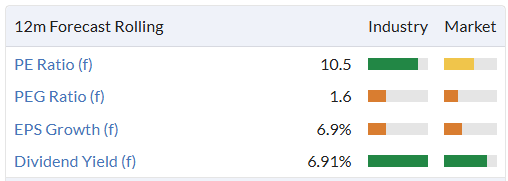
Note the attractive yield, fully paid for from cash flow (at least historically - hopefully 2025 is just as good). And with a buyback coming on top of this yield:
Strategic highlights - they now have 1 million members on SuperSave Club and 35 B2B partners including Auto Trader (LON:AUTO) and Rightmove (LON:RMV) (I hold RMV).
On the customer side, MONY’s plan is to convert customers from “transactional users” into long-term members who voluntarily come back to them without the need to see an ad. Pay-per click costs have risen by an extraordinary 19% in H2 vs. H1.
The Board’s KPIs are all moving in the right direction, except for active users - due to a decline in energy enquiries:
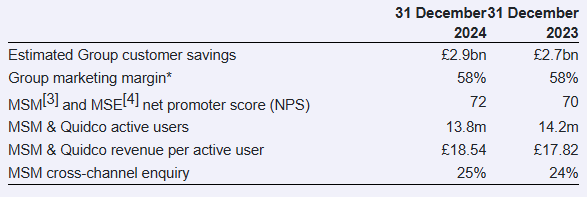
CEO comment:
"We are proud to have helped customers save a record £2.9 billion - the more customers save, the more the Group grows. We've done this by delivering strong performance both operationally and financially in 2024 as we continue to execute on our strategy. This includes encouraging customers to join our member-based propositions like the SuperSaveClub which, in turn, reduces our reliance on increasingly expensive pay-per-click (PPC) marketing….”
Outlook is not the strongest, with 2025 adj. EBITDA to be “broadly” within consensus.
The current 2025 consensus is for adj. EBITDA of £143.1m - £151.7m.
It’s a wide range but we are still very early in the year.
Trends by category: Travel (excluding travel insurance) remains quite weak in the short-term. Thankfully this is the smallest category. The key Insurance segment continues to do ok. It was up 1% year-on-year in Q3, and now it’s up 2% in Q4:
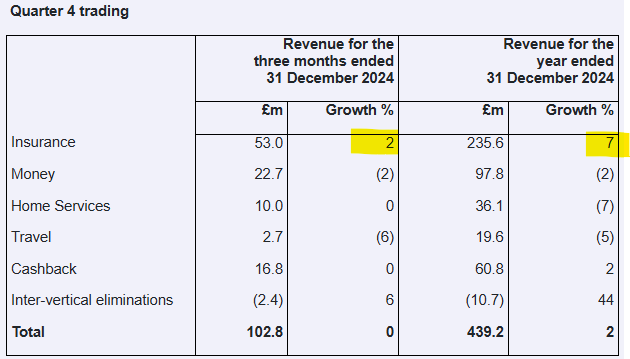
2% growth in Insurance came “despite premium inflation in car and home returning to more normal levels, with travel and life performing particularly well”.
Graham’s view
I remain a big fan of this one.
In December, I picked MONY as one of my 12 Stocks of Christmas. Looking at valuations for Gocompare and Comparethemarket, I concluded that a PER of 15-18x was about right.
MONY has traded at and above that level in the past.
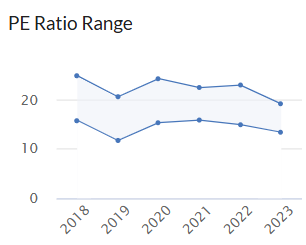
However, it now only trades at 10x.
I think this is just too low.
Top-line growth is admittedly quite pedestrian right now, and the recent surge in advertising costs are a threat. These are the two main detractors to the investment thesis, in my view.
Against that you have a fantastic track record of real profitability, prodigious cash flow, and sizeable market share in a space that is controlled by only a few operators (Comparethemarket being by far the largest of these).
MONY appears to acknowledge the challenges it faces and the strategy of converting users into dependable long-term members makes perfect sense to me.
For me, the positives continue to strongly outweigh the negatives and I can’t consider changing my positive stance on it for now.
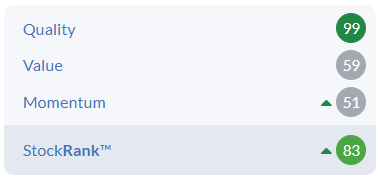
Note the perfect QualityRank of 99:
Assura (LON:AGR)
Up 16% to 45.1p (£1.5bn) - Possible offer for Assura plc - Graham - AMBER/GREEN
At 5.10pm on Friday, this healthcare REIT announced that it had been approached by two parties: the private equity giant KKR, and the investment managers for the UK’s Universities Superannuation Scheme.
It said it was reviewing the proposal.
This morning, we have had announcements from the two parties.
Firstly, the Universities Superannuation Scheme said it did not intend to make an offer for Assura, either as part of a consortium with KKR or otherwise.
KKR has had more to say.
It has explained that it made four proposals to Assura.
The fourth and most recent one (made last week) was a cash offer at 48p per share, which was at a 28% premium to the share price at the time.
However, it was still a small (2.8%) discount to Assura’s Net Tangible Asset value as of Sep 2024 (49.4p). And of course the NTAV may be higher than that now.
KKR reveals that on Saturday, the Board of Assura rejected the 48p bid.
So what next?
KKR is considering whether there is any merit in continuing to try and engage with the Board. There can be no certainty that any firm offer for the Company will be made. A further announcement will be made as and when appropriate.
With the Universities Superannuation Scheme out of the picture, perhaps KKR will not want to go it alone?
Trading update
There’s a company-specific situation, but there’s also a broader point about value in REITs at the moment.
Looking at Assura itself, the first thing I’d say is that if I was on the board of a REIT, I would never sell out for less than TNAV - unless the alternative was bankruptcy.
Secondly, the company had a trading update last month that was very positive. They do have a stretched balance sheet (49% as of the interims), but said they were “on track” to get this below 45% over the next 12-months.
Net debt to EBITDA was 9.7x which in a REIT context I don’t have a big problem with. Valuation against TNAV is what matters to me, and interest cover if the company is indebted.
But Assura is working on its net debt/EBITDA multiple and similarly said that it was on track to get it below 9x over 12-18 months.
There was “positive progress on rent reviews” with a £0.6m uplift, another £35m of rent (20% of rent roll) due to be reviewed in Q1 2025, and a pipeline of projects and opportunities to work on.
On the debt front, the company enjoys an A- rating from Fitch. Net debt was £1.5bn and the weighted interest rate being paid was less than 3%.
Graham’s view
On the basis of that January update, and also the interim results, I don’t see why Assura would be in a rush to sell out at a discount to TNAV.
We have already lost so many UK-listed companies to opportunistic bids. Perhaps REITs will be the next to go. But selling at a discount can’t be right. Perhaps we’ll see a nice gain in TNAV on the March 2025 balance sheet, along with deleveraging progress. So why sell out at a discounted price?
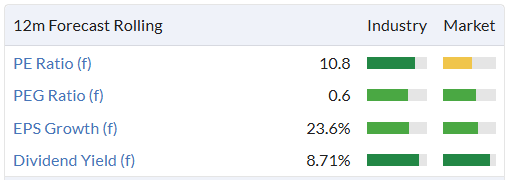
I’ll take an AMBER/GREEN stance on Assura as a gain in its share price from its current level to TNAV would return c. 9.5%. On top of that it offers a yield of nearly 9%:
Assura’s customers - GP surgeries, diagnostic and treatment centres - are, I presume, highly reliable paying tenants who relocate very rarely.
The broader point is that there are opportunities in REITs which, along with many other sectors, appear to offer good value in the current environment. There are dozens of choices in the sector but a quick review of some of the bigger ones gives me SGRO at a P/TNAV of 0.82x, LAND at 0.68x, SHC at 0.7x, HMSO at 0.75x, and GPE at 0.62x.
I haven’t reviewed these individually for debt levels or quality, I’m just pointing out that the sector is in general available at a meaningful discount to TNAV.
Returns from REITS are in theory less exciting than the returns from other equities, but perhaps the risk:reward currently available in the sector might be attractive to some readers. I do think that it’s hard to go far wrong if you find a low-risk REIT at a good discount to TNAV. It won’t offer the upside potential of an operating business, but it will be harder to lose money on it!
Wilmington (LON:WIL)
Down 11% to 328.4p (£296m) - Half-Year Report - Graham - AMBER/GREEN
There have already been some excellent comments in the thread below re: Wilmington. Let’s see if I can add anything.
The company provides “data, information, education and training services in the global Governance, Risk and Compliance (GRC) markets”.
I count 12 subsidiaries - as indicated by readers already, this is a company with many moving parts.
Organic revenue growth is 3%; growth is 16% if you use “ongoing” results - I’m not a huge fan of this word. It sounds like it’s supposed to mean “underlying” but it’s certainly not underlying.
Checking the definition, I see that “ongoing” is defined as:
Ongoing - eliminating the effects of the impact of disposals, closures and businesses held for sale
Whereas organic is defined as:
Organic - Ongoing, eliminating acquisitions and exchange rate fluctuations
So “ongoing” eliminates the effects of disposals, but it doesn’t eliminate the effects of acquisitions. I’d certainly want to avoid the growth rates thrown up by such calculations.
“Ongoing adjusted PBT” is £11.4m, while actual unadjusted PBT is £5.2m. This strikes me as rather a large gap.
There are £5.8m of adjusting items:
Acquisition earn-outs £2m (I guess these must have been categorised by the accountants as a form of remuneration, being tied to the continued employment of the sellers of the acquired businesses?)
Transaction costs £1.3m
Office lease termination due to business disposals £1.4m
Amortisation of intangibles £1.1m
You can make what you will of this. Personally I would not allow all of these adjusting items, or I would at least mark the company down for suffering so many of them.
During the previous financial year, there were over £7m of adjusting items (mostly impairments). So my initial impression is that WIL’s accounts are not very clean.
CEO 's comment says that trading in the current financial year (FY June 2025) is in line with expectations.
"We have delivered another strong financial performance, particularly profitability and earnings. Our margin also continued to improve.
"We have also continued to execute on our strategy of replacing low growth and low margin businesses with scalable high growth, high margin businesses, which are enhancing the quality of the Group.
"We have a notably strong balance sheet which leaves us well placed to continue to invest across the business, in both organic and inorganic opportunities.
Net cash excluding leases is £31m. The balance sheet is mostly goodwill/intangibles but does still have a positive value when you exclude them.
Graham’s view
I’ll downgrade this to AMBER/GREEN as the complexity and the manner in which the company has presented these complex results make me nervous.
On the positive side, the balance sheet is fine and there is organic growth in recurring revenue of 6%, with most of WIL’s total revenues being recurring in nature.
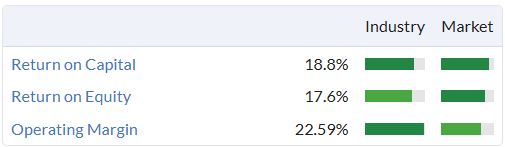
Quantitatively, it earns excellent returns for shareholders:
So I can see that there are some attractions. However, there are many subsidiaries to consider, and it’s rare to find businesses in the training/events space that turned out to be fabulous investments. So I think a moderately positive stance is fair.
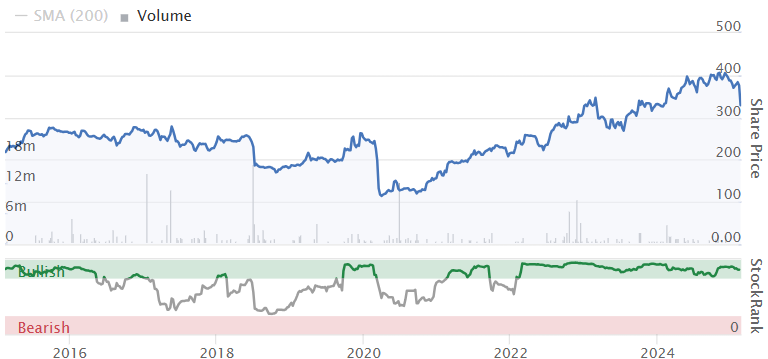
At 15x earnings it’s not particularly cheap, and that is likely to be before the adjustments are accounted for. Actual reported earnings per share were only 2.88p in H1. I may need to downgrade this further to AMBER, the next time I look at it.
Roland's Section
Springfield Properties (LON:SPR)
Up 9.6% to 108p (£128m) - Interim Results & Land Sale - Roland - AMBER/GREEN
Springfield Properties is an AIM-listed small-cap housebuilder that operates in Scotland.
Today’s half-year results highlight a useful improvement in profitability, but are likely to be overshadowed by news of a £64m land sale to FTSE 100 peer Barratt Redrow.
This four-year deal will deliver a significant bump to current year profits and is expected to allow Springfield to eliminate its debt position while tightening its strategic focus on the North of Scotland.
Land sale agreement: Springfield has agreed to sell 2,480 plots of undeveloped land on six sites in Central Scotland to Barratt Redrow (whose results we reviewed last week).
Barratt will pay £64.2m for the land in stages over the next four years. As a result, Springfield expects its results for the current year (y/e 31 May) to be significantly ahead of market expectations.
The £64.2m price agreed with Barratt is uncannily similar to the £62.9m net debt figure reported in Springfield’s half-year results today. The company now says it expects to reach a cash position during its 26/27 financial year.
I’m not sure if it’s cause or consequence, but this land sale will drive a strategic shift that will see Springfield focus more heavily on the North of Scotland:
Following the Land Sale, the Group's strategic growth focus will be on opportunities in the North of Scotland where the Group is uniquely placed to capitalise on the substantial need for new housing to cater for the high population and economic growth expectations in the region. This is being driven by the UK Government-financed green infrastructure development in the North of Scotland.
Springfield specifically mentions power network upgrades and the Inverness and Cromarty Firth Green Freeport as drivers for new housing in the region.
Today’s half-year results indicate that the company had a land bank of 5,797 plots at the end of November, with a further 6,305 under contract.
This land sale was agreed after the half-year period ended, so it appears to represent a 43% reduction in Springfield’s owned land bank and a 20% reduction in its total land pipeline.
As a result, Springfield will become a smaller but more geographically-focused builder. Updated broker notes this morning suggest significant alterations to profit expectations for the next 2-3 years as a result.
Let’s take a look at the interim results for some broader context.
Half-year summary: during the six months to 30 November 2024, Springfield’s new home completions fell by 16% to 361. Management describes this as in line with expectations and reflecting market conditions.
Unsurprisingly, revenue was 13% lower at £105.6m, but the company’s gross margin improved by 3% to 17.7% and operating profit for the period rose by 27% to £6.1m. This was due to several factors:
Completion of legacy affordable housing contracts at the end of the prior yea;r
“Profitable” land sales;
“Sustained focus on cost control”.
However, the company’s normal working capital cycle saw net debt rise from £33.9m at May 24 to £62.9m at the end of November 24. This largely reflects adverse working capital movements of £23m.
This seasonal shift may not be an issue in itself, but one point worth noting is that Springfield’s debt is all contained in an overdraft facility that was originally due to expire in January 2025, before being extended to January 2026.
My feeling is that today’s land sale may have been driven as much by the need to reduce debt as by any strategic considerations. Perhaps refinancing was looking difficult?
Current Trading: the company says that the private housing reservation rate reduced from mid-December but is now improving “following interest rate cuts”.
The outlook is also improving for affordable housing:
Since the Scottish Budget in December 2024, affordable housing providers' confidence has improved and two new contracts have been signed that will commence in the current year
In addition to the Barratt deal announced today, the company is also having “non-binding discussions” regarding further potential sales to Barratt.
Estimates: the outlook in today’s results commentary is limited to an upgrade to current year guidance:
The Group expects to report profit for FY 2025 significantly ahead of market expectations
However, broker notes issued today make it clear that the corollary to today’s news is that profit expectations for future years have fallen.
With thanks to house broker Singer, we have the following updated earnings estimates. I’ve included the last two years’ actual results to provide some context:
FY23A: 10.4p per share
FY24A: 6.8p per share
FY25E: 12.7p per share (previously 8.0p)
FY26E: 8.6p per share (previously 10.0p)
FY27E: 9.1p per share (previously 11.0p)
Singer says these revised 26/27 estimates reflect “reduced scale, combined with a more cautious approach to the pace of recovery”.
Progressive and Equity Development (both paid research) have also both issued similar updated forecasts today. All of these notes are available on Research Tree, but investors without access might not immediately guess at the reduced expectations for FY26 and FY27.
Roland’s view
When we last covered Springfield in July 2024, Paul thought the business looked “attractive value” and went GREEN on the shares.
Is that still true after today’s news? The elimination of net debt is clearly positive, but it seems to be coming at a cost. Springfield is selling over 40% of its current owned land bank. This suggests to me that the company’s management may not have been confident that it could refinance and organically reduce debt to more sustainable levels.
Today’s balance sheet suggests a tangible net asset value of 129p per share. Even after this morning’s gains, the shares are still trading slightly below this level.
However, Springfield’s profitability has been relatively average in recent years, not necessarily justifying a significant premium to book value:
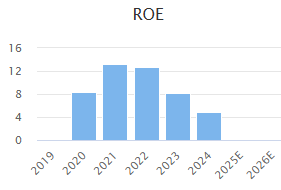
I think Springfield’s position looks more secure following today’s news, but this deleveraging seems to have come at a cost to medium-term earnings prospects.
The remaining discount to book value isn’t large enough to be a significant attraction, in my view, but I do think that broader market conditions are probably starting to improve.
On balance, I’m going to moderate our view to AMBER/GREEN.
Frp Advisory (LON:FRP)
Up 3% to 138.15p (£355m) - Q3 Trading Update - Roland (I hold) - GREEN
At the time of publication, Roland has a long position in FRP.
FRP Advisory Group plc, a leading national specialist business advisory firm, is pleased to announce a trading update for the nine months ended 31 January 2025 and declares its Q3 dividend.
FRP is a member of my rules-based SIF model portfolio here at Stockopedia. Today’s update is short, but makes for pleasant reading, with an upgrade to full-year guidance following a strong third quarter:
FRP is pleased with its performance in the year to date, with trading across each of the five service pillars currently ahead of the Board's expectations.
Management says that this demonstrates the company’s ability to support clients at different stages of the corporate cycle.
To put the strong Q3 in context, FRP reported organic revenue growth of 23% for the first half of its current financial year – Graham reviewed those results here, in December.
At the time, he noted that “Expectations for H2 are very modest so hopefully there is still a good chance of an earnings beat by year-end.” – that’s exactly what’s happened (my bold):
The Group's pipeline and activity levels remain strong, and as such the Board is confident that the Group will deliver results for the year ending 30 April 2025 ("FY 2025") ahead of current market expectations.
Dividend: An interim dividend of 0.95p per share has been declared (Q3 2024: 0.9p). FRP is unusual among UK stocks as it pays a quarterly dividend.
My sums suggest the shares offer a forecast yield of around 3.8%.
Estimates: the company’s broker, Cavendish, has provided updated forecasts today:
FY25E: EPS +2% to 10.8p (prev. 10.6p)
FY26E: EPS +5% to 11.8p (prev. 11.2p)
These numbers price FRP on FY25 forecast P/E of 13, falling to a P/E of 12 in FY26.
Roland’s view
This restructuring specialist has been a good news story for the AIM market since its flotation in March 2020:
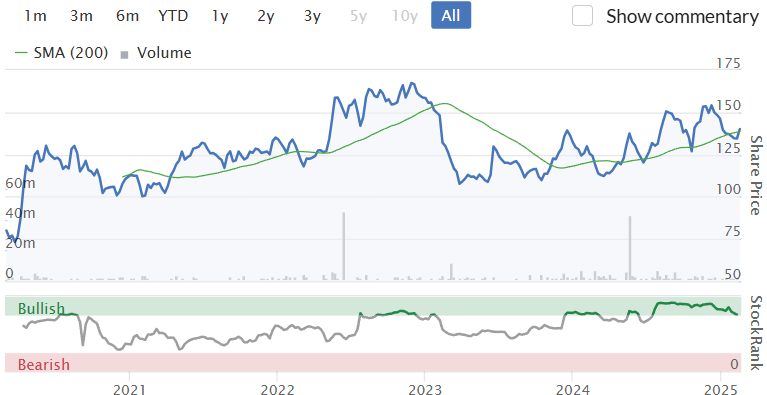
The shares have benefited from a number of broker upgrades over the last 18 months, perhaps providing a good example of the trends Ed has highlighted in his recent articles on earnings upgrades:
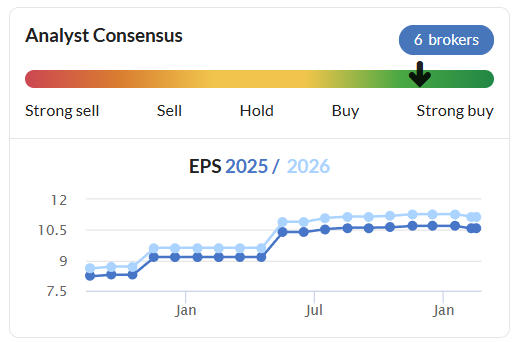
Today’s upgrade appears to provide further support for the growth story. Given the excellent quality metrics and net cash position of this business, the shares still don’t look expensive to me:
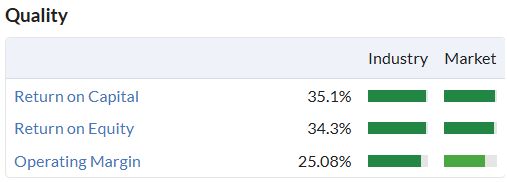
The main risk I can see is that this is an acquisitive, professional services business, where the main assets walk out the door every evening. History tells us that this kind of growth model sometimes comes unravelled, for example if financial discipline weakens, or if external conditions change unexpectedly.
I can’t rule out risks such as these in the future. But there doesn’t seem to be any cause for concern at the moment. Market conditions for restructuring specialists are also expected to remain favourable, due to the pressure on many businesses from higher costs.
I’m going to maintain our GREEN view on this stock, given the undemanding valuation and positive growth outlook.
Disclaimer
This is not financial advice. Our content is intended to be used and must be used for information and education purposes only. Please read our disclaimer and terms and conditions to understand our obligations.

42 comments
Graham, Would you like to expand on ' Could there be a way to arbitrage this?' re your comments on Tekcapital today?
Hi, they say their portfolio is worth ~ £50m, their market cap is £22m. Their portfolio is almost entirely publicly listed, and will be fully listed soon. The arb would be to go long TEK and short the shares in their portfolio in the correct sizes. I don't know if it would work or not, but it's an idea. G
Assura (LON:AGR) - I hold and have just doubled my position at 43.5p, which is 1.5p less than I had paid previously despite the bid.
Either a bid at 50p coming or KKR will walk away and you are left with a 9% yielding share, with the warm knowledge that KKR were quite happy to pay 48p! I think the board are correct to hold out for a bit more / carry on as is. That's the second bid recently for quality discounted asset plays. BBGI being the first.
There is definitely some value plays out there that are attracting attention. I would not be surprised to see a large renewables bid next.
Several REITS have already fallen to bids or amalgamations and it’s very likely more will too. The obvious candidates on very wide discounts get full coverage on the Investment Trust threads, but include Supermarket Income REIT (LON:SUPR) on 22% discount Schroder European Real Estate Investment Trust (LON:SERE) on 35% discount and Warehouse Reit (LON:WHR) on 35% discount.
I’m not convinced by Graham’s comments about bidders paying the full NAV though. EBOX (on a near 40% discount pre bid) which I held fell to a bid well below NAV and around 10% discount from memory. After all what’s in it for the bidder if they pay that very full price?
The good news is that Commercial REITS are past the worst, with Schroder Real Estate Investment Trust (LON:SREI) the latest to report a small NAV rise today. Discounts are still wide though, and dividends often around 8% or even a bit higher. Share prices are off the bottom and will be helped further by more bids (if they come) and falling interest rates (if they happen) and by more REITS confirming that the sector has bottomed now while reporting increases in NAV. It’s certainly a sector well worth checking out while the share prices are still subdued and discounts often wide.
I completely agree with you about Springfield Properties (LON:SPR) , Roland. A bit dubious to spin their full year results as now likely to be 'significantly ahead of expectations' when the reality is that they are giving away future growth to cut debt by selling off a chunk of the land bank. Two thoughts occur to me; 1. You can only pull off this trick so many times before you have nothing left to sell and 2. Would you really focus on the North of the country by choice? Don't get me wrong, I love the Scottish highlands for its stunning scenery but as a house builder you would surely want to focus on Glasgow and Edinburgh. So Barratt Redrow (LON:BTRW) have probably cherry picked the best sites.
Thanks for the section on Springfield Properties (LON:SPR) today, Roland. It's been towards the top of my shortlist for a few months now and I was beginning to kick myself for not dipping my toe in at 90p. But I'm also lukewarm on this deal upon your initial review and now don't feel so bad about missing the 20% move.
Hi Sparker - You may well have a point about Glasgow/Edinburgh but there is also potential in the areas they have mentioned - Cromarty Firth and Inverness which is in their back yard so to speak and where I suspect they have an advantage with far less competition as against the Central Belt
Springfield Properties (LON:SPR) I shall disagree with you if I may sparkler
The land sold today in the Central Belt was sold at 130% of book value, so their definition of ‘highly profitable” sounds accurate to me. It’s been apparent to the company and their shareholders for some time that they needed to reduce their debt and this sale achieves it in one fair swoop.
Re geography, any of the larger house builders can (& do) build in areas like the central belt which increases the competition for labour & resources. Springfield already have considerable infrastructure in the north of Scotland as they originated in Moray & still have their Head Office there. A decent proportion of their remaining land bank is also in the north. This gives them a decent ‘standing start’ with the new areas of opportunity they’ve identified, Green Infrastructure development.
To illustrate the scale of this I found the following, “Scottish and Southern Electricity Networks is investing billions upgrading the electricity network in the region and the project will require some 5,000 workers at its peak in 2027. Meanwhile, Cromarty Firth Green Freeport is expected to create more than 10,000 jobs locally with new investment in excess of £3 billion”. Workers need houses to live in.
Having held Springfield since IPO I suspect that their plans to develop in the north are already well advanced (and that we may see additional land purchases in the area too going forward). I shall continue to watch closely with interest to see if todays deal and renewed focus in the north of Scotland is the right one
No problem, AstonGirl. Healthy debate is what we want on this forum. You clearly know a fair bit about the history of Springfield Properties (LON:SPR) and the company's geographic strengths. I would, however, take issue with a little of what you say. Yes it is encouraging if the land bank is worth more than is shown in the books, but housebuilders make most of their money from building on that land and so when it is sold undeveloped the company is clearly not maximising returns. If this were not the case Barratt Redrow (LON:BTRW) wouldn't see value in buying it!
It is probably a sensible move for Springfield Properties (LON:SPR) to reduce debt that got too high during covid, so I am not criticising this decision per se, just the attempt to spin it as profits upgrade when underlying trading has not improved. Yes?
The level of investment into green energy infrastructure around Inverness is set to be huge. Billions are earmarked to build and connect wind turbines to massive new substations.
Add to this the Freeport’s, both are forecasted to create thousands of jobs and increase the population (12-15k).
Inverness has a population c.46k, Nairn and Forress c.10k each, so taken into context the equivalent of a new town may be required.
The area is served by a rail line (just takes ages to travel along it) and has an airport, both could be scaled up to serve larger populations.
This is Springfield Properties (LON:SPR) back yard, where they will likely have a competitive advantage given their land bank and local connections . They would be well positioned to have a very strong few years on the back of this.
Selling off land to remove debt may prove to be a shrewd move Would being debt free reduce any future working capital costs?
Sign me up.
Haha, it’s a good story but how often have we all been stung by one of those?
Still on the watch list for me for now to see how this starts to play out.
One final thought on MONY: the fact that it's up by 5% today despite only a "broadly" in line outlook must surely say something about the low expectations baked into the price here. G
Any ideas what has perked up Primary Health Properties (LON:PHP) today ?
KKR offer for Assura (LON:AGR) I guess. In much the same business.
It will also be interesting to see what the shorts do on Primary Health Properties (LON:PHP) too on the back of the bid for Assura (LON:AGR), I have never managed to fathom why they were / are short apart from a bond proxy bearish play perhaps?
Thanks for this - I should have worked that out...- though the shorts are indeed a mystery
£WILM H1 numbers. On the surface look fine - reported PBT up 39% to £11.4m. But buried in note 4 is £5.8m of favourable adjustments, the largest of which is £3.3m of "Expense relating to strategic activities". That is a bit of a catch-all! I'm surprised the auditors let that one through.
Doesn't smell right to me.
Wilmington (LON:WIL) I saw that too, Grumpy. Does not look good, H1 is unaudited though, so we have yet to see the auditor's view. I hold - for now.
But the statement will have passed the audit partner's desk before publication.
And just under that note the strategic activities are qualified as £2m earnouts and £1.3m transaction costs Re: Wilmington (LON:WIL)
Wilmington (LON:WIL) - note that the "expense relating to strategic activites" adjustment is a regular occurance in their accounts. The quantum this time is higher, however, probably related to the acquisitions of Astutis and Phoenix Health & Safety.
With acquisitive companies like this trying to unravel the real underlying value is really hard - there's £96 million of intangibles on the balance sheet for a start. They're clearly going to continue buying businesses, so if that makes investors uncomfortable they need to go somewhere else. As a small holding in a highly diversified portfolio I'm happy to hold here, but if you want this as a conviction holding you'd need to do a lot more work than I do to satisfy yourselves.
In the meantime the heavy adjustments - adjusted PBT of £11.4m versus statutory of £5.2m are either evidence that something is amiss or that they're buying and growing rapidly. Or both. Either way the market is indicating a certain lack of confidence today, although given how febrile markets are, particularly where there are lots of private investors holding, that may not indicate any very much.
Tricky stuff, investing.
timarr
I think the big problem here, timarr, is that Wilmington (LON:WIL) are 'buying and shrinking'. By this I mean that they have offloaded a lower margin business for an unattractive price (including a lot of deferred consideration) and replaced it with expensive acquisitions with small revenues. Yes, the business quality and operating margins improve but at a cost.
The figures are presented to show nice 'growth' in 'ongoing businesses' of 16% (albeit only 3% organic) but the reality is that total revenue was £123m in 2019, £121m in 2022 and forecast £107m in 2025. I also note that they will have to go some to make that number as the first half revenue was only £45m ( although they will get a full half-year contribution from the business acquired in October).
I like Wilmington (LON:WIL) quite a lot, but I sold out just after the latest deals because of the short-term dilution and stretched valuation.
I like Wilmington (LON:WIL) quite a lot, but I sold out just after the latest deals because of the short-term dilution and stretched valuation.
Fair enough, I think. To hold here at any size you need quite a lot of faith in the management. And on that note the fact that there haven't been any recent director purchases (the opposite if anything) is concerning.
timarr
Just wanted to do a quick shout out for MONY (LON:MONY) post its finals. I hold so am biased but to my mind this looks incredibly cheap at the current share price. Decent double digit margins all the way down the P&L. 12.4x P/E. 12.4% OpFCF Yield (so EBITDA - Capex). Strong ROCE. Net cash balance sheet. You have a 6.6% dividend yield. Plus with the announced £30m buyback (which is equivalent 3% of market cap) you are getting an almost 10% shareholder return. This is a cash machine. The fly in the ointment is obviously the pedestrian growth and competitive sector. Still, money saving in the current squeezed environment is not going out of fashion. And if they can just stand still and interest rates do continue to decline as forecast, this just feels mispriced (like so many stocks on the LSE) given the annual return available. If no rerating happens I could easily see a mid cap PE swoop in, take it off market, lever it up, massively reduce the tax paid through the interest shield and enjoy a decent double digit annual return. Anyway just my 2 cents. If the team get a chance to review would be very interested to hear their thoughts. Cheers
MONY (LON:MONY)
Yep, looks very cheap at these levels. It's quite complex, and as one vertical does well another drops off - e.g account switching will decline as interest rates drop.
At a quick glance the main driver of PBT increases is cost reductions as their investment program slows down, but the need to invest in technology is not likely to seriously decline. The other area of interest are their member programs, where they have direct marketing channels to customers, rather than paying for expensive third-party engagement. These seem to be gaining traction, which will improve margins.
Despite the jump today it's undeniably cheap. Low growth rates, high interest rates and general lack of interest in mid-sized UK stocks are all at work. There's no obvious dramatic driver for a re-rating, bar an acquistion, but you'd expect it to gently float up if markets continue to rise.
And, of course, there's now the inevitable buyback program ...
timarr
Hi Tim do you prefer MONY (LON:MONY) over Pets at Home (LON:PETS) ?
Regards
Andy
Hi TP
Hi Tim do you prefer MONY (LON:MONY) over Pets at Home (LON:PETS) ?
I hold both in about the same amounts. Overall I don't think MONY is going to shoot any lights out but it does seem to be unjustifably cheap (although so is half the UKmarket).
PETS, on the other hand, has been marked down for well understood reasons - the CMA enquiry, employer NI constribution rises and a slowdown in consumer spending. It's hard to argue that the price is very wrong. On the other hand the opportunity for a re-rating is obvious and, in particular, the slowdown is probably temporary both in terms of current consumer behaviour and the pandemic era cohort of pets aging.
So - short term I'd prefer MONY, but longer term PETS. I'll likely top-up the former when I get some cash and if I can convince myself the CMA investigation is unlikely to impact the latter I'd probably do the same there - but I've always found regulatory involvement takes longer to resolve and is more painful than you'd expect.
timarr
Thanks Tim both come up on my quality garp screen but my interest is always piqued when I see yourself or one of the other top table posters commenting on some of the stocks the screen throws up.
Good to see you posting here more regularly especially as sadly it seems a lot of other good posters seem to have departed with Paul S.
Regards
Andy
Phil, couldn't agree more, and I've covered MONY first today as it's a stock I really like to follow, and was keen to update after pitching it over Christmas. All the best. G
Thanks Graham for the detailed write up! Nice to see you also remain positive on MONY (LON:MONY) . And ditto even Mr Market seems pleased… for once….
Sorry, AGR is on 17% discount
Assura
the bid for Assura @23% premium indicates how undervalued the real estate shares are in UK markets.
AGR, has secured rents, well managed and still on 27% discount.
Recent directors buy was a good signal.
Watch out for Spire !
Whilst the bid is a premium to Friday's closing share price, it's basically 0% premium to NTA.
My natural assumption is that if KKR wants to buy you, their offer price, somehow, is far too low. These are very savvy folk and there will be something in your company that is far too undervalued. Assura (LON:AGR) has always looked unusual, with the NHS (i.e. us taxpayers) backing the payment of rent making the risks at UK bond level compared to the market rate that they charge to the doctors. For companies such as KKR, which may want to up the gearing against a reliable income stream, this is catnip.
Absolutely, Aislabie, there is no good reason for a Board to agree to give a company to PE at a discounted price. Even if it is KKR's 4th bid, we can assume that the 1st bid was just a test, to see how the Board would react and to open lines of communication. The 4th bid might be the actual bid.
Graham.
Have you taken in to account that Assura (LON:AGR) is a real estate investment Trust where NAV is a crucial factor, and not a Company where NAV isn’t?
Your comments about “no good reason for a Board to agree to give a company to PE at a discounted price,” would make total sense for a share (e.g a housebuilder trading at less than NAV) but doesn’t for an Investment Trust.
See topvest’s post to see that there might be another 2p or so if KKR are prepared to go that high. Note that other successful bids for Real Estate Investment Trusts have been successful at a small discount to NAV. e.g the EBOX example in my post earlier today.
Can you explain please why you think Assura (LON:AGR) is an exception and deserves to be sold for more than it is worth, and what would be in it for any bidder for any REIT prepared to pay more than NAV?
Ken, yes I'm valuing it according to NAV. Assura's tenants seem higher-quality than the average REIT's tenants, and the NAV being used is the Sep 2024 calculation which will soon be superseded by the March 2025 calculation. If Assura's shareholders want to let it go that's up to them, but I wouldn't be feeling charitable towards the likes of KKR - I'd want them to pay as close to full price as possible. That may only be another 2p but I think they should pay it! Just my two pence. All the best (and thanks for the comments). G
Fevertree Drinks (LON:FEVR)
Commencement of share buyback programme
Fever-Tree today announces the commencement of a share buyback programme regarding the purchase of ordinary shares in the Company with a nominal value of 0.25 pence each (the "Shares") up to a maximum consideration of £71 million (the "Programme").
Fever-Tree previously announced its intention to commence the Programme on 30 January 2025, alongside the announcement its strategic partnership with Molson Coors for the exclusive sales, distribution and production of the Fever-Tree brand in the US.
Fever-Tree has entered into a non-discretionary agreement with Investec Bank plc ("Investec") to purchase Shares on its behalf and to make trading decisions independently of the Company. The Programme will commence today, 17 February 2025, and end no later than 30 September 2025. The sole purpose of the Programme is to reduce the share capital of Fever-Tree. As such, the Company intends to cancel any Shares purchased.
Possibly relevant to Yellow Cake (LON:YCA) and other Uranium stocks. I hold.
US and European energy groups at risk from uranium supply crunch
https://www.ft.com/content/d0f...
Behind a pay wall.
Not sure why Yellow Cake (LON:YCA) is so cheap at the moment.
Here's the full article:
https://archive.ph/NIKBs