Daily Stock Market Report (Mon 9th March 2026) - CKN, NRR, KETL, SAA

Good morning! I hope you had a good weekend.
Overnight action is fairly dire in the major indices:
- FTSE futures are down 1%
- S&P 500 futures are gapping lower and currently down 1.6%
- EURO STOXX 50 down 2.9%
US oil futures are up $12 at $102.50, while Brent crude is up $14 at $107.
It looks set to be another dramatic week as financial markets digest the impact of the ongoing conflict in the Middle East.
8am update: The FTSE is opening down 1.2%. Reuters reported yesterday that "Iraqi oil production from its main southern oilfields has fallen by 70% to just 1.3 million barrels per day as the country is unable to export oil via the Strait of Hormuz due to the Iran war, three industry sources said on Sunday." Perhaps it's prudent to assume that this situation is going to persist for some time?
We're finished for today, thank you. Spreadsheet accompanying this report: link.
Companies Reporting
| Name (Mkt Cap) | RNS | Summary | Our view (Author) |
|---|---|---|---|
GSK (LON:GSK) (£83bn | SR92) | Alfasigma will acquire worldwide exclusive rights to develop, manufacture and commercialise linerixibat, which is being developed as a treatment for cholestatic pruritus in primary biliary cholangitis. GSK will receive $300m upfront, plus up to $390m for various regulatory and sales milestones. GSK will also receive “tiered double-digit royalties”. | ||
Pan African Resources (LON:PAF) (£3.2bn | SR72) | PAF will acquire ASX-listed gold explorer Emmerson for £163m or 0.1493 new PAF shares for each Emmerson share. Deal will allow consolidation of Tennant Creek JV project (75% PAF/25% Emmerson). PAF will apply for ASX listing. | ||
Clarkson (LON:CKN) (£1.36bn | SR82) | Revenue down 5%, adj pre-tax profit down 21% to £90.6m, in line with expectations. | AMBER/GREEN = (Roland - I hold) Today’s results show the expected decline in profits last year. This was mainly caused by a difficult H1, when US tariffs caused widespread disruption. H2 was much stronger, despite disruption caused by Russia-related sanctions. Clarkson’s profit metrics were slightly weaker than usual last year, but the broking division’s forward order book has expanded and the Financial and Research divisions both made strong contributions last year. Broker forecasts are upgraded for the second time in three months today. In this context, I think the valuation remains reasonable and in keeping with Stockopedia’s High Flyer styling, so I’m leaving my broadly positive view unchanged. | |
Newriver Reit (LON:NRR) (£327m | SR70) | Completed sale of Cuckoo Bridge Retail Park to institutional investor for £26.5m, reflecting a net initial yield of 6.9%, “an excellent outcome in southwest Scotland”. Now completed £100m of disposals in FY26, in line with book value. Proceeds will reduce LTV to “close to” medium-term target of <40%. | AMBER/GREEN (Roland) [no section below] Today’s update seems encouraging although management doesn’t specifically say that this disposal was in line with book value, leading me to think it may have been slightly below. However, £110m of recent disposals collectively in line with book value does not seem a bad result. While the company’s comment about the sale being a good result for the region flags up the challenge of owning retail property in non-prime areas of the UK, portfolio occupancy of 96.1% (reported in January) does not seem a bad situation to me. Management suggests this sale will reduce leverage towards its target of 40%, but LTV was reported at 42.3% in September. This suggests to me that any benefit to leverage from this disposal is relatively modest. NewRiver currently trades at a c.25% discount to NAV. Broker forecasts suggest the 9% dividend yield should be covered by cash flows this year. I think it’s fair to take a broadly positive view, with the caveat that I’d want to do some further research into the remaining portfolio before considering an investment. | |
Ferrexpo (LON:FXPO) (£301m | SR67) | Following suspension on 20 Jan 26, improved electricity supply has allowed production to restart at FPM. One pellet line is currently in operation, FXPO is using its own rail wagons to export to Eastern & Central Europe. The ability to make payments outside Ukraine is currently limited due to the liquidation of the group’s Swiss bank. Other issues are complicating the appointment of a replacement bank. Due to this, “there is a risk of material negative consequences for the Group”. | ||
Kitwave (LON:KITW) (£246m | SR98) | Cash consideration to be paid by buyers will now be funded by a combination of equity from the OEP Funds and new debt facilities, rather than wholly with equity from OEP Funds. | PINK | |
Kenmare Resources (LON:KMR) (£226m | SR47) | Tax authority in Mozambique is seeking to impose “updated terms” on Kenmare that would effectively increase the group’s tax burden and working capital requirements and might also complicate its offshore banking situation. Changes had previously been under negotiation for a more incremental solution. | ||
AdvancedAdvT (LON:ADVT) (£219m | SR31) | AdvancedAdvT chairperson Vin Murria has been appointed to the board of M&C Saatchi as non-exec deputy chair. AdvancedAdvT does not intend to make an offer for M&C Saatchi. | ||
Mkango Resources (LON:MKA) (£194m | SR20) | Mkango subsidiary HyProMag has commissioned a second automated hard disk drive pre-processing unit in the UK with the potential to process more than 30,000 HDDs per week. Magnets will be separated and sold for precious metals recovery. | ||
KEFI Gold and Copper (LON:KEFI) (£173m | SR35) | All the Tulu Kapi Project physical activities and associated financing arrangements are flowing in accordance with the schedule for first gold pour in early 2028 and full production by mid-2028. | ||
M&C Saatchi (LON:SAA) (£146m | SR58) | SP +5% By mutual agreement the CEO is stepping down from 31st March 2026. Vin Murria (major shareholder) appointed NED and Deputy Chair. The Chair becomes Exec Chair. | AMBER = (Graham) This advertising agency issued a profit warning last November before following it up with an "in line" update in January. That more recent update confirmed net cash of £13m at the end of 2025, having increased over the H2 period - and the net cash position is the main reason I'm not more bearish on this stock. Today we learn that Vin Murria is taking a more hands-on approach to this company, where both she and her corporate vehicle AdvancedAdvT (LON:ADVT) are major shareholders. She will be a NED, while the existing non-Exec Chair will become Exec Chair. It's a significant shakeup and I can't argue that it's a bad idea, considering the extent to which profit forecasts have been slashed here over the past six months. The 2026 EPS forecast, previously 23.4p, is now just 14.6p. While I admire the energy that's being applied to fix the company's problems, I believe it's probably still too soon for me to upgrade our stance. | |
Strix (LON:KETL) (£107m | SR93) | The Group now expects to generate revenue of c.£150 million and adjusted profit before tax in the range of £9.8 million to 10.2 million for the financial period ending 31 March 2026 ("FY26"). | BLACK (RED =) (Graham) | |
Aurrigo International (LON:AURR) (£78m | SR37) | £6.28m contract with Ultra Global Limited, the developer of personal rapid transit systems, to design and manufacture an initial quantity of 25 autonomous guided vehicles for use in airport and passenger transit settings in the UK. Ultra Global is owned by Aurrigo’s largest shareholder. | ||
Helix Exploration (LON:HEX) (£61m | SR16) | Helix has executed a lease agreement for a high-pressure jumbo tube trailer, “marking a key operational milestone for the Company.” The trailer has a service capacity of 156,300 standard cubic feet of compressed helium, providing the Company with dedicated helium transport capability. | ||
Cobra Resources (LON:COBR) (£47m | SR13) | Results from 4 of 18 recently completed Reverse Circulation drill holes from Blue Rose, a copper-gold-molybdenum prospect within the Manna Hill Copper Project (South Australia). “Cobra considers that these results validate the potential of the Manna Hill Copper Project.” | ||
Tekmar (LON:TGP) (£13m | SR69) | FY25 revenue of £28.7m (FY24: £32.8m) and Adjusted EBITDA of £0.1m (FY24: 1.7m) is in line with market expectations. FY26: “continued positive business momentum… has yielded £43m of new orders since 1 July 2025 and a current record order book of £40.7m.” The Board expects H1 2026 to be ahead of H1 2025 and full year performance to be in line with current market forecasts. | ||
Cordel (LON:CRDL) (£11m | SR18) | Further upgrade of its contract with Genesee & Wyoming Inc. , owner and lessor of more than 100 short line and regional freight railroads in North America. The contract has been further extended to cover 7 regional sub-divisions across the G&W Canadian division. |
Graham's Section
Strix (LON:KETL)
Down 12% at 41.5p (£94m) - Review of Last Six Months and Trading Update - Graham - BLACK (RED =)
Strix Group Plc (AIM:KETL), the global leader in the design, manufacture and supply of kettle safety controls and other components and devices involving water heating and temperature control, steam management and water filtration, announces a trading update, cost optimisation programme and CEO update.
It took me quite a while to decipher this trading update first thing this morning,
There has been a change of accounting date here, announced in September, which means that we now have a 15-month financial “period” rather than a financial year.
I’m generally suspicious of changes to financial year-ends, and the fact that Strix is doing one is not going to change that.
In my mind, changes to financial year-ends are most often associated with companies that are performing badly, and where the straight presentation of their financial results will not do them any favours.
In September, Strix said:
The Audit Committee has reviewed the date of the Group's financial year end and, to align better with industry cycles, especially around the key holiday season sales, as well as to allow Strix to integrate industry insights gained from attending the Canton Fair in April and October into its forecasting, the Company intends to change its accounting reference date and financial year end from 31 December to 31 March.
I can accept it more easily when a company is in a very early stage of its development, and is still setting itself up. But Strix was founded in 1951 (as “Castletown Thermostats”). It has evolved over the years but kettle safety controls are still its core business and it should already be aligned with the relevant industry cycles, if that is something that is really necessary. So I’m afraid I simply do not buy the reason given for the change in accounting year-end.
With that out of the way, let’s try to decipher the rest of this update.
Debt reduction
They remind us of the recent £105m disposal of Billi, which has enabled massive debt reduction.
Net debt at the prior interim results (to June) had been £69m. Net cash on completion of the Billi disposal was £35m. They subsequently launched a £10m share buyback programme (average purchase price so far: 48.7p).
Inventory reduction: they achieved their targeted £8m inventory reduction ahead of schedule, by 31 December 2025.
Rising commodity prices: in response to the rising cost of copper and silver, they raised their product prices and reduced capacity in order to forward fund these costs.
Therefore apart from the outflow caused by the £10m buyback, we should see an incredibly strong full-year cash flow statement, with various cash-generating activities happening on top of the Billi disposal.
Current trading: I had to read this section a few times, and I still think it’s very unintuitive.
Whilst market conditions remain challenging, Strix is encouraged to report that the early indications of post-tariff improvement in the Controls division that it experienced in Q425 have continued to build in early 2026. With trading volumes, most notably in the lower margin, less regulated markets to date, and order books for March, now holding at consistently higher levels than the Group saw in Q125.
However, what the Group has not experienced to date, is any anticipated catch-up of volumes lost over the course of 2025, particularly in the regulated markets, which it had previously anticipated to come through in the run-up to the busier April to June production period. Alongside this, the Board has made the commercial decision to reduce seasonal promotional activity in the final quarter…
So trading volumes are holding at consistently higher levels than they saw in Q1 2025, but at the same time they haven’t seen the recovery of volumes lost over the course of 2025?
It might be entirely my fault for having difficulty comprehending this, but I think it is poorly written
I think the plain English explanation may be that trading volumes are up in less regulated markets, and down in more regulated markets.
In any case, this update is most definitely a profit warning:
As a result of the above, the Group now expects to generate revenue of c.£150 million and adjusted profit before tax in the range of £9.8 million to 10.2 million for the financial period ending 31 March 2026 ("FY26").
CEO search: their existing CEO is stepping down in May, and they continue to search for a new one.
Estimates
Thanks to Equity Development for publishing on this today. Their changes to key estimates are as follows:
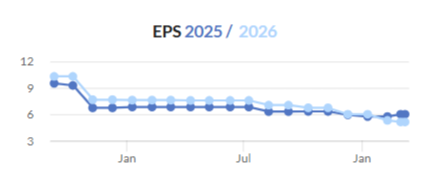
15-month period to March 2026: revenue £148.5m (previous estimate: £152.5m), adj. PBT £9.8m (previous estimate: £12.1m).
FY March 2027: revenue £93.5m (previous estimate: £97.5m), adj. PBT £6m (previous estimate: £9.3m).
Fortunately, the company is still expected to have net cash of close to £30m at the end of each period. The new estimate for FY March 2027 is that they will finish with net cash of £28m.
Looking beyond then, hopes for improvement performance include the potential for a contract manufacturing relationship with Billi, the adoption of next generation kettle controls, and widened use of these controls beyond just kettles to other small appliances.
Graham’s view
My main reason for caution here - the atrocious balance sheet - is no longer valid, with the company now sitting on a healthy cash balance.
However, this is still a pretty serious profit warning from Strix today. So I’m going to have to stay negative for the time being.
Looking ahead, assuming that trading stabilises, are there grounds for optimism? It could be argued that the current enterprise value (about £60-65m) is perhaps a little “cheap” against forecast PBT of £6m.
Personally, I don’t see it: there have been too many disappointments here over the years. Fundamentally, I no longer have faith in the value of the IP: I originally thought that Strix’s long-standing patents and market share implied that it was a quality company, but its actual performance has not borne this out.
I also think the CEO situation raises questions - it will be interesting to see who they appoint.
Having said all of that, I probably will upgrade this back to AMBER or AMBER/RED, whenever trading stabilises, as it’s no longer in a debt emergency.
Roland's Section
Clarkson (LON:CKN)
Up 1% at 4,435p (£1.37bn) - Preliminary Results - Roland - AMBER/GREEN =
(At the time of publication, Roland had a long position in CKN)
Clarkson is not as directly exposed to events in the Middle East as oil and gas producers, but it’s still very closely involved.
From offices in 25 countries on six continents, we play a vital intermediary role in the movement of the majority of commodities around the world.
As the world’s largest shipbroker (founded in 1852), it will be heavily involved in reshaping global tanker shipping flows (and rates) resulting from the near-closure of the Strait of Hormuz. Clarkson will also be exposed to any other second-order effects the conflict may have on global trade flows.
These come in addition to the existing disruption caused by sanctions relating to Russia. Clarkson notes that “nearly 1,000 vessels in the global tanker fleet” are currently sanctioned.
While these complex global conditions will keep Clarkson’s brokers busy, they are likely to be favourable for the group’s high-margin data business, which contributed around 10% of group profits last year.
The company cut profit forecasts early last year when President Trump’s tariff shock hit markets. But forecasts have stabilised and edged higher since then, with Clarkson’s most recent update upgrading guidance.
Today’s results appear to be in line with revised guidance for 2025 and have prompted a further, more substantial upgrade from broker Panmure Liberum.
Let’s take a look at today’s results and commentary.
2025 results summary
Profits were expected to fall this year so today’s 2% drop in earnings was not a surprise.
Revenue down 5% to £631.4m.
Underlying pre-tax profit down 21% to £90.6m.
Reported pre-tax profit down 23% to £86.7m.
Adjusted earnings per share down 21% to 225.8p.
Dividend up 3% to 112p per share.
Free cash resources up 7% to £232m.
Forward Order Book for invoicing in 2026 up 6% to $244m.
Commentary from chair Laurence Hollingworth suggests that 2025 was a year of two halves:
… the first half of the year [was] marked by significant political shifts, escalating tariff regimes, and the increase in use of sanctions by government authorities. These dynamics created a period of significantly reduced activity across many industries, with companies facing unprecedented challenges in decision-making and market engagement.
Conditions stabilised during the second half:
Despite these headwinds, the second half of the year started to see renewed momentum. Market sentiment improved, and businesses began to move beyond the earlier standstill, as larger players actively re-engaged in transactions and Clarksons supported its clients through turbulent times.
Profitability & Cash Generation: despite the somewhat mixed trading environment, Clarkson’s quality metrics remained fairly good last year, albeit below 2024 levels:
Operating margin: 12% (FY24: 14.9%).
Return on Capital Employed: 13% (FY24: 18.2%).
Return on Equity: 13% (FY24: 18.0%).
Free cash flow for the year fell to around £56m by my calculations (FY24: £108m), due to some large adverse movements in receivables. However, stripping these out suggests a more neutral picture to me.
This view is supported by the 7% increase in the company’s measure of net cash, free cash resources, which rose to £232m last year. This is defined as net cash including amounts held as short-term investments, but excluding cash reserved for bonus payments or regulatory reasons.
As critics often comment, bonus payments are significant in this business, in line with normal practice in the shipbroking sector. The amount reserved for bonuses at the end of last year fell from £249.6m to £211.1m.
Segmental commentary
Broking (operating profit £93.9m (2024: £122.6m)): this is the core of Clarkson’s business. It matches ships with freight, is active in the commodity derivatives market and plays a major role in the sale and purchase market for ships.
Broking is inescapably cyclical, but also benefits from the diversification benefit of operating in all major shipping segments.
CEO Andi Case notes that the business strengthened its capabilities in a number of growing markets last year, including South America. The company also acquired a business specialising in “fulfilling freight contracts with US government agencies”, which seems a timely deal.
While last year was disappointing in terms of profit, I don’t see too much to worry about on a longer view – this business is deeply embedded into the global shipping market (my bold):
Our continued investment in all areas of broking is underpinned by its robust performance across market-cycles and by the strength of our forward order book ('FOB'), which now extends for almost 20 years and provides substantial visibility over future earnings.
Financial (operating profit: 12.9m (2024: £5.2m)): this business enjoyed a strong year, offsetting some of the weakness in broking. Management note “an increasingly active capital markets environment”, with “particularly strong” trading in debt markets.
Support (operating profit: £4.8m (2024: £7.7m)): this business provides support services such as Agency services and support services for the offshore energy sector. Disruption to Suez Canal traffic and delays in offshore wind projects held back performance during the year, resulting in lower profit.
Research (operating profit: £10.5m (2024: £9.5m)): Clarkson’s data and research unit saw recurring revenue rise by 15% last year to represent 91% of total sales of £27.2m.
This business generated an operating margin of 39% last year and saw profits rise by 12%, highlighting the quality of the service and the value of the company’s “wide-ranging proprietary database and [...] constant flow of market-leading insights”.
Management say AI is “being leveraged in a balanced way” and emphasises that its technology already includes a high level of sophisticated processing and proprietary algorithms. I don’t see generic AI as a threat to this business due to Clarkson’s proprietary data and deep sector knowledge, neither of which is likely to be generally available to would-be competitors.
Outlook & Estimates
In the year to date, momentum from Q4 2025 has continued, market sentiment has been positive and trading has been good, evidenced by new spot business negotiated being higher than the same period last year.
With thanks to broker Panmure Liberum, we have access to an updated note on Research Tree today.
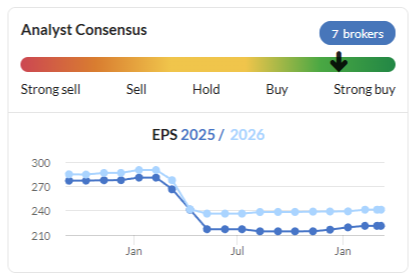
After a modest upgrade in January, Panmure has upgraded forecasts again, largely to reflect the strong result from the Financial business in 2025:
FY25 actual adj EPS: 225.8p
FY26E adj EPS: 257.8p (+7% vs prev. 241.9p)
FY27E adj EPS: 295.2p (+5% vs prev. 280.4p)
These estimates put Clarkson on a forward P/E of 17, falling to 15x for 2027.
Roland’s view
Clarkson is one of my largest personal holdings and a long-term position for me, so I am naturally biased.
That said, I like this business for the exposure it provides to global trade, shipping and commodity markets and for its long track record as a market leader.
The company has a strong balance sheet and a strong dividend history, with 2025 marking the 23rd consecutive year of dividend growth.
While critics point to the high level of remuneration enjoyed by CEO Andi Case and his brokers, my impression is that this is consistent with the wider shipbroking sector and has not prevented shareholders enjoying above-average returns over the last 20 years:
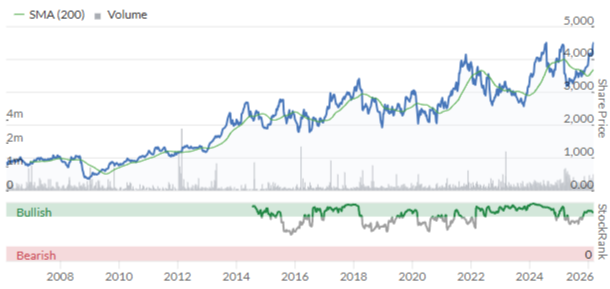
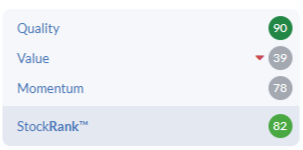
Clarkson shares aren’t as cheap as they have been at certain times in the last few years, but the valuation still looks reasonable to me on a long-term view. The StockRanks appear to concur, with High Flyer status and a notably high QualityRank.
I’m leaving my previous AMBER/GREEN view unchanged today.
Disclaimer
This is not financial advice. Our content is intended to be used and must be used for information and education purposes only. Please read our disclaimer and terms and conditions to understand our obligations.

55 comments
One thing to be aware with on Newriver Reit (LON:NRR) is that the average cost of their debt is quite low at 3.5% but the average maturity is only a couple of years. This means they may need to refinance at a much higher rate (I'd imagine at least 5.5%) in the next 2 years. Given their LTV is still quite high (over 40%) I fear that higher interest costs could eat into their cashflows and reduce dividend cover - I've not done the detailed calculations on this but I'd want to look at this closely before investing.
I posted this in Feb's Investment Trust discussion board " The active turnover of the portfolio does support the NAV, so the discount is strange. Share buybacks will further increase the NAV per share. There is the £300m loan at 3.5% to be re-financed by 2028. The company have said they will start the refinancing in 2026 so should avoid being under pressure. A takeover must be a possibility given the consolidation in the REIT sector. The business rate reforms will in theory make the rents more secure as tenants will see around a 10% reduction in rates."
I read the obtuse outlook statement from Strix (LON:KETL) as either one of two ways.
They're lost last year's volume forever. They don't say why. It probably is only one of two things.
(1) Kettle demand is down, and never to recover. Doubt that. Did everyone just stop wanting a kettle?
(2) They have competition, so the business went elsewhere. But Strix do not want to admit that to investors.
Caveat is that I would say my knowledge of Strix is surface-level rather than deep, so maybe I've missed something (eg kettle controls are now a tiny part of their business and I'm wrong above).
As it is actually a fairly quiet day for corporate news, I wanted to just circle back round and take another look at Vistry (LON:VTY) post their poorly received results last week. I was looking at the discount to tangible book value and thinking that value might be emerging after the heavy fall on the day and a further £1 drop since then. However there was one thing that made me do a double take. Net debt had fallen to £144m from £180m the previous year, but accompanying that was the admission that average daily debt had risen to £734m from £698m. What? I get it that debt levels will move around during a reporting period but a £590m difference between average daily debt and the year end figure?!!!
I would love to hear an explanation of this. Mark only briefly alluded to it in his write-up, but it strikes me as significant. It might be that the company simply converts a lot of housing stock into cash near each year end, but equally this could be more of a 'window dressing' exercise that flatters the debt position and hence the true enterprise value of the Group. Can anyone with more of an accounting background shed some light? I have seen a big divergence in the Contracting and Construction sector between average debt and year end position, presumably because lots of working capital can be tied up on long-term contracts before final payment is released. However, I would have assumed that with housebuilding the cashflows are smaller and less lumpy?
"Net debt had fallen to £144m from £180m the previous year, but accompanying that was the admission that average daily debt had risen to £734m from £698m. What? I get it that debt levels will move around during a reporting period but a £590m difference between average daily debt and the year end figure?!!!
I would love to hear an explanation of this"
Yes these figures can differ - but to get a answer that is informative and relevant you might be better to ask the company directly. Then you could decide if this is a normal level for the company or if there is something else to be concerned about.
Various reports suggest tat Bovis is having to reduce prices to get sales away, which could be an issue...
https://www.pressreader.com/uk...
I dont hold Vistry, but follow the House Building and Construction sector. Vistry is not a stock that I would consider.
My quips for what they are worth, first of all good to see some of the forum's big guns out with some words of calming common sense today. I work in wealth management and there's 4-5 people who have commented below who I view as in the top 1% of sensible investors.
Point two is it worth buying and holding a vix etf hedged to gbp for say 5% of one's portfolio or is this the kind of investment your guaranteed to loose on over time ?
Third thing I've been musing if this does drag on and the straight is still closed I wonder if the UK, Europe and Japan will be forced to send ships to the straight to try and help get oil/gas tankers out into the wider world rather than seeing their economies burn to the ground.
Interested in any replies good or bad and again thanks to the top table for adding huge value to this board.
M.E producers storage now full, so they've shut down production. Will take time to restart.
Iran now minting it by being the only country shipping oil out of that Straight. With the current high oil price. Funding more missles. Can't see Trump standing by and letting that happen, so maybe we'll see a tanker carrying Iranian crude blow up in the Straight? That will further cause oil prices to spike, if no more Iranian output either.
Heard same Boon. My source telling ME producers are now capping their refineries and storage. They just cannot shift the stuff. It will take time to restart even after cessation of hostilities.
Plenty of non‑Chinese vessels are spoofing Chinese identities to slip through, but that trick won’t hold up for long.
Point 2 seems a fair enough question doesn't it but VIX is notoriously difficult to trade - especially long. It trades as a future and you have issues round money lost in the roll....plus the future months often trade at premium to spot anyway. Some funds use long option premium as a proxy for volatility with some success. I would say investors who do look at this see it as a very short term trade, they put it on and sell on a spike like today. Over the last 20 years buy and hold Vix has been an easy way to lose money. Buying 1 year putt options on the S&P 500 is probably a better hedge but also has its own risks. Whenever I have looked at these alternatives though I have always concluded selling futures works best.
I am surprised to hear a wealth manager would consider buying a VIX ETF. This simply isnt in their repertoire of suitable investments. But I am happy to be told why I am wrong on this?
To be fair Grout I work in wealth management but I'm not a fund manager myself although I have access to plenty of fund managers from different groups if needed.
RD's knowledge is way above my pay grade I was reasonably sure Vix long term was a losing proposition due to the need to constantly role over contracts. Funds, ETFS and Investment Trusts I have a very good handle on but the more exotic stuff like options, vix, puts is out of my knowledge base other than a general broad brush understanding.
Join us tonight for an excellent line up of speakers, company presentations and our popular BASH returns: https://www.melloevents.com/mm090326
I appreciate the markets are horrible today but we have so much to enjoy that is positive so do join us on Monday evening from 5pm. Judith MacKenzie is up first with an interview on her current market insights. Three companies join us to with management presenting results updates and answer your questions following their presentations.
Full MelloMonday 9th March schedule below (subject to minor change): https://www.melloevents.com/mm090326
5:00pm: Interview with Judith MacKenzie, Partner at Downing
5:30pm: Company Presentation from Grainger (LON:GRI)
6.00pm: Company Presentation from Accsys Technologies (LON:AXS)
6:40pm: Company Presentation from PCI- PAL (LON:PCIP)
7:20pm: MELLO BASH (Buy, Avoid, Sell, Hold) Panel featuring Jamie Ward (covering Jet2 (LON:JET2) ) & John Chinery (The Oak Bloke) covering Unite Group (LON:UTG)
Don't miss this one... it is going to be an excellent show! Hope to see you on zoom tonight.
Use code MMSTOCKO50 for 50% off our 9th March MelloMonday webinar.
All MelloMondays are free with Mello Membership. Other benefits include exclusive discounts to our physical events, members only networking and more...
David
Investors Meet today at 11am for Synectics (LON:SNX)
CEO has made a small purchase today.
First purchase since she became part of the Synectics (LON:SNX) c-suite a few years ago. A £12k buy screams "token buy" rather than any confidence... I actually use it as a negative signal, any director buys below the £30k mark (there are exceptions to this, ofc).
It's not like most c-suite they don't have net worths in the 6-7 figures... and if they truly thought their own company shares were undervalued they would put more skin in the game.
Not sure why there is so much gloom on the board today.
Come back in a months time and the war will be over, oil will be back to $65 and the market will be back where it was. This war is temporary, remember Trump Always Chickens Out.
Having said that there is a more fundamental problem. The next major recession is overdue, national debt is getting harder to finance, pushing interest rates up and the U.S. markets are overvalued. But this particular chicken is not expected to come home to roost before the end of the summer at the earliest.
100% agree. I think that this is a short-term pullback in a bullish market.
I tend to have a small amount of cash at hand (10-20% of the value of portfolio) which I add on dips. I have just topped up some current holdings and added some new ones (VTY, BTRW and NFG). These are the times to add, when the chickens are selling...
I predict we will have a new FTSE 100 all time high in 1-2 months.
Let's see how this ages....
Where to start?
KOSPI is crashing. KOSPI is the poster child of the AI boom with companies like Samsung deeply embedded in AI supply chains.
I am long Vix, gold and cash:
The Iranian regime will win this war of distraction. The Americans are a few weeks away from running out of munitions and the Chinese will not supply any more electronics or rare earth metals to enable the Americans to bomb their ally and one of their major oil suppliers. All the Iranian regime needs to do is to hang on and drive the oil price to USD150 and beyond ... it is well on its way. This is existential for the Iranian regime and they are not going to give up. They have a lot of asymmetric opportunities and the area is economically target rich.
This will turn into an economic disaster and we are just at the start. Trump bankrupted 6 businesses, was well on his way to bankrupting the US and now it looks as if he has his sights on the whole World ... all because of the increasingly disgusting revelations coming out of the Epstein files from which he wishes to distract the notoriously sycophantic US press.
The Gulf States have hundreds of billions invested in the US and some of that money will be repatriated to pay for the damage .. what will that do to US treasury bond yields at the long end?
The whole thing is appalling and I am sick and tired of reading some of the comments online on the Daily Telegraph site from "patriotic" morons who have never worn the uniform, never been in a conflict zone and never worked with refugees, and never worked with soldiers and their families post conflict.
All the retired senior NATO officers I am in contact with are equally appalled and nobody is in any doubt as to the motivations behind this war.
Here is General Sir Richard Shirreff, Nato’s former Deputy Supreme Allied Commander Europe.
Make no mistake, this is going to be a lot worse than Iraq. Iran is bigger, more culturally diverse and considerably more competent that Saddam's equally appalling regime. You had better think about your portfolio positioning for the weeks ahead.
I would like to agree with Epitychia but I am with James.
Sir John Templeton's quote 'The four most dangerous words in investing are 'this time it's different ''
When I find myself hoping Iran holds out against Trump I do believe 'this time it's different'
I would have thought re-opening the Persian Gulf would be top priority now, with Iran nuclear sites taking a back seat but then, America has plenty of oil. Something for Sir Starmer et al to consider?
With what resources? We can barely cobble together a bathtub ... it is embarrassing and my heart goes out to the Cypriots who have very right to reply on us.
I did forget to add that onto my quips James if we do get drawn into it all to try and get energy out maybe Starmer might be able to russell up a couple of fishing boats.
I will sell an Orkney 14 ft to the Nation to help things out.
Remember the Mid Terms also.
Trump will do everything to try and manipulate the market to save his majority in both houses.
Whether it works is a different story but he will certainly try to satisfy his big ego.
This afternoon’s finance ministers meeting will try and issue a statement that may reduce anxiety at least temporarily.
I am envious of all the posters that currently have high liquidity.
Good luck with redeploying your funds.
The markets are looking miserable this morning but your Monday can still be Mello: https://www.melloevents.com/mm090326
Join us tonight for Mello Monday from 5pm starting with an interview from Judith MacKenzie of Downing, three company presentations and our popular BASH returns...
Full MelloMonday 9th March schedule below (subject to minor change):
5:00pm: Interview with Judith MacKenzie, Partner at Downing
5:30pm: Company Presentation from Grainger (LON:GRI)
6.00pm: Company Presentation from Accsys Technologies (LON:AXS)
6:40pm: Company Presentation from PCI- PAL (LON:PCIP)
7:20pm: MELLO BASH (Buy, Avoid, Sell, Hold) Panel featuring Jamie Ward aka Wonderstocks (covering Jet2 (LON:JET2) ) & John Chinery aka The Oak Bloke (covering Unite (LON:UTG) )
Use code MMSTOCKO50 for 50% off our 9th March MelloMonday webinar.
Anyone having dealing issues this morning or is it just me? IG keeps circling then says we can't process your transaction.
Unable to buy or sell anything.
With IG?
Yes IG.
10.10 and still can't deal. Am actually trying to buy a top up!
Whats the point of commission free trading when you can't buy or sell?
I note HL are fully operational btw
No problems with A J Bell ... just sold two positions. Seems to be plenty of liquidity and decent enough spreads, at least on the two positions I sold.
HL is unable to trade at present. No indication why
Time for tin hats and hope I think.
I prevaricated whether or not to post my small essay on oil and gas written over the weekend. Events are moving so fast parts of this report are now reading as a little dated ... oil was trading at US$107 on SE Asian markets late Sunday UK time. Also note, that although the UK and Norwegian stocks mentioned opened higher on Monday 9th February, they have heavily hedged their 2026 oil and gas production so cash flows will not benefit to the extent one might hope. Some of the Canadian names might be worth a deeper look.
I had made my decision to allocate a significant portion of my portfolio to O&G and was aiming for 20% but I am currently sitting at 10% and have no intention of chasing green candles higher. This decision had nothing to do with the Iranian situation as you will see should you read my thoughts. The balance I had intended to allocate to O&G remains in cash. I am also holding Vix to hedge positions I do not wish to sell (some of them like Wheaton Precious Metals (TSE:WPM) I have held for 12 years).
I do have two excellent deep analysis reports prepared by Will Thomson at the Massif Capital hedge fund on Harbour Energy (LON:HBR) and Var Energi ASA (STO:VARo) (also available on the Norwegian exchange as Var Energi ASA (OSL:VAR) ). I will email these out later this morning.
Report here: Oil & Gas | By jamesalastair | Stockopedia
Good luck folks.
Alastair
Personally as a momemtum trader I am practically in cash having sold all my positions at the beginning of last week. At this stage most of the RNS reports will be almost meaningless as in my experience the market is judge, jury and executioner. When markets are in freefall ( which I believe they are) stock ranks, valuations etc almost become meaningless as 80% of stocks will fall, even on positive news, even stocks that you would expect to potentially go up like BAE appear to be struggling technically on the charts ( although, its my belief thay may potentially change in the long run ). In my humble opinion, you can approach it 3 ways. You can A: hold on and wait until things reverse and see it as a paper loss ( personally I believe to be risky, as the percentage gains needed to reverse the loss work against you the more it falls.)B: sell and re enter with cash to deploy ( which I prefer in these markets) or C: look to short certain stocks or indices. I think the topic I would be looking at is which stocks are likely to rebound quickly if sentiments change? For transparency I bought one stock only after selling out all my holdings, Lockheed Martin (LMT) which I am currently in profit on. The only other stock I considered buying a small amount on Friday was James Fisher and Sons based on the technical upside reversal candle but the volume was not convincing enough for me in these bearish markets, ( I may be proved wrong).
Oh dear, where to start on momentum investing? Well, first of all, to be following momentum you have to see a trend establishing itself (say, a 10% rise or fall?) so on the trade in and out you are already losing 20% of the movement. Secondly, no-one is going to wave a big flag to tell you when to hop on or off so more can be lost there. Thirdly, markets can turn on a sixpence when you least expect them to, so that the trend is evaporating in front of your eyes without realising it yet.
If all that weren't enough, you are always going to be holding stocks that have potentially got too expensive just before they crash and burn, but also selling stocks when they go out of favour and get oversold. Of course this also means that you are running your winners and ditching the losers which can be a good discipline (and one that I am not good at adhering to). However, I would prefer to be doing the underlying research rather than just following the momentum. Unfortunately, that means I will be swallowing the pain until this conflict is resolved!
One of the many things I have learned Sparkler is that there are many way to make money in the market ... momentum trading is one of them. Why do you think the CTAs have done so well as a very well established strategy? It is not how I invest as I am not a trader, but I know an awful lot of people do very well momentum trading and it is something I (and the Stocko ranking system) take into account when evaluating entering a position. Take a look at the Cockney Rebel's substack - he identifies bowls developing into momentum and does very well, probably better than most of us here.
Entering a position is hard - not as hard as the exit decision, but still hard. Take a look at my oil and gas report if you want to see how you can make a mess of entry by being out by one trading day on entry. I am quite candid about my short comings, which my wife and dog tell me are extensive.
Can't argue with you there, James, as it is the many and varied approaches that make up a market. I would just discourage less experienced investors from taking radical action in volatile markets. I have lost count of the number of times I have seen posters proudly proclaiming they are 100% in cash only to go very quiet a few weeks later when markets have bounced sharply and they haven't got back in.
I'm sure the likes of Cockney Rebel have done pretty well over the years. His ideas often sound compelling. However, I would rather be in his shoes as the leader in and out of stocks than a follower coming late to the party. I came across a 2023 podcast with him the other day and noticed that a high percentage of the recommendations had crashed and burned subsequently.
Fair enough
Well I'd say if you see 10% as a trend then you're probably asking for trouble.
My strategy with momemtum investing ( which has worked for me) is to have a solid set of rules. The main ones are to only invest when the market is in a solid uptrend, with the very odd exception. ( main MAs trending upwards) and the most important one for me is keep losses down by having strict rules of entry and exit). In my experience doing this means you can get away with getting only 50 percent right or sometimes less and still having decent profits. I mitigate my risk further by using pullbacks as an entry point on stocks on high relative strenght . Fundamentals are important as they provide the fuel to keep stocks moving upwards, but ultimatelty its timing and risk mitigation which I believe are the most important. I try to keep my average loss to around 3-4 % and try to capture a few 20% plus moves.
Reassuring to know I'm not the only one who has taken option B the last couple of weeks.
Have done the same. Sold all individual shares but keep funds. Now holding big % of cash
The renewable investment trusts look a strong buy with the gas price having doubled in a week, which will no doubt impact electricity prices as well on a delayed basis. Greencoat UK Wind (LON:UKW) is the highest quality and offers an 11% well covered dividend and a 30% discount. Any thoughts on the sector?
The renewable investment trusts look a strong buy with the gas price having doubled in a week, which will no doubt impact electricity prices as well on a delayed basis.
Logically that's correct but the renewable funds' NAV's are based on DCF models which are adversely impacted by interest rates, so they don't usually act as hedges against an oil price rise.
At some point they will presumably start to get valued on the basis of energy security, but who knows when that will be?
timarr
Greencoat UK Wind (LON:UKW) is already using an 11% discount rate (iirc). I am not sure that a half point change in bond yields will force the company to change the discount rate.
I feel that the 11% dividend yield is attractive and with a historical 1.3x dividend cover - an increase in wholesale electricity prices could provide a significant increase in net cash generation and hence dividend cover. With the board doing buybacks too - the higher net cash generation could also lead to an increased pace of buybacks (if higher electricity pricing persists).
Greencoat UK Wind (LON:UKW) is already using an 11% discount rate (iirc). I am not sure that a half point change in bond yields will force the company to change the discount rate.
I agree, I was merely (as always) pointing out the contrarian position.
I (already) hold Greencoat UK Wind (LON:UKW), Renewables Infrastructure (LON:TRIG) and Octopus Renewables Infrastructure Trust (LON:ORIT).
timarr
From memory Greencoat UK Wind (LON:UKW) is the most sensitive to gas prices amongst the renewable trusts - the others tend to hedge more than UKW. NAV has been weak recently, principally due to falling gas prices - here is the relevant snippet from the last set of results.
In 2025, the Company's NAV decreased by 17.8 pence per share to 133.5 pence, with the most significant reduction resulting from lower power price forecasts driven principally by falling gas prices over the year
Therefore it's logical that this should benefit the most from any sustained rise in gas prices. Also worth noting that despite the recent fall in NAV, cash generation remains strong and the dividend is 1.3x covered.
YKW have you seen how few shares the directors hold even after getting freebys I have no confidence in renewable NOW
Thermal coal looks a no brainer as well !
Aren't most wind generators in the UK on fixed price contracts? Which means no benefit from medium term electricity prices rises. Even for generators selling at market rates, there's a not insignificant risk of a government windfall tax to help fund emergency support to stretched households.
Aren't most wind generators in the UK on fixed price contracts?
Hi Mark
I believe that's correct. Greencoat UK Wind (LON:UKW) is the main exception - although this isn't an area I'd claim much expertise in, so caveat emptor.
timarr
If you take UKW, it has from its 1,942MW of capacity basically 3 sources of income, as far as I understand.
1) CFDs: It has a few farms under cfd contracts - where the price is fixed (but increases with CPI) over the 15-years life of the CFD contract. Most of these still have many years to run. Once the 15 years elapses, UKW would receive the merchant price (i.e market price).
2). Unsubsidised farms. It has around 7 farms where the production just receives market prices. These are either from farms that were built recently (onshore) without incentive or where previous ROC scheme (see below) has expired.
3). ROCs + market price. The vast majority of UKW's production still comes from sites eligible for ROCs (Renewable Obligation Certificates). Older wind farms built (prior to c2016) are covered by the ROC scheme - before the Govt changed to cfd contracts. Under ROC for the first 20 years of a site's life, the site is eligible to receive ROCs for each MWh of electricity produced and the site can then sell this electricity too. I believe a ROC is currently worth around £65-70. So very roughly speaking for those sites that are still covered by ROCs, they are getting around half of the revenue (per MWh) at a fixed price and around half at market. Obviously, over time, the ROCs will fall away reducing revenue and increasing the percentage of revenue subject to market prices.
This model is what gives the backing to the UKW dividend policy (div increasing with CPI) - as it has a large amount of revenue that is fixed with a CPI linkage. [UKW still has full exposure to electricity production - as this has been a problem over recent years as production has been below forecast, largely due to wind speeds being below forecasts.]
UKW gave a presentation on ImC on Friday. They gave the following split of revenue source over the next ten years (on an NPV basis) on slide 32 (showing 58% of revenues are fixed. [The rest of the presentation is also interesting and gives lots of data.]. DYOR.
The starting point ahead of todays open is not great... VIX 29 and MOVE 81....it does show why professional investors have to rescale portfolios quickly as volatility conditions change ( reduce gross exposure, which is the sum of longs and shorts ).
Today's open will necessitate change for those that resisted and the timing is obviously awful and will accentuate issues. I won't be surprised to see some announcement before the US open to try and calm the situation but with oil prices spiking so high a lot of damage is being done and memories of the reaction to Ukraine are still fresh. There will no doubt be some weird moves that don't make sense as positions are unwound and for choice I would be looking for things to pick up .... but obviously not expecting to make short term money as conditions most likely remain volatile for a while. Good luck all.....
Out of curiosity what's on your shopping list to pick up?
Are there any particular stocks/funds that you are hoping to buy at cheap(er) prices?
I will be looking to buy AGT and FGT when the panic selling stops.
I run many watch lists at any time.... but how I deploy depends really on how things evolve particularly for Oil and inflation prospects. Bond market moves so far limit the rate cut story and net net I don't see the economy benefitting from any recent developments. I will be watching European industrial sectors closely and how emerging markets trend. The emerging inflation outlook is not positive for the Dollar IMO and so I continue to void the US generally.