Daily Stock Market Report (Tue 18th August 2026) - MTEC, SNX, MCG, FRAS, KNOS, BHP

Oil prices jumped yesterday evening after Trump said the US is not seeking an extension of the Memorandum of Understanding with Iran. Fundamentally, it means that the formal diplomatic framework intended to end the six-month war has collapsed. However, it is not immediately obvious what this means on the ground. Both nations claim the other violated the terms almost immediately after signing it in June.
There were reports of drone attacks launched from the Iranian border targeting Kurdish infrastructure in northern Iraq yesterday, though no direct US-Iran kinetic clashes inside Iranian territory followed immediately overnight.
Presumably the Strait of Hormuz Stays Restricted and the US Blockade Resumes. However, traffic hadn’t returned to pre-war levels anyway. Earlier in the day, Iranian officials said they were close to finalising a deal with Oman, which would have allowed transit through Hormuz. Fox News reports that Trump has threatened to bomb US ally Oman if it "gets in the way" of his administration's own talks with Iran.
Oil markets are pricing in no swift resolution to this standoff, and Brent Crude hit $90/bbl. However, the major indices are relatively sanguine about what all of this means for equities, with the S&P 500 dropping just 0.51% overnight, leaving it just 1.4% off all-time highs.
Interestingly, gold continues to show signs of decoupling from its recent negative correlation with oil, and is starting to act like a safe-haven asset again rather than a risk asset; it rose above $4400/oz last night before slipping back down to be largely flat on yesterday's price.
Overnight market movements:
The FTSE is up 0.1% at 10,737
S&P 500 is down 0.5% at 7,708
Brent crude is up 0.8% at $90.04/bbl
Gold is down 0.6% at $4,388/oz
Bitcoin is down 0.3% at $64,200
Spreadsheet accompanying this report: link.
Dr James Fox joins me (Mark) today. A very quiet news day today, so if readers have any backlog requests, feel free to add them in the comments.
12:30 - Report is complete.
Companies Reporting
| Name (Mkt Cap) | RNS | Summary | Our view (Author) |
|---|---|---|---|
BHP (LON:BHP) ) (£171bn | SR80) | Revenue +15% to $58.8bn, U/L EBITDA +27% to $32.9bn, U/L Profit +30% to $10.2bn. Net Debt $8.7bn (HY26: $14.7bn). U/L EPS +30% to $2.60. Final dividend $0.99. “Demand for our commodities remained resilient in FY26, despite the Middle East conflict.” | AMBER/GREEN = (Mark)
Today's results are mixed, with strong financials led by copper demand and pricing being offset by weakness in the Iron Ore outlook and capex overruns at Jansen. | |
Frasers (LON:FRAS) (£3.55bn | SR78) | Received valid acceptances corresponding to 17.62% of the share capital (47.89% including Frasers’ existing holding). | AMBER = (Mark) [No section below] Frasers now sit just below the 50% level that would give them the de facto majority that would allow them to make board appointments or pass ordinary resolutions. However, there is no separate legal trigger under German law that occurs at 50%. They would need 75% to approve structural measures such as a domination and profit-transfer agreement, or capital increases/reductions. Hugo Boss's management and supervisory boards have publicly opposed the takeover as underpriced, so even if they reach the 50% Frasers can't unilaterally trigger a delisting. They are even further from the 95% squeeze out threshold, meaning their attempt to gain full control could be protracted. | |
RHI Magnesita N.V. (LON:RHIM) (£1.38bn | SR89) | Stefan Borgas will step down as CEO and Executive Director from 31 Oct. Gustavo Franco appointed CEO, effective from 1 Nov. | ||
Kainos (LON:KNOS) (£1.13bn | SR75) | Strong momentum from FY26 has continued in the first months of FY27. Now anticipates delivering revenue and adj. PBT for FY27 comfortably ahead of current market expectations. (£509.3m and £77.1m, respectively.) | AMBER/GREEN = (James) With today’s move, the shares are now on around 24x unrevised FY27 consensus, against the 20.3x on the StockReport. The upgrade behind the move looks smaller than that. Even at the £84m top of the disclosed range, which is 9% above consensus, EPS reaches roughly 52p and you would still be paying around 22x. The guidance is better than in May and removes the vagueness that Roland flagged, and quality isn’t in question. But the shares have run to consensus, so I’m sticking with the existing view rather than upgrading it. | |
Winvia Entertainment (LON:WVIA) (£253m | SR35) | New £33 million 3-year term loan agreement with Barclays which will replace its existing banking facility with Eurobank +£5m RCF and £15m uncommitted accordion. 30 June 2026: net cash £31.8 million. | ||
| Mobico (LON:MCG) (£162m | SR74) | Proposed Sale of UK Bus | Reached an agreement in principle for the sale of the net assets and operations of its West Midlands bus business to the West Midlands Combined Authority for an expected upfront residual amount of approximately £24m after deductions for transferred liabilities. +£5.5M deferred. Expected to be broadly neutral to earnings going forward and to 2026 covenant gearing. | RED = (Mark) [No section below]
This sale appears to be an acceleration of the move of West Midlands toward a franchised bus network. |
Made Tech (LON:MTEC) (£57.1m | SR64) | Appointed as part of a consortium to a significant new four-year contract with a UK government department worth £40m. Expected to commence in FY27 and significant contribution expected in FY28. Now expects revenue for FY27 £63-£66m and ad. EBITDA for £6.3 - £6.6 million, ahead of current market expectations (£60.3m and £6m respectively.) Current Contracted Backlog approximately £115m. | GREEN = (Mark - I hold) | |
Georgina Energy (LON:GEX) (£37.7m | SR20) | Site preparation works for the Hussar EP513 drilling programme in Western Australia’s Officer Basin has advanced, with the water well now complete and flowing 250,000-350,000 litres per day to supply the rig. The water well rig will next drill and set the the 20-inch conductor pipe before the contracted Ensign 970 rig arrives – civil work including the water storage pond, cuttings sump, linings, and camp pad are progressing. | ||
Synectics (LON:SNX) (£36.9m | SR88) | H1 revenue -37% to £22.2m , adj. EBITDA -76% to £1.0m reflecting the absence of a £7.8m non-repeating gaming contract in the comparator and delays to Energy sector orders caused by the Middle East conflict. Adj. LPS 0.1p. Gross margin +7% to 48%. Net cash £10.5m. Order book -25% vs last year to £26.4m. Full year adj. EBITDA expected to be below expectations at £3.7m (vs. current £4.1m consensus). | BLACK/AMBER/RED = (James) | |
Time Out (LON:TMO) (£35.3m | SR21) | FY26 group revenue is expected to be around £72m (FY25: 73m), with continuing operations up 11% to £61m – Markets revenue £40m (+8%) and Media revenue £21m (+17%). Business pointed to Media returning to adjusted EBITDA profitability on UK and US sales growth, better client retention and a cost efficiency programme. Three markets opened during the year (Budapest, New York Union Square, and Vancouver) taking the portfolio to 13, with six in development. | ||
Neo Energy Metals (LON:NEO) (£23.9m | SR25) | South Africa’s mines minister has granted Sibanye Gold the Section 11 consent to take transfer of the Southern Free State Mining Right, the first of three sequential approvals needed before Neo Energy can acquire the New Beisa uranium/gold node. Sibanye’s Section 102 consents, separating New Beisa from the rest of the Beatrix operation, are still with the DMPR. |
* Market caps at previous trading day’s close
Mark’s Section:
Made Tech (LON:MTEC)
Up 8% at 42p (£57.1m) - Secures largest contract in its history - Mark (I hold) - GREEN =
At the time of writing, I hold a LONG position here.
Public-sector IT Solutions has been a hot sector this year. Last week, I reported on a £25m MoJ contract win for TPX Impact. This week brings good news for Madetech:
…has been appointed as part of a consortium to a significant new four-year contract with a UK government department. The total contract value attributable to Made Tech is expected to be approximately £40 million over the life of the four-year contract award…
The background:
The context is that these companies sit at the confluence of three positive factors at the moment:
Drive to improve public sector efficiency: IT projects are seen as a key pillar of that aim.
Catch-up from the delayed Spending Review: Following the July 2024 announcement of a £22bn public sector “black hole", government departments were made to run new approval processes for spending decisions, which immediately slowed the awarding of new digital transformation contracts. At the time, government signalled that these constraints would be lifted once the Autumn Budget and the multi-year Spending Review were done. But the Spending Review itself then slipped from March to June 2025, and crucially, the money it allocated only became available to departments from April 2026. This created a long freeze followed by a release of pent-up demand.
Shift to SMEs: The bigger picture is a decade-long deliberate policy shift. After the mega-IT-contract failures of the 2000s and early 2010s, the Cabinet Office capped major contracts at £100m and pushed departments to break large systems-integrator deals into smaller pieces. That structurally favours firms exactly like TPX and Made Tech that are digital-native, agile-delivery consultancies built to sell into frameworks rather than win single giant contracts.
The impact:
Unlike with last week’s TPX win, this contract doesn’t appear to be in forecasts, as the company says:
Revenue from the Award is expected to commence in FY27, with a more significant contribution expected in FY28. As a result, the Board now expects revenue for FY27 to be in the range of £63 million to £66 million and adjusted EBITDA for FY27 to be in the range of £6.3 million to £6.6 million, ahead of current market expectations.
Their house broker, Canaccord, raises their revenue estimate from £60.6m to £63.6m, and Adj. EPS is increased by 7% to 3.1p, on Adj. EBITDA of £6.4m. They say “Our new estimates conservatively sit towards the lower end of the guided ranges…”. This company has made a habit of guiding conservatively and beating expectations, a reputation I expect it will want to maintain for FY27.
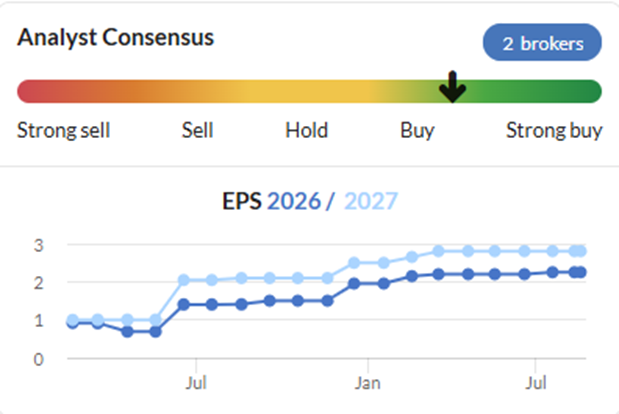
Indeed, what appears to be hidden in the note is that Canaccord has also upgraded FY26. With FY26 revenue up to £58.9m from £57.4 and Adj. EPS up from 2.2p to 2.4p.
The bigger impact should be on FY28. However, Canaccord does not yet provide a FY28 estimate, so it is hard to gauge the longer-term impact of this win. We do learn a couple of other snippets from the note. Although the customer is unnamed, Canaccord suggest that:
Given the size of this deal, we would assume this to be with an existing customer and believe it highlights the sticky relationships and 'land & expand' potential in UK public sector digital transformation…
Valuation:
Today’s 8.5% rise in share price roughly matches the near-term upgrade to FY26 and FY27 numbers. So the Stock Report figures are largely unaffected by today’s update and the subsequent price move.
The c.13x earnings looks much higher than TPX. However, to do a fair comparison to TPX, we have to account for the differing cash levels:
Made Tech | TPX Impact | |
| Buy Price(p) | 42 | 75 |
| 2027 P/E | 13.5 | 9.0 |
| 2027 EV/EBIT | 9.0 | 6.5 |
Even on an EV/EBIT basis, TPX Impact looks like a potentially better value. However, I think there are some reasons to prefer Made Tech (as I have with my own money). They have a much longer history of guiding conservatively and beating expectations. Made Tech's 5-year revenue CAGR is much higher at 53%, versus 9% for TPX.
Overall, I think both companies deserve consideration while the sector's current very positive outlook remains in place.
[For completeness, I should mention the third listed company in this sector, Triad. However, in my opinion, this is a much poorer quality business, where I have some serious corporate governance concerns, and it is on around 3x the current rating of the other two. I ran through why some caution may be required here.]
Mark’s view
9x forward EV/EBIT is towards the upper end of what I would typically consider good value for a UK small cap company, and is above where its peer TPX trades (despite a great share price performance recently). However, today’s contract win shows momentum continues with the sector and the company.
The company has a habit of guiding conservatively. Indeed, despite not mentioning FY26 in today’s RNS, Canaccord took the opportunity to upgrade EPS for that year by 9%, as well as the +7% impact on FY27. Most of the impact of today’s contract win won’t hit until 2028, and without current forecasts for that year, it is hard to see the true improvement in prospects. This uncertainty may be holding back the share price rise today, until we have greater visibility.
Roland kept our positive GREEN view on the company when they reported a further upgrade to FY26 guidance at the end of June. With the share price only 5% higher today than it was then, and today’s material contract win, I am in no hurry to change our stance.
BHP (LON:BHP)
Flat at 3261p (£171bn) - BHP FY2026 Results Announcement - Mark - AMBER/GREEN =
I previewed these results on the Week Ahead. The market's initial reaction was positive, rising a couple of per cent, with profit, EBITDA and dividend all coming in slightly ahead of analyst forecasts. Revenue rose 15%, and underlying EBITDA was up 27% to roughly US$33 billion, both ahead of expectations. The RNS format itself I found particularly hard to read, so I've turned to their presentation for the rest of the highlights:
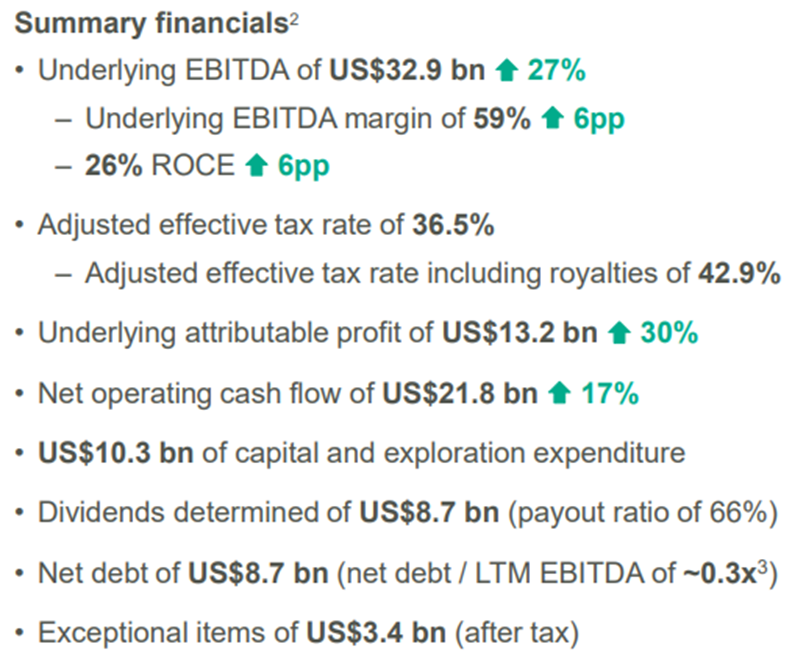
When I previewed the results, I highlighted three key points to watch: copper's growing weight, China and iron ore demand, and capex guidance. Here's how these landed in these results:
- Copper: At the half-year, copper crossed 51% of group EBITDA for the first time; for the full year, it rose further to 54%, with copper EBITDA up 48% to US$18.2 billion from US$12.3 billion. Copper revenue also overtook iron ore for the first time in BHP's history, underscoring the pivot toward electrification-linked commodities.
- China: Iron ore EBITDA grew only 1%, despite Western Australia delivering a system record of around 290 MT, as higher energy and freight costs squeezed it. On China, management struck a "resilient but not roaring" tone: it reiterated confidence in long-term fundamentals for steelmaking materials, but explicitly flagged that the property sector shows no signs of recovery. This may be why the market didn't respond to the strong results, as investors read the China commentary as confirming near-term demand softness.
- Capital allocation and Jansen: the Jansen potash project remains BHP's single biggest capital commitment. The "mid-CY27 first production" timeline for Jansen Stage 1 held, but costs were poorly controlled. Stage 1 capex has increased by US$1.7 billion versus its original $5.7bn estimate, and Stage 2 saw a 40% cost increase to US$6.9 billion, along with a two-year timeline extension to FY31. Despite these worries, the final dividend was $0.99/share, for a 72% payout ratio, as management tried to reassure investors that Jansen's cost overruns aren't going to crowd out shareholder returns.
Taken together, I can see why the market may have taken a neutral view on these results.
Valuation:
The other issue I have here is the valuation metrics, which don't look particularly good for a commodity producer:
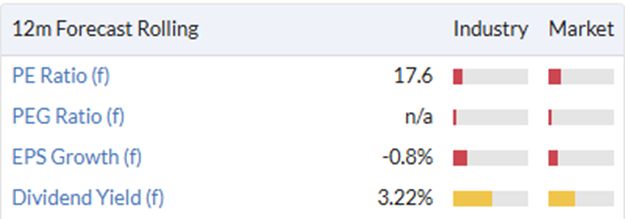
The narrative is that the company is well positioned for a multi-year boom in commodity pricing in electrification minerals such as copper and the growing need for agricultural fertiliser across the world. Jansen is a bet on long-term global food demand as the global population grows and diets shift toward more protein. Potash demand is expected to rise steadily, which is why BHP frames it as a diversification play alongside copper and iron ore rather than a cyclical commodity tied to industrial or construction demand, as iron ore is.
However, it would be naive to think capital allocation cycles have been abolished, and investors still need to take a positive view on commodity pricing to invest at current multiples.
Mark's view
Despite my valuation concerns, there is no denying BHP appears well positioned for future demand from electrification and agriculture. However, whether they can deliver these without also being hit by cost overruns due to higher commodity inflation remains to be seen.
While the algos rate this a "High Flyer", I think it makes sense to remain broadly positive:
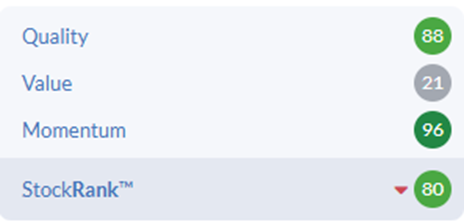
However, I'd be quick to change my stance if that Momentum started to drop rapidly. AMBER/GREEN.
James’s Section:
Synectics (LON:SNX)
Down 6% at 195p (£35m) - Interim Results - James - AMBER/RED =
Half-year figures from Sheffield-based Synectics were released this morning, and the market doesn’t like them – as I write, the stock is down 6%, compounding the pullback we’ve seen over the past 12 months (down 38%).
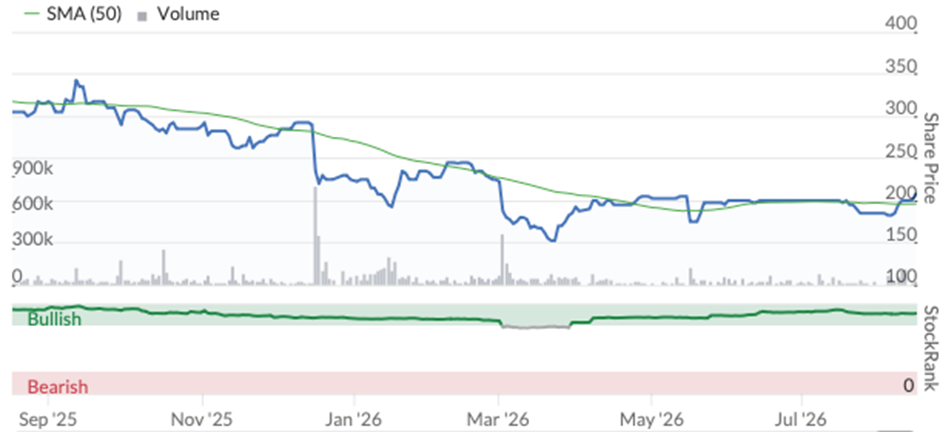
Today's headlines aren’t pretty:
Revenue down 37% to £22.2m
Adjusted EBITDA down 76% to £1m
Gross margin up 6.8pts to 47.8%
Net cash £10.5m, no bank debt
Interim dividend held at 2.2p
FY26 adjusted EBITDA guided to £3.7m–£4.1m (consensus: £4.1m)
H2 Weighting:
In its commentary, the business suggested that trading would be second-half weighted, but also flagged that the second half now has to do an unusual amount of work. H1 delivered £1m of adjusted EBITDA, so hitting the guided range means £2.7m–£3.1m in H2 – roughly three times the first half. The CFO highlighted that these numbers were still dependent on developments in the Middle East.
...there is a limited timeframe by which delayed orders or project restarts from Middle East customers must be received in order to be able to deliver them and recognise revenue.
The disruption isn't new. The Middle East conflict was reported in May, and the AGM update told us FY26 would be in line only "subject to energy sector activity normalising through the second half". What we didn't have until today was the scale: revenue down 37%, and a comparator that turns out to have contained a single £7.8m gaming contract. Energy hasn't normalised, and guidance has moved again as a result.
Margins:
Synectics sells security cameras and the control-room software that runs them, into settings where a failure is a serious problem – casinos, offshore oil platforms, city-centre CCTV, bus fleets. Two divisions: Systems, the higher-margin product arm sold worldwide, which carries the gaming and oil & gas exposure, and Ocular, which installs and maintains systems for UK and Ireland customers.
Before delving deeper into the bad bits, there does appear to be a genuine improvement in the margin story. That’s partly structural, with the broader gains attributed to operational efficiency, and improvements in the Systems division attributed to better pricing discipline and a mix shift towards support agreements – Systems' 57.7% is expected to “drop down moderately” in H2 as mix evolves.
Guidance:
Today’s RNS does raise some concerns. The guidance cut is in a footnote. The body text guides to "£3.7 million to current market expectations" without saying what those expectations are. Footnote 5 reveals these to be: £4.1m, itself the reduced figure following the earlier profit warning. So consensus is now the ceiling of the range, not its midpoint. The sub-headline says the outlook "remains achievable", which is not the same as saying trading is in line.
Order Book:
The order book is called "stable". At £26.4m, it is stable against November's £26.5m. Against £35.1m a year ago, it's down 25%. The gaming contract doesn't explain it either – that £7.8m was recognised as revenue during H1 2025, so the £35.1m was the book after delivering it.
Adjustments:
A few other things are worth digging into. The financial summary carries no statutory profit measure, so you have to go further down for the statutory picture: an operating loss of £(0.5)m, a pre-tax loss of £(0.4)m and basic EPS of (2.2)p against 15.4p last year.
James’s view
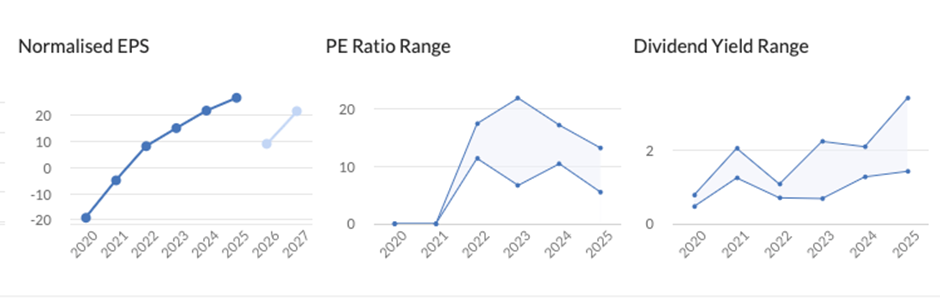
The screening data may be a little misleading here. The trailing EV/EBITDA of 3.35x is calculated on FY25 – a peak year inflated by a contract that won't repeat. On today's guidance, it's nearer 6.5-7.2x.
The forward numbers need care too. A rolling 12-month P/E of 10.9 looks undemanding, but with a November year-end that blend is roughly 70% weighted to FY27. The more telling figure is FY26, where we now have some visibility – half the year is reported, and the guidance range is on the table – and on FY26E EPS of 9.0p the shares sit at around 22x. FY27's forecast of 21.5p is what drags the rolling multiple down to 10.9, and that's a year we know very little about – it rests on a recovery the company has yet to demonstrate.
Net cash of 59p a share – around 30% of the market cap – plus 0.8x book and a held dividend are what keep me from going lower. However, this report doesn’t provide enough to change our stance from Mark’s AMBER/RED in June.
Kainos (LON:KNOS)
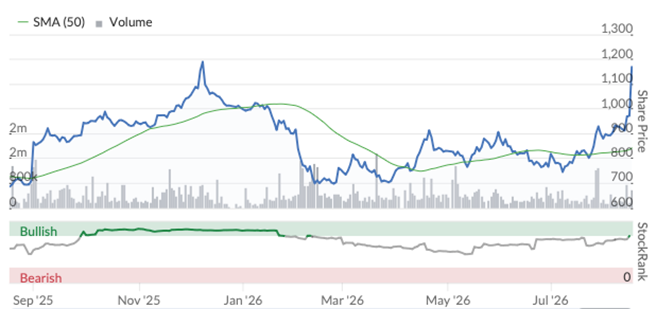
Up 17.6% to 1,143p (£1.33bn) - Trading Update - James - AMBER/GREEN =
When Roland covered FY26 results in May, he cut his view a notch, and his main complaint was specific: Kainos said nothing about FY27 expectations, which he felt left room for a quiet broker downgrade without an explicit warning. Today they've done the opposite, guiding explicitly and upgrading:
- FY27 revenue and adjusted PBT now expected "comfortably ahead of current market expectations"
- Consensus, as compiled by the company: revenue £509.3m, adjusted PBT £77.1m
- Sell-side range disclosed: revenue £498.0m–£514.0m, adjusted PBT £75.0m–£84.0m
- Digital Services "continues to grow very strongly"
- Workday Services and Workday Products both recording double-digit revenue growth
- H1 results due Monday 9 November 2026
Looking forward, we remain confident in our outlook for the financial year and beyond. A robust pipeline and a significant multi-year contracted backlog underpin this confidence. While the macroeconomic environment remains volatile, Kainos operates in markets driven by clear structural trends and remains well positioned to deliver on its strategy.
Understandably, this has been welcomed by the market:
The business:
Kainos is a Belfast-headquartered IT services provider with three divisions. Digital Services builds and supports custom digital platforms, and is heavily weighted towards UK government departments and the NHS. Workday Services implements and supports deployments of Workday's finance, HR and planning software. Workday Products is its own proprietary add-on software for Workday, and the source of the group's recurring revenue.
Checking the upgrade:
Kainos does at least tell us what it's beating. The footnote gives consensus of £509.3m revenue and £77.1m adjusted PBT, and unusually also the full spread of estimates behind it. That lets you check the claim, and it's worth doing: the top of the range is already £84m, so "comfortably ahead" of a £77.1m consensus could still land inside the spread analysts had. There's a direction of travel here, not a new number.
The momentum behind it looks real. FY26 delivered revenue up 17% to £431.1m, with bookings up 32% to £505.3m and a multi-year contracted backlog up 18% to £433.9m at the March year-end, so Kainos went into this year with decent forward cover. Today adds that Digital Services has won further contracts since April, though it provides no updated backlog figure.
Margins:
One gap – albeit from this relatively short trading update – was on margins. Roland's other caveat was that adjusted PBT margin fell from 17.9% to 15.6% due to greater use of contractors and third-party suppliers. Management guided that this would unwind: "as we replace temporary contractors with full-time employees over the course of the year, we anticipate clear margin improvement." Today's upgrade does cover adjusted PBT rather than revenue alone, which is implicitly encouraging, but it would have been good to see it confirmed.
Valuation:
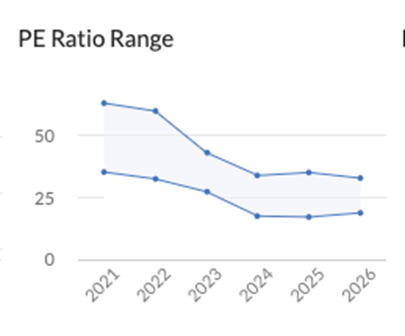
Today's share price movement significantly shifts a few things on the StockReport. The market cap is nearer £1.33bn than the £1.13bn shown, and the multiples move with it: on unrevised FY27E EPS of 47.8p, the shares are on about 24x, against the 20.3x shown, which is struck at last night's close. FY28E is roughly 20x.
At 1,143p, they are also sitting right on the consensus price target of 1,142p. These P/E figures also put the business on the more expensive end of the sector, and the PEG is nearer 1.2 once today's move is applied, against the 1 shown. Moreover, this is not a business that has looked particularly cheap in recent years:
James's view
The upgrade behind today's move looks smaller than the move itself. Even if adjusted PBT comes in at £84m, the top of the disclosed range and 9% above consensus, EPS gets to roughly 52p, and you are still paying about 22x.
While it's hard to ignore the operational momentum, it might be ambitious to assume much more of a re-rating from here. The shares have already run to the consensus target of 1,142p, and ValueRank has dropped to 22.
Quality isn't a question, with a ROCE of 49.8% and net cash of £82.9m, but it's worth tempering the optimism a little here, and that's why I'm sticking with Roland's AMBER/GREEN.
Disclaimer
This is not financial advice. Our content is intended to be used and must be used for information and education purposes only. Please read our disclaimer and terms and conditions to understand our obligations.

37 comments
Not being an expert in bonds, is there a reason Governments don't take advantage of the low bond prices and buy them back and cancel them?
As an example, TG61, a nominal 0.5% bond that currently has a yield of over 5.6% as its price is 22.3. Why doesn't the Government buy it at that price, cancel them and save paying out all the interest payments for the 30 odd years?
Hmmmmm -:)
Inflation and budget deficits
All the best
Hi af20001,
The follow on question would be, how would they fund the acquisition of the bonds? As the govt is short of cash they would need to raise other funds to pay for the acquisition likely via issue of new bonds, those new bonds would need to be issued at the same coupon, 5.6%, in which case it’s a worthless/circular exercise.
The Mello Team have now launched Mello London, taking place on the 17th & 18th November. Early bird tickets on sale now and full event details are here: https://www.melloevents.com/mellolondon2026
For those who haven't been before, Mello is a two-day investor event that's built around what we feel matters most to investors... getting direct access to company management teams, learning from some brilliant keynote speakers, and spending time with other serious investors to share ideas or just talk investing in general - something you don't typically do down the pub or in your usual social circles!
To those of you who have been to Mello conferences before (many have attended double digits since the first in 2014), the team will of course try to improve on our Mello2026 and MelloBirmingham events earlier in the year. If you have any companies you would like us to bring along, any panels that may be of interest or areas of investing you would like Mello to cover, please do drop your suggestions on the #MelloLondon thread here on Stockopedia.
Richard Staveley Rockwood Strategic (LON:RKW) & Lord John Lee will be returning to our keynote stage plus a few new names of other investing heroes and respected fund managers will be on our Mello Theatre stage. Again, 50+ quality companies will be delivering investor presentations and exhibiting in our main hall (scroll down our Mello London page to see the companies that were on show at our Mello event in June). Ed Croft will be doing a new presentation not featured here before so we look forward to that one
As the formal presentations wrap up, and just before investors start to relax in to the evening chats, we will have our ever-popular BASH (Buy, Avoid, Sell, Hold) panels featuring investors such as Richard Crow, Jamie Ward, Paul Scott, Mark Simpson, Lord John Lee and more. The Mello Team will be pulling out all the stops to make this as great a Mello event possible. I hope to see as many of the Stockopedia community at the event with us...
Important to note, tickets are on early bird until midnight tonight, making it just £69 for a one day pass or £99 for a two day pass... Booking early particularly helps us with event planning and making Mello as smooth an event as possible and we are currently 55% ahead on ticket sales so it may sell out completely well before the event! Investors can save up to £100 by booking early and our MelloMembers receive a further 30% discount.
If you miss the early bird, use code Stocko25 for 25% off General Sale & Final Release tickets: https://www.melloevents.com/mellolondon2026
See you in November for Mello London, it is going to be an excellent two days for investors - Mello really is a very open and welcoming investor community so do join us!
David
Back at the end of June I commented: “Made Tech (LON:MTEC) looks like an earnings inflection story — 3 consecutive beats, a macro tailwind from the UK government's £20bn digital transformation commitment, and shares still trading at a 35% discount to analyst consensus with cash equal to 25% its market cap. Hard to find much not to like”.
Yet the share price languished and here we are in mid-August and the market hasn't caught on. The £40m contract — the largest in Made Tech's history — takes the backlog to £115m (+25% YoY), and it's driven the second FY27 guidance upgrade of the year: revenue to £63–66m, EBITDA to £6.3–6.6m, both ahead of consensus. Canaccord conservatively raised their FY27 EPS estimate 7% on the news this morning, reiterating Buy.
And the stock? Three consecutive earnings beats has become four. The ROCE inflection I was pointing to in June is now unambiguous; from -26% 2 years ago to nearly 16% today.
Well done on holding Made Tech (LON:MTEC). They're clearly doing well.
I am just looking into it this morning - this year I am focusing much more on buying companies where there is good momentum. It's a tactic that's worked out pretty well so far this year!
Looking at their FY25 results they do flag customer concentration. As these will be government departments or agencies they don't carry the same risks as private businesses but there are other ones (e.g. risk of reputational risk associated with political controversies).
Do you have any sense of whether a) these customers are single contracts or multiple contracts with a single supplier and b) what date these contracts may expire?
Significant customers
The Group had four customers that exceeded 10% of revenue in the year (FY24: four customers).
Customer A accounted for £8.7m (or 19%) of total Group revenue during FY25 (FY24: £7.0m or 18%).
Customer B accounted for £6.3m (or 14%) of total Group revenue (FY24: £4.0m or 10%).
Customer C accounted for £5.0m (or 11%) of total Group revenue (FY24: £5.4m or 14%).
Customer D accounted for £4.6m (or 10%) of total Group revenue (FY24: £3.4m or 9%).
EDIT: One other risk is there are no FY28 estimates in the market currently with brokers saying they will publish these at the FY26 results in September. However, this time last year there were FY27 estimates - so there may be a risk that FY28 isn't looking as strong currently.
Overall though this looks like a good business, executing well, on a pretty reasonable multiple - especially when you include the net cash which is almost worth 10p in terms of share price.
re. Made Tech (LON:MTEC) - I've been a holder for a long time due to the consistently "ahead" announcements. It's felt for more than a year now that the share price might break out of this range - but it seems to keep falling back after each punchy new announcement. I wonder if today's deal might be the moment.
Look at this chain of announcements in the chart below. Ahead/Significantly Ahead, Guidance Raised, Record contracts.
watching for a jump in momentum rank next fews days and SR also to be in 80s.
I've been a holder since 24p. I think it was held back by the diminishing order book and this contract news possibly being held back in the interim because sales hit is expected to start in this (2027) financial year and the majority doesn't hit until 2028 and the life of the award is over 4 years, maybe an additional award would see it break out
How to you create the above chart with all the ahead statements?
I'm developing a database with various news extractions - it's all in R&D, well ahead of site development.
Great news this morning. The momentum story continues. Interested in Mark's learned views on this one.
Kainos update also shows the government digitizing agenda continues at pace.
Kainos (LON:KNOS) Flipping 'eck, up 15% in early trading.
It's a warning, amongst many other companies that we've seen so far this years (EXPN, RELX, etc.) of being wary of market narratives. In this case the narrative was that AI would kill software.
I managed to buy these back in July at 760p at a fwd PE of less than 16. I figured that if you can get a good quality company for less than that, you should do OK. The price is now around 1110p, showing how surprisingly quickly sentiment can change.
Over the last 10 years revenues have risen from £84m to £431m. It didn't need to raise capital to do it. Its ROE averages about 33%, and has net cash. Operating margins have come down over the last 5 years, which is a little disappointing, but overall it seems like a good company.
Leopold Aschenbrenner seems to figure in this, although I don't think directly in the UK market. For those not in the know, he set up a 4X leveraged fund a few years ago which bet on AI stocks whilst simultaneously shorting software stocks. His narrative was widely publicised and he made investors a lot of money.
The stocks cratered at one point, though. He got margin-called in July, and was forced to sell his portfolio to Citadel at a discount. I hear he's been given yet more money to carry on his adventures despite his huge blunder.
I get very much the sense that we're in a risk-taking market, especially in the US, although we've seen the S Korean market became even crazier. Maybe it will take a market that goes sideways for a decade to sober us all up. In the meantime, stonks to the moon.
Kainos (LON:KNOS) Flipping 'eck, up 15% in early trading.
Bid rumours around Workday, with Silver Lake looking to acquire. Kainos now up over 65% since the AI driven cratering back in March and April. Softcat (LON:SCT) up 80% in same timescale and Bytes Technology (LON:BYIT) 55%.
Broadly, whenever you see whole sectors dumped on sentiment it's a buying opportunity. The trick is being able to separate sentiment driven selling from that caused by the market adjusting to new realities.
I'd note that the data analytics companies that were also punished earlier in the year haven't recovered to anywhere near the same extent as the software and IT services sector.
timarr
So why no write up (yet) by the Stocko crew? I've held for years, top sliced when Stocko advised and now back at £40k. Updated view needed imo
Argg, hoisted on my own petard!
Hello Mark
Can I respectfully ask that you heed previous advice and stop posting in detail about your successful trades ? No one else cares in the slightest
If Paul S was still around you would be going away with a flea in your ear. And yet you still do it - pretty well the only person on here who does.
I for one would really appreciate it . Its a shame as you do have many useful other comments to make and contribute
Many thanks.
Seraphim Space Investment Trust (LON:SSIT) looks like a positive step forward investment with a new portfolio company - Hubble Network Inc - an existing investment of Seraphin Space Venture Fund II. It's a new investment for Seraphim Space Investment Trust (LON:SSIT) I believe which I suppose is positive. A complex set of arrangements between various funds run by Seraphin which I guess holders understand better than me.... but new investments are interesting moves. Certainly no shortage of money flowing into the "space" - pardon the pun......
It’s going into the SSIC fund not SSIT and the purchase takes the expenditure above the level which will allow for a partial conversion into SSIT shares come September.
re Seraphim Space Investment Trust (LON:SSIC) Can I ask - does the conversion happen at book value? and therefore an uplift of 20% on the proportion that converts? You would expect the discounts on both shares to be the same would you not?
You can definitely ask…. but somebody else will have the answer…there’s a hugely complicated formula above my pay grade…
The formula is on the Investment Trust thread for August.
Key Formulas & Conversion Metrics
If use Gemini AI or similiar it will work out for you if your looking at buying SSIC as a cheap way into SSIT- or if the reverse is true. All depends on the next SSIT NAV. Looks like it will be around £2.45. But all depends on the ICEEYE valuation ( and Molten Ventures (LON:GROW) holds ICEYE as well, though much smaller % of GROW's porytfolio.
Ok thank you.
At the risk of being stupid then... 1000 Seraphim Space Investment Trust (LON:SSIC) C convert to approx 550 Seraphim Space Investment Trust (LON:SSIT) AND in NAV these two holdings are the same ( c£980). However 550 Seraphim Space Investment Trust (LON:SSIT) trade at 183 = £1006 and 1000 Seraphim Space Investment Trust (LON:SSIC) only cost 82p = £820. So on conversion you close the discount since conversion takes place at NAV and the IT trades at a premium to NAV compares to the C shares at a discount. The problem being you buy 1000 shares and only a fraction convert but it looks to me like you do win on conversion unless the ordinary shares move to a discount.
It depends on the relative NAV's on conversion date and the % they decide to convert. All the SSIC will be converted, I guess within 6 months. I have bought SSIC as a cheaper way in, but it is very dependent on the relative NAV's. I used 99p for the SSIC. Here are a couple of other screen shots of calculations. Ultimately it depends on ICEYE I guess, though S~~S~IT have another couple of holdings doing OK.
Now I understand more - so if last reported NAV was used ( as I did ) it's a win but if the IT NAV has moved up to 237 .... then the much lower number of shares offsets the discount gain. ( By definition the ordinary also trade at a discount). Therefore you can almost calculate the expected NAV for the IT based on the discount.... thus they do trade at breakeven not as I suggested. It will be interesting to see how they report conversion NAVs.... but if you right and reported NAV appreciates to 237..... buying this at 182 is a good trade.
Exactly and hence the next NAV will be key. £2.45 seems expected, but I am not as bullish so thinking maybe £2.30. But who knows and ultimately this space play is a long term win-in my opinion.
Morning peeps! I'm suprised the VIX Index is down at 15.2 when the talks (shouting!) in the Middle East have broken down - yet again! Plus Trump is hinting at polishing his nukes. Not to mention bombing Oman!!! Even I'm beginning to think he's losing the plot.
Still the experts know better than I.
Think Luke Groman put it well - eventually you end up in zugzwang - situation in chess when all moves result in a worse position. The bond market shouldn't like this and will be interesting to see how the dollar travels. Possibly weaker this time - hence Gold positive not negative...maybe.
I do wonder if at a certain point RD if he will just pack up and go home which would be a terrible outcome for both the US and the world at large.
The rest of us will just have to pay the tolls, as far as I can see the hardliners in Iran have zero intention of bending the knee.
Certainly very complex - to retreat and win looks like a difficult trick to pull off - so does stay and win. Therefore positive moves look limited.
Trump has no good options here. The mid terms will be very crash and burn for Republicans if the price of gas does not come down. Trump as a lame duck President; we can only hope this would curb his more excessive traits
This popped up on the Wise (LON:WISE) news feed yesterday afternoon. Sorry, it's a bit long.
NEW YORK, Aug 17 (Reuters Breakingviews) - Even the Trump administration's smart steps toward financial deregulation veer into worrisome territory. The Office of the Comptroller of the Currency granted its latest trust bank charter to a fledgling financial technology firm, part of a sensible initiative to give newcomers more of a fighting chance against incumbents. Just days after rejecting applications from several overseas startups, Friday's recipient was World Liberty Financial, a cryptocurrency venture backed by the U.S. first family.
The provisional approval enables World Liberty to issue its own stablecoins, hold customer assets and settle payments. Such licensing for banking wannabes has been rare since the financial crisis. Done properly, however, it can add competition, foster new services and boost regulatory oversight. Empowering a company 38%-owned by an entity affiliated with President Donald Trump and his relatives undermines such benefits.
World Liberty has many troubling aspects. It funneled more than $1.5 billion to the Trumps, largely from sales of crypto tokens that have saddled many retail investors with losses, according to a Reuters investigation published in June. A subsequent report last week said it was doing business with Chinese artificial intelligence companies the White House flagged for security concerns.
In addition to broader conflicts of interest involved with the government protecting customers of a bank partly owned by the U.S. president, World Liberty appears to have some of the same features that prompted the OCC to deny other outfits seeking charters. Earlier this month, for example, the agency snubbed Dutch fintech Bunq, citing its lack of U.S. banking experience.
Only World Liberty's chief legal officer has notable industry experience, at Robinhood Markets and Charles Schwab. None of the named executives or directors led a regulated lender. Zach Witkoff, the company's chief development officer and son of Trump's Middle East envoy Steve Witkoff, spent less than two years at Wells Fargo as a junior member of its commercial-property lending team.
The OCC also turned away UK-based Wise WISEa.L in part because of shortcomings in its anti-money-laundering controls. World Liberty itself received $100 million from a British businessman under investigation for money laundering, the New York Times reported earlier this month. Wise, Bunq and others are allowed to reapply. The Trump administration has denied any conflicts with World Liberty.
More competition in U.S. banking is long overdue. Before 2008, authorities regularly approved dozens of new regulated financial institutions; from 2009 to 2024, they authorized fewer than 50. Over that span, JPMorgan JPM.N and its peers got bigger, often while paying depositors next to nothing for their savings. Trump's banking shakeup, however, is creating at least as many liabilities as assets.
Follow Stephen Gandel on LinkedIn and X.
I've come to the conclusion that this situation will never be sorted out whilst Trump is in charge. When he goes, it'll probably be resolved quite quickly.
What can be expected of a bull in a china shop?
To quote from American Dad, "Acting isn't hard, Renee Zellweger just makes it look hard."
SNX. Quite alot of waffle again
Or (!?) is Amanda showing that the 5P transformation is working via the wider margin, whilst building her future KPI with the implied downgrade on an obscure global macro weakness?
I am a holder so my perspective is engrained in the decision to sell or hold. I see little reason to sell at these levels, but understand why there would equally be any motivation to buy on this subjectivity.
Without any personal need to sell, my fundamental view is that (1) with no debt, (2) a business model in a growth/demand area and (3) a transformation project that does fundamentally make sense and (4) a market cap primed for acquisition, I won’t be selling. I’ll wait for either the “buy” signals to scream, or Amanda to deliver the goods.