Daily Stock Market Report (Wed 11 Dec 2024) - US inflation, CHRT, BILN, BOOM, RM., BATS, SUS, SVT

Good morning! 12.30pm: we're finished for today, cheers!
Macro comment
This afternoon (at 13:30 GMT) we'll have the monthly US inflation rate, and it's expected to come in at an annual rate of 2.7%.
If true, that would be a slight increase on the 2.6% recorded in October.
With thanks to TradingEconomics.com, here is the trend in CPI over the past year:
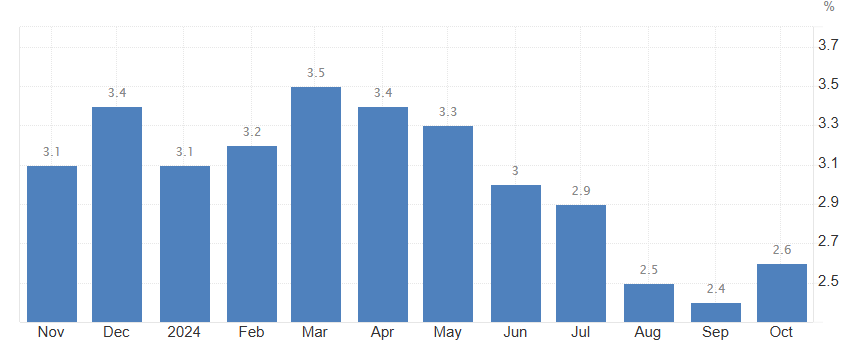
If November does come in at 2.7%, it will be seen as a short-term blow by many commentators. On the long-term, however, I think the progress in reducing inflation in the post-Covid era has been nothing short of remarkable - and while I hoped that it would happen, I had little conviction that it would.
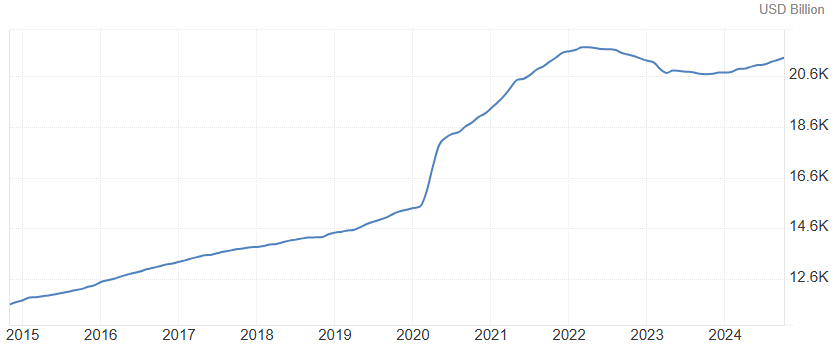
I don't think I'm alone in the naive belief that money supply feeds through to inflation. On that basis, with both US government debt (now $36 trillion) and M2 money supply soaring a few years ago, I had a genuine concern that it might not be possible to get inflation back under control in a reasonable timeframe. But that is what has happened.
Again courtesy of TradingEconomics.com, here is the US M2 money supply. Note that as soon as the rate hiking cycle began in March 2022, its growth did come to a halt. Perhaps this is still a relevant metric for inflation:
Turning back to the short-term, a CPI rate of 2.7% today is expected to accompany an annual "core" inflation rate (excluding food and energy) of 3.3%.
With the Fed's preferred measure, the PCE (Personal Consumption Expenditure) rate, also running above its 2% target, there do remain some lingering concerns that US inflation is not fully under control.
Nevertheless, 90% of economists polled by Reuters believe that another 25 basis points interest rate cut is on its way in December, reducing the Federal Funds Rate to 4.25%-4.5%.
That's not something that would be on the cards if the Fed was very concerned about inflation, so I interpret this as a sign that they think it's "good enough" at c. 2.7%.
What does it all mean for equities? I suspect it means more of the same: more all-time highs in the US equity market.
Other articles on Stockopedia:
The Case for Overlapping Value - my colleague Alex has written an article on how "Value" can be interpreted in many different ways.
Share Buybacks: are we getting value for money? The latest standalone article from Roland.
Explanatory notes
A quick reminder that we don’t recommend any shares. We aim to review trading updates & results of the day and offer our opinions on them as possible candidates for further research if they interest you. Our opinions will sometimes turn out to be right, and sometimes wrong, because it's anybody's guess what direction market sentiment will take & nobody can predict the future with certainty. We are analysing the company fundamentals, not trying to predict market sentiment.
We stick to companies that have issued news on the day. We usually avoid the smallest, and most speculative companies, although if something is newsworthy and interesting, we'll try to comment on it. Please bear in mind the "list of companies reporting" is precisely that - it's not a to do list. We have a particular emphasis on under/over expectations updates, and we follow the "most viewed" list of readers, so if you're collectively interested in a company, we'll try to cover it. Add your own comments if you see something interesting, and feel free to discuss anything shares-related in the comments.
A key assumption is that readers DYOR (do your own research), and make your own investment decisions. Reader comments are welcomed - please be civil, rational, and include the company name/ticker, otherwise people won't necessarily know what company you are referring to, if they are using unthreaded viewing of comments.
What does our colour-coding mean? Will it guarantee instant, easy riches? Sadly not! Share prices move up or down for many reasons, and can often detach from the company fundamentals. So we're not making any predictions about what share prices will do.
Green (thumbs up) - means in our opinion, a company is well-financed (so low risk of dilution/insolvency), is trading well, and has a reasonably good outlook, with the shares reasonably priced. And/or it's such deep value that we see a good chance of a turnaround, and think that the share price might have overshot on the downside.
Amber - means we don't have a strong view either way, and can see some positives, and some negatives. Often companies like this are good, but expensive.
Red (thumbs down) - means we see significant, or serious problems, so anyone looking at the share needs to be aware of the high risk. Sometimes risky shares can produce high returns, if they survive/recover. So again, we're not saying the share price will necessarily under-perform, we're just flagging the high risk.
Others: PINK = takeover approach, BLACK = profit warning, GREY = possible de-listing. Links:
Daily Stock Market Report: records from 5/11/2024 (format: Google Sheet). Updated to 10/12/2024.
Companies Reporting
Name/Mkt Cap | RNS | Status/ brief comment | Our view (Author) |
British American Tobacco (LON:BATS) (£66bn) | Trading Statement | Confirming FY24 delivery in line with guidance. | AMBER (Roland) |
Volution (LON:FAN) (£1.1bn) | AGM TU | Revenue growth 1.3% in first four months of the financial year. | |
Cohort (LON:CHRT) (£471m) | Half Year Results | Current year outlook unchanged. Stronger performance in H2, in line with previous experience. | AMBER/GREEN (Graham) |
S&U (LON:SUS) (£176m) | Trading Statement | Motor finance division: receivables down 10%, lending down 33% ytd, PBT down c. 50%. | AMBER/GREEN (Graham) |
Audioboom (LON:BOOM) (£56m) | TU | Ahead of expectations. 2024 Adj. EBITDA $3.1m vs. $2.8 forecast. 2025 rev to grow at least 10%. | AMBER/RED (Roland) |
Billington Holdings (LON:BILN) (£54m) | TU | 2024 PBT to be ahead of expectations. Confident of delivering 2025 expectations. | AMBER/GREEN (Roland) |
RM (LON:RM.) (£75m) | Full year TU | Adj. op profit 5% to 10% ahead of expectations. Net debt also finished the year ahead of exps. | RED (Graham) |
ProCook (LON:PROC) (£40m) | Interim Results | Q3 revenue +7.5% so far. Expectations for full year performance are unchanged. |
* Market caps at previous trading day’s close.
Summaries
Cohort (LON:CHRT) - up 4% to £10.63 (£495m) - Half-Year Results - Graham - AMBER/GREEN
This share rises today after a strong H1 result even though the full-year outlook is unchanged. Orders keep rolling in with the order book hitting an all-time high and the book-to-bill ratio staying over 1x. I’m happy to keep our mildly positive stance for now but will not do so indefinitely - if it keeps going at this rate, valuation will eventually be overcooked.
Billington Holdings (LON:BILN) - up 11% to 461p (£60m) - Y/E trading update - Roland - AMBER/GREEN
A material 16% earnings upgrade for 2024, but 2025 forecasts are left unchanged. This suggests earnings could fall back somewhat in 2025. Manufacturing efficiencies have improved profitability this year, but I wonder if falling steel prices have also helped. Notwithstanding this, Billington’s capex plans and confident approach to growth seems justified to me by its strong order book and decent balance sheet.
Audioboom (LON:BOOM) - up 5% to 355p (£58m) - Trading update - Roland - AMBER/RED
The podcast platform has upgraded 2024 EBITDA guidance for the second time in two months. I am encouraged by progress and the potential for positive free cash flow in 2025. However, risks remain and recent gains mean that the valuation already prices in significant further growth.
RM (LON:RM.). - up 8% to 96.5p (£81m) - Full year Trading Update - Graham - RED
It’s an excellent full-year update with adj. operating profit and net debt beating estimates. However, the company was not forecast to reduce net debt (vs. H1) in any meaningful way, and that needs to be the priority. A growing order book will hopefully help to reduce the leverage multiple (which I estimate at c. 4x currently). For now I’m cautiously staying RED on this.
British American Tobacco (LON:BATS) - up 0.8% at 2,993p (£65.7bn) - Trading Update - Roland - AMBER
The tobacco group confirms full-year expectations, despite mixed trading conditions and some pressure from cost-of-living and “illicit” vape sales. Market share remains strong in most key markets and I don’t see any near-term risks to the 8% dividend yield. However, leverage is a little high and the market is awaiting details of a major legal settlement in Canada.
Short Sections
S&U (LON:SUS)
Down 3% to £14 (£170m) - Trading Statement - Graham - AMBER/GREEN
I’m concerned that I may have jumped the gun slightly on this motor finance / property bridging company. I upgraded it to AMBER/GREEN in October having patiently stayed neutral on it until then, while the FCA carried out its review.
Today’s trading statement for the period since the beginning of August has the gloomy tone and the broadsides against authority that we are accustomed to, but it also includes some very poor numbers: motor finance receivables down 10%, loan advances down 33%, and PBT down by half. The recent Court of Appeal decision - which found that car dealers, acting as loan brokers, have a fiduciary duty to their customers - receives much of the blame. Other villains are claims management companies chasing compensation, and the government’s recent budget.
In contrast to motor finance, S&U’s property lender Aspen continues to grow at impressive rates with net receivables up 30% to £154m. It’s now more than half of the size of the motor finance division.
Graham’s view: despite the worrying numbers in today’s report, I’ll leave my AMBER/GREEN stance on this unchanged today. The key line for me in the statement is: Advantage's discussions with the FCA continue on a constructive basis as the s166 formal investigatory process draws to a close.
When the FCA gets out of the picture, which should be sooner rather than later, I’m hopeful that we’ll have something close to business as usual at S&U. And with the market cap discount to balance sheet equity (£233m) now quite material, I continue to think this is an interesting opportunity.
Severn Trent (LON:SVT)
Down 5% this week to 2576p (£7.7bn) - Reports of accounting scandal - Megan - RED
This week, the BBC’s Panorama has reported that £1.68bn of assets reported on the balance sheet of water company Severn Trent (LON:SVT) are in fact of no value to the business.
Panorama claims that the accounting trick used to report these assets has helped the business look more financially robust than it really is. Severn Trent sits on just over £14bn of total assets (most of which are long term) and has a total equity value of £1.86bn. Which would look very fragile if it wasn’t for the £1.68bn of assets highlighted by Panorama.
The details of the investigation can be read on the BBC. It’s complicated, but the overall takeaway is that there is an asset on Severn Trent’s balance sheet which seems to be made from numbers that are completely fabricated.
The reason this is interesting to private investors is that these assets have an impact on the company’s ability to pay dividends. Water companies are tightly regulated and their payout levels have to be agreed by Ofwat, based on the company’s earnings and investment in the service.
The £1.68bn of reportedly false assets contributes to the company’s retained earnings figure, which is taken into account when Ofwat agrees to the level of dividend payment. So the company may have been permitted by the regulator to pay out higher dividends than it can actually afford.
Since the anomalous asset was added to the accounts in 2017, Severn Trent Water has paid out £1.62bn to shareholders. Reported profits over the same period were £1.25bn, which means the company has paid more in dividends than it made in profit. Justifying this level of spending has relied on the balance sheet strength and retained earnings.
Megan’s view
Water companies are under the microscope at the moment for various misdemeanours. While Severn Trent rebuffs its accounting fraud accusations, unlisted (and perpetually unloved) Thames Water is defending the bloated pay of a senior executive. There are also swirling concerns about the regulated cost of water bills.
Only three of the UK’s water companies are listed and because the industry is so tightly regulated, all of them are held primarily for their dividends. But with pressure building on the industry from all angles, those payouts don’t look as safe as perhaps they once did. RED
Graham's Section
Cohort (LON:CHRT)
Up 4% to £10.63 (£495m) - Half-Year Results - Graham - AMBER/GREEN
Back in July we looked at Cohort’s excellent full-year results. We now have a fresh set of interims bringing us up to the end of October.
Revenue, adjusted operating profit and net funds are all “ahead of recent guidance”, but I’d treat this carefully as Cohort also says that the current year outlook is unchanged. An H2 weighting is anticipated, “in line with previous experience”.
So while H1 may have gone slightly better than expected, it’s not enough to cause a change in full-year expectations, at least from the company’s point of view.
In line with this, Equity Development have also left their forecasts unchanged today. For FY April 25 they estimate revenue of £240.2m, adj. EBITDA of £33m, and adj. PBT of £25.7m. These forecasts were last upgraded in November.
Turning back to today’s interims, I note that orders continued to roll in to the tune of another £139m, which is 1.2x revenue (i.e. book-to-bill is more than 1x, which bodes well for future revenue growth).
The order book closes at another record high, £541m. In an excellent achievement when it comes to revenue visibility, over 99% of consensus forecast revenue for the current financial year has been booked in. It’s true that there are only four months left, but my experience is that similar companies are often at this stage still uncertain as to how exactly they will meet full-year expectations. Whereas Cohort have it pretty much all booked in already.
H1 revenues are up 25% to £118m, while H1 adj. EPS almost doubled to 20p.
Net funds jumped up to £38m by the end of October, “well ahead of expectations due to working capital flows that included strong customer advances”. So we should be ready for this gain to potentially reverse as soon as working capital flows in the opposite direction..
Acquisition: Cohort is no stronger to acquisitions but its largest ever purchase was announced last month: the £75m purchase of the Australian company EM Solutions. EMS is a “developer and producer of high-end SATCOM terminals for global naval and defence customers”.
The deal was funded thanks to a combination of the existing cash pile, debt facilities and a placing for £40m (along with a retail offer for £1m).
Chairman comment reiterates some of the demand drivers that have been mentioned before:
The continued expansion of the order book is a strong indicator that we are offering competitive products in a growing market. On-order revenue is now deliverable out to the mid-2030's. The pipeline of order opportunities for the remainder of the year also looks strong. Demand for our solutions and services continues to be driven by heightened international tensions in the Asia-Pacific region as well as conflict in Europe and the Middle East. This backdrop is driving increased spending on defence and security. Overall, we continue to see a positive outlook for organic growth in the years ahead."
Graham's view
This is not a stock that is naturally in my wheelhouse but it is one that has impressed me every time I’ve looked at it in recent months.
My stance on it is driven more by an unwillingness to fight against momentum more than anything else: whether that’s momentum in CHRT’s order book or momentum in its share price:
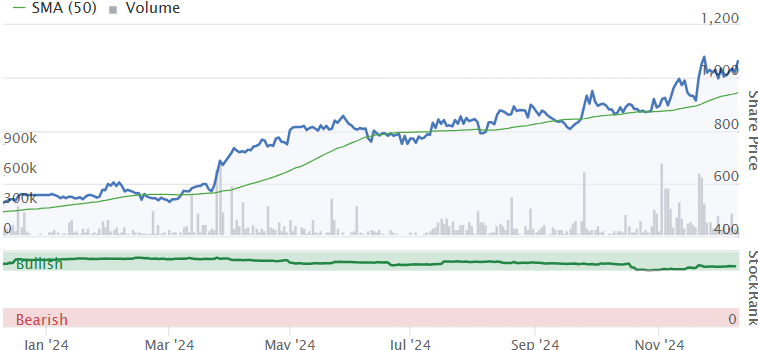
Valuation has been punchy for a while. The stock trades at an adjusted PER of 24x (current year) falling to 18.5x for FY April 2026.
But there is clearly no shortage of demand for CHRT’s various high-tech defence products that span many different forms of communication and surveillance.
In addition to that you have a successful track record when it comes to acquisitions, which will hopefully be continued with the latest Australian deal.
I feel the need to put a rule in for when I might downgrade this to AMBER, as I can’t stay positive on it forever, regardless of how expensive it gets. Perhaps a simple rule could be; if the forward (adjusted) PER gets above 20-22x, then I should think about turning neutral?
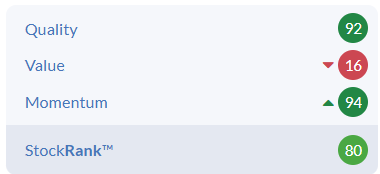
I note that it passes three bullish stock screens but all of them are to do with momentum. The market demands that we pay up for this level of quality performance:
RM (LON:RM.)
Up 8% to 96.5p (£81m) - Full year Trading Update - Graham - RED
I see that Paul was concerned about the financial situation at RM in July.
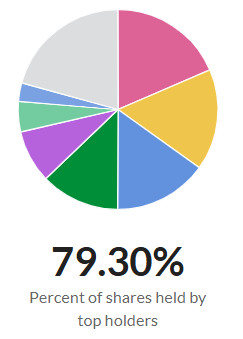
As he noted at the time, the free float is very limited here, an important fact to be aware of as only around 21% of shares are likely to be available to trade at any given time. Some extra volatility could be expected:
Fortunately this is a good news update for FY Nov 2024:
Subject to completion of the FY24 audit, the Company expects FY24 adjusted operating profit to be £8.4 to £8.8 million, 5% to 10% ahead of market expectations, with adjusted EBITDA of £13 to £14 million. Revenue from continuing operations, which now excludes the Consortium business, is expected to be 5 to 6% lower than in FY23.
RM uses Investec, whose research notes are not widely available, but the company does helpfully let us know that prior expectations were for adj. operating profit of £8m.
I also appreciate the notification that results are trending 5% to 10% ahead of those expectations - wouldn’t it be great if every company did this, instead of leaving us to decode “broadly”, “slightly”, “significantly”, etc.?
The brief update continues with the following key points:
£100m of contracts won by Assessment during FY24, the “vast majority” of these contracts being recognised as revenue from FY25 onwards. Contracted order book 2.25x higher than a year ago.
Other divisions also saw improved profitability in FY24.
Net debt has finished the year ahead of market expectations, with the company staying within bank covenants during the period. The net debt market consensus for Nov 2024 was £53m, little changed vs. the figure at the end of H1.
CEO comment:
“This has been a year of transformation for RM, and the success of our strategy is reflected in the progress we have made driving profitability and growing our contracted order book. Our focus on the significant opportunities for Assessment has delivered a number of major new digital contracts, alongside operational improvements throughout the business. We are pleased with the progress that has been made and remain focused on reducing our net debt.”
Graham’s view
This feels like a special situation where you have to form a view on the solvency picture. The interim results had a very long going concern statement which concluded that the company had sufficient funds to meet its liabilities as the fall due. And so far, they are right and the company has complied with its bank covenants.
An important sense-check for me is to ask how long it would take for the company to pay off its debts, based on current profitability.
This is essentially what the net debt/EBITDA multiple (leverage multiple) is designed to assess, although in my view it does so in an overly forgiving way.
Using the latest full-year estimate, if I use a year-end net debt figure of £52m, I get a net debt/adj. EBITDA multiple of nearly 4x. This is unacceptably high, in my view.
I’m therefore inclined to leave this at RED as the leverage is still beyond a level that I consider to be reasonable for a company of this size. And that’s before we question the adj. EBITDA calculation itself and find out whether it's a reasonable approximation of cash profits.
However, given the increased size of the order book, there is hope that adj. EBITDA and real profits can increase sufficiently to make the debt load appear more manageable.
Valuation: the enterprise value (market cap plus net debt) is in the region of £130m, so that the EV/EBITDA multiple for the current year is c. 10x.
Bear in mind that in general, an EV/EBITDA multiple should be much, much lower than the PER. So the value of the equity does not strike me as particularly cheap, based on this year's earnings, but clearly the market must be expecting great things in FY 2025.
Conclusion: as the leverage multiple remains too high by my standards and the equity doesn't strike me as cheap yet, I going to leave this on RED. But if I see a leverage multiple of less than 3x, either due to lower debts or higher earnings (or ideally both), I'll upgrade it.
Roland's Section
Billington Holdings (LON:BILN)
Up 11% to 461p (£60m) - Y/E trading update - Roland - AMBER/GREEN
This structural steel group appears to be enjoying strong trading conditions and has today upgraded its profit guidance for 2024:
Continued strong delivery in the second half now results in Group profit before tax for the year ending 31 December 2024 ("FY24") is expected to be ahead of current market expectations.
The company says that its improved performance is the result of both strong trading throughout 2024 and capital expenditure to improve the efficiency (and profitability) of its manufacturing facilities.
Updated 2024 forecasts: improved profitability appears to be a key factor in this upgrade.
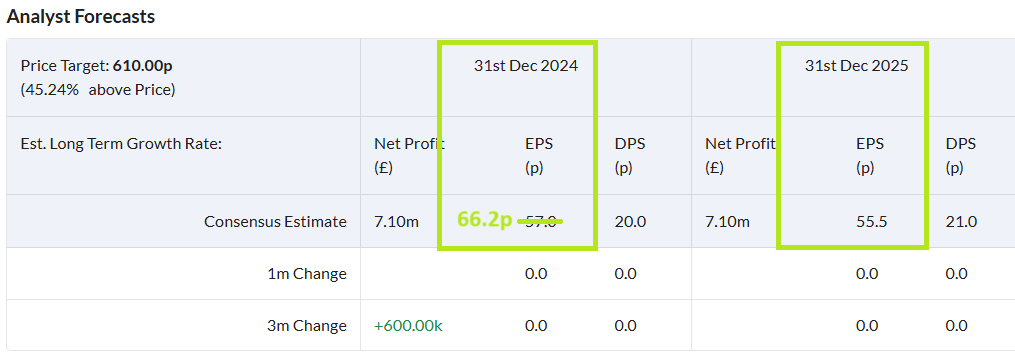
With thanks to house broker Cavendish, I can see this morning that revenue expectations have been left unchanged at £125m, but forecasts for adjusted earnings per share have been increased by 16.1% to 66.2p per share (previously 57p).
According to Cavendish, this upgrade has been driven by an improvement in gross margins. In addition to improved manufacturing facilities, I wonder if gross margins have also been improved by falling steel costs over the last year:
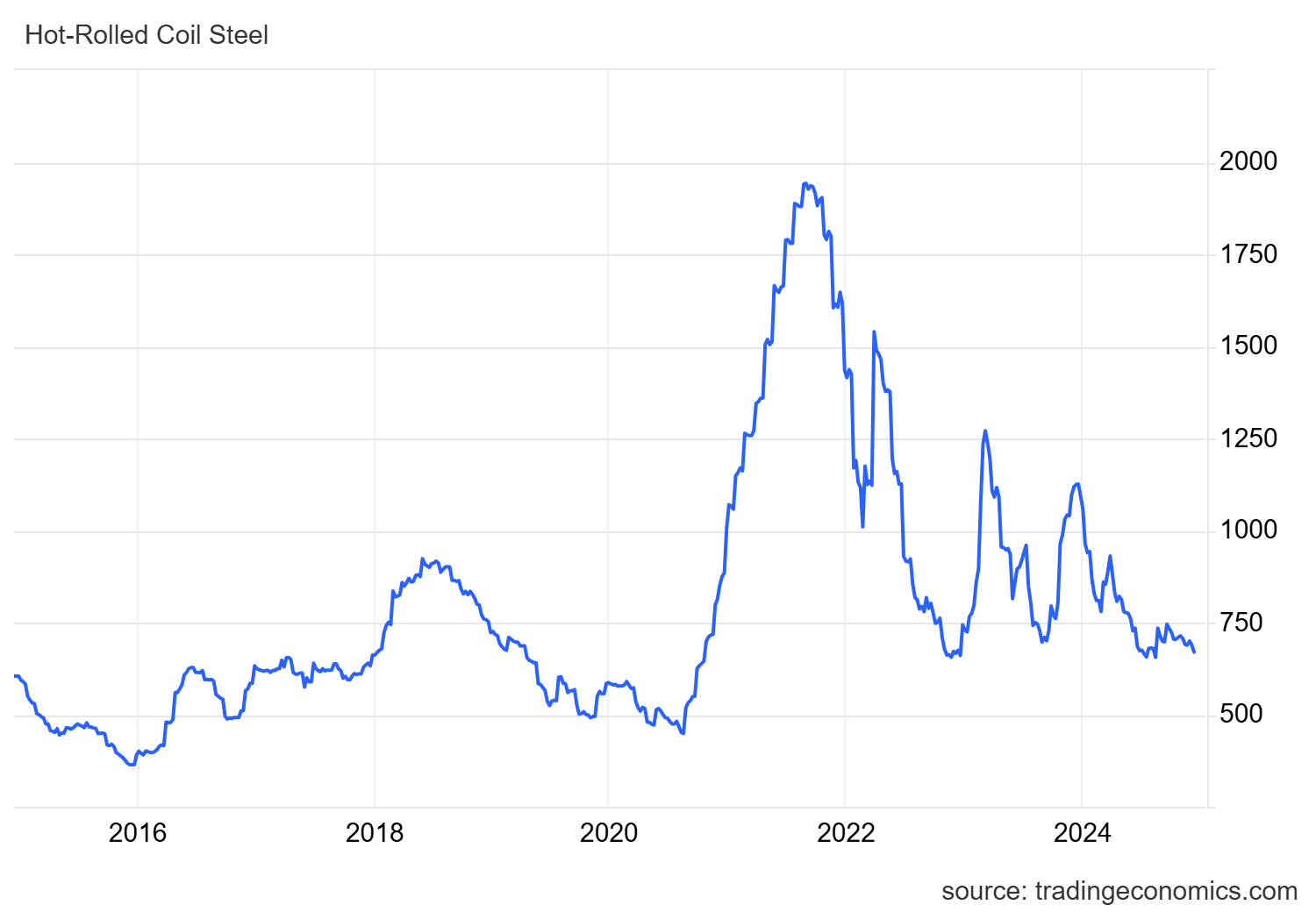
I don’t know how much exposure Billington has to steel prices (i.e. are its contracts fixed price or fixed margin?). This is an area I’d look at in more detail if I wanted to invest. But lower steel prices seem like they could be good for demand, especially given cost increases elsewhere.
Order book and Outlook: Billington certainly appears confident in the outlook. The Billington Structures business has recently taken on an extra shift at its Shafton location, while a new building is currently being constructed for the Tubecon business at the same location.
This appears to be justified by a strong order book across a range of high-value sectors:
The Group has a strong order book spanning multiple market sectors, and has been successful in securing a number of significant, good quality contracts for 2025 and into 2026, particularly in sectors that require more complex solutions such as energy from waste, high-tech manufacturing and data centres.
Billington says it’s “confident of delivering upon its market expectations for 2025.”
However, it’s worth noting that 2025 earnings forecasts have been left unchanged at this stage, which Cavendish attributes to the impact of higher planned capex. As a result, Billington’s earnings could fall sharply again next year if no further upgrades are forthcoming:
We may yet see upgrades to Billington’s FY25 forecasts if trading remains strong next year. But I’d imagine the risk of lower earnings in 2025 is the main reason why today’s share price rise has lagged behind the increase to FY24 earnings forecasts.
At the time of writing, Billington shares are now trading on a FY24e P/E of 7.0 and a FY25e P/E of 8.4.
The shares also offer a useful 4.3% dividend yield, which looks sustainable to me.
ISG Construction administration: I’m somewhat encouraged by Billington’s statement today on the recent administration of ISG Construction, which was until recently the sixth-largest construction firm in the UK.
Billington’s management say that while they’ve worked with ISG many times, all current contracts were “substantially complete” when ISG went into administration. Billington has already received an interim payout from its credit insurer and expects its financial exposure to be limited to the excess on its credit insurance.
I don’t know what the excess amount is likely to be, but this comment suggests to me that Billington is large enough and sufficiently well run to be proactively managing its credit risk – a perennial problem in this sector.
Roland’s view
This update is an interesting contrast from the profit warning issued by sector peer Severfield in November, which we covered here.
Billington’s strong performance makes me think that at least some of the issues at Severfield may be company specific, rather than sector wide.
In any case, I am encouraged by today’s update and also by the company’s focus on investing in its operations. My experience is that capital intensive businesses such as this one can often achieve worthwhile improvements in profitability and competitive positioning by ensuring their facilities are modern and well invested.
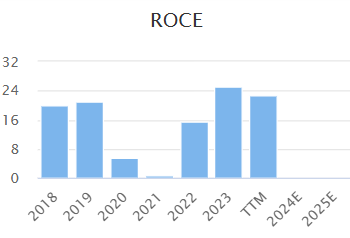
Billington’s profitability has certainly recovered strongly since 2021 and the business appears to generate attractive returns on capital employed:
I’m also encouraged by the company’s strong balance sheet. Net cash was £22m at the end of June and is expected to be at a similar level at year end.
Having cash on hand gives companies optionality to invest and manage their operations for long-term profitability. For a business of this kind, I think this can be a significant advantage.
Today’s update reads well to me and does not suggest any major concerns. I’m happy to maintain our AMBER/GREEN stance.
Audioboom (LON:BOOM)
Up 5% to 355p (£58m) - Trading update - Roland - AMBER/RED
It’s another earnings upgrade from this podcast platform today, following on from November’s upgrade:
...the Board now expects that Audioboom will generate an increased adjusted EBITDA(1) profit of at least US$3.1 million, significantly surpassing the recently upgraded market expectation of US$2.8 million.
Audioboom shares have risen by around 75% since early November, as the market has responded to evidence of improved profitability. However, this remains a painful shareholding for investors who bought during the pandemic – BOOM shares peaked at more than 2,100p in 2022…
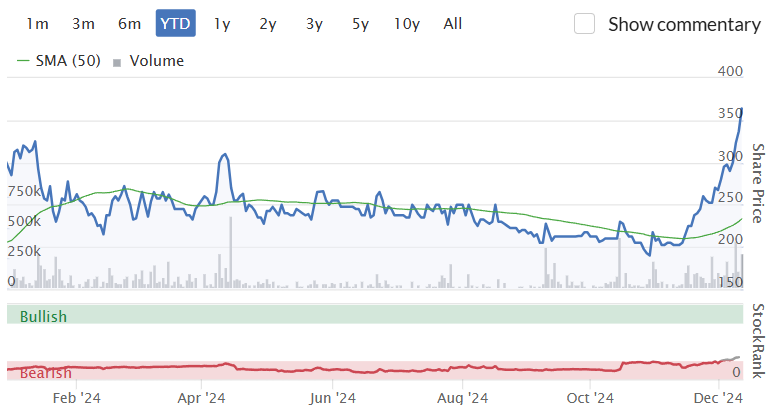
Trading update: Audioboom now expects to generate adjusted EBITDA of “at least $3.1m” in 2024, up from previous estimates of $2.8m.
This follows a previous upgrade in November, so it seems that trading has picked up markedly during the latter part of the year.
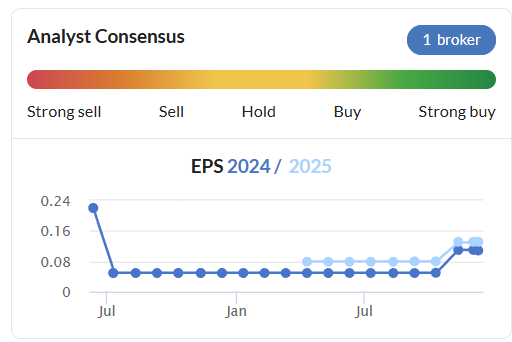
The company says that improved profitability this year is being driven by a strong performance from its highest margin “tech-focused advertising marketplace” offering, known as Showcase.
Showcase revenue +53% so far this year
Record monthly brand advertiser count of 10,165, up 65% vs Nov 23
eCPM (revenue per 1,000 downloads) of $75.60, up 38% vs Nov 23
There is some context here which I think is worth considering. Audioboom’s record of revenue growth was broken last year when Apple introduced changes to its podcast software that drastically reduced the number of episodes that were downloaded:
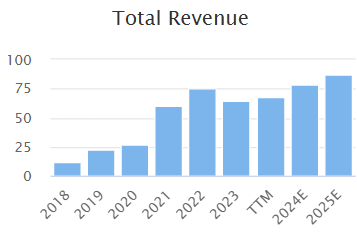
Prior to the update, Apple’s podcast software would often automatically download entire backcatalogs of a series, regardless of whether the user had requested them. That’s no longer true and has had a predictable impact on podcast downloads.
This is significant for advertising-led services like Audioboom, which base advertising calculations on downloads and do not know if individual episodes are ever listened to.
Outlook: I’m not a fan of adjusted EBITDA as a measure of profit. Fortunately we have updated forecasts from broker Cavendish today - many thanks.
Cavendish analysts now expect Audioboom to report revenue of $78m in 2024, up from $73m previously.
Adjusted earnings are expected to drop out at 14.3 cents per share, an increase of 11.7% from previous estimates of 12.8 cents per share.
Perhaps most importantly, Cavendish believes Audioboom will breakeven at a cash flow level this year, opening the door to the possibility of positive free cash flow in 2025.
My sums suggest earnings of 14.3 cents per share converts to a FY24e P/E ratio of 31 after today’s share price gain.
Roland’s view
I recognise that if Audioboom can continue to scale up its activities, it could become far more profitable than it is at present.
However, Audioboom operates in a competitive market and it’s not clear to me that it has any significant competitive advantages versus rivals such as Acast.
Looking at the stock as a potential investment, I would argue that net cash of c.$3m does not provide all that much headroom for problems.
In terms of valuation, the P/E of 31 already seems to price in significant further earnings growth.
On balance, I think this remains a fairly speculative investment that could still suffer further funding problems. I’m going to maintain our stance at AMBER/RED for now.
British American Tobacco (LON:BATS)
Up 0.8% at 2,993p (£65.7bn) - Trading Update - Roland - AMBER
British American Tobacco has confirmed it expects to report full-year results in line with expectations, despite some headwinds in the US.
The company says US cigarette market volumes have fallen by 9% this year, reflecting cost-of-living pressures and illicit single-use vape sales.
In tobacco, BAT says it’s gained 0.2% of market share by volume in its top eight cigarette markets, but lost 0.2% of share by value. This implies that customers are switching to cheaper brands.
Vaping remains a key area of growth where BAT is closer to scale and profitability than UK-listed rival Imperial Brands (disc: I hold IMB).
In the US, BAT has faced tough competition from “illicit single-use Vapour products” and has been lobbying hard for enforcement to support sales of its legal products, sold under the Vuse brand.
These efforts appear to be yielding some results. BAT says Vuse now has a 40.3% share by value in its top eight geographic markets, rising to 50.7% in “US tracked channels”. I wonder how big the untracked channels are?
Outlook: Overall guidance for the year remains unchanged. BAT expects to report “low-single figure” growth in underlying revenue and adjusted operating profit.
However, the company admits that leverage is likely to end the year at the high end of its target range of 2.0x - 2.5x EBITDA. I don’t see this as a pressing concern, but personally would prefer a slightly greater focus on debt reduction here, given that net finance costs are expected to be £1.6bn this year.
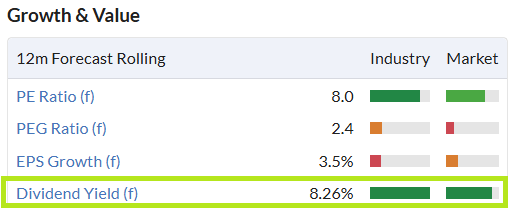
Operating cash flow conversion is expected to be over 90%, providing continued support for BAT’s generous dividend:
Roland’s view
The big FTSE 100 tobacco stocks remain a popular choice with income investors – and with good reason. Large scale and sector consolidation (with zero new entrants) means that even in a shrinking cigarette market, they remain highly profitable and cash generative.
However, regulatory and legal risks remain and it’s not clear to me when the next step-change in market conditions might take place – either relating to vaping or perhaps tobacco demand.
On balance, BAT looks reasonably priced to me at current levels. While I think there’s some scope for upside, higher debt levels and as-yet the unknown impact of a major legal settlement in Canada prompt me to stay neutral for now. AMBER.
Disclaimer
This is not financial advice. Our content is intended to be used and must be used for information and education purposes only. Please read our disclaimer and terms and conditions to understand our obligations.

33 comments
Regarding the new Show commentary feature on Stockreport charts, I found this bug (e.g. Audioboom chart) which I have reported to the team and a workaround that others may find useful:
Accessing the link to the latest report is impossible if the box is placed up against the right edge of the chart. If you hover over the box until the link appears then right click, ignore the popup menu and now left click on the link brings up the commentary.
Actually it is not a problem on my system and l don't have a mouse.
But l'm getting loads of error messages on this site recently, this started about 2 weeks ago, especially if l try and load mini charts n a folio.
I have reported several things to support but no response.
Card Factory (LON:CARD) CEO has purchased about £50Ks worth of shares today - always a good sign.
Just a thought here for those that hold card payment companies.
I noticed my bank, Lloyds, have now implemented a payment link that has no fees to it. As a small business owner, I am now using this to send to customers instead of using my card reader to send payment links. ATM I’m not sure it will make a huge difference to the card processing companies but in the future it may well do. Obviously this will likely only impact these companies when a payment link is done and not with direct card payments but it is possible that card fees may drop in the future. Why pay a card fee if you can get it for free and the payment links do cost more than a normal card transaction fee.
So this could affect PayPoint (LON:PAY) ?
Good luck with Lloyds, had loads of problems with them recently, blocking transfers. One took 3 hours on the phone for them to sort it out.
I imagine it will affect all the card payment companies though not a lot atm. Something to be wary off though.
not had any problems with Lloyds.
I noticed my bank, Lloyds, have now implemented a payment link that has no fees to it
This is Open Banking, aka direct from account payments. All UK (and EU) payment institutions are regulated to provide this. It's free to use (by regulation) for individuals and small enterprises. The underlying payment goes via Faster Payments (owned by Mastercard), just as if you log in to your bank and do a credit transfer.
Banks get paid for card payments but not for Open Banking payments so they're not especially hot on promoting this.
If available Open Banking is probably the safest way of making an online payment but there are no rules about reimbursement in the event of a dispute as there are with cards. Using a credit card to make online payments remains the best option due to the chargeback rules and other consumer protections offered.
Open Banking doesn't work in shops at the moment because there's no equivalent of the card or phone app to tap on the terminal (technically the problem is the terminal). However, the FCA are keen to find ways of making this work in order to drive competition with Visa and Mastercard. It's in the recent UK National Payments Vision - https://www.gov.uk/government/...
But there is significant opportunity to further develop account-to-account payments in the UK – enabling consumers to pay digitally for goods and services in shops and online, without using a card. This would provide greater choice to consumers and merchants in how they make and receive payments, which in turn is likely to spur innovation and downward competitive pressure on the cost of payments.
Open Banking style payments are on the rise around the world - Brazil has PIX, India has UPI, etc, etc. Longer term this poses a threat to Visa and Mastercard's existing business but as you'd expect they're already all over it. Other payment companies, particularly smaller ones, are more likely to be impacted.
PayPoint (LON:PAY) has been investing in Open Banking for some time - their investment in obconnect is designed to allow them to address the wider market and, if needed, to manage a transition away from card payments.
timarr
I see US inflation did come in at 2.7% as expected. Markets are up.
Thanks for the write up on RM (LON:RM.). As per usual a fair and balanced view. Regarding the debt it is expected that RM (LON:RM.) should be divesting one of the divisions in the not too distant future. Hopefully that should then significantly strengthen their balance sheet. (I hold)
Roland, a thank you for covering British American Tobacco (LON:BATS) held in the family income portfolios, not the most exciting share, and for some uninvestible, a small part of a wider investment, I also hold Imperial Brands (LON:IMB) a couple of the portfolios look impressive having picked up near the year lows, others are just a long term hold, so not worried about the share price, just the cash going into mum's bank account every three months.
Tommy
Any comment on Volution (LON:FAN) [I hold] would be welcome, even though today's news is only a Trading Update. It seems such a splendid company, with a good niche, and about the right size for this Report. Though I quite understand if not, as the news is not very dramatic!
At long last the take over deal has been done at Equals (LON:EQLS) :-
"Equals Group's EQLS.L shares jump as much as 13.3% to 136p
** Co, which develops and sells scalable payment platforms, agrees to a 283 million pound ($360.5 million) all-cash takeover by a consortium including Embedded Finance Ltd and TowerBrook Capital Partners
** The 140p-per-share offer represents a premium of 37% to EQLS' closing price on Oct. 31, the last business day prior to the start of the offer period
** Stock now up 12.5%, taking YTD gains to ~11%"
Been 12 months or so but, as they say, patience is a virtue
Equals (LON:EQLS) at last, patience has paid off, nearly sold some yesterday.
Warpaint London (LON:W7L) a bargain at this price. Think the takeover playing havoc with stocko's IT?
Warpaint London (LON:W7L) down 57% according to stockopedia. Had to check another source!
Crikey, I'll bet a few Warpaint London (LON:W7L) holders are choking on their cornflakes this morning with what looks like a data error on the share price (Stocko showing it down almost 60% but brokers have it around 530p offer)!
Optima Health (LON:OPT) is missing from today's results list. Not sure why Marlowe (LON:MRL) was of no interest to readers last week, but this is the demerged healthcare arm. RM (LON:RM.) has also had a trading update. I don't currently hold either of these stocks but they do operate in growth sectors and are the right sort of size to interest me more than, say, British American Tobacco (LON:BATS). Any insights would be appreciated.
Morning Graham. Going back to the table - I prefer it now, but I know some don't. If you asked your dev team to try the table with a 'sticky' or fixed first column, it would keep the column with the company name and ticker in view, whilst enabling scrolling on the other columns.
This format is worse, for me, so much wasted space, not everyone is using a mobile. The tagged stocks column is too wide. The margin is too wide.
I'll mention this to the team daviHard. Thanks!
Progress at RM (LON:RM.) Adjusted operating profit expected to be 5-10% higher than market expectations with contracted order book 2.25 times higher than last year. Net debt, a little coy on detail is said to be lower than market expectations.
Need to re-read announcement but the turnaround appears to be heading in the right direction. I have a modest holding having plagiarised Richard Staveley at Rockwood Strategic (LON:RKW) .
Interesting turn of events at Kainos (LON:KNOS) this morning with the previous CEO returning after stepping down just over a year ago. In June last year he said this:
"My decision to step down as CEO of Kainos was not an easy one, but made easier knowing the talent and motivation of the team leading the business today. I have complete confidence in Russell to lead us successfully into the future and I look forward to supporting him and the wider team over the next twelve months.”
Whereas today the company says this:
Kainos Group plc (KNOS), a UK-headquartered IT provider with expertise across three divisions - Digital Services, Workday Services and Workday Products - announces the re-appointment to the Board of Brendan Mooney as Chief Executive Officer. He will succeed Russell Sloan, who is stepping down with immediate effect.
The share price has been drifting down over the last year and this news looks to have been well received by the market today.
Good article on inflation Graham. Steve Hanke is excellent on the impact of money supply. The money printing is is what caused the inflation a few years ago, in my view, and obviously was not helped by all the supply chain problems. The Central Bankers blamed Russia for inflation and don't measure money supply to avoid pointing the finger at themselves!
At its peak, I believe, money supply growth was c25% - this caused the massive spike in inflation. Since mid-2022 money supply turned negative and is now only growing well below trend. To hit the inflation target money supply needs to be positive by c5-6% and it's about 2-3% now I believe. The outcome of this latter period is why inflation should be heading down along with a likely recession hitting in 2025...long and variable lags of monetary policy as Steve Hanke would say. In fact, I wouldn't be surprised to see data revisions showing we are already in a global recession. Time will tell. It feels like we are...just look at lowering job vacancies, lack of car sales, recruiters struggling, big-4 accounting firms laying off staff, retailers starting to struggle, unemployment starting to rise etc. etc. All-time high global stock markets looks a tad complacent. Recessions often happen when you don't expect them - the markets thought a recession was coming in 2024 but it didn't happen. Maybe its just 2025 instead as this market cycle is extended due to the high levels of stimulus injected?
re CPI data .... I would add to your comments, the month on month change for Nov 23 was -0.2% ... should the current MoM therefore continue on recent trend of 0.2% this technically pushes annual inflation up... yet annualised inflation remains in line and sort of on target ...near er 2.5% .... but lets say between 2% and 3% is ok. For this reason I think the market looks less at annual numbers and more at month on month. I think it gets freaked out by numbers like 0.4% or 0.5% ... and much less so by technical moves up in the annual rate. The numbers falling out of the data in Q4 have always been negative and therefore unless the MoM is weak...much less than 0.2% then it always looked as though CPI would rise in Q4. This is the hallmark of why some call the Fed cuts a mistake already... and others don't. All eyes on the MoM numbers Id say.
Looking further forward to Q125 the MoM numbers started 2024 strong. So the first 4 numbers for January through April were ... 0.6%, 0.6%, 0.6% and 0.4%. This year this caused the bond market to weaken and the rate cut story to evaporate. Next year the reverse could be in play....so again, just running at a MoM rate of 0.2% will result in weakness and the annual inflation number falling again. Four months in 2025 at 0.2% would in fact result in annual inflation falling to 2%..... this is the counter argument to the Fed mistake crowd.
Good luck all, fingers crossed for 0.2%.
I think these are the UK CPI rates you have listed RDHowarth, rather than the US? But the gist is completely correct of course. And Powell is completely comfortable seeing anything with a 2-handle just now, on the yearly rate. He's definitely pivoted his focus to employment, under the dual mandate, to ensure the soft/no landing.
The US employment data last week (job openings, initial jobless claims, ADP & non-farm payrolls, unemployment rate) was fine on the whole. The Sahm rule was triggered a few months ago, although Claudia Sahm herself said at the time that it was likely a false alert. I think it would currently take a material deterioration in the employment data to halt the US equity rally. Unless / until it collapses under its own weight.
No they are the US rates.... I have been tracking for three years nearly.
No announcement yet from Equals (LON:EQLS) about PUSU deadline. Deal off or on? How will the shares react?
deal announced @135p +5p special divi
The month-on-month expectation for today's US CPI figure is only 0.2%, which is perfectly fine. I wouldn't expect a material market reaction unless we see quite a big surprise, something like 0.0% or 0.4% m-o-m.
These inflation prints are much less important now than they were 12 months ago. The market is more sensitive to employment data currently.
Good to see it covered though. I've taken a much keener interest in macro data over the past few years and it really does help to explain the market movements that we see each day.
Cohort (LON:CHRT) defence company reported interim figures ahead of expectations. I have top sliced recently (never wrong to take a profit I am told) but still giving upbeat outlook
Cohort (LON:CHRT) - H1'25 results: records continue to tumble - link to latest research: https://www.equitydevelopment....
For the six months to 31 October 2024 Cohort reported revenue (adj.) operating profit and net funds ahead of recent guidance: revenue +25%YoY at £118.2m, (adj.) EBIT +69%YoY to £10.1m and net funds at 31 October of £37.9m. Order intake of £139.2m compared to £119.1m a year earlier, with a record closing order book of £541.1m. EPS (adj., dil.) was 19.8p (H1 24: 10.3p) and the interim dividend was raised by 12%YoY to 5.25p/share.
Communications & Intelligence delivered revenue of £55.2m, +26%YoY and (adj.) EBIT of £8.5m, +41%YoY, a 15.4% margin compared to 13.7% a year earlier; the order book increased from £108.8m in April to £134.4m. Sensors & Effectors posted revenue of £64.2m, +26%YoY and (adj.) EBIT of £5.3m, +1.3x, an 8.3% margin compared to 4.5% in H1 24. Its closing order book was £406.8m (April, £410.7m) with H2 order intake expected to exceed revenue.
Post period-end, Cohort announced a conditional sale and purchase agreement to acquire Australian satellite communications specialist EM Solutions (Europe) B.V., for an enterprise value of c.£75.0m. The acquisition will take the Group pro forma order book to above £650m.
Recent events in Syria, the ongoing conflicts in Israel the Ukraine, and with persisting tension in the Far East / Asia Pacific region, serve as reminders of the importance to the UK of retaining an efficient and modernised defence capability.
We retain our Fair value / share of 1090p. That price is indicative of a FY26E PE of 19.0x compared to a peer group market cap weighted average of 22.2x, and EV/EBITDA of 10.1x, compared to 12.5x