Daily Stock Market Report (Wed 5 Feb 2025) - CRST, FUTR, FXPO, MTEC, GSK, FSJ, SSE, TND

Good morning! I have a backlog section on CRST to kick us off today.
Event tonight! At 5pm (London time), Megan and Ed are hosting a webinar on how to navigate reporting season. Here's the signup page.
13:15pm: we've run out of time again, thanks everyone.
Spreadsheet accompanying this report (last updated to: 23rd Jan 2025)
Companies Reporting
| Name (Mkt Cap) | RNS | Summary | Our view (Author) |
|---|---|---|---|
GSK (LON:GSK) (£57bn) | Final Results | 2024 rev +3% to £31.4bn, adj op profit +11% to £9.2bn. £1.8bn Zantac charge. 2025 outlook 3%-5% rev growth. | AMBER/GREEN (Roland) |
SSE (LON:SSE) (£17.8bn) | TU | FY25 adj eps exp 154p-163p (vs 158.5 in FY24). Business unit op profit exps unchanged. | AMBER (Roland) |
DCC (LON:DCC) (£5.4bn) | TU | Q3 adj op profit “broadly in line with prior year”. FX headwinds. FY25 op profit growth expected. | |
JTC (LON:JTC) (£1.6bn) | FY TU | FY results to be in line with market exps. Organic rev +10%, adj EBITDA margin 33%-38%. | |
Grainger (LON:GRI) (£1.6bn) | TU | 15% growth in net rental income. Occupancy 96%, in line with exps. Outlook “exceptionally supportive” | |
Future (LON:FUTR) (£1.0bn) | TU | YTD “on track to achieve market exps” in FY25. US ad market YoY growth, UK more challenging. | AMBER/GREEN (Roland) |
Target Healthcare Reit (LON:THRL) (£527m) | TU | 1.47p quarterly divi fully covered. Net tangible assets +0.9% to 112.7p, LfL valuation uplift. | |
Ferrexpo (LON:FXPO) (£478m) | Legal case | This Ukraine miner has received a claim for nearly $4bn in damages relating to alleged illegal mining. | RED (Graham) I have no insights into Ukrainian politics or their legal system, but can only assume there is a risk of shareholder wipeout arising from this lawsuit. |
Custodian Property Income Reit (LON:CREI) (£336m) | TU | 1.5p quarterly divi fully covered. C. 8% yield. Valuations stable, 0.5% LfL increase. | |
Aptitude Software (LON:APTD) (£178m) | FY TU | 2024 in line. ARR +2% to £52m total revenue fell as anticipated. Net funds £20m. 2025 started well. | |
James Fisher And Sons (LON:FSJ) (£154m) | FY TU | “Solid” H2. Underlying op profit c. £29m, ahead of exps. Net debt within target range 1.0 - 1.5x. | AMBER (Graham) An excellent transformation, including some disposals, has seen this get back into a reasonable financial position. Oil, gas and renewable energies are providing nice tailwinds as it proceeds. Perhaps it's trading at fair value here? |
Made Tech (LON:MTEC) (£41m) | Half-Year Results | H1 revenue +14%, adj. EBITDA +29%. Both now expected to be ahead of upgraded exps. | AMBER (Graham) Excellent momentum in terms of earnings upgrades, a healthy net cash position, and opportunities to benefit from government spending plans. But I wonder if it's still quite expensive for what it is. |
Tandem (LON:TND) (£9m) | TU | Rev +11% to £24.6m, adj. PBT in line. Early indicators in Jan 2025 align with management exps. | AMBER/GREEN (Graham) A new senior management team and a new NED. A meaningful discount to net tangible assets. I have run out of patience waiting for this to generate meaningful, sustainable profitability. In the short-term, prospects look decent. |
Backlog
Crest Nicholson Holdings (LON:CRST)
Down 7% yesterday to 163p (£419m) - Final Results - Graham - AMBER/RED
CRST’s track record as an accident-prone housebuilder continued yesterday with a £144m loss and a “going concern” warning that spooked the market.
Their full-year results (to October 2024) were “in line with guidance” officially, with an adjusted PBT of £22m.
Investigating the difference between the £22m adjusted PBT and the £144m statutory loss, it turns out that the main reason is a “combustible materials charge” of £132m.
This includes a £98.5m provision for estimated remedial costs for buildings that have not yet been surveyed, £15m of estimated remedial costs for buildings that have been surveyed, and an £18m increase in remedial costs for buildings where a provision had already been recognised.
So all of these items amount to pretty much the same thing, but it’s worrying that the actual cost appears so uncertain.
Net debt: £8.5m as of October 2024 (down from net cash of £65m a year prior).
Average net debt in the year was £50m, which I think is a more useful number.
Going concern warning: the market hated this disclosure, for good reason.
Whilst the Group forecasts to meet all its covenants in the base case scenario, the cumulative impact of the assumptions and mitigations in the SBP [severe but plausible] downside case indicates that the Group would not meet its interest cover covenant during the going concern period, with the first measurement date in April 2025.
I’m surprised that the Board have proposed a 1.2p final dividend in these circumstances.
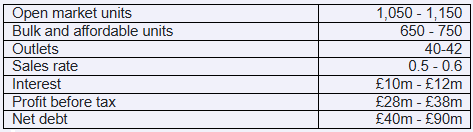
Guidance for 2025 suggests an increase in open market units and higher adj. PBT, although net debt is also forecast to increase:
Graham’s view
Readers may know that I tend to value housebuilders relative to NAV first of all, before other considerations.
Today’s results from CRST show one of the dangers with this approach: NAV can be volatile. CRST’s NAV has fallen from £856m to £729m, as a result of the large reported loss in these results.
At least this £729m is still a tangible number, mostly - there are only £29m of intangible assets on the balance sheet.
Therefore, for a £419m market cap, there is a lot of “value” on offer, if we can assume that another large set of provisions doesn’t come along in the current year to wipe out this value.
I also note that Bellway (BWY) were willing to offer around 262p per share for the business last year.
However, I must be disciplined. When there is a going concern warning, I always take a negative stance, due to the risk of dilution (or worse). So I’m going to take an AMBER/RED stance on this today. I would be fully RED except that I do think CRST shares offer some speculative value.
For example, it passes the Ben Graham NCAV Screen - but would Ben Graham invest in a share that had a going concern warning, even as part of a diversified portfolio? I'm not sure.
Graham's Section
Ferrexpo (LON:FXPO)
Down 23% yesterday to 80p, now at 73.7p (£442m) - Update regarding Ukrainian subsidiary - Graham - RED
I’ve never commented on this before as it’s an iron ore miner based in Ukraine.
Keelan covered it in an article about opportunities in base metals here.
Yesterday’s RNS concerned a police investigation that Ferrexpo had previously mentioned in an update on 16th January.
The January update noted that the Prosecutor General’s Office of Ukraine had made accusations against senior Ferrexpo managers relating to “the alleged illegal mining and sale of waste products that are produced normally as a result of the mining and processing of iron ore”.
The case had been sent to court, awaiting a first hearing date.
Yesterday we had an update as follows:
FPM [Ferrexpo Poltava Mining] has now received information that a civil claim was filed seeking joint liability of FPM and its General Director for damages amounting to UAH 157 billion (approximately US$3.76 billion) in favour of the Ukrainian state.
Initial accusations on the illegal sale of waste products have transformed into accusations that FPM is illegally mining and selling subsoil (minerals other than iron ore), which is said to have caused damage to the environment. FPM rejects these allegations in their entirety on the basis that there was no illegal extraction of the subsoil.
Graham’s view
This is a geographic problem, first and foremost. Who can understand the motives of the Ukrainian police and prosecutor’s office? Not me, that’s for sure.
One of the reasons that I stay away from the resource sector is that many listed resource companies are based in geographies, such as the Ukraine, where I do not understand local politics and where political matters can and often do interfere with business. Perhaps locally-owned businesses might do a little better, but London-listed companies with foreign shareholders rarely seem to attract much sympathy from the authorities who govern many resource-rich locations.
FXPO’s homepage loudly blasts that they are “standing with Ukraine” and have been involved in providing a great deal of humanitarian assistance in the country. But apparently that is not enough to insulate them from these charges (to be clear, I don’t have a view on whether or not these charges have any merit.)
I’m going to go RED on this as a claim for $3.76bn of damages poses an extreme risk to FXPO’s Ukrainian subsidiary and I have no way of knowing the probabilities around the outcome of this claim. Perhaps it will go away and the company will carry on as normal, but how are we to know?
Made Tech (LON:MTEC)
Up 12.5% to 31.2p (£47m) - Half Year Results - Graham - AMBER
Made Tech Group Plc, a leading provider of digital, data, and technology services to the UK public sector, is pleased to announce its unaudited half year results for the six months ended 30 November 2024
I had a brief look at this in November, on the day of its AGM.
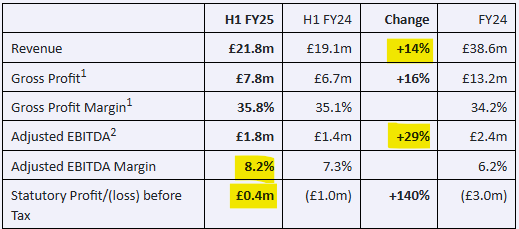
Today we have interims; here’s an excerpt from the table.
Estimates: The company is now tracking ahead of expectations for FY May 2025 and they helpfully inform us that prior expectations were for revenues of £38m and adj. EBITDA of £2.8m.
It looks like 57% of the full-year revenue estimate was achieved in H1, and 64% of the full-year EBITDA estimate.
It’s great to see EBITDA profits growing faster (at 29%) than revenues (at 14%).
Although I must point out that the EBITDA margin of 8.2% is still quite low, compared to what you might see from businesses in higher-quality sectors. MTEC is a consultant providing IT transformation services to the UK public sector.
Singers have helpfully provided fresh numbers today: they are now looking for adj. EBITDA of £3.0m this year, rising to £3.4m next year (FY May 2026). They also suggest that further upgrades are possible, and they believe the company is heading towards an adj. EBITDA margin of 10%.
Adjustments: In November, I suggested MTEC had a poor track record when it came to converting adj. EBITDA into real profits.
The table I posted at the start of this section highlights the problem, as while the company did generate a small pre-tax profit in this six-month period (£0.4m), that’s only a fraction of its adj. EBITDA (£1.8m).
When I investigate this, I find that the biggest reason for this discrepancy in H1 was £1m of share-based payments, i.e. management remuneration. This is not an adjustment that shareholders should be ignoring, in my view. And it’s a significant number in the context of a sub-£50m market cap.
Net cash: £9m, so the enterprise value is £47m minus £9m = £38m.
Current trading and outlook:
Strong trading performance expected for FY25 underpinned by £80.8m Contracted Backlog, with the Group on track to achieve double-digit percentage annual revenue growth for FY25 and free cash flow positive for the year
A strong sales pipeline, active bids, and Government stated priorities indicate a positive outlook for FY26 and beyond
The CEO echoes the above, saying “the business is in great shape to benefit from new public sector digitalisation programmes, which are expected to be announced in the UK Government Spending Review in the Spring.”
Graham’s view
Probably my favourite aspect of this stock is that it’s a likely beneficiary of the new government’s tax/spending policies, rather than a victim.
Top-line growth is good, and margins are improving.
But I really want to see this convert into meaningful profits. Latest forecasts suggest adj. PBT of £2.1m in the current year, and then £2.4m in FY26.
Write that down by 25% and we have adjusted after-tax net income of £1.6m and then £1.8m.
Whichever way you cut it, the P/E is well over 20x.
I still don’t think I can give this anything more bullish than AMBER. It can grow into this valuation, but it’s not there yet.
James Fisher And Sons (LON:FSJ)
Up 9% to 334.7p (£169m) - Full Year Trading Update - Graham - AMBER
James Fisher and Sons plc (FSJ.L) ('James Fisher', 'the Group'), a leading marine services company providing innovative solutions across energy, defence and maritime service, today provides an update on trading for the year ended 31 December 2024
Excellent news as we learn that underlying operating profit will be c. £29m, ahead of expectations.
For a small company, this enjoys plenty of broker coverage, four brokers in total. Although none of them have posted up on Research Tree about it recently.
I think the estimate for underlying operating profit was c. £25m. It looks like we have a significant beat against that number, but we should bear in mind that it includes “a contribution from several specific non-recurring items”.
Exposure to the cyclically strong energy sector has been a boon to performance (oil, gas and wind).
FSJ’s defence division has also done well, so the only weak point at the moment is the “maritime transport” division, which has seen weaker demand for ship-to-ship LNG transfers.
Net debt: within the target range of 1.0-1.5x, sounds fine. The company has a recently refinanced £95m facility.
CEO comment:
We ended the year in a stronger position having continued to execute on our turnaround strategy, including undertaking disposals and refinancing our debt facilities. As a result, we are now beginning to see the benefits of our transformation programme coming through.
The company has had a very poor run, explaining the need for transformation:
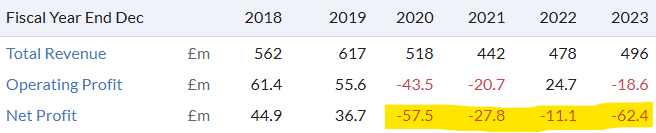
I’m encouraged to see no increase in the share count in recent years, despite the poor financial performance. Disposals of non-core businesses have been key to achieving that.
Outlook: trading in the new year has been in line with expectations, so I think we need to underline that the earnings beat for 2024 was the result of non-recurring items.
Whilst conditions in key end markets are expected to remain supportive in 2025, underpinned by structural drivers, the Group remains mindful of the continued near term political and economic uncertainty.
Against this backdrop, the focus remains on delivering against the turnaround plan, with the next phase of initiatives now underway. The Board sees opportunities to build on progress made to date and drive the business further towards its medium-term target of 10% underlying operating profit margin.
Graham’s view
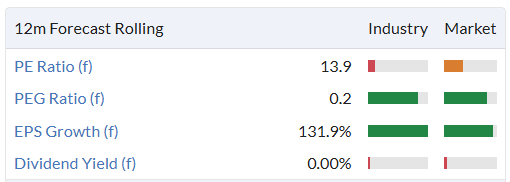
I think today's gain in the share price is a little optimistic, as the earnings beat is due to non-recurring factors and the 2025 outlook is merely in line. Nothing wrong with that, but does it justify a nearly 10% increase in the valuation?
More broadly, I was negative when I looked at this a year ago. Paul was neutral in more recent times, thinking that it could be interesting once disposals completed.
With a refinancing out of the way and a reasonable leverage multiple, I’m happy to be neutral on this now.
It doesn’t stand out to me as being particularly cheap, but it’s no longer in a financial emergency.
Well done to FSJ for getting through a very difficult period. Hopefully better days lie ahead!
Tandem (LON:TND)
up 20% to 191.5p (£10m) - Trading Update - Graham - AMBER/GREEN
This is now eligible for coverage, as its market cap has reached back up to £10m!
I used to own a lot of TND stock, relative to the size of my portfolio. I eventually got out and didn’t look back, as I got sick of the endless problems at this company.
It has been listed for decades and the fact that it is still worth just £10m tells the story.
But today’s update is quite encouraging.
2024 revenue is up 11% to £24.6m.
Adjusted PBT will be in line with expectations, although no word in this RNS about what those expectations are. It looks like about £0.5m was forecast.
For a company as old as this, operating in mature industries, a pre-tax profit of £0.5m doesn’t impress me too much, but at least it’s no longer loss-making, as it was in the previous year.
Toys, Sports & Leisure: revenue up 20%.
Bicycles: revenue up 11%. Within this, Squish bike sales were up 69%.
Golf: up 13%. Home & Garden: down 22% due to bad weather.
Outlook: “early indicators in January align with management expectations”.
Graham’s view
I’m planning to never own this share again, as I didn’t enjoy owning it the first time. It wasn’t good for my sleep! Although that’s probably got something to do with the fact that I owned too much of it.
The new management team is supposed to be more shareholder-friendly than the previous team, who seemed to view external shareholders as a nuisance.
17% shareholder Simon Bragg has been on the board as NED since October 2024. They also have a new Chief Commercial Officer on the board as of January.
Checking the most recent interim report, I see net assets of £23.3m, although £5.5m of this is intangibles. Let’s call it c. £18m of tangible assets.
As of Dec 2023, the last date for which we have an annual report, the company claimed to have £14.3m of freehold land and buildings included within PPE, more than the market cap.
So I’m guessing there is probably still some deep value available at TND. I don’t have any faith in the long-term profit profile, so personally I’m going to pass. But the stock can move when it wants to - up 20% today - and may have further to run. AMBER/GREEN.
Roland's Section
Future (LON:FUTR)
Up 2% to 953p (£1.1bn) - Trading Update - Roland - AMBER/GREEN
Future plc (LSE: FUTR; "Future" or "the Group"), the global platform for specialist media, today announces a trading update covering the four-month period ended 31 January 2025.
I remember buying cycling magazines published by Future Publishing when I was a teenager. Today the company has a broader UK/US offering, primarily online, and is also the owner of the Go.Compare price comparison website.
FY25 outlook: this morning’s trading update appears to be broadly positive. Departing CEO Jon Steinberg has left expectations for the year to 30 September 2025 unchanged:
Overall Group performance in the first four months has been as expected with the Group on track to achieve market expectations for FY 2025.
Future has helpfully provided figures indicating its view of consensus forecasts:
FY25 revenue: £776.9m (range £758.5m to £785.4m)
FY25 adj operating profit: £217.8m (range £197.3m to £223.0m)
These figures are slightly below the equivalent figures for FY24 of £788.2m and £222.2m. Future expects a return to revenue growth from FY26.
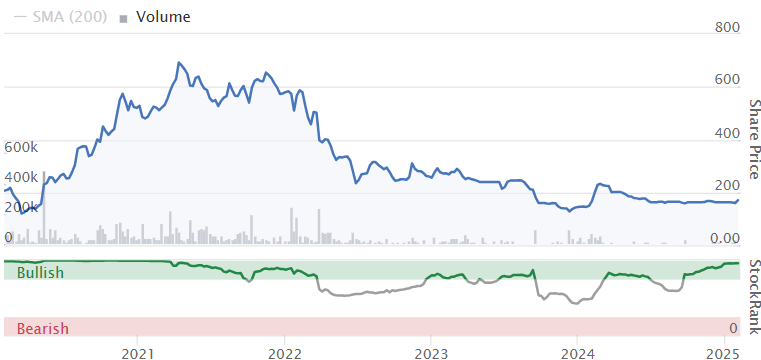
Current forecasts appear to support a forward P/E of 7 for the current year – potentially interesting value if the business does return to growth. Cash generation has been strong, historically.
Trading summary: Future generates revenue from advertising, ecommerce affiliate sales and traditional subscriptions and newsstand sales. The company was hit hard by the post-pandemic advertising slump, but is now showing signs of recovery.
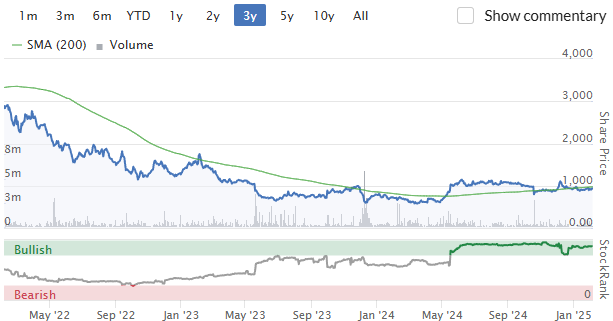
Looking at the detail of today’s update, my impression is that performance remains mixed, albeit without any major concerns.
B2C: this division includes all the consumer publishing online and in print. B2C generated 66% of revenue last year. Progress during over the last four months appears to have been stronger in the US than the UK:
Improvement in US digital advertising and ecommerce “has continued”
UK advertising “continues to be challenging”
Magazines (i.e. printed) have been “more resilient, led by premium titles”
The UK remains the largest market for Future, generating over 60% of revenue. The US generates the remainder. So slower conditions in the UK could potentially continue to hold back the performance of the wider group.
Go.Compare: this UK price comparison website enjoyed “a standout” FY24, thanks to a surge in car insurance switching. However, performance has now moderated, “reflecting the expected slow-down in the car insurance switching market”.
Go.Compare is continuing to diversify into markets such as home insurance “which are delivering good growth”.
B2B: this business provides content marketing solutions for corporate customers. Performance “remains mixed” so far this year.
Share buyback: a £55m buyback is ongoing, with just under £10m repurchased to date.
New CEO: Jon Steinberg will be replaced by Kevin Li Ying at the end of March. Ying has been at Future for over 20 years and is currently head of B2C, the company’s largest division.
Roland’s view
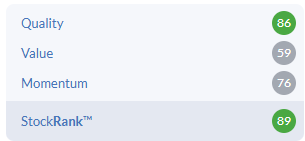
Stockopedia’s algorithms style Future as a Super Stock with a StockRank of 89. My view on the business is broadly positive at the current valuation, too.
One point I would make is that the company is a heavy adjuster of profits. In FY24, for example, adjusted operating profit of £222m translated into reported operating profit of £134m.
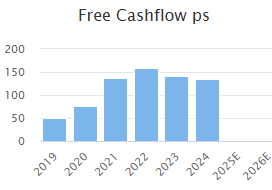
My test in these scenarios is to look at the company’s free cash flow. I calculate Future’s FY24 free cash flow to have been £156m, excluding acquisitions.
This compares very well with the current £1bn market cap, implying a free cash flow yield of c.15%.
So while I’d prefer to see fewer adjustments, in this case I don’t see it as a concern, given the company’s strong cash generation and modest valuation.
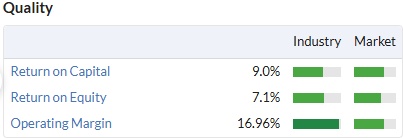
The other point I’d make is that while Future’s margins are quite high, return on capital employed and equity are more average. I think this is largely a reflection of hefty past spending on acquisitions, some of them perhaps quite fully priced:
Graham took an AMBER/GREEN view on Future in December. I don’t see any reason to change this today.
GSK (LON:GSK)
Up 5% to 1,458p (£60bn) - Final Results - Roland - AMBER/GREEN
Pharma group GSK is one of the first UK companies to publish full year results for 2024. Five weeks from the year end seems an impressive turnaround for a global business that handled £31.4bn in sales last year.
Megan covered GSK more broadly in a recent article here. Let’s take a look at some highlights of today’s results, which have been well received by the market:
Total sales up 7% to £31.4bn at constant currency
Core (adjusted) operating profit up 11% to £9.2bn
Core EPS up 10% to 159.3p at constant currency
Dividend up 5% to 61p per share
£2bn share buyback programme
Net debt down £1.9bn to £13.1bn
Trading commentary: last year’s growth was driven by the company’s specialty medicines portfolio, where sales rose by 19% to £11.8bn. This includes cancer, respiratory/immunology and HIV treatments.
This strength offset a weaker performance in vaccines, where sales were down 4% at £9.1bn. Vaccines have historically been a key strength for GSK, but in today’s results CEO Emma Walmsley suggests the group’s focus may be shifting slightly:
In particular, we are increasing and prioritising R&D investment to promising new long-acting and specialty medicines in Respiratory, Immunology & Inflammation, Oncology and HIV.
One reason for this, of course, may be the possibility that the political support for vaccines in the US is about to weaken. Sales of flagship vaccines for shingles, RSV and flu all fell last year, while the company’s Established Vaccines portfolio only managed to eke out a modest gain.
This compares to double digit sales growth for HIV and respiratory/immunology medicines, together with a near-doubling of sales in oncology, aided by recent acquisitions.
Zantac litigation: GSK appears to have (almost) resolved the litigation relating to the heartburn treatment Zantac. Today’s results include details of a £1.8bn charge related to settlement costs.
Outlook: GSK tends to provide quite clear guidance. Today we have numbers for 2025:
2025 revenue growth of 3% to 5%, versus analyst expectations of c.3.5%
2025 core EPS up 6% to 8%, aided by a £2bn share buyback
2025 dividend is expected to be 64p, giving a 4.4% yield
We also have upgraded guidance for the period to 2031:
2031 sales outlook: revenue target increased to “more than £40 billion”, from £38bn previously.
This upgrade reflects “late stage pipeline progress” with “significant phase III” trial progress since last year and “multiple launch opportunities” over the next five years.
Roland’s view
As an investor I tend to lean towards relying on quantitative metrics. GSK is always an interesting study in this way.
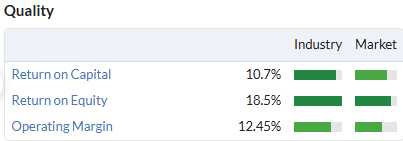
Quality metrics are quite strong, although not outstanding (and weaker than some peers):
However, the gaping chasm between core and reported profits always causes me some concern.
For example, today’s 2024 results show a core operating margin of 29.2% (£9.1bn), but a reported operating profit margin of just 12.8% (£4.0bn). Adjusting out the £1.8bn Zantac settlement improves this to 18.4% (£5.8bn).
When faced with big adjustments I generally turn to the cash flow statement to understand what’s actually happening.
My sums suggest GSK generated free cash flow of £4.2bn last year (2023: £4.1bn).
Using this as a guide suggests the stock is currently trading with a free cash flow yield of around 7%. That seems like reasonable value to me, and comfortably covers the £2.5bn dividend.
I’m torn between whether to go AMBER or AMBER/GREEN with GSK today. The company’s indifferent performance over the past decade suggests some caution may be warranted. The shares first traded at current levels in 2011:
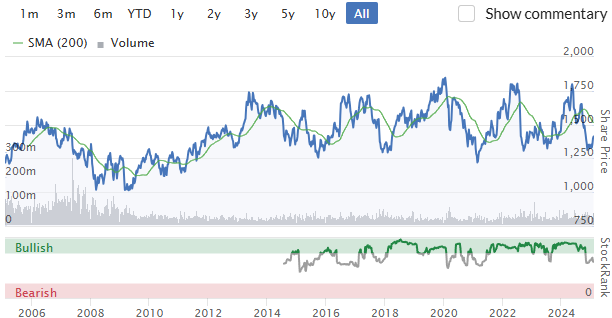
However, today’s results and upgraded outlook seem broadly positive to me and the stock’s forward P/E of nine doesn’t seem too demanding.
With the Zantac issue now (hopefully) fading into the past and the prospect of improved cash generation, I am going to take a chance with an AMBER/GREEN view.
SSE (LON:SSE)
Up 1% to 1,630p (£18.0bn) - Q3 Trading Statement - Roland - AMBER
Today’s update from this FTSE 100 utility group provides earnings per share guidance for the 25/26 financial year, which ends on 31 March 2025:
2024/25 full year adjusted earnings per share expected to be between 154 - 163 pence
The consensus shown in Stockopedia prior to today was 163p, so today’s guidance range is perhaps towards the lower end of expectations.
The market does not seem concerned though, which may be because CFO Barry O’Regan has confirmed that the group remains on track to deliver material growth in earnings in the 2026/27 financial year:
Looking further ahead, our resilient and balanced business mix continues to give us confidence in achieving targeted adjusted earnings per share of between 175 - 200p in 2026/27.
SSE is one of the UK’s largest renewable generators and reports that its renewable output rose by 26% to 9,253GWh over the nine months to 31 December 24. This increase was driven by a mix of new capacity and favourable (i.e. windy) weather – about three quarters of SSE’s renewable output is from wind.
Interestingly, gas generation remains more significant in terms of volume and has also risen. Output from SSE’s thermal power stations rose by 15% to 12,459GWh during the nine months to 31 December.
The outlook for the final part of the year remains somewhat uncertain, with “variable weather conditions” seen in January. Presumably this is reflected in the range of earnings estimates for the full year.
SSE’s transmission networks business (in Scotland) is said to have delivered a “strong operational performance” to date.
Roland’s view
SSE’s share price has pulled back substantially since September:
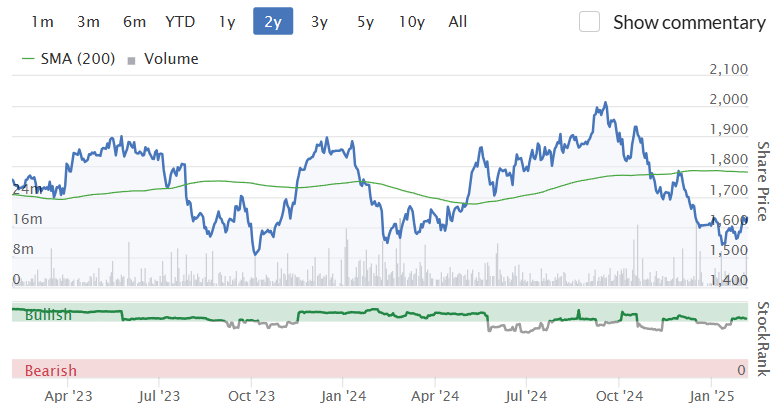
The share price decline seems to have reflected a series of earnings downgrades for the 25/26 financial year since last summer:
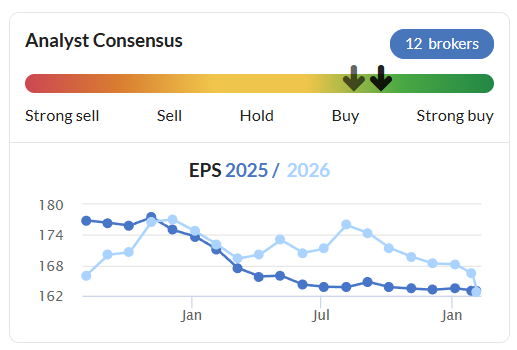
Exposure to weather-related variability and lower future prices are possible risks, but my main concern when I look at big UK utilities is usually the level of capex and debt involved.
SSE plans to invest at least £22bn in grid infrastructure by 2031 and potentially up to £32bn. The group’s net debt was just under £9bn at the end of June 2024 and will presumably be higher by 2031.
While borrowing is linked to regulated asset values (i.e. regulated income), the numbers involved are staggering and I would guess that there’s at least some risk the dividend could come under pressure again at some point.
However, SSE cut its payout a few years ago and now has earnings cover >2x. I think this should provide some level of safety unless the premise for payouts is altered.
On balance, my feeling is that the shares are probably fairly valued at current levels. The 4% dividend yield should be covered and my sums suggest investors could see a return on cost of equity of 10%-12% from buying at current levels.
I’m going to take a neutral view ahead of the company’s year end. AMBER.
Disclaimer
This is not financial advice. Our content is intended to be used and must be used for information and education purposes only. Please read our disclaimer and terms and conditions to understand our obligations.

66 comments
Fresnillo (LON:FRES) upgrade of note:
Fresnillo #FRES shines as Citi’s top EMEA gold pick! The target price was raised to 1,000p as strong Q4 gold production (+30%) & soaring cash flow yield (12%) bolster the investment case. With gold eyeing $2,950/oz, Citi sees big upside!Fresnillo (LON:FRES) certainly lags gold miners, such as Serabi Gold (LON:SRB) and Pan African Resources (LON:PAF), probably because it is not a pure gold miner. DespiteSerabi Gold (LON:SRB) going up 138%, in the past year, it still looks better value than Fresnillo (LON:FRES). I don't agree with JP Morgan's comments, maybe they are looking at commodity miners?
Silver prices are rising so Fresnillo (LON:FRES) is worth considering.
FXPO And to think folks that people thought Putin was the real risk here.
"Who can understand the motives of the Ukrainian police and prosecutor’s office?"
From what I've been hearing, Ukraine is no better at due process than the Russians.
Private investors David and Monique Newlands have acquired 3.3 million shares in Inspecs (LON:SPEC) post the update last week.
Stocko reports fcst p/e 7.4, peg 0.6.
p/b 0.44 and psr 0.23.
They have done very well at Filtronic (LON:FTC) holding 11.38% of the equity. Have they spotted value here as things turn around at Inspecs?
@SCSWSharewatch on X:
#Spec really pleasant update. Debt down , gross margin up, Vietnam plant ready to roll, lens side doing well. If they grow that top line as expected the drop through on 51pc margin is a tantalising prospect. If anyone breathes on this i think it could double.
Good news from (AIM: IKA), the UK pioneer in solid-state battery technology, announces that its collaboration with the UK Battery Industrialisation Centre (UKBIC) has successfully demonstrated its ability to scale key steps in the manufacturing of its Goliath battery, which is expected to reduce costs, increase the range of electric vehicles and reduce their charging time.
Is anyone else looking at/holding this?
I hold Ilika (LON:IKA). It is good news, but of course does not answer all the questions on whether they - or someone else - will be able to manufacture their Goliath batteries at a price close to current batteries.
One of my flaws as an investor is that I can't resist buying a few before profit companies. By and large it has been a small but disastrous part of my portfolio but recently 2 have done well - SRT Marine Systems (LON:SRT) and Cordel (LON:CRDL).
As for Ilika, I will feel a lot better about the company when they start making some real money out of the Stereax batteries.
Staffline is too cheap, says Liberum
Recruitment firm Staffline (LON:STAF) is ‘far too cheap’ given its growth potential, according to Liberum.
Analyst Joe Brent retained his ‘buy’ recommendation and target price of 52p on the stock. Staffline’s shares soared 28.7% to 24.2p on Tuesday on the back of a full-year 2024 update.
It indicated that earnings and net cash are both ahead of expectations ‘despite market concerns to the contrary’. This led Brent to increase his full-year earnings per share estimate by 10%, which he acknowledged was an impressive outcome, given the backdrop.
He said its Recruitment GB division is gaining market share ‘through deeper penetration of customers and new customers wins’, while Recruitment Ireland is ‘relatively stable’. Although Staffline’s PeoplePlus arm has seen delays he believes there is still a strong pipeline.
‘We maintain our “buy” recommendation and target price of 52p; a revised current year 2025 price-to-earnings of 6 times is far too cheap given the growth potential,’ added Brent.
I'm surprised Stockopedia did not cover Staffline (LON:STAF), as you say it rose over 28% yesterday, l suppose they have bigger fish to fry.
Looks tempting but most recruiters are in the same boat and Staffline (LON:STAF) is not well regarded.
Paul Scott reviewed last July, Amber/Red, weak balance sheet.
Singer Capital Markets - Made Tech (LON:MTEC)
"Having upgraded back in November, we have another opportunity today, following a strong H1, during which sales grew +14% y/y to £21.8m and EBITDA is up +29% to £1.8m.
Exceptionally strong sales execution was key to this, as per +233% bookings growth to £42.0m, following several ‘seven figure’ deals.
We think MTEC can maintain this rich vein of form in view of its well-developed pipeline and how Government initiatives should continue to benefit.
While we have upgraded forecasts today, we believe the company could do better still if current momentum continues.
We also take this opportunity increase our target price to 38p ~1.1x EV/FY26 Sales or 10x (unmodelled) FY27 EBITDA the latter reflects our preliminary assumption that EBITDA margins are progressing towards 10%."
Hi Graham. Hope there will be commentary on todays trading update from James Fisher And Sons (LON:FSJ) Cheers
fine example and advert for the colour flag system today with Crest Nicholson (different but similar inability as Vistry to "accrue costs in timely fashion" ) and Ferrexpro. I am not advesre to the odd investment in stocks with some red flags - but hopefully the sensible people here swerve anything with the potential for complications that can throw a huge spanner in the works - heck its hard enough trying to work out whether the company we invest in has sustainable profits medium without the dangers of these know potential issues lurking in the background that may or may not rear their ugly heads.
Ref housebuilders - i have manged to resist the temptation to dive back in here. Hopefully stuff like this for Crest Nicholson is another step towards these housebuilders being open and frank ref their provisioning - the problem is i see them partly like the banks as most ebing shsyster types who are not likely to ever admit to worst case scenario that may be reality as that would perhaps destroy the shareprice. Note i am not presuming all housebuilders are equally affected but current issues i am sure some are much cleaner than the bad boys . Times like these kinda sorts out the wide boys from the good uns. I tend to defaulty to persimmons as the yardstick average builder (they used to be wider than delboy and thats saying summit) - i see they have bounced from recent lows - but that recent low looks like a close to a 10 year plus low - at 10% over book value and p/e of 13 they dont even strike me as being cheap today - perhaps though that signals that we might perhaps be near the bottom for them - if the real worst is closing to being factored in. Note persimmon would probably be near the bottom of my list if i was to choose a housebuilber due to their previous delboy attitude to doing business. One thing to always remember is that when housbuilders do pop their value can shoot up very quickly so there is certain logic to simply being in in now for those future good times even if you dont know if and when they may return - not without risks though as evidenced by CN and vistry !
A bit more good news from hVIVO (LON:HVO) today - explains the miserable increase in SP today
https://www.stockopedia.com/sh...
Tandem
Surprisingly ok update .
I thought they might have 1-2 more profit warnings to come
I sooke to simon bragg long suffering and biggest shareholder last week and also not value investor david barry now above 3%
Previous self serving dick turpin management are now all gone. They were useless and interested in status quo of under performance no accountability to shareholders and big tickets
They were absolutely woeful and even divested of the iconic holdsworth brand to yours truly for the best deal i ever did in 35 years
New ceo i dud think was pretty average but maybe he will get there
Massiveky below NAV and big freehold new warehouse
Lots of competitors have gone
Tandem have clean stock which is very surprising seemingly didnt go mad in covid boom
E bike sales down which doesnt bother me they are a pain the the arse as hard to move around and lots of warranty issue
Mechanical bikes up 38%
Owm brand swish doing well
I know bike market is moving out of the bell curve
very illiquid , ive been buying a lot the last month or so between 1.62 and 1.70
Bit of a passion play for me as its “my” industry but hard to go wrong at these levels .
Clear signs now, and in the latest updates from both Alternative Income REIT (LON:AIRE) and Custodian Property Income Reit (LON:CREI) today, that the Commercial Property sector has bottomed at last and is slowly turning up. For those who like big dividends now looks a good time to have a good look at the bargain priced REITS. Good chance that sector consolidation will continue too.
The following Investment Trusts (and many others)get better coverage than in this post on the Investment Trust threads here.
e.g Aew UK Reit (LON:AEWU) 101p. 6% discount and 7.9% dividend,
Alternative Income REIT (LON:AIRE) 69p. 16% discount. 8.6% dividend.
Custodian Property Income Reit (LON:CREI) 75p 22% discount and 7.9% dividend.
Supermarket Income REIT (LON:SUPR) 66p 25% discount and 9.2% dividend. Big supermarkets are their clients. Can’t get much safer than that?
Schroder European Real Estate Investment Trust (LON:SERE) in the Commercial Property Europe sector 66p 35% discount and 7.5% dividend.
I hold all these except Custodian Property Income Reit (LON:CREI) which also looks tempting.
An interest rate cut tomorrow might help too, as lower gilt yields make the big yielding Investment Trusts more attractive to investors. Both Alternative Income REIT (LON:AIRE) and Custodian Property Income Reit (LON:CREI) go ex dividend tomorrow. Dividends are paid quarterly.
Here’s a key bit from the Custodian Property Income Reit (LON:CREI) update today:-
“Commenting on the trading update, Richard Shepherd-Cross, Managing Director of Custodian Capital Limited, said: “This Quarter saw further evidence that the market has bottomed out, with the last 12 months seeing two quarters of broadly flat valuations followed by two quarters of like-for-like valuation growth. These valuation increases add further support to our belief that we are at the start of a gradual upwards trend having delivered like-for-like average rental growth of more than 5.0% per annum over the last 18 months, with proactive asset management being the key driver of returns. We completed 25 plus lettings, lease renewals, re-gears and rent reviews during the Quarter at significant average premiums to ERV and previous rent, as well as continuing to make disposals on terms ahead of valuation. These activities will be supportive of future earnings and our longstanding track record of fully covering our dividend, which now offers investors an attractive c.8% yield.”
Supermarket reits
Annual charges of 3.2% puts me off investing in this sector. No wonder the share price is down year after year. whatever money they make is spent on hedge fund managers!
Supermarket Income REIT (LON:SUPR) not sure where you got that figure but management charges nowhere near that high (were recently reduced but can't remember the exact figure off the top of my head). Hargreaves Lansdown and various other platforms often quote charges which bear no resemblance with reality so worth checking the actual reports to get an accurate figure.
Hargreaves Lansdown often puts out inaccurate information they want us to invest in unit trusts so they collect .45 % in charges
Seems HL collect more on Supermarket Income REIT (LON:SUPR), so that does not make sense. Plus there are transaction fees, unlike on funds.
Rusty2.
I hold Supermarket Income REIT (LON:SUPR) with Hargreaves Lansdown in my ISA. The only charge from Hargreaves is the dealing charge when buying and selling. The charges for Investment Trusts are the same as for shares.
Not according to HL, they charge a fee.
Just gone into HL, they are charging a 0.45% fee, according to the costs, in an ISA.
I have an account with HL. There is an annual account charge of .45% on holdings within ISAs and SIPP,s
Yes that is on funds and ITs, it is not on shares. So ITs fees are more expensive, than funds and shares, if held in an ISA or SIPP. It is capped at £45 per annum.
I must have a special HL account where I am getting my b*lls squeezed. I am paying .0.45% on stocks.
In fairness the the HL explanation of charges says that you pay 0.45% on everything and have to cough up monthly.
There is an account fee but if you hold funds, that is in addition, l believe. That is why some complain about fees on funds.
Here are the fees on funds:
Funds
Shares
Including UK and overseas shares, investment trusts, exchange-traded funds, VCTs, gilts and bonds.
0.45%capped at £200 per year
The above is what I see when I open my account page
£200? I have £45.
For shares (and ITs!) it’s capped at £45 in an ISA and £200 in a SIPP. £0 management charges in a general trading account.
Yes that is on funds and ITs, it is not on shares. So ITs fees are more expensive, than funds and shares, if held in an ISA or SIPP.
Not according to HL, at least in an ISA:
https://www.hl.co.uk/investmen...
Those tiered fund fees mean you can pay a maximum of £4,000 a year if you've £2 million invested. The same amount in investment trusts would cost you £45.
timarr
OK, l was confused by HL costs, which shows 0.45%.
The HL example could be much clearer. If you already have over £10,000 in your ISA or SIPP, in shares and ITs, there will be no fees. The way they show the costs, it looks like it is the same, as on funds.
RE SUPR
From memory I think that there was a change in the way that charges were levied - share price/NAV.
I have recently bought a small position based on the recent Fitch report. I don't have a strong conviction here as this has looked cheap for ages and then got cheaper.
The Fitch report highlights the bear points which could be useful to keep in mind. Borrowings slightly higher than peers and sensitive to interest rates being higher longer.
I don't trust valuations as experience across various property sectors suggest these are as much an art as a science - so these are not that material to any investment decision.
The good news is that SUPR let in the main to blue chip supermarket chains and the default risk fairly low I would guess. These chains are however are much bigger than SUPR and probably quite demanding when renegotiating leases.
yadi.
Don’t know where you got your figure from.
afaiaa these are the charges for Supermarket Income REIT (LON:SUPR).
“Supermarket Income REIT (SUPR) has an ongoing charge of 0.95% of its Adjusted NAV (ANAV) up to GBP 500 million. The charge decreases as the ANAV increases. The ongoing charge plus performance fee is estimated to be 1.36%.”
These charges are taken out of the share price. There has been a big problem with misinformation on Investment Trusts charges and it has been a factor behind some of the weak share prices and wide discounts.
Yes this really needs to be sorted out as it must be a factor behind the huge discounts these things trade on - there will be a lot of investors like Yadi who will see this 3.2% figure and simply refuse to buy (I've lost count the number of times I've seen people complain about these 'charges' and refused to even consider them as a result)
You’re SO right Bouden about the misleading and inaccurate too high Investment Trusts charges needing sorting asap.
Here’s an Investors Chronicle article by John Barron about this. It’s behind a paywall but the first 2 paragraphs are there and are well worth reading.
https://www.investorschronicle...
I’ve invested in Investment Trusts very successfully for many years now, and except in the rare cases where charges are excessive, I don’t let charges influence my buy decisions. The underlying investment case and wider than usual discounts to NAV are far more important
Posts today going on about those incorrect charges and still believing they are right reflect misunderstanding about those charges. Perhaps too those posts reflect people not realising that unlike Open Ended Funds/Unit Trusts, Investment Trusts can be bought at sometimes big discounts to Net Asset Value.
I.e an Investment Trust at a 40% discount to NAV of £1 can be bought for a discount 60p! Investors opting for a similar Unit Trust are charged the full £1. Plus points like that along with being able to trade them instantly unlike Unit Trusts, dwarf the often very reasonable charges. And Investment Trusts don’t lock their investors in as Unit Trusts sometimes do when there’s heavy selling. Investment Trusts simply go to ever wider discounts…..creating some great buy opportunities !
While this inaccurate charge nonsense continues to fester it will put off investors from buying Investment Trusts. But it also means there are some at extreme bargain prices, including some of those in my posts this morning including Supermarket Income REIT (LON:SUPR) where timarr posted this today:-
"I hold quite a lot of Supermarket Income REIT (LON:SUPR). Unless there's something wildly amiss here it's staggeringly cheap."and if they are paying dividends of 8% or more a year, there is decent income while waiting for correct information on charges to prevail again. “
SUPR charges
I obtain the figures from the documents on ii and Hargreaves website.
Thank you all for enlightening me on this subject. As you say I passed investing because of this charges. Now I will reconsider my decision.
Thanks again.
Were these fees on HL? l can't see them, l can see an HL fee, in the Key document, other costs are all nil.
3.26 % listed under the charges / costs section please Rusty
Can't see it, l can see:
In the Key document it has no costs, apart from HL fee.
On a laptop there is a costs tab please Rusty...
On mobile the tab is called charges please
OK found it now, but that includes HL fees.
My understanding is the ongoing cost is 2.32% per annum (excl any annual costs, if any, taken by the platform_
The cost disclosure document provided by II shows the initial cost is 2.64% + the cost taken by the provider. Then there is a 2.32% annual ongoing cost.
The same 2.32% Net annual ongoing cost is shown on HL website
The 2.64% includes the 2.32% fee. Total charges on ii are 3.18%, first year, subsequent years will be lower as no transaction fees, unless you trade it.
Hi Rusty. Is my understanding correct that after year 1 the annual ongoing cost is 2.32%* (plus any costs incurred by the platform provider).
I believe so but l have only started looking at it today. The high fees are rather off-putting, l must admit.
Supermarket Income REIT (LON:SUPR) Maybe the share price went down because of the large dividends?
No Rusty, the big dividend is a consequence of the big fall in the share price from 130p to current 67p and the share going from a premium when the sector was in favour to a big discount now that it isn’t. Same applies to other Investment Trusts and in other sectors that have fallen out of favour. There are plenty of oversold Trusts available.
Supermarket Income REIT (LON:SUPR)
Annual charges of 3.2% puts me off investing in this sector.
As a few people have noted these charges are wrong.
The issue is an EU inspired regulation called PRIIPs which, while well intentioned, has led to fee disclosures that were both confusing and, often, just plain wrong. They're a one-size-fits all approach which is particularly ill-designed for investment trusts.
The main issue is that PRIIPs led to IT's double counting their costs when purchased through a platform like HL or AJB. This in turn has led to wealth managers avoiding IT's because they have to double disclose the doubly disclosed charges. Or something. It's too confusing to work out the details.
The upshot of this is that IT's are trading at insane discounts and yields which the better informed private investor is greedily lapping up in the sure and certain knowledge that at some point the dozy and supine FCA will actually do something more than the current vague instruction that PRIIPs can be ignored - which is itself being ignored by a number of platforms.
Anyone with a penchant for cheap, safe yield should acquaint themselves with the monthly Investment Trust thread run by Charles and ably supported by Ken.
timarr
P.S. I hold quite a lot of Supermarket Income REIT (LON:SUPR). Unless there's something wildly amiss here it's staggeringly cheap.
"I hold quite a lot of Supermarket Income REIT (LON:SUPR). Unless there's something wildly amiss here it's staggeringly cheap."
No I don't think you have missed anything. As you can see from my earlier post I have recently bought at 67p and I would consider myself a very cautious investor.
The principle risk for me is that interest rates are higher longer. Then also the concern that in an inflationary environment the big supermarkets seek to renegotiate inflation adjusted leases.
A minor concern - but one I do keep in mind is the ASDA situation, where the company is being squeezed from all sides. Fortunately, SUPR has relatively low exposure to ASDA.
At 67p - a cautious buy for me.
Sharescope reports the Total Expense Ratio to be 1.357%. I'm happily paying that (it's already in the share price) for the (IMO) quality, reliability and safety of the dividend. I believe this trust will re-rate closer to NAV in due time. Until then, and most likely well beyond that, I'm happily collecting the dividends.
The other way to play this sector is via the ETF iShares UK Property UCITS ETF GBP (Dist) (LON:IUKP) which has a divi of 4.7%. I don't think you'll get the same gearing as some REITS when markets improve, but it's a safer way to play the theme.
I hold along with Supermarket Income REIT (LON:SUPR) & Assura (LON:AGR) which both have massive divis, safer tenants, and big NAV discounts. The downside is their LTV is relatively high so if you thought interest rates might go up that could be a problem; it also means the upside from declining interest rates is bigger. It's some time before they need to renew substantial loans - looking at the loan book, and when loans are due to be renewed or paid off, is key in this sector.
Crest Nicholson Holdings (LON:CRST) yesterday stated
"FY24 operational summary
· Practical build completion was finally achieved at Farnham in September. This has been a challenging and complex development. We are disappointed with the additional costs incurred in FY24 but the majority of residential units are now occupied with less than 13% of remaining apartments to sell through"
What they didn't mention was the occupancy on the commercial units, as per https://www.brightwellsfarnham...
My understanding, from someone who ate at Monte Forte in Brightwells on Saturday, is that only Reel Cinema, plus 4 of the 25 commercial units, are currently occupied. This is unlikely to be helped by the slated opening of a Wetherspoons close to Brightwells, albeit there seems some doubt as to whether this is happening.
I mention this because, in trying to draw a line under the Brightwells fiasco, Crest Nicholson Holdings (LON:CRST) seem to be being a little economic with the truth.
Crest Nicholson Holdings (LON:CRST) The price reaction was surprisingly mild. A going concern warning is a major red flag. The large provision for remedial work also indicates very poor quality work. Who would buy a house from this outfit?
As a long term holder in Ferrexpo (LON:FXPO) back to 2016 and one of my most profitable shares over time I would much appreciate any comments from those who perhaps know about Ukraine deemed I know before Russia invaded to be one of the most corrupt countries in Europe.
It is not looking good in my opinion.
I don't know anything about the latest Ferrexpo (LON:FXPO) news regarding a civil case, however it's main plant in Ukraine is on the 'wrong' side of the Dniepro river, and thus I would expect it to be incorporated into Russia before too long. If you examine the maps of Russian progress, you'll see they are not that far away distance wise from that area.
Can you imagine when they finally get around to rebuilding the place. Out of every dollar around 10c gets put in the ground. Bet Trump already looking ahead. End of day taxpayer pays.
I sold the rest of my Ferrexpo (LON:FXPO) this morning after top slicing a large chunk at 106p. It was a rewarding fun punt but it’s too risky for now. I did flag up the buy opportunity here at 47p but unfortunately it was immediately rubbished by a blunt but influential poster, so that might have put most off looking any further.
Is there a chance you're confusing being lucky with being right? The acute political risk was there the entire time you held the stock.
No Koueremenous, I was not confusing being lucky with being right about Ferrexpo (LON:FXPO) at 47p. Ahead of being elected Trump was saying repeatedly that he would end the war on day1. Obviously he couldn’t but at just 47p there was a very high chance that markets would quickly price in the increased chance of the war ending soon, so buying ahead of that getting priced in looked a very obvious punt.
I knew and posted that it was a risky buy but with potentially big short term upside. And that’s exactly how it turned out. I sold the majority of mine a few weeks ago at 106p as at that price the opposite now applied. A risk that the war wouldn’t end hitting the price hard, and as always with Ferrexpo (LON:FXPO) …they are operating in a very corrupt Country, so the risk that an update like the one yesterday is always there.
'blunt but influential'. Let me guess......... (smile)
Well done Ken. You spotted a deal and doubled your money against not a lot of downside. Great trading.
Made Tech (LON:MTEC) ahead of expectations. You know it's going to be a good H1 report when the figures are all in a chart front and centre.
Totally agree, ahead of upgraded expectations and good FCF generation together with strong pipeline. FWIW my wife has been in discussions with getting them to deploy AI solutions within a government environment.
In fact going further through the figures:
Only needs another £16.2m to meet this years ahead of exp, having achieved £21.8m already
Potential £3m FCF this year
FY26 revs expected to be £40m
I'd expect more broker upgrades again.
For balance, I would want to see H2 has converted the backlog into realised revenue. Missed out on some projects, perhaps better salesforce? Also, scaling up whilst keeping costs down may be an issue?
Made Tech (LON:MTEC) H1 order book is up 44% and a has a double Ahead update.
Take a look at Ed’s articles on outperformance from Ahead announcements and the one on shares showing Trend Clarity – Both apply to MTEC