Daniel Thwaites (THW): A smooth brew

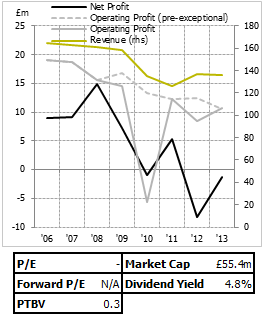 Going back to a pub group feels like a bit of a homecoming - I spent a lot of time when I was starting out with investing looking at Marston's, the brewer and pub co., but never invested. In many ways they typify how my opinions on companies have changed; I was drawn to Marston's back then by the fact such a large and established company was trading at a sizable discount to its book value, and when I'm explaining how I invest to people who ask - or am trying to put things in a way which is tangible and easy to understand - I often start with a company like this. I'll structure this post a little differently from some of my others, then, as a quick tutorial of how things have changed.
The simplest thesis
The easiest argument for why Daniel Thwaites (OFEX:THW) is trading at a discount is fairly evident from the graph/statistics I include with most of my brief stock analyses - the PTBV, price to tangible book value, is at 0.3. This is to say for every 30p (£0.3) you invest in the business, you receive £1 of net tangible assets. Net tangible assets is a figure which simply looks at all of the things they own - mostly property and land - sans all their obligations, like bank borrowings and payments to suppliers. In that sense, if the book value fairly reflects the market value of these assets, we have a lovely, simple investment hypothesis - a company surely can't be worth 30% of the 'value' of its underlying equity, can it?
To answer that question, we need to think about how that value can be realised - and there's evidently value there, in those property assets. Firstly, most obviously, we might argue that the company should be trading at the value of its assets because, in a worst case scenario, they can simply sell the property and get their money back. If profitability is elusive, they can just get rid of their assets, pay off their debts, and return the residual to shareholders. We even get a nice (70%) buffer between the market value and the book value. Secondly, and slightly more nuanced, we might argue that a book value this low is a hint at underlying cheapness, because it implies ludicrously low returns on the company's assets. As I talked about here, in my post on return on capital, capital will always flow to where returns are greatest. The corollary of this is that capital flows out of markets where there's no money to be made. We can see this easily enough from the industry itself - pubs, like so many other businesses, have been in rather stark decline over the last few years. That's simple economics in action - supply and demand is mismatched, returns are inadequate and thus the 'supply' of pubs is shrinking. If we have faith in the efficiency of the market, then, expected returns from assets will always normalise in the long term. It's not too much of a stretch of the imagination to see a scenario in a few years where pubs are doing better - lots have closed and consumer confidence appears to be on the way back up. If it is, and conditions conspire to put more money back in the pockets of those who'd quite like to spend an evening (or a long afternoon) down the local, things could look up.
The problem with assets
The problem with relying on the value of the underlying assets is manifold. If we're trying to talk about the simplest reasoning - that it provides a floor value because it approximates what the company could be liquidated for, I'll focus on two. Firstly; there are enormous costs associated with wrapping up a business which make the practical 'value' of a business, if ceased today, far less than the value of those assets. Assessors may have their 'market values', but getting market value in anything like a quick sale for hundreds of pubs doesn't seem hugely likely. The same goes with brewing equipment - how many buyers of used brewing equipment are there in the current market, and how closely does a neatly-depreciated book value relate to what they would pay for it? The asset side takes a hit, then, and the liability side stacks up, too - ceasing contracts, prematurely ending operating leases, factoring in redundancy payoffs and tapering down of production (with a few enormously loss-making months) requires a lot of cash. Business statements are written on a 'going concern' basis, after all. Secondly, there has to be a desire to actually liquidate the business. Who provides that, particularly when point one is considered? Most simplistically it could be considered to be either a) management, deciding that returns are insufficient and they want to return cash to shareholders or b) someone hostile to management but feeling the same way. Given all the uncertainties involved in the valuation of their assets and the fact they're a relatively small company with low trading volumes, it doesn't really sit anywhere on an investing horizon.
If we're unable or unwilling to realise 'fair value' by selling the assets, then, we're mostly left with option two - pencilling in an improvement in returns in the future.
The problem with returns
Surely an operating capital of ~£280m can generate more than £11m in operating profit? You would hope so. Unfortunately for Thwaites, their operating profit has hovered between £10m and £20m since 2006, falling in more recent years as their operating capital has fallen. Returns have hovered about 3-4%. This is an extremely low return figure, and it's one they've consistently achieved. Much of their value in the years leading up to the recession, I suspect, came about from the rising property value of their portfolio, and not excellent operating economics. Now that trend has reversed - and people looking at the business, like me, no longer pencil in big increases in property values in the future - we're left with the bare bones.
Where's our nice, economically logical mean reversion? It might be in the future, to be fair. Perhaps, in our theoretical world, now analysts and industry insiders have stopped expecting property value appreciation, the economics of the underlying businesses will normalise to higher levels of profitability.
I doubt it, though. To invest in the markets you need to have a healthy scepticism for the efficiency of markets, in my opinion - if the world was as neat and rosy as the textbooks model it, there wouldn't be much to investing at all; it'd all be rather more predictable. My feeling is that - and I might be wrong - pub groups are under enormous competition from a lot of sources and angles (restaurants/supermarkets, for instance) and are the victims of rather bad demographics. Young people just don't drink in pubs like previous generations did. Even given the sizable decline in the number of pubs over the last decade, returns haven't been great industry-wide, as far as I can see.
I don't think this is as much of an economic anathema as the theory might have us believe. I've seen plenty of examples of recurrent high returns on capital - so it's likely that there are some persistently low ones, too. The reasoning for this, at its core, has to be that there's too much capital in the industry - too much money chasing too little profit. Why might that be in the case of the brewery/pub industry? My instinct is that many of these companies, like Daniel Thwaites, have been around such a long time there's simply no realistic prospect of them shutting up shop, even with years of sub-par returns.
That's a rather industry-specific reason, but it's something that rather reminded me of something Warren Buffet said in one of his Berkshire Hathaway letters to shareholders. After years of operating in a textile industry which had in good years produced mediocre returns on capital and in bad ones lost money, he noted that he suspected other textile company chairmen had likely done exactly what he had done over the last few years. Individually, they continued investing in the business to earn an edge over their competitors. Collectively, they were simply plowing money back to cancel each other out and earn more sub-par returns on a higher capital base.
I suspect you can't escape unfavourable economics, and in industries where your product is hard to differentiate (pubs, I would say, attract sales based mainly on location), the collective attempt to get ahead - and not to give in, of course, because all management teams think they will outperform - simply dooms the sector to an overall poor performance.
In summary
If you agree with me that returns are likely to continue to be poor, Thwaites's discount to book value is justifiable. The size is justified by the significantly below-average returns on capital. You can look at this another way, if you like - and I often talk about this when I mull on the 'cyclicality' of it all - and wonder what their underlying assets are really worth. If their assets have such a poor return on capital for so long, perhaps we should simply start to think about it another way; that their assets just aren't worth what the book value says. It's two sides of the same coin, really.
In many ways it's a shame to have such a long post talking about Daniel Thwaites with so little discussion of the actual business itself - 200 years old, a company with a long and storied history in the north-west of the country. Perhaps that's the sort of sentimentality that keeps an otherwise heavily oversupplied industry so competitive. Perhaps I'm just a hopeless pessimist, extrapolating the declining trends out endlessly.
Either way, I won't be investing. I think the most likely source of a revaluation for the company will come if investors start brightening up on their property assets again - but that, to me, is hugely speculative.
Disclaimer
This is not financial advice. Our content is intended to be used and must be used for information and education purposes only. Please read our disclaimer and terms and conditions to understand our obligations.
No comments yet
No one has commented here yet! Why not be the first one?