Dart Group (DTG): Decision time

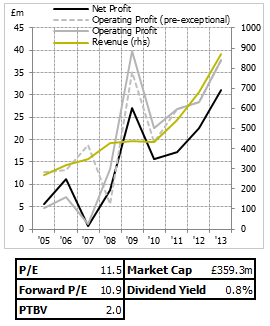 Dart (LON:DTG) has, as I mentioned in my portfolio review last week, seen a rather strong rise in the time it's been sitting in my portfolio. I bought at about 90p back in July 2011, and after a (not at all worrying) 40% drop in value in the first half year of holding, it's now seen an relentless surge and sits at about £2.50 a share. Before I get into talking about Dart's position now, I just want to note that the story above illustrates quite nicely a principle I was talking about in the comment section of that post:
I am a little stubborn as an investor. I don’t buy into the stoploss mentality. I think buying shares because you think the market is irrational and misprices securities is a perfectly reasonable thought process – but then saying that you’ll sell if it falls below some arbitrary, predetermined value is a little suspect. I stick to my guns almost relentlessly unless either I realise I was wrong in the first place or something significant changes.
Being a long-term, fundamentals based investor is sometimes at odds with much of what is apparently market mentality, and is even more often at odds with what seems like common sense or ingrained behaviour. I don't want to take the intellectually seductive line in painting 'value investors' (a phrase which, as I've learnt, hasn't a great deal of meaning) as stoic, noble stalwarts against the foolishness of the market, but when investing you always have to ask yourself what edge you have over the market - what it is which makes you better. It's not a question about deserving a better return as such, but if you're investing in the hope of doing better than the fund managers and their fees, you have to understand what you're bringing to the table which means you can earn a better return. Looking at smaller shares is a good start, in terms of both taking on additional risk (a reason congruent with EMH) and in terms of allowing more potential for pricing error (a reason at odds with EMH). Even better is having the conviction to ride out big falls in the knowledge that it is exactly your perception of a mispricing that caused you to buy in the first place. Why can't it become more mispriced? In short - don't bury your head in the sand, but as Dart proves, sometimes you have to ride out the pain to see your conviction vindicated. Whether you can do that depends on the confidence you have in that conviction. If I was a better investor, I would've been able to take that a step further, and enjoy the market's madness by buying even more.
On Dart
What's happened to Dart in the last 2 years, then? Firstly, obviously, the price increase makes the business less attractive from a valuation perspective. If we simply look at the P/E ratio, though, we're still not too expensive - put two and two together, and you get the strong earnings growth they've enjoyed over the last few years. Both revenues, operating and net profit have gone up year-on-year since 2010, and now stand about double the level in that year. On a price-to-book basis, however, the company is significantly more expensive than when I bought. Investors enjoyed a 30% discount to the value of all their assets minus their obligations then, and now we pay a fairly significant premium. This is testament to the way the company has grown. They've essentially leveraged up a little, with £120m in effective debt (through operating leases). The working capital situation is also very favourable for Dart, particularly when they're growing - they receive money from customer bookings well in advance of when they have to pay their suppliers, and as such, normal business growth problems are essentially reversed. They don't have to stump up cash to grow; they get given it beforehand.
That cash does complicate things from a valuation perspective, though, and there's been rather a few differing opinions offered on it around the web. I take a fairly relaxed approach. I think the £220m sitting on their balance sheet is like any other source of working capital, really; how much it needs to be there entirely depends on how readily the company has access to other forms of capital. What we really want to know is what a suitable level of cash the company should be holding is. In reality, that's a question management are best placed to answer - it's something that should be tapered with the level of forward bookings expected (since growing bookings means you can be more aggressive with how much money you use). Implicit in that answer is how beneficial the current situation is for Dart, though.
There's a number of interesting more qualitative stories at play here, too. Jet2 Holiday's great growth is testament to the fact that the company is doing something very right in that respect, and the results highlight the nice synergies in having an airline business and the retail facing holiday business, too. Most obviously, it means your airline is less reliant on other people sending customers your way. Fowler Welch still strikes me as a slightly strange diversion from the two clearly complementary main businesses. I wonder how much desire there is to sell this division - it's not obvious the company actually needs the money (actually, it seems unlikely they need the money at all), but from a macro perspective I always squirm a little when there's ill-fitting bedfellows under the same roof. Surely a dedicated distribution company could extract more value from Fowler Welch?
The complicating factor with Dart Group, I think, comes from the way growth is so valuable for them. The way they finance growth - through mostly operating leases, an off-balance sheet form of debt, and through advance customer bookings, basically interest-free money, compounds the usual benefits of getting bigger. Most companies have to raise money through equity or debt.
I'm very unsure on Dart. I think the share price has come to reflect a far more realistic view of the company's operations, and at the current level - much like Richard Beddard opines - I feel like much of the future hinges on the growth prospects, particularly given what I mentioned above. Brokers seem to be very bullish for Jet2 Holidays, and they certainly seem to be doing something very right, but decisions like this always make me a little bit uneasy. It appears to be a very well run business with a great regional strategy - now, presumably, entrenched enough to be comfortable re: competition, though I'm curious to see the impact of the Royal Mail rejigging, which previously helped given them an edge. I don't think I'm going to sell, because I like the business, but I no longer have the conviction that the market is completely misunderstanding it.
Yours, as ever, very much in two minds.
Disclaimer
This is not financial advice. Our content is intended to be used and must be used for information and education purposes only. Please read our disclaimer and terms and conditions to understand our obligations.
No comments yet
No one has commented here yet! Why not be the first one?