Digging Deeper - A Review of the Mining Sector in 2023

Introduction
The mining sector in 2023 experienced a confluence of challenges and opportunities, marked by evolving market dynamics, geopolitical shifts, and the pressing need for critical minerals as we attempt to transition towards ‘Net Zero emissions’ by 2050.
As we delve into the performance of the sector and its outlook for the year ahead, we'll analyse key demand and supply drivers behind precious metals, platinum group metals (PGMs), base metals, and other critical resources that play a pivotal role in various industries. Additionally, we will turn our attention to some UK stocks within the mining sector, evaluating their prospects for the upcoming year.
So, let's start with a glance back at 2023, shall we?
A Year in Review - 2023
Precious Metals
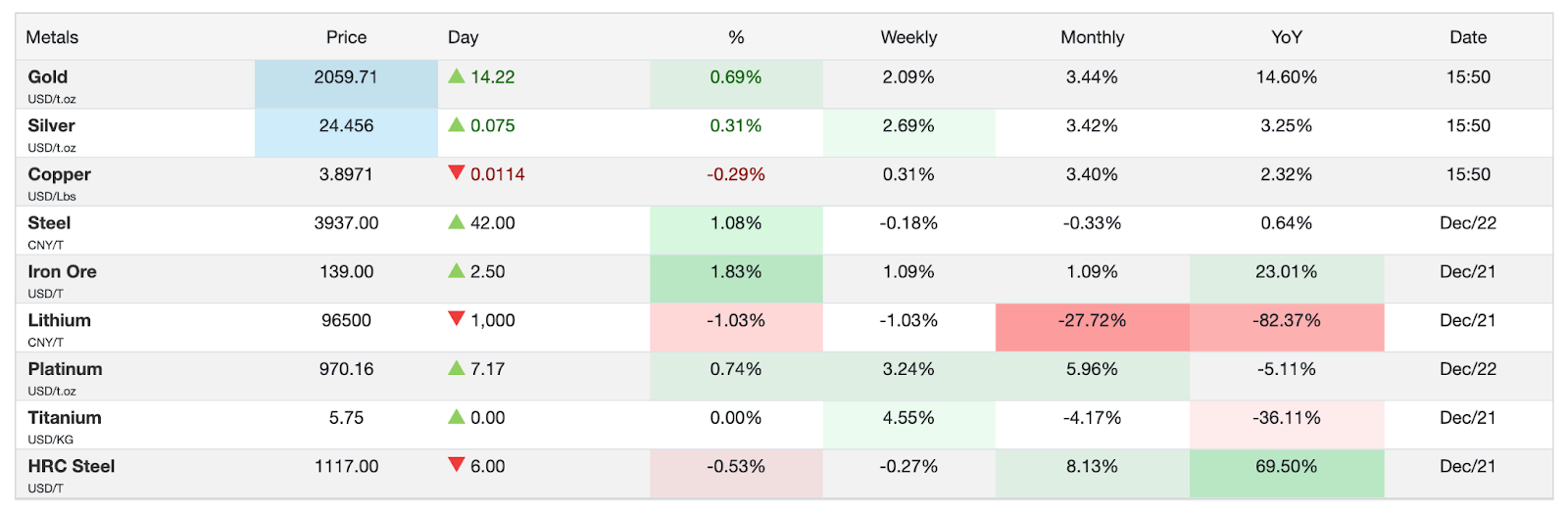
In a year of complexity and volatility, precious metals emerged as the shining stars of the mining sector. The group as a whole saw impressive performance, with gold prices up 14.6% year on year and silver prices up 3.25%. These valuable metals had investors flocking towards them, seeking stability amidst economic uncertainties.
Gold, known as the bastion of stability, held its allure as a safe-haven asset throughout the year. Its price per ounce averaged around $1,800, a testament to its enduring appeal in uncertain times.
Source: Trading Economics (Commodities Overview)
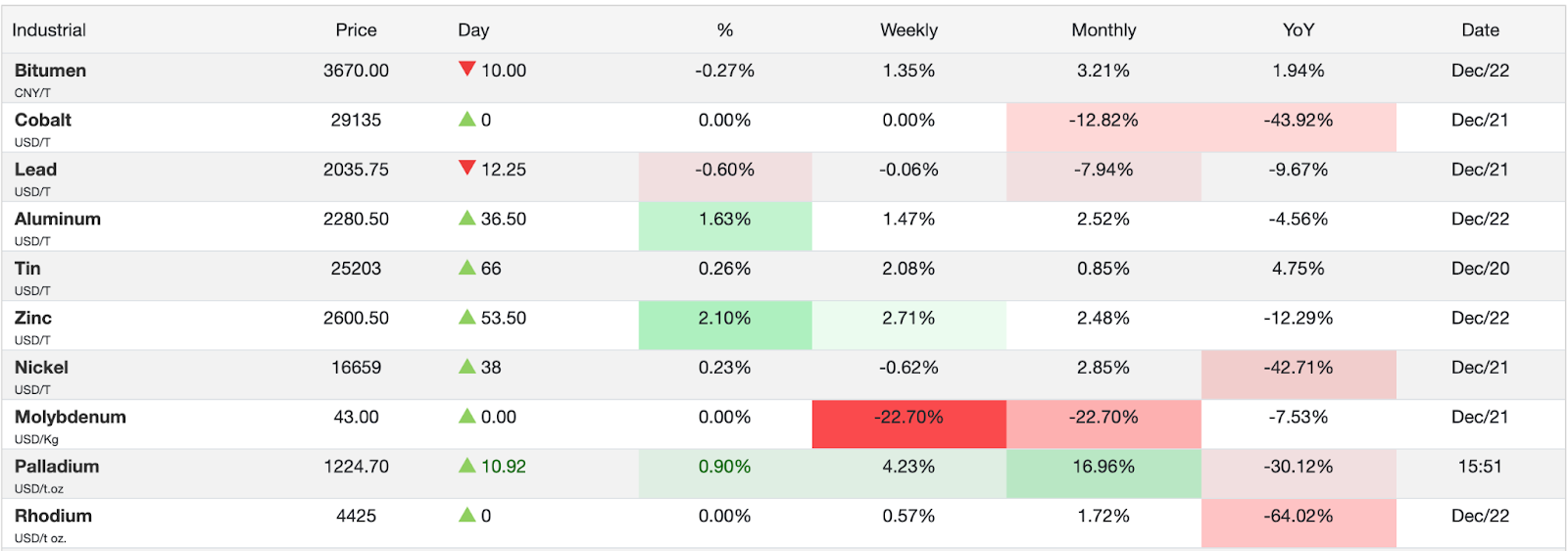
When compared to base metals and platinum group metals (PGMs), as depicted by the images above and below, the precious metals unquestionably maintained their 'safe haven' status in 2023.
Source: Trading Economics (Commodities Overview)
Base Metals
Now, let's turn our attention to base metals. Unfortunately, it wasn't the best of times for these metals in 2023. Aside from iron ore and copper prices, which managed to hold their ground, most base metals experienced a tough year.
Lead lost 9.67% of its value year on year, whilst zinc and nickel lost a whopping 12.29% and 42.71% respectively. Nickel, in particular, took a hit due to a short-term supply surplus caused by reduced demand in China's stainless steel production.
Platinum Group Metals (PGMs)
Equally notable, is the collapse in PGM prices in 2023. After a strong rally in the previous three years, a sudden drop in demand from the automotive industry for catalytic converters, the primary use for PGMs, led to falling prices.
Platinum and palladium prices were down 5% and 30% year on year, even after a recent recovery. And let's not forget about the rhodium price, which fell from its dazzling high of over $28,000 an ounce in 2021 to around $4,400 today.

Source: Johnson Matthey
Outlook for 2024 and ahead
Now, let's take a closer look at the data and explore what the future holds for the mining sector in the coming years.
Precious Metals
ING expects gold prices to reach record levels in 2024. JP Morgan also agrees with this believing that gold could reach a peak of $2,300 in 2025, and silver crossing above $30 an ounce. Analysts as a whole are maintaining a bullish outlook on gold as the Federal Reserve moves towards easing monetary policy, with a predicted 150 basis points rate cut between the second quarter and the end of 2024.
Silver, valued for its dual role as a precious metal and an industrial commodity, experienced robust demand from both investors and industries. The World Gold Council predicts a steady increase in gold demand, driven by central bank purchases and continued uncertainty in global financial markets. Silver is expected to see sustained demand from the technology sector, particularly in the production of solar panels.
Base Metals
After a difficult year, base metals are expected to recover slightly. Fitch Ratings recently raised their iron ore price assumptions for the coming years, taking into account pricing trends, restocking expectations in 2024, and a positive supply-demand balance over the medium term.

Copper price assumptions for 2023 reflect year-to-date pricing, while the higher 2024 assumption takes into account steady demand growth driven by the metal's crucial role in the energy transition, particularly in the renewable energy sector and electric vehicles.
Potential supply interruptions, such as those observed at First Quantum's Cobre Panama operations, could lead to a tighter market balance or small deficits, influencing copper prices in the medium term. Copper stock levels are also expected to remain low in the coming years with little new production coming online to meet the growing demand.
Fitch Ratings did reduce their 2024 nickel price assumption due to lower demand in China's stainless steel production. Zinc, on the other hand, looks relatively balanced in terms of supply and demand dynamics. Keep an eye on these base metals, as a slight recovery may be on the horizon.

Platinum Group Metals (PGM)
Despite a challenging 2023, there may yet be hope for PGMs in the coming years. The Heraeus Precious Forecast anticipates a deficit of 445 koz for Platinum in 2024, driven by robust global demand and potential production issues in South Africa. Autocatalyst demand should remain more stable, and the price is projected to trade between $800/oz and $1,100/oz.
Palladium faces a significant 2024 deficit due to subdued secondary supply and declining automotive demand. The price is expected to trade between $700/oz and $1,200/oz.
Rhodium is also projected to have a slight 2024 deficit, influenced by primary supply dips and challenges in the automotive sector. The price is estimated between $3,500/oz and $6,500/oz.
However, it is the outlook after 2024 that may look more promising for PGM’s as a notable lack of investment has taken place to develop new projects in recent months. See below the chart, which demonstrates a 94% reduction in non-gold precious metal capital raising over the period Jan-July 2023. Supply side shortages in the coming years could drive stronger PGM pricing.

Challenges in the mining sector
The mining sector grappled with rising production costs, supply disruptions, and geopolitical risks in 2023. Escalating labor and energy costs, in particular, have conspicuously strained mining companies' profitability. The industry's inherent labour intensity and growing competition for skilled personnel have contributed significantly to rising labor expenses.

Source: EY analysis of S&P global capital IQ pro data
High oil prices in 2023 have also contributed to higher input costs, whilst the move towards sustainability has demanded substantial initial investments in greener technologies to be made, thereby sacrificing shorter-term profitability.
When we think about mining, we can't ignore the operational risks that come along for the ride. These risks stem from the very nature of mining activities. Think of mine collapses, machinery malfunctions, or even the ever-present threat of geological hazards. After all, Mother Earth can be quite unpredictable, can't she?
However, geopolitical uncertainties can also significantly impact the mining sector. Political instability, changes in government policies, and regional conflicts can lead to sudden disruptions in mining operations. Issues such as trade disputes, sanctions, or changes in regulatory frameworks may create an unpredictable environment, affecting the profitability and continuity of mining projects. You can see from the image below, the scale of disruptions around the world in 2023.

Now that we've uncovered the perils of the mining sector, let's take a step back and consider how we can navigate these treacherous waters. How can we prepare ourselves to seize the opportunities while mitigating the risks?

Opportunities in the mining sector
Despite its challenges, this industry is undergoing a transformative phase, fuelled by the global drive towards decarbonization and sustainable energy solutions. Amidst the challenges, these shifts are unveiling significant opportunities for growth and innovation within the industry, for companies to take full advantage of.
Renewable Energy Materials: The rising demand for renewable energy, particularly solar and wind power, has heightened the need for minerals like silver, copper, lithium, cobalt, and rare earth elements. Mining companies strategically investing in and extracting these critical materials stand to benefit from the growing demand for renewable energy technologies.
Battery Metals: The surge in electric vehicles (EVs) and energy storage systems has driven an increased demand for battery metals like lithium, nickel, and cobalt. Mining companies strategically positioned to extract and supply these metals can capitalise on the exponential growth in the electric mobility and energy storage sectors.
Technological Advancements: Embracing innovations such as automation, artificial intelligence, and data analytics can enhance operational efficiency, reduce environmental impact, and elevate safety standards in mining operations. These investments position mining companies to remain competitive and sustainable in a rapidly evolving market.
Eco-Friendly Mining Practices: The pursuit of sustainable and eco-friendly mining methods presents an opportunity for companies to differentiate themselves. Implementing responsible mining practices, reducing carbon footprints, and prioritising community engagement contribute to a positive corporate image, attracting environmentally conscious investors and ESG funds.
Company Analysis
Now let’s take a closer look at some of the companies listed on the London market that offer exposure to the different metal groups.
Anglo American (LON:AAL)
On the 8th December 2023, Anglo American’s shares fell to their lowest level in over 3 years after the company reported that it was aiming to further cut costs across the business and reduce capital expenditure over the next few years. As a result of these cost-saving initiatives, which could potentially drive up to $1 billion of savings by the end of 2024, production is expected to fall by around 4% in 2024 and a further 3% in 2025.
The market was not thrilled with the news that production would be falling over a period when commodity prices are largely expected to be in a stronger pricing environment. The share price fell 20% on the day of the announcement but has recovered quickly since then, as investors were quick to notice the value of the company’s increasing copper production over the coming years.
Source: Anglo American Q3 investor presentation

Anglo American’s wide ranging metal and mineral exposure helps it to navigate the commodity cycle. The company produces Copper, Nickel, Iron Ore, PGM’s, Diamonds, Steelmaking Coal, Manganese and Polyhalite (crop nutrients). In 2021, when Anglo American’s commodity basket was last at its peak, the company generated over $8.5 billion in net profit.

Despite the fall in commodity prices, especially with regard to its PGM and Diamond operations, the company still managed to produce just over $4.5 billion in profits last year, a testament to the business’ quality and resiliance throught the economic cycle.

Even at relatively depressed commodity prices, Anglo American is still able to generate notable free cash flow and pay out a near 4% dividend yield. Its quality characteristics remain in the top quartile of the industry, and its rigorous focus on innovation and cost control should ensure that it stays that way.
Central Asia Metals (LON:CAML)
Copper, zinc and lead producer, Central Asia Metals, has endured a tougher year in 2023, as falling prices of its commodity basket have impacted upon the profitability of its operations. Whilst it generated around 40p in free cash flow per share in 2021, this is expected to halve to around 20p per share this year.

Despite the more challenging operating environment, the company still maintains excellent quality characteristics, with a Quality Rank of 93 at the time of writing. In October’s Q3 update, the company also confirmed that it is still on track to meet its production targets of 13,000 to 14,000 tonnes of Copper, 19,000 to 21,000 tonnes of Zinc, and 27,000 to 29,000 tonnes of Lead for the full year.
Source: Central Asia Metals Q3 investor presentation

Its copper production in Kazakhstan and zinc/lead production in North Macedonia have proven to be immensely profitable over the life of the assets, with operating costs in the lowest quartile of the industry. This has allowed the company to consistently pay out a dividend of around 7-8% in recent years, and return $319 million to shareholders since 2012, which is not far off the current valuation of the company.
Source: Central Asia Metals Q3 investor presentation

Central Asia Metals has also successfully grown a cash pile that now stands at over $50 million. As their mining resources start to dwindle, Central Asia Metals has set its sights on new acquisitions. They've been busily appraising 22 opportunities in the first half of 2023 and have even signed 5 non-disclosure agreements.
Now, this presents both an exciting opportunity and a potential risk for the company. On one hand, acquiring new assets could be the fuel they need to propel their growth in the future. But on the other hand, it's not without its fair share of risks, as venturing into new territories always carries an element of uncertainty.
Central Asia Metals has been known for its relentless focus on operational excellence, which has helped them outshine their peers in recent years. They have set themselves apart by excellently showcasing how things should be done in the mining world. But with new acquisitions comes new challenges, and they'll need to maintain their rigorous standards to ensure continued success.
Centamin (LON:CEY)
One of the largest listed gold producers on the London markets, Centamin, has seen its share price end the year in a strong position. Since breaking above its 50-day moving average in early November, the share price has rallied by nearly 20%.
But here's where things get interesting. If we take a closer look at the current share price relative to the price of gold, Centamin's shares seem to offer great value.
The last time gold comfortably breached the $2,000 per ounce mark was in August 2020, when the shares were trading at double the current price. Centamin’s share price has largely remained in the doldrums since falling back towards the £1 per share level in December 2020, though the company has made plenty of operational progress during this time.
Source: Centamin’s 2023 Interim Results presentation

The company’s flagship asset, the Sukari mine in Egypt, is forecast to produce between 450,000 - 480,000 ounces of gold in 2023, at an all in sustaining cost of between $1,250 and $1,400 per ounce. The Sukari mine not only promises substantial production, but it also boasts significant reserves.
Recent mine design optimisation means that the company expects to produce around 506,000 ounces of gold annually over the period from 2024 to 2032.T he all-in sustaining costs, which take into account everything from production to administrative expenses, are expected to dip below $1,000 per ounce. Production expanding and margins improving at a time of rising production bodes well for the company.
The improving fundamental picture seems to already be starting to feed through to the company’s financials. It’s Piotroski F-Score of 7/9, highlights improving profitability, cash flow generation, cost control and productivity. Analysts are now starting to raise their forecasts as well.


Centamin generated $34.9 million in free cash flow in the first 9 months of the year. During that time, the average gold price was hovering just under $1800. At the current gold price of $2,060, free cash flow is set to accelerate quite quickly in the upcoming quarters.
While it is true that the company remains vulnerable to the whims of the gold price and relies heavily on its sole producing asset, the Sukari mine, it seems they have managed to turn a new leaf after examining their mining operations. Furthermore, there could be additional impetus provided in 2024 from the company’s development assets in Cote d’Ivoire.
Sylvania Platinum (LON:SLP)
South Africa based PGM producer, Sylvania Platinum, has long been a darling of the StockRanks and Stockopedia community. However, a more difficult PGM pricing environment has significantly affected profitability over the past 18 months, with net profits falling from $99.8 million in 2021 to $45.4 million for the full year ending in June 2023.
The share price has fallen 30% over the past year as a result. Nevertheless, despite the drop in earnings, Sylvania’s operations remain lucrative and its valuation is becoming increasingly attractive.
Mining companies tend to naturally trade at lower multiples than other industries, due to the cyclical nature of the industry. But it is hard to justify a company currently trading on an enterprise value to EBITDA of just 1.7, or a price to free cash flow of 4.9.

Even at the current PGM basket price of around $2,086, this remains well above the cash cost per ounce of $771. At current prices, the company still generates an impressive $48.5 million in free cash flow per year, and its cash pile sits at over half the company’s market capitalisation.
The company’s PGM production is also growing, rising by 13% to reach 75,469 ounces for FY 2023. The potential for additional PGM production growth and Chrome operations via the Thaba JV and Volspruit development projects could yield further upside in the future.

Given the company’s significant cash resources at its disposal, it may be able to fund these development projects itself, or embark on some earnings accretive M&A activity.

Even though PGM fundamentals do not look exceedingly rosy over the medium-term, shareholders should take comfort in the generous capital returns policy adopted by the company’s management team. This policy has seen $101 million returned to shareholders in the space of 5 years, and significant share buybacks carried out.
Honourable mentions
Here are also some honourable mentions in the mining sector, which may also be worth further investigation:
Rio Tinto (LON:RIO) - Mining giant offering good metal diversification and excellent iron ore and copper exposure.
Serabi Gold (LON:SRB) - Brazilian-based gold producer, with expanding operations and potential copper upside through a partnership with Vale.
Shanta Gold (LON:SHG) - Growing Tanzanian gold producer, recently ramped up 100,000 ounces of gold production a year. Unfortunately, looks to be going for cheap as it's currently locked in takeover negotiations.
Tharisa (LON:THS) - Another very attractively valued South African PGM and Chrome producer.
What are your top mining sector picks for 2024 and the years ahead? Would be great to hear your thoughts in the comments below!
Disclaimer
This is not financial advice. Our content is intended to be used and must be used for information and education purposes only. Please read our disclaimer and terms and conditions to understand our obligations.

23 comments
Glad to see some good sector coverage here - it would be great to have something more regular in the line of the SVCR.
Shanta Gold (LON:SHG) SHG is currently my largest holding, having done pretty well in 2023. I have holdings of plenty of others you mention, but also Anglo Asian Mining (LON:AAZ) and Caledonia Mining (LON:CMCL) amongst others.
One of the key decisions is which end of the profitability scale to go for. A company like Central Asia Metals (LON:CAML) has very low relative production costs, which means it should still make a profit even when the prices for the commodities they produce is low, hence limiting the downside somewhat Perhaps counter-intuitively, a company with high production costs that's currently struggling or failing to make a profit is much more affected by commodity price changes - either one way or the other. So if you believe you know which way the commodity price is going, then it makes sense to buy (or short) the less profitable companies. Personally, I usually prefer to own the low-cost producers.
One pretty obviously binary bet is Ferrexpo (LON:FXPO) - depending on how the war in Ukraine plays out.
This is a very helpful and excellent article, thank you very much. I hold a number of the shares mentioned including Centamin, CAML, Shanta and SLP. My one surprise has been that their has not been more take overs in the sector as market caps have reduced substantially. In respect of Shanta though I'm appalled by the recommendation of the board to accept 13.5p, which grossly undervalues the company.
Understand your pain on Shanta Gold (LON:SHG) however there are two sides to this.
The city has ignored it for years, even when recently the prospects seem so good - in fact collapsing the SP recently when the Odey situation played out - lets get cheap shares! Then along comes a bid and everyone's shouting "foul".
The London market is a disaster area and is going to wither on the vine - I don't understand any company seeking a listing here.
A few years back the Russian goldies left one-by-one to cheap deals and I was left aghast (I held most) at the boards' financial advisers advising the boards that the bids were reasonable even though at pitiful premiums just as new major developments were about to come on stream.
The financial institutions in London are the problem .
Some great info here, I've just been doing some research into Empire Metals (LON:EEE) who claim to have discovered the worlds largest titanium mineral deposits.
Maybe one to watch.
videos on crux investor and proactive if you want to know more. Pitfield is the main focus but that is ONLY 1 of the 4 prospects in Australia. Very well worth your time to research. I've been in since June 2022.
Thank you so much for the info Cartman, Ill have a dig further. Pardon the pun
I actually hold Sylvania Platinum (LON:SLP) , but my focus is on a shovel and pick operation LMS Capital (LON:LMS) which is making big inroads into the US mining scene without the risks of an exploration coy the big one being price of metals!
Always find it strange.
Keelan's article (which I enjoyed) mentioned copper 12 times but iron ore only 4. Especially in these energy transition days the group think is concentrated on copper and other "green" metals. (But look at what happened to Lithium and Cobalt over the last year).
My poison is iron ore - in fact it is a better indicator of the health of the commodity market than copper in my opinion. The steel requirement of the energy transition will dwarf all other metals.
BHP (LON:BHP) and Rio Tinto (LON:RIO) have set themselves up over the years to dominate extreme low cost production mainly by spending many,many billions of dollars in the Pilbara region of West Australia.
Iron ore has been rising markedly for the last six months or so - I tend to look at Dalian futures. Looks good at the moment for iron ore producers and they have been doing well.
For people that want some exposure to commodities but don't want to research in detail BlackRock World Mining Trust (LON:BRWM) might suit - nicely liquid - normally low % discount (occasionally premium) - top 10 is essentially the worlds biggest quoted miners.
(Currently hold BHP and BRWM)
A.
(Edit. On Fitch price assumptions - in my experience these are not even close when you look at them after the event. In fact, if you look at the iron ore forecast for next year of $95 even now this looks virtually impossible given a current spot of over $140 and May 24 futures of $137.)
Very interesting article. I think the mining cycle deserves more attention. Mining goes through booms and busts depending on where we are in the cycle. The silver price for example is very close to cost of production, therefore supply will likely decline, although demand is rising from solar and electric cars.
What surprises me in this article is the table of price assumptions provided by Fitch Ratings above which, without exception, shows the prices for all commodities in the table, falling from 2022 to 2026. If this is truly the case, coupled with rising mining costs, then the sector is in real trouble.
Have I misinterpreted this table?
Ned Kelly.
Commodity price forecasts are to be taken with a large pinch of salt in my experience, and the more so out as far as 2026.
There are also convincing reasons why there could well be a multi year Mining bull market ahead. I covered some of those when starting this thread a few weeks ago:-
https://www.stockopedia.com/co...
Any thoughts on Antofagasta and Freeport-McMoRan (I hold both) and on Southern Copper?
Thank you for the article; good to see some more focus from Stockopedia on the resource/commodity sector. There has been so much focus on the China (demand) factor through 2023, yet this article correctly notes the restraint shown by companies as they protect balance sheets, focus on investor returns and high grade the restricted investment dollars. The responses to date to the article, or perhaps lack of, truly captures the uncertainty that investors generally have in this space. It is a wonder to me that so many are prepared to pile money back into crypto before taking a longer-term view on the mining stocks, which offer downside protection through balance sheet strength and dividends. OK I get that crypto makes a great momentum play as rates drop and money searches for a new home, but a correction is always imminent with seemly no backstop.
Commodities price on the margin, so whilst the consensus assumes weak demand, the lack of investment to maintain supply and the drawdown of inventories will likely lead to tightening markets in 2024. Ex-growth China still has a huge appetite, however any stimulus should quickly tip the market into supply deficit. I own most of the stocks within the article and have been rotating from US to UK miners given the better performance of the former. I also like Glencore (LON:GLEN) for its ability to trade around solid physical positions. I believe this is a hugely under-owned sector, yet with substantial market weighting, such that any market momentum will force money back into the sector as underweights become rather uncomfortable.
I have good profit on Glencore and BHP Anglo American a disaster they waste a fortune trying to produce a unproven fertiliser in North York Moors .
No mention of two of the best stocks in the sector. BHP and Glencore
Really insightful article thanks. Find mining shares difficult to predict. Currently hold Sylvania Platinum (LON:SLP) & Mineral & Financial Investments (LON:MAFL) & Tharisa (LON:THS) - hoping for platinum prices to go up ie petrol / diesel cars to pick up as I do t think the world is ready for the majority to have electric cars yet.
Never will be ready for EV's. I filled up my VW diesel tank in less than 5 minutes, did a few miles and could see that I had a range of 750 miles in hand. No amount of Gretas will convince me to change this situ.
couldn't agree with more, its interesting that volcano eruptions in Iceland are pouring tonnes of CO more than enough to wipe out any CO saving made by the UK.
Hi JSLDUK,
Thank you for your comment!
It does look like we are still some way away from an EV world. A number of governments are actually reducing EV subsidies now, Germany just ended their subsidies ahead of schedule.
I imagine a lot of buyers will now turn their attention back towards petrol/diesel cars as a result. The growing middle class in countries like India is also more likely to go with petrol/diesel cars than EVs.
Could provide a much-needed boost for PGM prices!
An alternate perspective is that Governments are no longer needing to subsidise EVs as prices are declining as mass market options ie under £30K are coming to market and fears over range (what % drives over 200miles without an hour's rest more than a couple of times a year?) and access to charging decline.
Those with an integrated EV + solar + battery (another £10K of investment) have convenient recharging on their own driveway, lower lifetime costs including financing/repairs plus a way of reducing their home energy costs. The relative cost of EVs is likely to fall sharply over the next 10 years as battery chemistry improves, faster charging becomes commonplace and renewables become a bigger part of the energy mix and energy pricing reflects it.
At the same time existing depreciated ICE factories will need re-tooling and ICE cars will need replacing and the costs of climate change will become more obvious making the subsidies and reliefs for oil & gas harder to sustain.
Older owners like Silver Moon above might be slow to want to change but the same sort of innovation S curve that cars did for horses, CDs for cassettes, and laptops for desktops is underway although it may take another 10 years to really play out as cars last that long before replacing. But look at the currently most advanced markets - US California and China to see what is coming.
As ever, the rate of change will vary by niche but the long term cost and innovation curves for EVs seem unstoppable to me.
FWIW - my current car is a 10yr old ICE vehicle.
Not a ZipCar, Zipman?
Does anyone hold Mineral & Financial Investments (LON:MAFL) here + have any views?
It’s a tiny company but holds more in cash than the market cap looks really cheap but SP has performed poorly not sure what I’m missing?
Not a sector I know much about and never heard of the company, but my first thought after a glance at the stock would be around what they are doing with the money and the lack of communication with shareholders. No buybacks, No Divis, No director purchases and very illiquid. Only a select few would take the risk.