Digging for high yields among the market's biggest mining stocks

Shares in a number of large and mid-cap mining stocks have been on a strong run over the past two years. In fact, we’ve seen several of them break-out sharply in the first quarter of 2019. And according to the latest figures, it’s not just price growth we’re seeing from the miners - it’s impressive dividend growth too. So is this a sector we should all be taking more seriously?
Not so fast. Mining of course is one of those highly cyclical sectors that has a habit of catching us unaware. As recently as 2015 and 2016 the whole sector fell out of favour and drastically underperformed the market. But while holding those stocks might have felt daft at the time, they’ve come racing back in the years since.
You can see this in a 10-year chart which shows the wide drawdown of the FTSE 350 mining index (blue line - consisting of 12 large-cap stocks) against the main FTSE 350 index (green line). It looks pretty brutal...
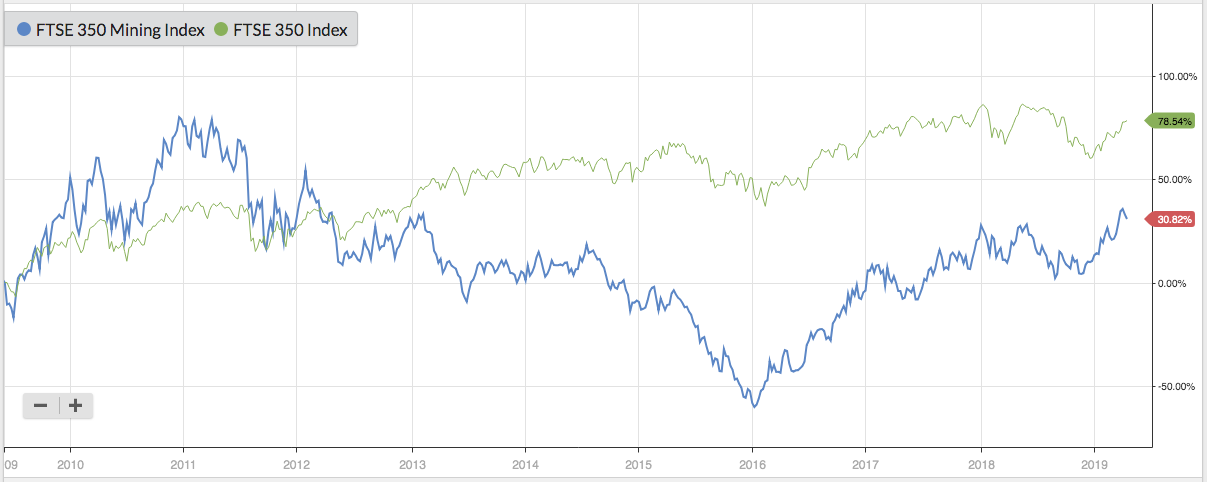
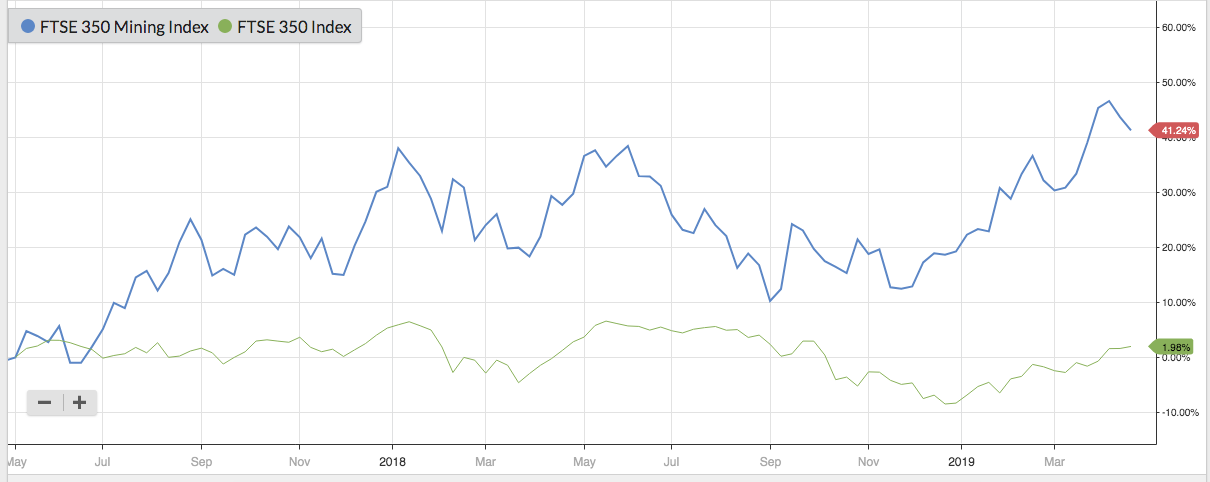
…but then over the past two years there’s clear outperformance by the big mining stocks against the index:
The causes of these swings are varied. Share prices are naturally sensitive to commodity prices, and the prices of products like coal and metals are driven by global supply and demand. Then you have to consider how individual companies are being run. Many were guilty of over-leveraging and over-expanding in the mining boom early this century. When supply fell away and uncertainty swept in, it took years to unwind those mistakes.
A recovering sector
What we’ve seen over the past few years is the end of that cyclical swing. Some of the largest companies have stripped back their businesses. Assets have been sold, balance sheets have been strengthened and commodity prices have (in some cases) been rising.
The first signs of this kind of move come when deep value investors start smiling. After years of being out of favour, mining stocks can move very rapidly and it’s the brave long-term holders that benefit first. Indeed, the moves in very large mining stocks can be swift and spectacular.
Take Anglo American. Just two years ago, the diamonds and precious metals group was worth around £7 billion. Its shares had actually been rising over the previous 12 months, so it had already moved off its cyclical low. But in the two years since then, Anglo American has doubled in value to more like £30 billion. You don’t often see such sizeable moves in large stocks.
Yet, it’s partly because of their cyclical nature that investors are generally wary of miners. Even after this strong run we’ve seen, many still attract fairly low ratings. Anglo American, for instance, trades on a price-earnings ratio of 13 times, which is forecast to fall to just 9 times next year. Evraz, which has been one of the biggest winners over the past year, trades on a PE of 5, rising to 7 times next year. That doesn’t shout these are hugely popular stocks.
Price gains and high yields
According to the latest dividend data from Link Asset Services, mining has also been the source of the greatest dividend growth in 2019 so far. Asset sales triggered a massive £1.7bn special payout from BHP, and another is expected from its fellow mining blue chip Rio Tinto. But special payouts aside, mining still managed to outpace most other sectors in Q1 when it came to dividend growth.
And while growth rates are expected to settle down as the year progresses, Link are still forecasting that the market yield will remain well above its long term average this year - and that payouts will remain strong.
So where are the biggest yields in the mining sector at the moment? Here’s a screen that goes in search of the highest 1-year forecast yields in mining & metals stocks across the FTSE 350. It includes the StockRank, which scores the overall quality, value and momentum of each stock - from zero (poor) to 100 (excellent).
On top of that, this table shows the number of dividend increases from each company over the past 10 years. It also includes the dividend cover for these stocks - most of which are well ahead of the 1.5-times that’s generally accepted as a reasonable level.
Name | Forecast P/E Ratio | Forecast Yield (pc) | Forecast Dividend Cover | Dividend increases (past 10 years) | Stock Rank |
7.7 | 8.0 | 1.6 | 1 | ||
11.8 | 6.4 | 1.3 | 7 | ||
10.9 | 5.4 | 1.7 | 8 | ||
9.4 | 5.4 | 2.0 | 5 | ||
15.5 | 5.2 | 1.2 | 3 | ||
9.9 | 4.2 | 2.4 | 3 | ||
4.6 | 3.8 | 5.7 | 2 | ||
17.2 | 2.9 | 2.0 | 6 | ||
20.3 | 2.6 | 1.9 | 5 | ||
21.1 | 1.8 | 2.7 | 4 |
As you can see, the valuations of these stocks - even after a tearing run for many of them in recent months - are still fairly tame for the most part. While companies like Evraz, BHP, Rio Tinto and Polymetal offer some attractive numbers in terms of yield and StockRank scores, there’s a definite sense here that the market is cool on the cyclical ups and downs of the mining sector.
This year some of the biggest equity market uncertainties are likely to be around Brexit and its impact on domestic economics and the value of sterling. In these kinds of conditions it could be worth considering the diversification benefits of a sector that is quite separate from the home market. And while mining stocks come with their own challenges, the price performance and yields on offer are a reminder why many find them appealing.
Disclaimer
This is not financial advice. Our content is intended to be used and must be used for information and education purposes only. Please read our disclaimer and terms and conditions to understand our obligations.

5 comments
I think that miners tend to do well later in the economic cycle and that appears to be where we are now. A lot depends on the impact of the recent Chinese stimulus and the potential US/China trade deal.
The recent drop in mortgage rates in the US may help increase demand for Copper and other materials via a revitalized housing market. This is certainly an area for consideration and I like the look of the dividend yields and their fairly healthy covers.
Or if you don't want he miner itself but want a good yield how about Anglo Pacific (LON:APF) ?
For those looking for a conservatively managed mining company focused on base metals, Central Asia Metals (LON:CAML) could well justify further investigation. Its operations in Kazakhstan and North Macedonia cover Copper, Zinc and Lead. Very importantly, it's a low-cost producer of both its mains metals: Copper and Zinc (With Lead and some Silver as a by-product).
Having raised some US$60 million in 2010, it went on to construct its Copper leaching plant in Kazakhstan from scratch (And no, it did not return to the market for repeated fundraises). Since listing in 2010 it has returned some US$160 million in dividends and share buybacks to shareholders.
It expanded its business through the acquisition of the SASA Zinc/Lead mining operations in North Macedonia in 2017 and took on some US$187 million of debt. A substantial amount of which has already been paid back. In 2018, it repaid US$38.5 million and refinanced the remaining debt on more favourable terms.
Its basic model is to return between 30% and 50% of free cash flow to investors via dividends. But investors should be aware that it does not have a progressive dividend policy. Returns are largely linked to its profitability which is why it has set itself up as a low-cost producer. If commodity prices collapse then so too will dividends.
In terms of growth, its organic prospects are limited. Growth will almost certainly come through acquisition and that is likely to be financed by debt. It took around four years of searching to find a suitable match in SASA. And last year alone it seriously looked at over 20 potential acquisitions but none met its exacting criteria so rapid expansion does not appear to be on the cards. But, in my view, it's a well-managed business with a degree of protection. It produces three main metals, operates in two jurisdictions and is a low-cost producer in the markets in which it's based. While it looks for opportunities to grow, it's paying down its borrowings. And it offers a generous yield.
By the way, I am invested in the company.
I'd be wary of ever forecasting Chinese demand. Firstly, all of their figures are frankly unreliable. Secondly, the belt and roads initiative is a huge project and involves building infrastructure globally. That is about leveraging Chinese influence and manufacturing expertise: the Chinese have built more roads, ports, trainlines, power stations etc than anybody else over the last 20 years, and now if you want them in your country it is quicker and cheaper to get the Chinese to fund and build them. I don't know where that shows up in terms of global demand. But I would hesitate to think that the price of copper or iron is about to drop because of Chinese domestic demand as it is more complex than that.
Hi Ben,
This article is really informative,but please remember that the main purchaser of metals,China, is starting to slow its demand and this will make the mining sector contract again in the next few years.