Do global multi-baggers continue to outperform?

I recently wrote an article as a follow-up to the popular multi-bagger studies, looking at the subsequent performance of the UK multi-baggers. To do this, I used two studies: "The makings of a multi-bagger" by hedge fund Alta Fox in 2020 and, more recently, Stockopedia's 2023 study, which looked at the best-performing UK Stocks over the previous decade.
The key attributes of stocks that generate exceptional performance found by these studies (and others) tend to be the same. I have previously summarised these into my "MROC" framework. Investors should be looking for companies that have moat, runway, operational leverage and are cheap.
Moat
These are companies with a sustainable competitive advantage. This means that competitors have been unable to deploy additional capital to eat into their returns over time. Instead, the company can reinvest capital at high rates to drive sales growth.
Runway
A moat is a great asset for a company, but if there isn't scope to deploy additional capital at very high returns, the business will always remain niche. For investors to receive phenomenal returns, a company requires a significant growth runway ahead.
Operational Leverage
A strong moat and significant sales growth alone can generate excellent profit growth, which may be reflected in the share price. However, the returns will be even higher if the bottom line grows faster than the top line. This is known as operational leverage.
Cheap
The best returns came from investing in companies where sales grew quickly, profits snowballed, and the multiple the market gave those earnings expanded. Multiple expansion is far more likely when investors pay a low multiple when purchasing a stock.
If these qualities are present in great companies and missing in the rest, then investing in great companies should keep generating strong returns. However, when I looked at the subsequent performance of the previous UK high-performance stocks, the results were a bit deflating. Far from being a secret of success, investing in all previously high-return stocks was a losing strategy and significantly underperformed wider market indices. In particular, the UK companies in the Alta Fox study had subsequently underperformed the UK Allshare index by around 50%.
I did manage to improve the future results of the multi-baggers from the Stockopedia study by excluding loss-making shares and those that had grown sales or share count very rapidly. However, it only improved the results to the market average rather than something more impressive.
This leads to a strange contradiction – in order to have a stock that generates an exceptional return, it must first have been a 2-bagger, 5-bagger, 10-bagger, etc. Yet the place to look for the most likely 5-bagger isn't amongst the recent 2-baggers, and 5-baggers are more likely to give up their gains than become a 10-bagger. This doesn't mean that the MROC framework is worthless. It is an excellent way of finding stocks with the potential to multi-bag. It is just that other factors appear also to be driving high returns, such as investor sentiment, and these are far more likely to mean revert than continue to drive high returns.
When I did my initial analysis, I only looked at the UK stocks because these companies are stocks that the average UK investor would have heard of. However, the UK market has been a bit of a global laggard lately. Perhaps my results were due to the quirk of fate that has made the UK a relatively poor-performing market. Maybe multi-baggers in other countries fared much better. In particular, many investors feel that the recent strong performance of the US market makes it a much better hunting ground for high-return stocks. But is this true?
The Data
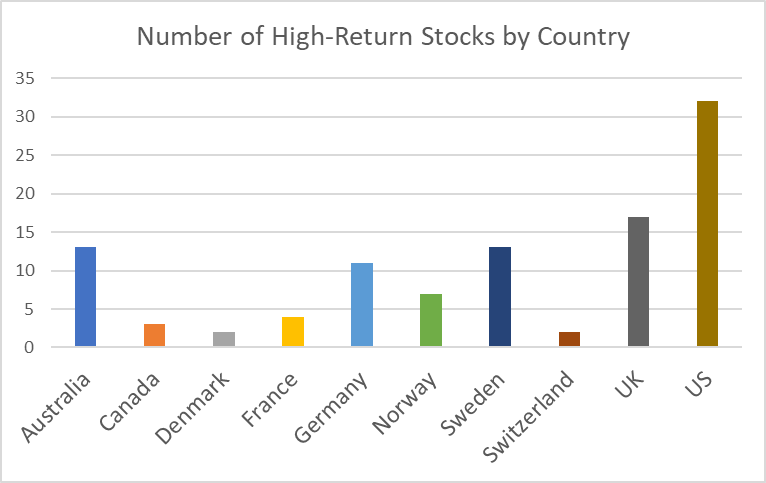
Thankfully, the Alta Fox study was a global study of the best-performing stocks domiciled in North America, Western Europe, and Australia (excluding energy, materials, and financials), so I have the data to answer this question. Of the 104 stocks that delivered greater than a 350% return in the five years, this is the country breakdown:
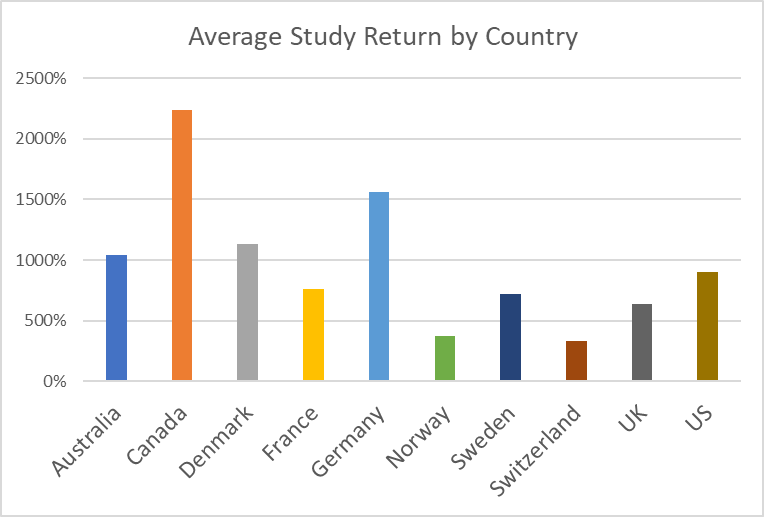
Here is the return of these stocks in the Alta Fox study by country:
However, this is the average return of these stocks after the initial study ended on 8th June 2020 through to 20th September 2024:
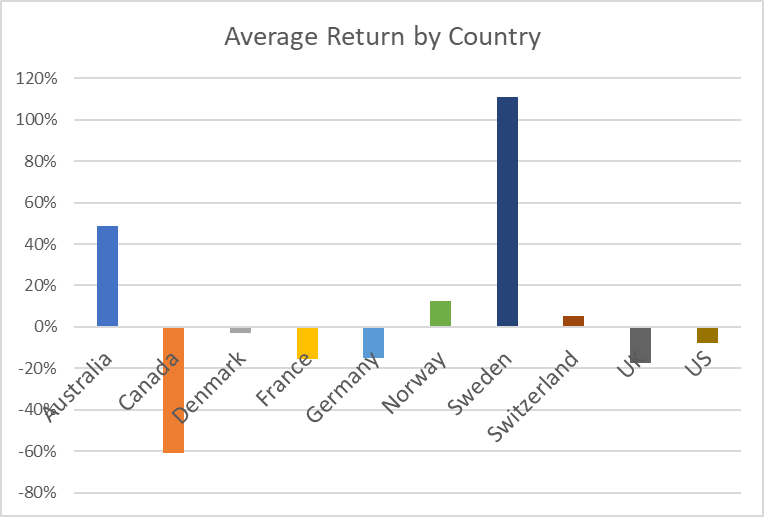
Far from being an outlier, the UK performance is fairly typical of these types of stocks. Indeed, the US stocks faced a similar loss, on average. Only Australia and Sweden were in positive territory. This performance is even worse when we look at the returns compared to the indices for each country:
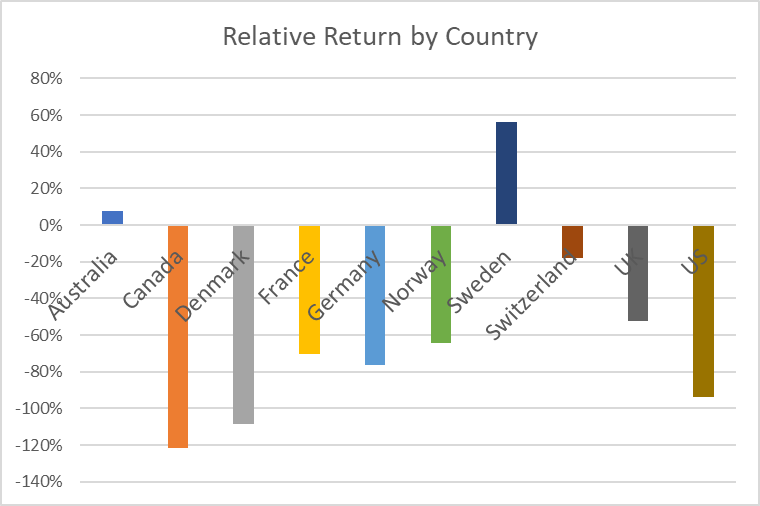
In this case, only Sweden generated a significantly positive subsequent relative return.
[Note that I have simply taken the index return from the absolute return, so this can go below -100%. This doesn't mean that investors have lost all their money. For example, Canadian index investors received a 61% price return from June 2020 to September 2024. Those who held the past Canadian multi-baggers from the end of the study lost 61%. Index investors ended up with four times the amount of money in the end!]
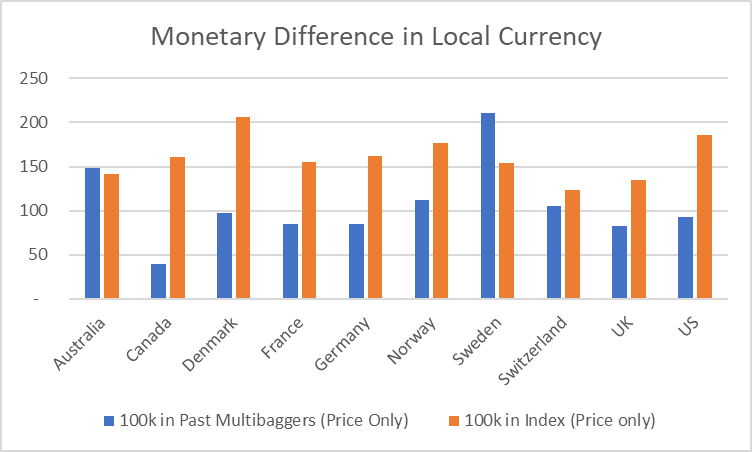
Taking the weighted average across all these stocks, they generated a 12% return in the subsequent period. However, the weighted average of the indices generated a 62% return, giving a 50% relative underperformance for the whole set of stocks. The broader conclusion matches that of the UK-only analysis: past multi-baggers are more likely to underperform than continue to generate those great returns.
What made the difference?
When I analysed the Stockopedia UK multi-bagger data, I found that extreme returns led by exceptional revenue growth tended to mean revert. The same effect can be seen here in the global data. The very high return stocks in the Alta Fox study are some of the worst performers subsequently:
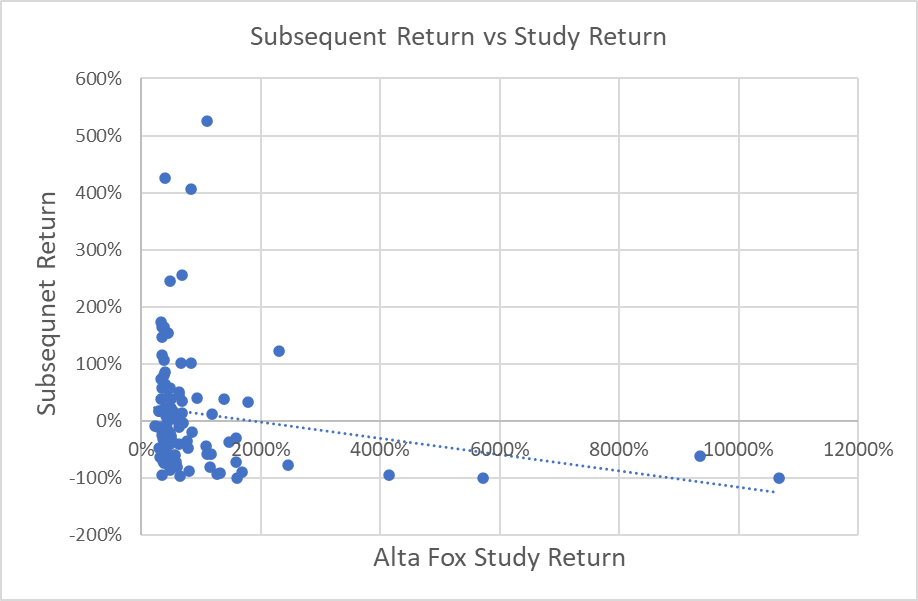
Notably, in the top 20 highest-performing stocks in the Alta Fox study, three were total losses; two went bankrupt, and one turned out to be a fraud. I call these Icarus stocks—they flew too close to the sun! While the relationship here is clearly negative, it is also noisy. Even some more modest-performing stocks suffered a total loss, or close to it.
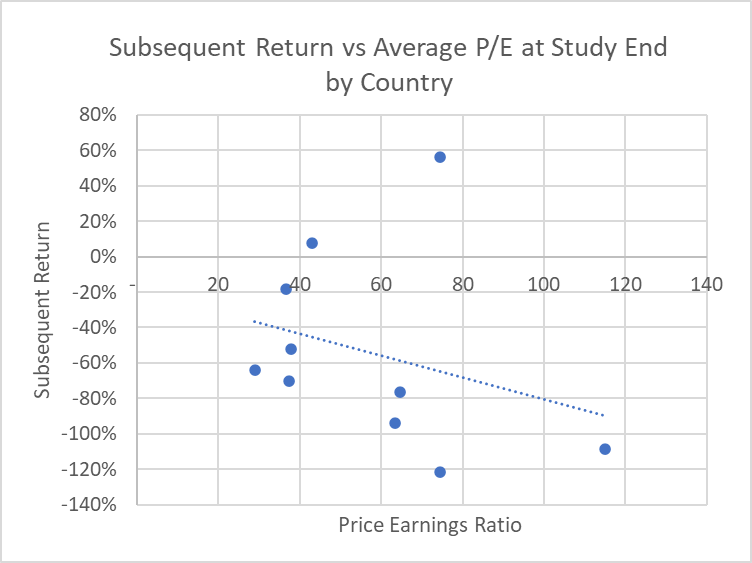
As a value investor, I'd love to think that the high earnings multiples led to many companies' downfall, with investors getting carried away with the potential for future growth. There is some evidence for this at the country level. Sweden is a notable outlier here, though:
At the individual company level, the pattern is less clear, and multiple mean reversion can't be the only explanation:
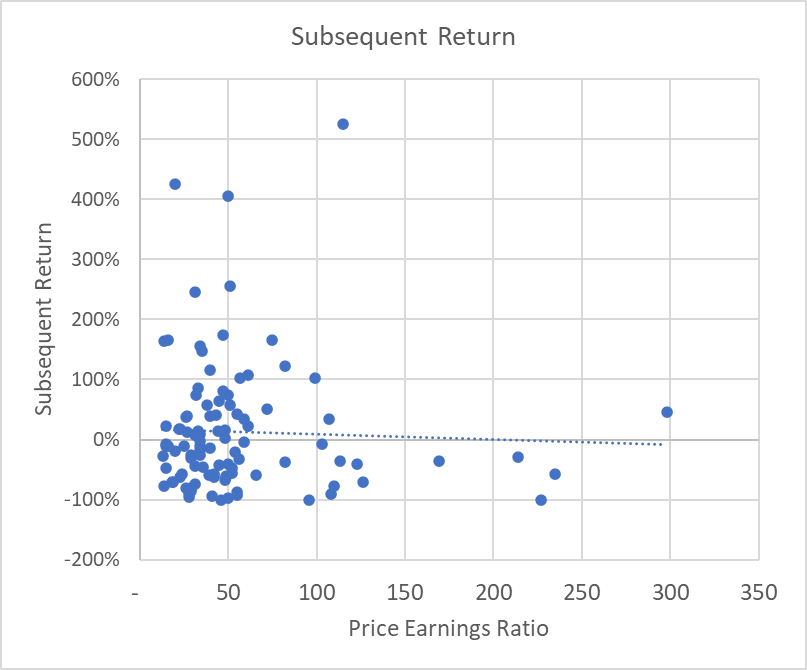
It is worth noting that all three loss-making stocks (that hence don't feature on this chart) were significant losers. It seems avoiding loss-making stocks is a good strategy, no matter how good past returns have been.
These companies are not just experiencing mean reversion in sentiment. The biggest driver of their poor average returns is the mean reversion of the business performance itself.
What about Sweden?
Sweden is the outlier here, with high-performing stocks that have kept going. While the subsequent returns are not as good as the initial study returns, these have shown significant outperformance. Perhaps this is a market that UK investors should consider more seriously in their search for high-performing stocks. What I noticed while looking through the Swedish companies in the Alta Fox study is that they tend to be fairly mundane. For example, they do software for accountants, consumables for life sciences, medical equipment, logistics, or cabling and accessories. This leads us to another contradiction in our search for multi-baggers. When looking for exciting returns, a boring business is usually best.
Disclaimer
This is not financial advice. Our content is intended to be used and must be used for information and education purposes only. Please read our disclaimer and terms and conditions to understand our obligations.

12 comments
Hi Mark / anyone. Not trying to be difficult but I am intrigued by this - in your previous article you mention "Over very long periods, stock market performance tends to be dominated by a few big winners, whereas the majority of stocks produce mediocre returns at best" - this would suggest a select few of the previous multi baggers have continued to grow thus countering those that didn't.
Timarr also kindly pointed to this: https://papers.ssrn.com/sol3/p... Focusing on aggregate shareholder outcomes, we find that the top-performing 2.4% of firms account for all of the $US 75.7 trillion in net global stock market wealth creation from 1990 to December 2020. Outside the US, 1.41% of firms account for the $US 30.7 trillion in net wealth creation.
Is the take away that most firms that bag will then fall away except for an exceptional few. Also that timing of investment in such firms will then dictate your results ?
And yet…. the US is stuffed full of multibaggers that seem to have been with us for decades. Perhaps it’s because that vast internal market gives a long runway which is then extended by the rate of US GDP growth which then extends in turn through global conquest by the companies’ products. That aside, it’s all about the moats!
Logically a business can't keep out performing it's peers by multibagging for ever, and this seems to confirm it. There's a popular quote about "Time in the market, not timing the market." Yet this would appear to contradict it- you'd have to be able to judge when to sell down your holding and get out. The analogy I'm thinking of is one of those weird lifts in old films that has no door and keeps going up on a belt. You have to spot the top floor- or earlier- and leave, otherwise you'll get spun upside down and crash onto your head.
Hi AA, The lift with no doors which you are referring to is called a Paternoster lift. There use to be one at Salford University many years ago. You don't get spun upside down when you get to the top, you get shuffled sideways and then return back to ground level the right way up, then get shuffled sideways again to continue your journey upwards.
The other phrase which is used regarding how big a company can grow is "Trees don't grow all the way to the sky", in otherwords a company can only grow so large.
David.
Also Elephants dont gallop, although they can reach 40 km per hr !
Hi littledavesab,
Its been a very long time since I've heard the phrase so my memory is a little bit rusty but the actual saying was something along the lines of.....
"Elephants don't gallop whereas a flea can jump 200 times its own body length but the trick is picking the right flea", or words to that effect.
In other words what the late Jim Slater was saying was that small cap shares can greatly outperform large company shares but you have to select the right small cap share otherwise you can lose.
David.
Time in etc is the most ridiculous aphorism in investing. It was clearly coined by the fund management industry that want the consistent fees. Mark's study is an exemplar of the gains to be had from timing, of which the timing of sales is a core activity.
Hi Mark
Many thanks for this article, I found it highly insightful.
I own a couple of Swedish companies that have been wonderful holdings and it's a market that I keep a particularly close eye on.
For any interested many Swedish-based companies have Investor Relations pages and presentations in English. I've also found many of them to be very responsive to small PI's like myself.
The biggest issue that I've found, apart from sometimes very high multiples (for me), has actually been the FX risk. I've had one holding increase by >100%, but where FX took away 30% of my return. Thankfully it's been a price worth paying.
Cheers again
A
Hi abtan,
I'm glad you found it useful, and it's good to hear that you have had a positive experience investing in the Swedish market. Having results available in English, written by the company, not Google Translate, is useful. One of the things that often puts me off investing overseas is not understanding the cultural language around results. For example, we all know that "broadly" means a small miss, but not sure I'd be able to pick that sort of nuance out of foreign language commentary.
You also highlight the other problem with overseas investing which is the currency issues. I am more sanguine about FX movements, which could potentially have gone the other way and enhanced returns for you. The biggest issue for me would be the FX conversion rates brokers offer, which can amount to a lot if an investor regularly buys or sells and converts the currency via the usual retail brokers. I think the answer here has to be investing in companies that one hopes to hold for several years. This is certainly the case if one can find good MROC stocks, though, and this minimises this cost.
Cheers,
Mark
Thanks Mark for this excellent data driven article with Sweden being quite a revelation and a market I have never considered. iShares MSCI Sweden ETF (PCQ:EWD) may be the way to get exposure.
Thanks SCI20,
Interestingly, the Swedish index from 2020-24 hasn't been particularly amazing, at 54% over the period. This is pretty much the median return across all these countries' indices. So I am thinking more of the Swedish market as a good hunting ground for MROC stocks rather than holding the whole market, but good to know there is a low-cost way of gaining access to the whole market if desired.
Cheers,
Mark
There is an article somewhere on the web which explains Sweden put more effort on getting Individuals to invest compared to other countries and is reaping the rewards.
https://www.statista.com/stati...
Foreign shareholders comprised the largest shareholder group of the Swedish stock market as of June 2021, with 40 percent of the total value. Financial corporations followed, by around 27 percent of the total value.