Eating the sundae: the continued exodus from the LSE

Takeovers have been a frequent theme of our daily reports, and are an ongoing source of return for investors in the UK market.
However, I can’t be the only one - and judging by our comments sections, I’m not - who is concerned about what this means for the long-term health of the LSE. Judge for yourself, but it seems to me that the companies being targeted for acquisition tend to be of higher-than-average quality, and in some cases they are being snapped up at rather underwhelming takeover premiums. And they certainly aren't being replaced by IPOs of a similar quality, as there have been hardly been any IPOs for years. In fact, IPO fundraising has hit a thirty-year low.
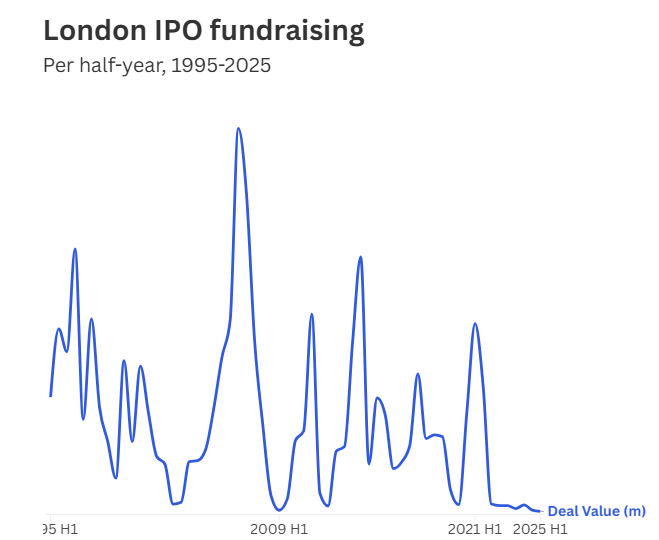
Source: dealogic via CNBC
This personally impacted my portfolio recently when International Personal Finance (LON:IPF) (I still hold) announced a recommended offer from a US investor. The premium against the prevailing share price was only c. 24.9%.
I acknowledge that this is very much a first world problem, but IPF is a stock that I intended to hold for the long-term, and I was excited about what the company might achieve in the years ahead. It was a company that I had researched, had gained familiarity with over a period of several years, and where I felt that I understood many of the pros and cons of an investment. If its share price had gained 25% in a year without any takeover offer, I would not have been terribly surprised.
Seeing this leave my portfolio is therefore not a prospect that I’m looking forward to, even if it will give my portfolio an immediate boost. I don’t come across opportunities like IPF every week, so I won't immediately know what to do with the proceeds.
An overview of takeovers we’ve noticed in recent months
To give some context for what I’m talking about, here are some companies where we’ve had the colour “PINK” (signalling takeover activity) in our daily report. I've tried to sort them roughly by the takeover premium.
Empresaria (LON:EMR): possible offer from a UK source at a 148% premium (will it go ahead?).
Spectris (LON:SXS): a private equity battle between Advent and KKR, with KKR ultimately offering £41.75 plus a dividend. This is a 104.9% premium to the undisturbed price.
Spirent Communications (LON:SPT): this is a long-running regulatory situation (for over a year), but US-based Keysight are buying Spirent at an 85.9% premium to the undisturbed price.
Just (LON:JUST): takeover by a Canadian-based financial group, at a 75% premium.
Direct Line Insurance (LON:DLG^G25) : takeover by Aviva (LON:AV.) at a 73% premium (admittedly this one was originally announced last December, but it completed in July).
Alpha International (LON:ALPH): a US trade buyer offered a 55% premium to the undisturbed price.
Renold (LON:RNO): another US private equity takeover, with a 50% premium.
Deliveroo (LON:ROO): takeover by DoorDash at a 44% premium to the price when Doordash gave Deliveroo an offer letter, or a 29% premium to the price when everything went public.
Assura (LON:AGR): a long-running saga over who will buy this, KKR or Primary Health Properties (LON:PHP). KKR’s offer is a 39.2% premium to the undisturbed price.
Dalata Hotel (LON:DAL): a European hotel consortium offered a 35% premium.
Epwin (LON:EPWN): UK trade buyer offers 31.9% premium.
International Personal Finance (LON:IPF) (Graham holds): a New York-based financial firm offers a 24.9% premium.
Bakkavor (LON:BAKK): merger situation with Greencore (LON:GNC).
Ocean Wilsons Holdings (LON:OCN)/ Hansa Investment (LON:HAN) : this is a merger of two investment vehicles that was enabled by a large business disposal at Ocean Wilsons.
Empiric Student Property (LON:ESP): takeover by Unite (LON:UTG). 10% premium to the undisturbed price (lower premiums can sometimes go through for property companies).
S4 Capital (LON:SFOR): a possible merger with a UK-based advertising agency, although press reports have subsequently suggested that it’s not going ahead.
Dewhurst (LON:DWHA): delisting to become a private company. Tender offer to go with this.
John Wood (LON:WG.): Wood Group shares were suspended due to its failure to publish results. There is a possible offer of 35p from a Dubai-based firm.
Frenkel Topping (LON:FEN): possible offer from Harwood Private Equity at a 19.5% premium.
Anexo (LON:ANX): DBAY Advisors offered a 17.6% premium.
Warehouse Reit (LON:WHR): Blackstone takeover at 8.3% premium.
PRS Reit (LON:PRSR): a UK-based real estate investor has made a possible offer at 115p.
For the sleepy summer months, this seems to be quite a lot of activity! And as noted above, these deals have certainly not been offset by IPOs. And so the overall size of the market continues to shrink.
I note a mix of buyer types, but with plenty of North American buyers still involved. Considering that the US dollar has weakened by about 10% in the last six months, I’m impressed that they are still so determined to pick up UK bargains.
How to decide what to do after your stock receives a takeover offer: a very simple plan
I’m not going to overcomplicate this. I'm also not going to pretend that this is the only way, or even necessarily the right way, to respond when a takeover offer pops up in your portfolio. Please feel free to disagree with my approach and/or to offer your own techniques in the comments.
Step 1: compare the current share price against your opinion of its fair value
This might seem obvious, as it’s something that (in theory) we should all be doing, all of the time! But a takeover situation is a good chance to refresh our view on a stock.
For example, suppose you own stock XYZ which was trading at 100p until it received a takeover offer at 151p, and it’s now trading at 150p.
Great, we have just made a 50% gain overnight, at least on paper.
If you already had a price target for the stock that represented fair value, whether that was 130p or 170p, then Step 1 is easy: either the share price has reached that price target, or it hasn’t.
My position is a bit more difficult than that, because I don’t have explicit price targets. I simply try to buy excellent companies, and then my plan is to hold them until something on this list happens:
- A) their valuation becomes ludicrously expensive.
- B) they become far too large as a percentage of my portfolio (although even then I’m likely to keep holding them, perhaps with some top-slicing).
- C) something happens that significantly undermines the quality of the company and/or increases its riskiness. This can include situations where my initial assessment of the company was wrong.
- D) they get acquired.
- E) they go bust (although this shouldn’t happen if I’ve already sold out in a “C” situation!)
In a takeover, therefore, I’m likely to keep holding until it actually goes through. The market tends to reward patient holders with an additional few pence per share, if they continue holding.
The primary reason I wouldn’t continue holding is if I think that the valuation being offered, and therefore the current share price, is ludicrously expensive, i.e. we are in an “A” situation.
Step 2(i): if the share price has reached or exceeded fair value, then there is no shame in selling
If the share has hit or exceeded your fair value target, then it might be time to consider cashing out. If you do that, you avoid the risk of the deal failing to go through, and you are free to reinvest.
In my case, if I think we are in an “A” situation, i.e. that the valuation has become ludicrously expensive, then I’m going to want to get out before the buyer comes to their senses. The extra few pence that I might achieve by holding on are not worth the risk, in this situation.
Step 2(ii): if the share price has not reached or exceeded fair value, then consider being greedy
If I’m not greatly impressed by the offer, then I’m going to hold on and take the additional return that is available for continuing to hold.
There is a key point here: I am not afraid of the deal collapsing in this case. In fact, I might even want the deal to collapse, so that I can hold onto these shares and reap the rewards of the company’s long-term success.
In my view that is the main reason for continuing to hold, not because of the extra few pence that are available when the deal completes (although they don’t hurt!).
Does it matter if the share price is trading at a premium to the offer price?
This is a slightly unusual situation. It tends to imply that at least some shareholders are unsatisfied with the offer that has been made. They may expect a bidding war between potential buyers, or simply a higher bid from their corporate suitor.
My view is that, while interesting, the existence of a share price premium against the offer price does not necessarily matter very much. I simply go back to Step 1 and ask: is the current share price at or above fair value? Or as I like to put it: are the shares now ludicrously expensive? If they are, then I’ll sell. If not, then I’ll hold.
Yes, this attitude means that I’m risking some of the profits if I don’t sell, and if the deal then goes ahead at the offer price. But I’m not in this investing business for a few pence per share. I’m in it for the big moves! Or as Jared Vennett put it in The Big Short, I’m in it for the sundae. I let other people have the sprinkles.
Want to know what you get out of it? You get the ice cream, the hot fudge, the banana, and the nuts. Right now I get the sprinkles, and yeah, if this goes through, I get the cherry. But you get the sundae, Vinnie. You get the sundae.

Disclaimer
This is not financial advice. Our content is intended to be used and must be used for information and education purposes only. Please read our disclaimer and terms and conditions to understand our obligations.
26 comments
A football Analogy
US Nasdaq = Champions League
US NYSE = Premier League
European Stock Markets various = UEFA Cup
FT 100 = Championship
FT350 = Division 3 (now named Division 2)
FT All Share = Division 4 (now named Division 3)
AIM = Vauxhall Conference (showing my age!) - a feeder league for the bigger clubs !
A more serious point is as per Football the lower leagues can find bright prospects (growth companies) but if they are forced to loose the star players it is the clubs higher up the scale that benefit from the longer term growth (irrespective of "value").
Despite all the doom and gloom, I’ve managed 60% over the last two years on a UK-only VM strategy. So it can’t be so very bad here, as I am no Buffett. And surely in an efficient global market, if valuations in the UK are much more reasonable than in the USA then at some stage (other than just buying the companies) investors will look at the value offered here in the shares themselves. The darkest hour etc etc….
Well done Sir, what a wonderful record, it rather proves that their is great value in UK stocks
Dave, excellent performance. Are you picking a basket of the top VMs or cherry picking from them? The top VMs (25) are up around 56%, over the last 2 years. A lot of the top VMs don't appeal to me, l tend buy more QMs and QVMs. Gold has done well, my Wisdomtree holdings, are up about 78% in 2 years.
US stocks can look expensive but there tends to be more growth and less debt, than UK stocks. NVIDIA (NSQ:NVDA) up about 80%, in the last few months, results out next week.
I'm not meaning to sound cocky. Over 3 years it's only 40% overall. I'm just saying that despite the gloom there is value there. I mostly look at the top VM shares and pick from them. For example I wouldn't take Drax (LON:DRX) at the moment because I think their "renewable" premise is anything but!!
I agree about Drax (LON:DRX) that should be closed down.
I do hold 5 out of the top 25 VM stocks.
I thought VM would be the top performers over 2 years, but they are only 4th, QVM, QM, QV are above them. M are in 5th: https://www.stockopedia.com/sc...
Of course, some of this is because of takeovers, l've had about 6 in the past 2 years, maybe more, can't keep track of them all.
Fantastic results dr any tips on your process ?
Mostly I just look at the top VM shares and see if their income is rising, EPS is rising and chart is above 200 day MA . I sell on bad news, indifferent results, stage 3 chart momentum or VM falling below 90. There's a steady stream of new high VM shares.
IMO one of the main drivers of this is Directors share option schemes, many of which are designed to vest on a take over as if they had achieved all their performance targets.
This trend has been established for a long time. Remember when ARM was snapped up by SoftBank for a ludicrously low premium. Much of the return, such as it has been, on my own portfolio over the past fifteen years has come from takeovers of companies which, like Graham's holding of International Personal Finance (LON:IPF), I would rather have continued to hold. My interpretation is that this is caused by weakening capital accumulation in the UK - primarily caused by government policy - but this is not something that is going to change, whatever official huffing and puffing there is. What to do about it is another matter. I don't see the newsflow to have any confidence in entering overseas markets, though I think those who go this route are right.
By coincidence, this issue was featured by Charles Hall of Peel Hunt at the investors Summit last week and is also covered by No Free Lunch in the Investors Chronicle this week. Why on earth are tax breaks give to enable people to invest in other countries' stock markets?
https://www.investorschronicle...
Why on earth are tax breaks give to enable people to invest in other countries' stock markets?
It’s to encourage people to prepare for their retirement rather than depending upon the state. And since returns are so much better overseas, it would be madness to remove the incentive.
It is what it is and moaning about it won’t change anything. We live in a moribund state with blinkered and unambitious leadership beyond (in the case of the previous administration especially) satisfying their own personal desires. Is it a surprise that our companies are a sorry collection of ever-diminishing number and quality? Stocko should stop grumbling and start covering the far more vibrant European small cap universe if it wants to survive long term (US is too big and well covered already). Follow the momentum, as you like to tell us at every juncture.
"Stocko should stop grumbling"
I think if you look through the list of Stocko shareholders you won't find Graham listed.....
It’s a constant refrain on here, MC.
It is hard to see how this will stop given the discrepency in valuation between London and New York.
Although perhaps if all shares were quoted on one global market this would be no bad thing?
Great article - thank you.
I've been investing in London for 31 years - here's my somewhat simplified view.
London is caught in a self fulfilling downward spiral;
These fellas don't get the traffic their podcast deserves but go to 1 hour 15 mins as an example of how private investors got stiffed by PE and founding management in a great example.
&t=5552sAnd I have done the classic Plan E. Having had a significant position in IPF, I have sold half already, because I felt I knew what to put in that would do better now, given their comparative prices. Probably holding the rest for the week it'll take to know the outcome, but that's in a very long-term account where decisions are only meant to be very slow, because the company is fundamentally sound and inheritable.
But I agree, the winnowing out of the decent firms is very concerning. The miser in me wants to remain with UK-only Stocko subscription (sorry, Ed!), but that's going to get harder over time (maybe a bright side for you...).
VCT's: What also seems significant is the dire performance of most VCT portfolios in recent years. These are supposed to be high risk incubators of tomorrows gems. No one seems interested in buying their unquoted holdings at all atm. The managers continue to fleece the 'hate paying tax at any price' wealthy. Most punters losses far outweigh their 'tax benefits'. So the future is even more bleak for 'potential' UK quotes.
International Personal Finance (LON:IPF) seems to stand out here. Miserly premium for a business that seems to be gaining momentum. Why have the directors recommended? Do they have worries for the future? Will the major shareholders accept?
Great article thank you.
Great piece Graham.
We currently have 1252 screenable UK stocks.
2 years ago there were 1523.
(:relevant angry exploding emojis:)
I don't remember the quote but it's such a great film!!
It's when Vinnie calls him at the gym to ask, "how are you ****ing us?". Agreed - it's a brilliant film.
The Big Short.
It's the Brexit dividend that comedian Johnson told us about ...