European Aerospace and Defence I

Background
I have started a (free) substack with the sole purpose of trying to organise my sometimes chaotic thoughts (Alastair Kendall | Substack) and hopefully simplify my portfolio and process, so I can spend more time with my family, horses and fishing. I find myself focussing on areas where I feel I have a competence and interest - Defence & Aerospace, Space, Chemistry, Engineering and Real Assets (Copper, Uranium, silver, platinum and the great debasement trade - gold). I also manage money for a small family office and whilst I prefer individual shares in my own portfolio, I have made extensive use of ETFs and Investment Trusts with family money. It was a shock to me to strip out the ETFs recently and find the annual performance last year of that "sub-portfolio" of ETFs was 62.5% It makes you wonder if the more important decision is allocation to themes rather than identifying individual shares. I know that will be anathema to the Stocko community and am looking closely at my individual share performance against the sector/theme ETF and acting accordingly.
In over 40 years of investing, I cannot recall a time when geopolitics had such am impact on global capital flows, supply chains and investing. I believe we can no longer ignore geopolitics in investing and much of my thinking is driven by such considerations. I will start with the opportunities in the European Aerospace and Defence sector.
Thesis
NATO is dying and the only question is will the Americans give the Europeans sufficient space and time to develop alternative structures to secure the future of European security. In truth, the Europeans have been complacent, only too ready to rely on the American blue collar tax dollar to fund our security, whilst successive European and UK governments have created the largest social welfare programme since the Romans used to Colosseum to distract and control the hoi polloi.
NATO was established on April 4, 1949 with the signing of the North Atlantic Treaty in Washington, DC with the objective of providing collective defence against aggression from the Soviet Union. Europe lay in ruins after a brutal war and was only too happy to shelter under Uncle Sam’s economic, industrial and military might. The first NATO Secretary General, Lord Hastings Lionel Ismay summed the geopolitical reality a little more bluntly stating that:
Thanks for reading! Subscribe for free to receive new posts and support my work.
“NATO was designed to keep the Americans in, the Soviets out, and the Germans down”
In those days, America’s moral leadership was not in doubt, whereas now, many European politicians and senior military officers question the US’s moral direction under the Trump administration and America’s continued commitment to NATO and article 5. It is not yet clear to what extent America will retreat behind its borders; nor the extent to which America remains committed to article 5 and European security.
Matthew Whitaker, the U.S. ambassador to NATO recently said that a German should lead NATO. He made the remark at the Berlin Security Conference in November 2025, suggesting that Germany should eventually take over the role of Supreme Allied Commander Europe (SACEUR) — a position traditionally held by an American since NATO’s founding.
What has become abundantly clear is the need for European countries and the UK to step up to the plate and take control of their own sovereignty, command and control systems within NATO, and to invest in the lethality and competence of their own militaries which have suffered from years of political neglect. After a decade of failing to meet the 2% of GDP target, Europe has collectively underspent by an estimated €850bn. However, The Europeans are rapidly catching up:
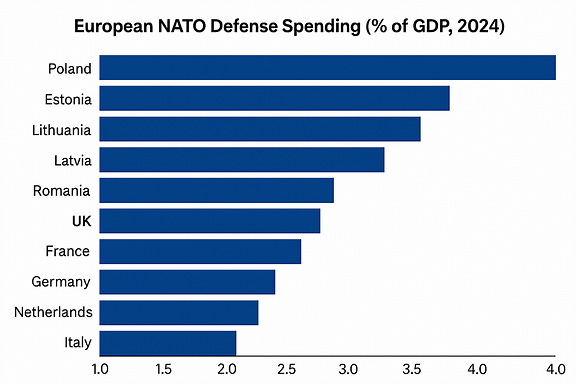
NATO’s official 2024 estimates, compiled by the Atlantic Council and McKinsey (above).
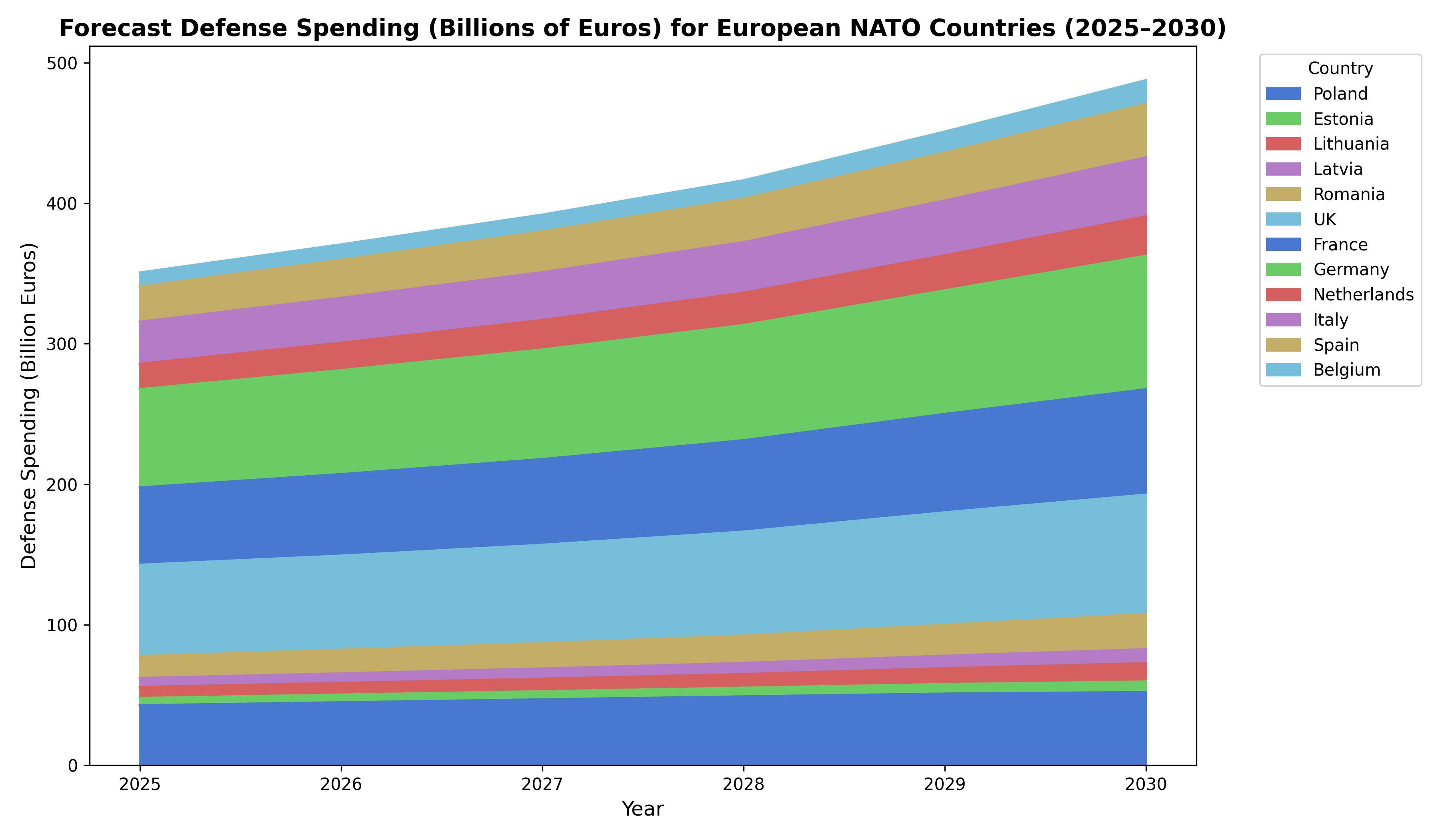
The above graph above and summary table below was created by converting each European NATO country’s average forecast GDP out to 2030 and applying the forecast percent of GDP defence spending.
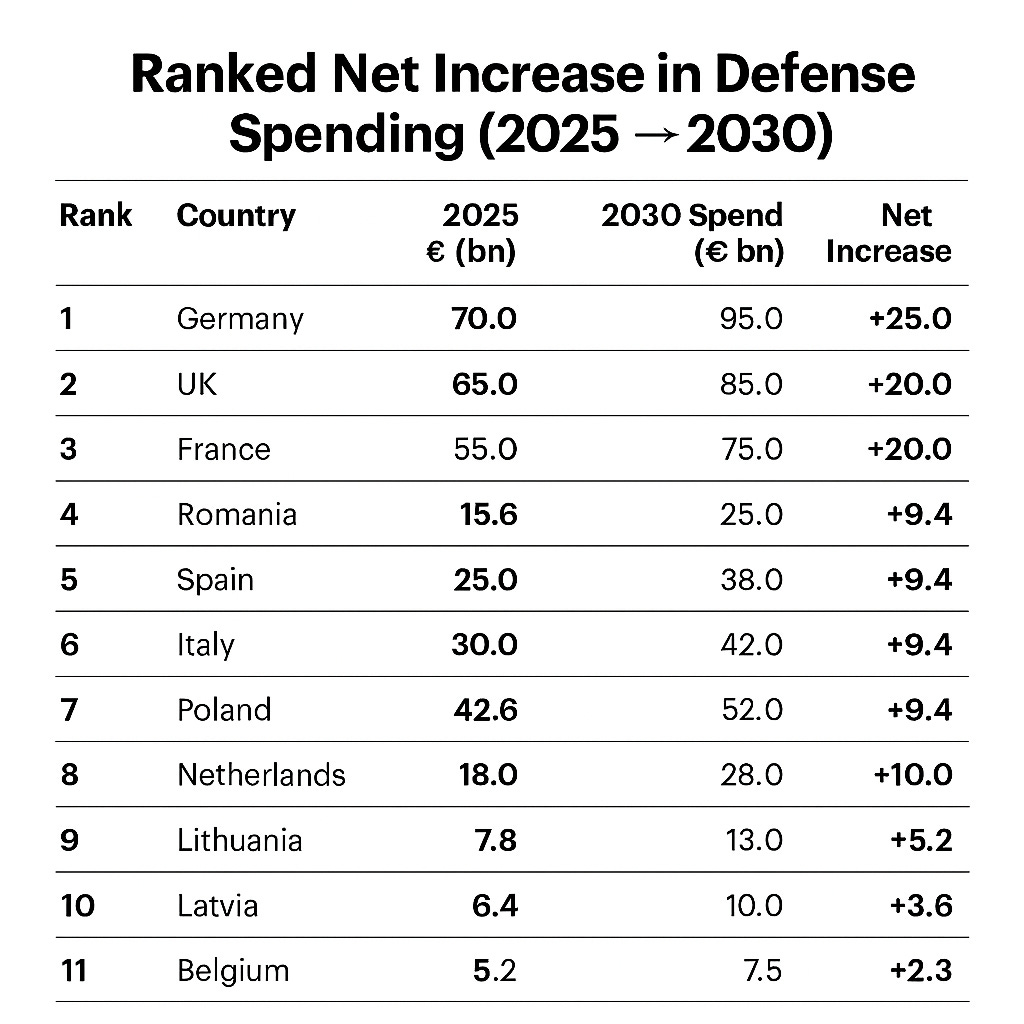
The source of the data is:
- IMF World Economic Outlook (Oct 2025) – GDP forecasts for each country.
- European Commission Country Forecasts (Nov 2025) – EU member state projections.
- National central banks (Bank of Lithuania, Latvijas Banka, Banco de España, Banque de France, Bundesbank, etc.) – supplemental projections.
The key observation are that
- Germany, UK, and France dominate the absolute increases, together accounting for ~65 bn of the total rise of 126.1 bn Euros.
- The CAGR from 2025 to 2030 is 5.5% which, given the threat, might be considered rather modest.
- Southern Europe (Spain, Italy) shows significant jumps despite starting from lower baselines.
- Eastern flank states (Poland, Romania, Baltics) rise sharply in relative terms, but their absolute euro contributions are smaller.
- Belgium has one of the steepest proportional climbs, though from a low base.
A NATO without America
If the Americans leave partially or wholly, I believe NATO will fracture as it has become quite obvious we do not all share the same values and are not willing to contribute to the same extent:
NATO without the U.S. would not collapse overnight, but it would split into tiers:
- Tier 1: UK, France, Germany—capable of leading but divided on strategy.
- Tier 2: Eastern front-line states—demanding stronger deterrence, possibly drifting toward bilateral pacts.
- Tier 3: Southern members—resistant to higher spending, more focused on Mediterranean security.
The result: a weaker, fragmented alliance, still militarily formidable but politically incoherent, vulnerable to Russian pressure and internal disputes.
Likely Fracture Dynamics
- UK-led JEF/CJF: Britain would leverage its nuclear arsenal, expeditionary tradition, and Nordic/Baltic trust networks. The CJF (UK–France) is already being scaled into a corps-level force, potentially offering NATO a “strategic reserve”. Without the U.S., this could become the de facto Western European pillar. The UK-led JEF membership consists of the UK, Sweden, Finland, Norway, Denmark, Iceland, Estonia, Latvia, Lithuania, and the Netherlands. Canada might join.
- Bucharest Nine: The Bucharest 9 has become the political voice of NATO’s eastern flank, pushing for higher defence spending (up to 5% of GDP in recent pledges) and stronger forward presence. If U.S. guarantees vanish, the B9 could harden into a military bloc, possibly coordinating nuclear guarantees with France/UK. Membership of the Bucharest nine consists of Bulgaria, Czech Republic, Estonia, Hungary, Latvia, Lithuania, Poland, Romania and Slovakia. It is led by Poland.
- Southern Bloc: Mediterranean states may resist massive spending hikes and prioritize naval/migration issues. This could dilute cohesion further. The Spanish, Portuguese and Italians have varying degrees of commitment to investment in NATO and Ukraine.
- Ad hoc coalitions: Europe has a tradition of “coalitions of the willing” (e.g., Gulf War, Libya). Without U.S. leadership, these flexible formats could proliferate, but they risk duplication and inefficiency.
Strategic Implications
- Fragmentation is almost certain. NATO’s command coherence would erode, replaced by overlapping coalitions.
- Deterrence credibility would split. Eastern states would rely on B9 solidarity, while Western powers (UK–France) would try to project nuclear-backed leadership.
- Industrial inefficiency. Competing blocs would duplicate procurement and logistics, weakening Europe’s ability to sustain long wars.
- Political divergence. France/Germany may push for an EU defence union, while Poland/Baltics resist dilution of Russia focus. The UK and Nordic countries have deliberately excluded Germany and France from JEF to avoid EU politics and French posturing.
- Not in JEF: The UK‑led JEF is Northern‑Baltic focused, expeditionary, and deliberately excludes France/Germany to avoid EU politics.
- Not in B9: The Bucharest Nine is Eastern‑flank focused, highly Russia‑centric, and sceptical of Franco‑German compromise.
- Instead: France and Germany would likely push for an EU Defence Union or “European pillar,” trying to consolidate southern and western members (Italy, Spain, Greece, Belgium, etc.) under their leadership.
French / German Military Co-operation
An EU Defence Union will only come about if led by France and there are serious questions as to whether or not a more assertive Germany will permit this. The Germans (Airbus) and the French (Dassault) have already fallen out publicly over the allocation of work under the 5th generation FCAS fighter jet project, whilst Spain’s Indra Sistemas looks on with considerable bemusement. There have been problems with:
- Persistent disputes between Dassault and Airbus over design authority and workshare.
- France wants a lighter carrier‑capable jet (~15 tons), Germany prefers a heavier air‑superiority design (~18 tons).
- Rising costs (estimated €100 billion+) and delays — demonstrator flight now unlikely before 2028–2029.
- German lawmakers have recently called for withdrawal, citing fears of being treated as a junior partner
Where to Invest?
Rump NATO (ex-USA) has an urgent need to raise investment in Ukraine and in their own military lethality after years of atrophy, lack of political interest or leadership, and a careless reliance on American blue collar taxpayers whilst running the largest social welfare benefits programme in the World. Europe’s politicians have finally realised the cold winds of political reality are upon them and they must act at a time when European treasuries are empty.
The European NATO countries need to focus on the investment in the core strategic enablers which the Americans have always been very careful to control in the past.
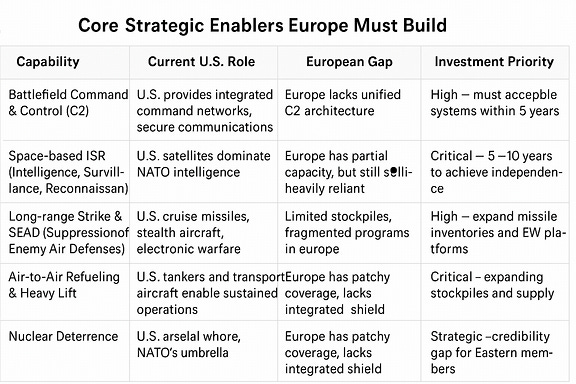
There are other issues to resolve including where Ukraine fits into a new fragmented European Defence posture (join B9?); how France and the UK share the nuclear deterrent and associated costs (Germany has already offered to help fund the UK’s deterrent; and, the extent to which European nations specialise, coordinate their industrial bases, and ultimately fund all of this.
There are other questions. There must surely be questions about how independent of America the UK’s nuclear deterrent really is. Aldermaston, where the UK’s nuclear warheads are maintained, had American management involvement through Lockheed Martin and Jacob’s Engineering (now Jacob’s Solutions inc.) up to July 2021, but the facility is now 100% under the control of the UK Ministry of Defence via the Atomic Weapons Establishment (AWE). The Trident ballistic missile delivery system however is rented from, and maintained by, the Americans.
There is also a strategic question where Canada and the UK sit given Trump’s stated objective of bringing both countries into their sphere of influence and prising the UK in particular from the political embrace of Europe. Meanwhile, the Canadians are showing every sign of getting closer to Europe and diversifying their geopolitical posture.
The UK has several world-class aerospace and defence companies. Babcock Engineering (LSE: BAB) is building the new general purpose modular type 31 frigate (£250 to £320 million a pop) at their yard in Rosyth; BAE (LSE: BA.) is building multiple type 26 anti submarine frigates (£1.3 billion a pop) on the Clyde and the BAE-led 5th generation Typhoon fighter jet with Italy and Japan is progressing according to plan in marked contrast to the political travails of the French-German-Spanish FCAS programme which is bogged down in work allocation arguments. There are also several small cap opportunities such as Chemring (LSE: CHG), Cohort (LSE: CHRT), MS International (LSE: MSI) as well as many other small cap companies with some defence exposure such as Goodwin (LSE: GDWN).
Or, you could just buy the HAN European Defence ETF (LSE: ARMY) to gain exposure to European’s finest including Rheinmetall, Leonardo, Dassault and SAAB.
The next article will focus on the structure of the HAN European Defence RTF (LSE: ARMY) and any ETF competitors. Subsequent articles will focus on an analysis of the strategic position of some of the key UK and European aerospace and defence companies and returns we might expect over the next 5 years.
The author holds shares in the HAN European Defence ETF, Cohort, Chemring, Rolls Royce, Melrose Industries, Babcock Engineering, Kongsberg Gruppen and in SAAB through an investment in Swedish holding company, Investor AB.
Disclaimer
This is not financial advice. Our content is intended to be used and must be used for information and education purposes only. Please read our disclaimer and terms and conditions to understand our obligations.
16 comments
CDS' speech at RUSI this week is worth a read. Note in particular this bit:
"Next, we have to build the capacity in industry to meet the demands in the UK and of our allies to re-stock and re-arm.
That means we need more capital to flow in to defence industry. I keep being told that there is plenty of private capital looking for a place to make a return, but progress in building this capacity across Europe has been painfully slow. Part of the solution will be long-term and stable commitments on defence spending – like we saw at this year’s NATO summit – and opportunities for investors to make greater returns.
Building this industrial capacity also means we need more people who leave schools and universities to join that industry.
So, we need defence and political leaders to explain the importance of the industry to the nation, and we need schools and parents to encourage children and young adults to take up careers in the industry.
And we simply need more people to develop the skills the defence industry needs. Like STEM, digital and project management.
We also need to harness the power of those institutions that will rely make the difference in war. Just as I have seen in Ukraine, where the cleverest minds from Ukrainian universities and industry are manipulating and exploiting technology to solve specific tactical problems and overcome the numerical and economic advantages Russia enjoys.
That means making sure that the totality of the government’s huge research and development investment portfolio – not just that done in defence – is shaped by considerations of defence and security. Making the IP generated available right across government...."
Thanks for sharing the USA has shot itself in the foot. The Europeans have for too long been tied to the US defence industry its a crazy situation when the US dictates when a US weapon can be used. Time for Europe to reassert itself.
Great thought provoking article James, and I've happily joined your substack.
I too have had mistimed adventures into defence stocks and have over time realised that my ability to pick winners is hit & miss. I therefore have a very large weighting towards ETF's, Inv Trusts and Unit Trusts and have had better success when looking at themes and utilising these collectives.
Having served previously myself (a long time ago) and witnessed the decline of our services (all branches) I would fear that we would have zero chance of being able to put up any fight against a heavily armed and technically capable fighting force. It is therefore critical that these various alliances come to fruition and the various leaders stand by their promises to increase spending in order to provide a deterrent that prevents this ever being tested.
I look forward to your ongoing articles.
Best wishes. Kevin
Thank you Kevin
Excellent article. I agree that geopolitics will be a key driver to sector performance. I do not have the knowledge of specific companies, excepting BAE Systems (LON:BA.) and Rolls-royce Holdings (LON:RRN) which I hold , and so have used ETFs to target the defence, gold, copper and uranium/nuclear sector. These have been key drivers to my portfolio performance YTD and will, I believe, continue to deliver excellent returns.
In your opinion do you believe the UK defence sector will benefit from being outside the EU. The UK in theory is now free to build relationships with Canada, Japan etc and not be caught up in the inevitable arm wrestle between France and Germany.
The ongoing problems in the UK are the lack of knowledge of MPs (particularly the latest Labour intake) about defence, and the fact that defence spending is completely absent from the national debate. The chiefs of staff are more muzzled by Starmer & Co than previously.
Also worth noting there is some very high quality manageent in the sector.
I've said it before, but the fact people talk about about the European Defence industry on Investment forums lays bare the problem with the western/NATO defence industry - it's designed to make investors money and pay high salaries to former government officials, rather than to actually produce what is required at any reasonable cost.
Most European Governments are already extremely unpopular, raising taxes or cutting social spending will guarantee they won't survive. I find it hard to see how any European Government can increase defence spending to the mooted levels without using creative accounting - e.g. adding infrastructure spending to the defence budget on the basis that the military will use roads and railways etc. So I wouldn't neccessarily expect the supposed increase in defence spending to result in more business for the defence companies of the scale expected.
Some European NATO members have already laid out detailed investment plans including the Scandinavians, the Poles and the Germans. We know exactly where some of the additional investment will be made and this is something I will post on later. I agree that treasuries are bare and this will be politically difficult, at least here in the UK, in France and in the Southern Mediterranean countries who perceive a different type of threat. It is noticeable that the closer to NATO's Eastern flank one gets, and the more realistic and higher is the defence spend.
The Germans have committed substantial sums to rearming. However, broad support for German defence investment is fragile and highly dependent on political leadership. If Chancellor Friedrich Merz were to lose his job, consensus could weaken significantly, especially given opposition from the Greens and scepticism among parts of the SPD.
The Eastern NATO members including Poland, the Baltics and Finland are under no illusion and importantly, neither are their people. I know as my nephew serves in the Jaeger Brigade in the far North of Finland. It was the price of his passport as he is Scottish but met his wife at Helsinki University. My perception of France is that there i a lot of posturing and little ability or willingness to work in partnership with other NATO countries in the development of shared weapons platforms. France is as bankrupt as the US and UK, so it is extremely unclear where the money would come from.
Finally, like any company, the game is to make money and I am guessing that is why you are a member of Stockopedia. Why should the aerospace and defence sector be any different? The average cost of Europe-made system is between 30 and 50% cheaper than the American equivalent (where this is an equivalent). There are some American systems that currently have no European equivalent - notably Patriot and the F35. However, these exquisite systems do not come cheap. A single Patriot battery typically ranges from about $1–2.5 billion for export customers, while individual missiles cost between $4–10 million each. The nearest equivalent in Europe is the SAMP/T (Sol‑Air Moyenne Portée/Terrestre), also known as Mamba. It is a Franco‑Italian long‑range air and missile defence system developed by Eurosam (a joint venture of MBDA and Thales). It is cheaper with maybe 85% of the performance. The F35 (35% supplied by BAE BTW) has no competitors in Europe and it will be 10 years before we see anything capable of matching the F35's stealth profile and ability to operate safely in contested airspace.
So yes, it is complex and yes there are both budgetary and political issues. I have worked in Russia an Ukraine and on a personal level have no doubt Europe needs to rearm. Having served, I am also under no doubt that we need a Scandi approach to the development of reserve forces.
Yes, I'm here to make money, but the point is the Russian defence sector isn't there to make value for shareholders, it's there to create what they need in a timely & efficient manner, at what seems like a reasonable cost, which will never happen in Europe, as far as I can see.
But of course, that doesn't mean the value of defence ETF's won't go up. I did well with Future of Defence UCITS ETF Acc (LON:NATP) earlier in the year, riding it's momentum (I'm primarily a momentum investor), even if I don't agree with how the future of the defence industry will pan out.
Another issue that bugs me in this sector is that a lot of the potentially highest growth companies are privately or PE owned. Helsing being an example.
Helsing is one of the best examples of exciting growth companies avoiding the public markets. I follow their capital rounds quite closely. Helsing have recently raised two further tranches of capital, US$487 in July 2024, and , €600M in June 2025, valuing the company at US$12 billion.
Helsing's ownership and funding is led by Daniel Ek via his private equity vehicle Prima Materia. Mr Ek was the founder of Spotify.
The only way in for private investors at this stage is via publicly listed Saab AB (STO:SAAB B) who are also major shareholders, but you get the rest of SAAB as well, although SAAB has been an excellent investment for me (and I used to love and drive their slightly eccentric cars!).
Helsing is actively supplying, testing, and co‑developing drones with Ukrainian partners. The company has delivered thousands of AI‑enabled loitering munitions and strike drones to Ukraine, and testing of newer models is taking place in Ukrainian combat conditions, including their model.
There are other investable options for investment in military drones including AeroVironment (NASDAQ: AVAV); Kratos Defense & Security Solutions (NASDAQ: KTOS) and there is an ETF: Defiance Drone & Modern Warfare ETF (JEDI) launched in 2025 but I am not sure if it is UCITS-compliant.
And another in the drone space is Ondas (NASDAQ: ONDS), which I own. Sounds like we are on the same page! My only privately owned defence co looks like it might sink ignominiously.
Thanks for that Grumpy ... I had not heard of Ondas Holdings (NAQ:ONDS). I think the experience in Ukraine and investment opportunities might be worth an article.
Thank you very much for posting such a detailed viewpoint. I had just finished reading over the weekend the 2025 USA National Security Strategy document. Therefore your comments in your post are well-timed and fascinating, as I was trying to consider the investing ramifications of the US document.
Separately, I would confirm that getting the "macro" calls/themes right drives the bulk of my returns. (Gold/Silver debasement trade has been standout in 2025) ,
Hi Billy. What I call the debasement trade accounts for just under 50% of my portfolio which many will find absurd or even shocking. By nature I am a cheery optimist, but I find little to be optimistic about in capital markets (or politics) these days.
There is a second post here: European Aerospace and Defence Sector II | By jamesalastair | Stockopedia
Many thanks indeed.
Strangely I had a similar % exposure in my SIPP (including gold/silver miners) but I have taken a very large % "off the table" during this phenomenal rally in 2025 purely down to risk management. I was certainly early doing so , but I have been a long term holder boring all and sundry why Gold was an essential protection against the bind in which central banks find themselves, and the "jenga tower", which is the debt based financial system (which Nixon kick started in 1971).