European Aerospace and Defence Sector II

The European defence and aerospace sector is fragmented, politically sensitive, and structurally opaque, making rigorous analysis difficult without deep institutional access and scenario modelling.
Fragmented Industrial Base Leading to Inefficiencies
Thanks for reading! Subscribe for free to receive new posts and support my work.
The European defence and aerospace sector is fragmented with over 4,000 companies across 27 European states, some of which are in NATO and others not. There is no unified procurement or production strategy with European governments pursuing their own national champions at the expense of cross-border integration of design, manufacturing and supply chains. The inability to standardise on a few designs limits economies of scale in procurement, manufacturing and R&D. As an investor attempting to analyse the sector, the fragmentation makes it challenging to identify the winners.
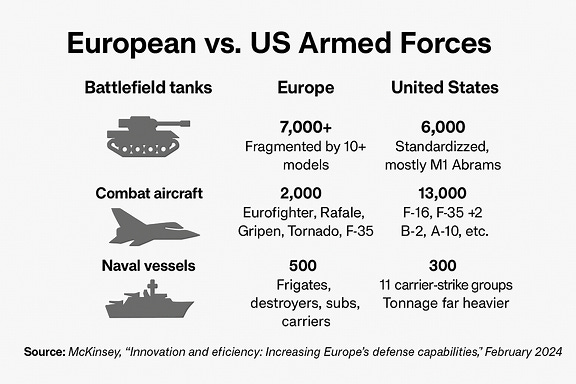
Opaque Data and Procurement
Defence budges are rising but procurement flows are poorly disclosed making analysis challenging. Adding to the challenges are that many contracts are classified or politically negotiated behind closed doors and it is extremely difficult to track actual spend against announced budgets.
Political and Strategic Divergence
Whilst national sovereignty concerns hinder the desperately needed industrial consolidation across European markets, European governments are committed to prioritizing the purchase of European-manufactured systems rather than buying “off-the-shelf” US systems. Although there have been well publicised difficulties with some European defence projects, notably the French and German who are locked in a prolonged dispute over the Future Combat Air System, (FCAS), there have also been notable successes.
The Babcock Engineering designed type 31 (Arrowhead variant) has been sold to the UK (5 frigates), Poland (3 frigates), Indonesia (2 frigates) and Babcock is in advanced negotiations with Denmark for 3 ships and Sweden for an undisclosed number. Babcock’s Rosyth facility will build the 5 ships for the UK’s Royal Navy and the export hulls for Denmark and Sweden; the PGZ Stocznia Wojenna is building the Miecznik-class locally, with Babcock providing design and integration support.
BAE have successfully sold the new type 26 anti-submarine frigate to the UK (8 frigates), Canada (up to 15 frigates) and Norway (5 frigates). In addition Australia is buying 9 frigates. The Norwegian and UK frigates will be built on the Clyde; the Canadian ships will be built by Irving Shipbuilding, Halifax, Nova Scotia and Australia will build their 9 ships at Osborne Naval Shipyard, Adelaide. With 30+ ships ordered across four navies, the type 26 is now the most successful British frigate export design since the Leander class. The shared design across NATO allies enhances interoperability in North Atlantic and Indo‑Pacific ASW operations.
As a Scot whose family is steeped over multiple generations in ship building and warship design, this does bring a small tear to the eye. It also points to a future where Europeans can successfully co-operate to share designs and expertise in such a way that the economic benefits and jobs are fairly shared. Perhaps the French should take note - there is much to learn here.
The Russians will eventually face a fleet of 28 anti-submarine frigates across the North Atlantic and Arctic waters. Furthermore, Type 26 frigate crews will train together, at least between the UK and Norway, under the new “Lunna House Agreement.” This pact establishes an interchangeable fleet of Type 26s and includes joint training, wargaming, and Arctic exercises. The eight Royal Navy Type 26s and the five Norwegian Type 26’s will operate as a combined force and, given the direction of political travel, it can only be a matter of time before Mr. Carney takes Canada into JEF and Canada’s 16 Type 26’s will join an already formidable force.
Regulatory and Budgetary Complexity
EU’s SAFE defence loan scheme (€150bn) and new Defence Commissioner signal intent, but execution is slow. Whilst Canada managed to secure access for a reported 10 million euros, the UK has refused to contribute the considerably higher 4.5 to 6 billion euros requested in return for access. The UK’s failure still leaves the option of supplying out with the loan scheme and up to 35% by value of loan financed weapon system purchases. It is tempting to regard this as a political failure, but the point really is to note the complexities of some of the budget allocation and pools of capital available, each with their own peculiarities. Clearly paying up to 4% of the total 150 billion loan pool was punitive and one wonders the extent the French wanted the Brits anywhere near this in the first place. There was a time when the French wanted access to British fishing waters in return for access to the EU loan pool - as Kaja Kallas, the EU’s foreign policy chief said in April 2025: “I never knew fish were so important”.
So to summarise, there are significant challenges for the analyst wanting to analyse this sector and make sensible decisions and forecasts. Whilst I own a number of UK and Nordic defence stocks, I am coming to the view that the simplicity wins and buying the Hanetf European Defence ETF is the sane way forward. We will have a detailed look at this ETF in my next post.
The Hanetf Future of European Defence (UCITS LSE: ARMY)
Inception Date: 07/04/2025
Base currency :EUR
Thanks for reading! Subscribe for free to receive new posts and support my work.
Net Assets of Fund: €135,762,586
TER: 39 bps
Replication Method: Physical Replication
Domicile: Ireland
SFDR Classification: Article 8
ISIN:IE000I7E6HL
Risks: Thematic ETFs are inherently more risky and often exhibit greater volatility. Furthermore, this is a new ETF and relatively small. HANetf manage another defence ETF called Future of Defence ETF (LSE:NATO) which has USD2.8 billion under management.
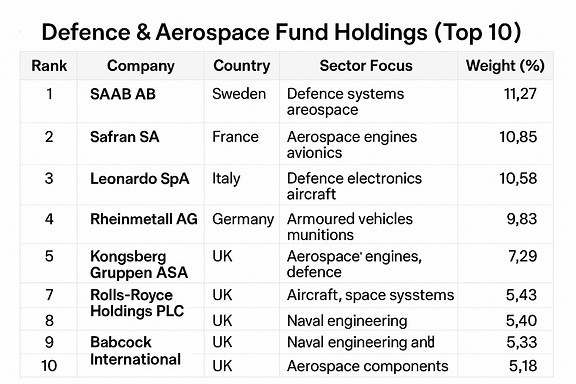
Holdings:
Methodology for Inclusion
“Companies must derive more than 50% of their revenues from the manufacture and development of defence equipment (such as military armoured vehicles & tanks, weapon systems and missiles, munitions and accessories, electronics & mission systems, and naval ships), defence technology applications, or cyber security contracting with a NATO member nation verified by publicly available contract information. Companies manufacturing military aircraft must derive at least 20% of revenue from defence.
Constituent business operations must comply with United Nation Global Compact (UNGC) principles and Organization for Economic Cooperation (OECD) Guidelines for Multinational Enterprises.
Companies involved in the production development or maintenance of anti-personnel mines, biological or chemical weapons, cluster munitions or depleted uranium are excluded from consideration for the index”.
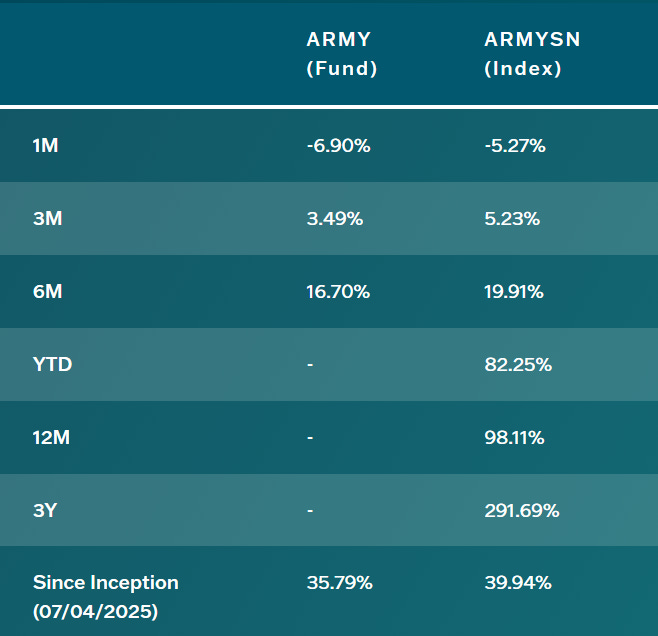
Performance before inception is based on back-tested data. Back-testing is the process of evaluating an investment strategy by applying it to historical data to simulate what the performance of such a strategy would have been.
Competitors
This ETF is newly launched (May 2025), reflecting growing investor demand for exposure to European defence contractors amid geopolitical tensions.
It is currently the only UCITS ETF dedicated to defence. Other thematic ETFs (e.g., aerospace & security) exist globally, but they are not UCITS-compliant or are domiciled outside Europe.
Trading Venues:
- London Stock Exchange (GBP ticker: DFEU)
- gettex (EUR ticker: DFNC)
- Xetra (EUR ticker: DFNC)
- Borsa Italiana (EUR ticker: DFNC)
- SIX Swiss Exchange (CHF ticker: DFNC)
Liquidity is concentrated on LSE and Xetra, with secondary listings on continental exchanges.
Disclaimer
This is not financial advice. Our content is intended to be used and must be used for information and education purposes only. Please read our disclaimer and terms and conditions to understand our obligations.
No comments yet
No one has commented here yet! Why not be the first one?