Eurozone Hedge Fund AUM: What up!?

The past few weeks have seen an abundance of media reports about the growth of the hedge fund industry since it hit bottom earlier this year. Not only did hedge fund launches outpace closures in Q3, but overall assets have (re-) hit the $2 trillion mark.
So what gives in the Eurozone? According to ECB figures updated late last week, hedge fund assets make up a paltry 2% of Eurozone financial assets (77 billion Euro). That’s not a huge surprise since the bulk of Europe’s hedge funds are based in London or off-shore. But what is surprising is that the absolute size of this segment has steadily fallen over the past year – a year when global hedge fund AUM grew by double digits.
The data itself show the following decline…
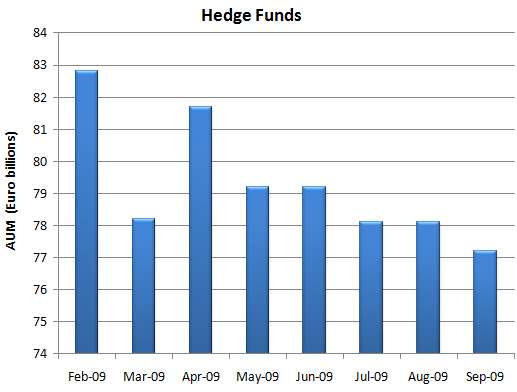
So much for a growing industry, right? Well, there may be several explanations here. One is that the definition of “hedge fund” used by the ECB is imperfect. The recent data uses an August 2007 definition (available in this document) (our emphasis):
Hedge funds: …any collective investment undertakings regardless of its legal structure under national laws, which apply relatively unconstrained investment strategies to achieve positive absolute returns, and whose managers, in addition to management fees, are remunerated in relation to the fund’s performance. For that purpose, hedge funds have few restrictions on the type of financial instruments in which they may invest and may therefore flexibly employ a wide variety of financial techniques, involving leverage, short-selling or any other techniques. This definition also covers funds that invest, in full or in part, in other hedge funds provided that they otherwise meet the definition. These criteria to identify hedge funds must be assessed against the public prospectus as well as fund rules, statutes or by-laws, subscription documents or investment contracts, marketing documents or any other statement with similar effect of the fund.
In a throw-back to the days when a hedge fund was simply an unconstrained mandate, the ECB is tracking only funds with a loosey-goosey offering memorandum. To be sure, many hedge funds still do. But try telling a convert arb hedge fund manager or a CTA that they are untied to any particular asset class. The maturation and institutionalization of the hedge fund industry has resulted in a mosaic of different constrained strategies, not one amorphous “unconstrained’ strategy.
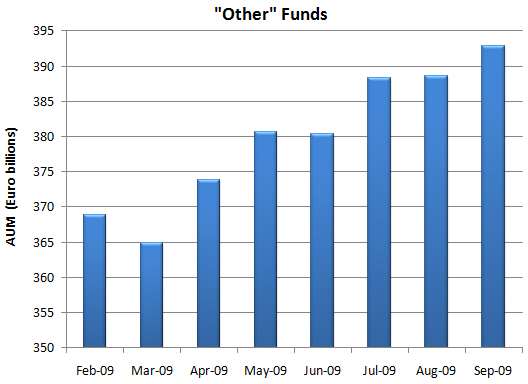
In addition, it’s unclear where UCITS hedge funds (aka “hedged mutual funds”) fit into the equation. Unfortunately, we can’t tell from the data if some funds have been categorized inappropriately. The ECB’s bucket of left-over funds (”other” funds”) has a whopping 400 billion Euro in it. And in contrast to hedge funds, this bucket has been growing all year…
But there is another, more ominous, potential reason behind the incredible shrinking EuroHedgeFund: emigration of funds to off-shore jurisdictions (or for that matter to the UK, which lies outside of the Eurozone). If a move to off-shore jurisdictions is behind these lacklustre numbers, then this data is sure to fuel the debate about the EU’s regulatory clamp-down.
Disclaimer
This is not financial advice. Our content is intended to be used and must be used for information and education purposes only. Please read our disclaimer and terms and conditions to understand our obligations.
No comments yet
No one has commented here yet! Why not be the first one?