Fever-Tree: trumped up tonics or fledgling global powerhouse?

Fevertree Drinks (LON:FEVR) is a special brand. It’s not every day you see a single drink power the vast majority of growth in one category for the best part of a decade, but that is exactly what Fever-Tree has done for premium tonics. The group is now the world’s leading supplier of premium carbonated mixers, with distribution networks in 72 countries around the world.
The group was launched in 2005 after its founders, Charles Rolls (formerly of Plymouth Gin) and Tim Warrillow, spied a gap in the mixers market. Rolls and Warrillow correctly surmised that if quality-conscious consumers are willing to splash out on premium gin, they are also likely to pay a little more for a decent tonic.
From this simple insight came phenomenal growth. Today, with its £1bn+ market cap, Fever-Tree is almost a victim of its own success. It is now so dominant in the UK market that some wonder where growth will now come from and question how it can defend high market share and operating margins from copycat competitors.
Fever-Tree’s asset-light business model makes for big profits, strong margins, high returns on capital, and lots of free cash flow. No surprise that the group has a Quality Rank of 96. It also leads to a premium valuation. At peak popularity a couple of years ago, shares traded on as much as 65-70 times forecast earnings.
Below par growth figures revealed at the group’s HY19 results precipitated a dramatic decline in the group’s share price. Now, Fever-Tree has a Momentum Rank of just 7 and its share price has fallen by some 72% in less than 18 months.
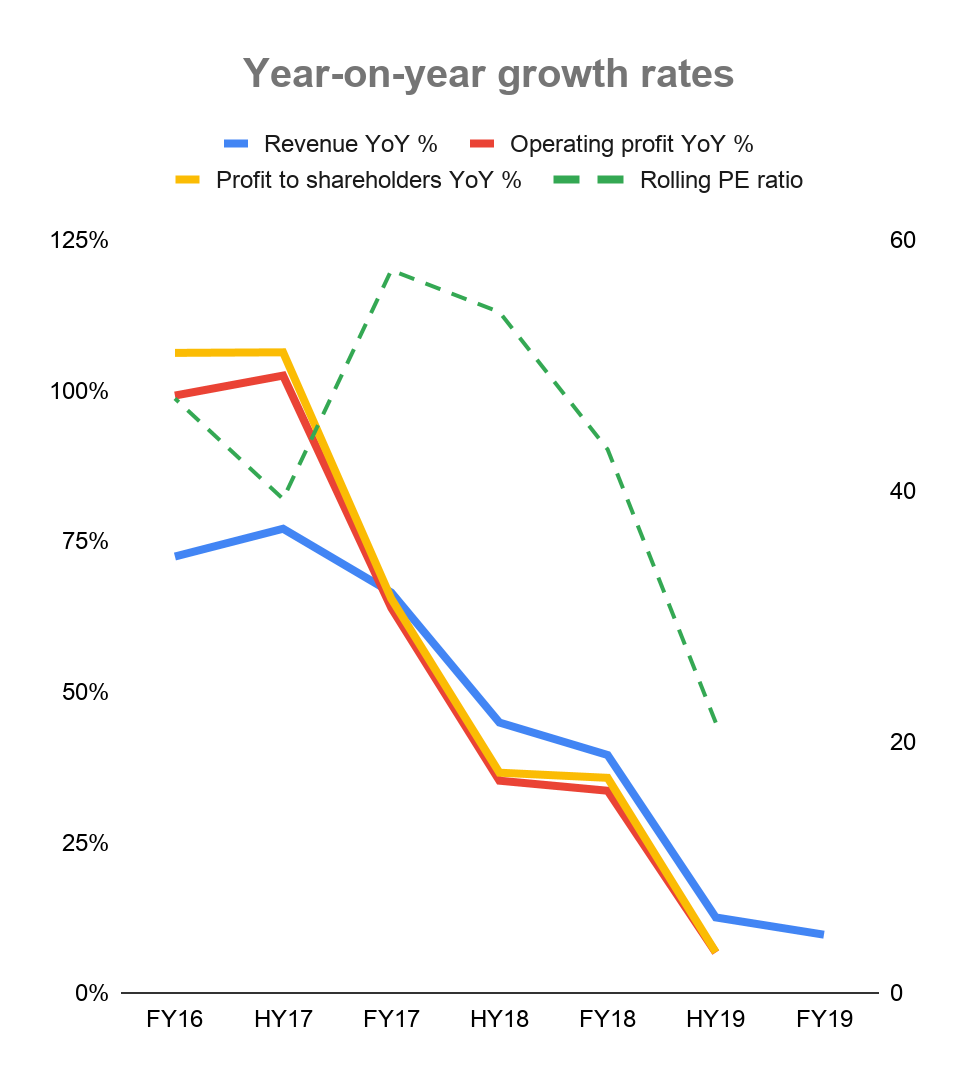
Yet still FEVR’s shares trade on a growth multiple of 22.3 times FY18 earnings.
I like a gin & tonic as much as the next man, but there are certain prices I won’t pay. In fairness to FEVR, such a lofty valuation appeared justified at the time due to its growth trajectory, quality characteristics, and habit of smashing broker forecasts. For most of its listed life, the group’s shares have been too pricey for me, but it has been a great success for others willing to pay up.
Now we find ourselves in a totally different market, with rapidly changing share prices. The mighty are falling. Has Fever-Tree just become affordable? The group has packed a lot into five years of listed life and it’s been a heck of a ride so far.
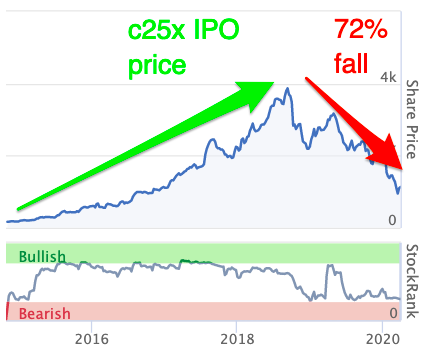
FEVR might be less expensive now, but is it still desirable? Perhaps the easy money has been made. As it laps increasingly tough comparative figures, Fever-Tree’s year-on-year growth rates have moderated dramatically.
But, then again, if FEVR’s underlying prospects remain the same, then it might quadruple to get back to where it was less than two years ago. The group’s shares have never been cheaper, but the group’s growth figures have never been less spectacular.
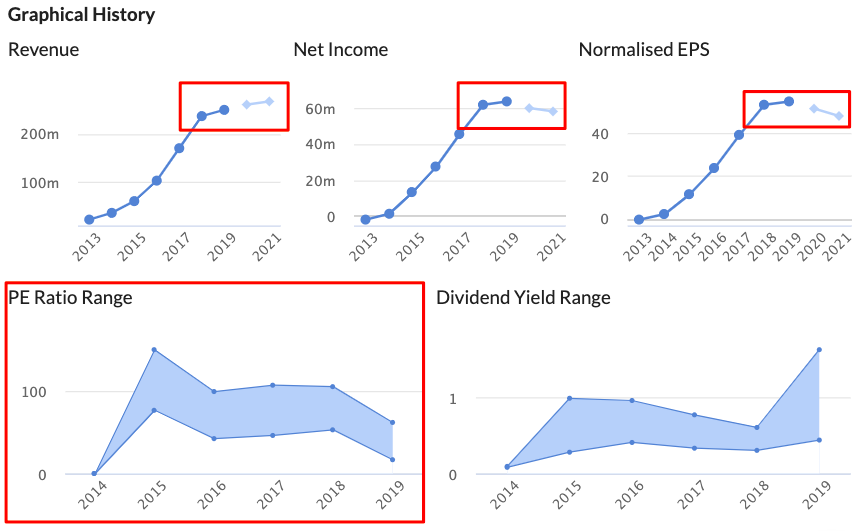
Management says there is a global opportunity. The market has clearly been spooked by stalling growth figures.
Strategy
Fever-Tree uses high quality ingredients to differentiate its brand and products from mass market alternatives. There does not seem to be a lot preventing competitors from attempting something similar, but then again Fever-Tree has by now significant first mover advantage and is building up and leveraging a global distribution network and developing relationships with distributors and spirit makers.
Brand recognition is key if Fever-Tree is to protect its margins and market share in the long term. To this end, its capital-light and largely outsourced operating model provides strong cash generation and high returns on capital.
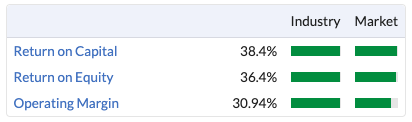
This cash can then be funnelled into its marketing budget, further enhancing brand awareness. Protection and enhancement of the brand’s market position is a key strategic focus for the group.
An important part of whether or not Fever-Tree might have built up a brand recognition style of moat is the sheer size of its first mover advantage. It has well and truly stolen a march on its competition in terms of establishing a world-leading presence as the foremost premium spirits mixer. In fact, Fever-Tree alone is responsible for the bulk of growth in this category over the past decade.
Management
The group’s management team and board includes the founders of the business, who have considerable experience in the sector.
Much has been written about director buys and sells at FEVR. While it is true that co-founders Rolls, Warrilow, and chief financial officer Brachflower have sold millions of pounds worth of stock since 2016, they retain substantial holdings in what is now a £1bn+ company.
Here are some of the larger sales to be aware of:
- July 2017 - Rolls & Warrilow sell 1,550,000 shares at c2,000p
- March 2018 - Rolls sells 3,000,000 shares at 2,750p
- August 2018 - Rolls & Warrilow sell 3,000,000 shares at 3,450p
These are significant sales, but all were made far in excess of today’s share price. That said, neither Rolls or Warrilow have been tempted to pick up shares in the 1,000p-2,000p range so far. Other directors, however, have made reasonably punchy purchases starting from 2018 through to as recently as February of this year, at 1,390p.
Director buys and sells aside, having Warrilow et al in charge means that shareholders will at least be represented by the management team that has been responsible for Fever-Tree’s stunning success to date.
What the company has to do to succeed
Up until recently, the UK has been the main engine of FEVR’s phenomenal growth. Now it must evolve into a global player.
This can be a tricky transition - note Domino's Pizza (LON:DOM) ‘s ill-fated foray overseas. Can FEVR take the next step up to become a global powerhouse and generate similar levels of growth from markets such as the US, Europe, Australia and Canada?
The data shows that international sales has only started increasing as a proportion of group sales over the past year. This is hardly a surprise, as it coincides with a period of low to negative growth in the UK.
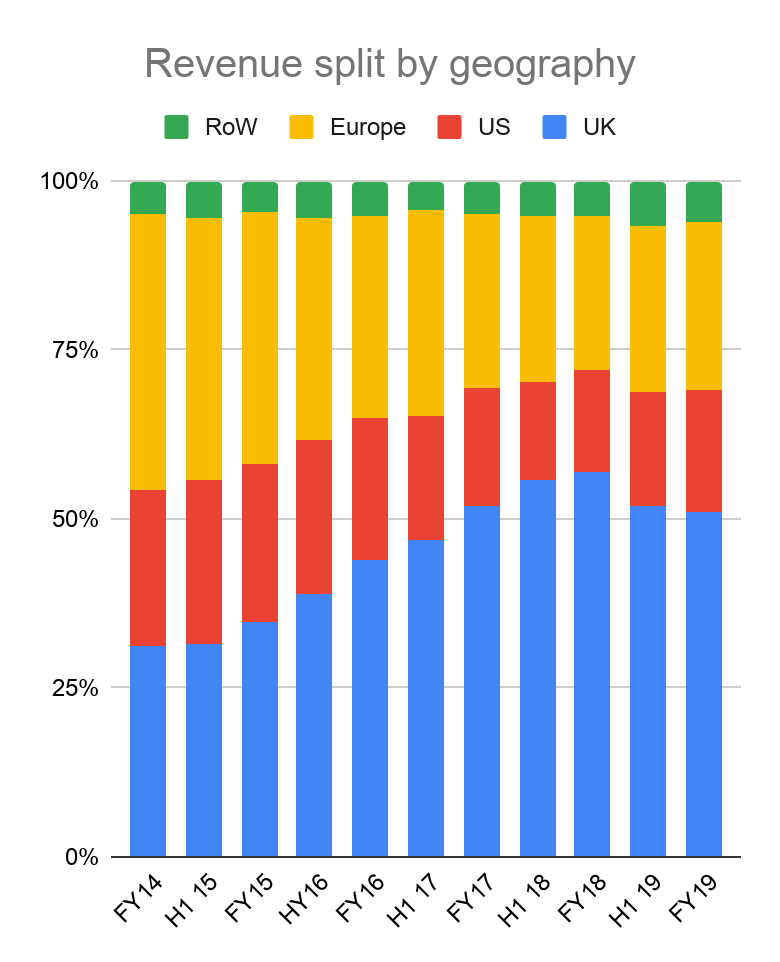
In fact, growth rates across regions are at best stable and at worst declining precipitously:
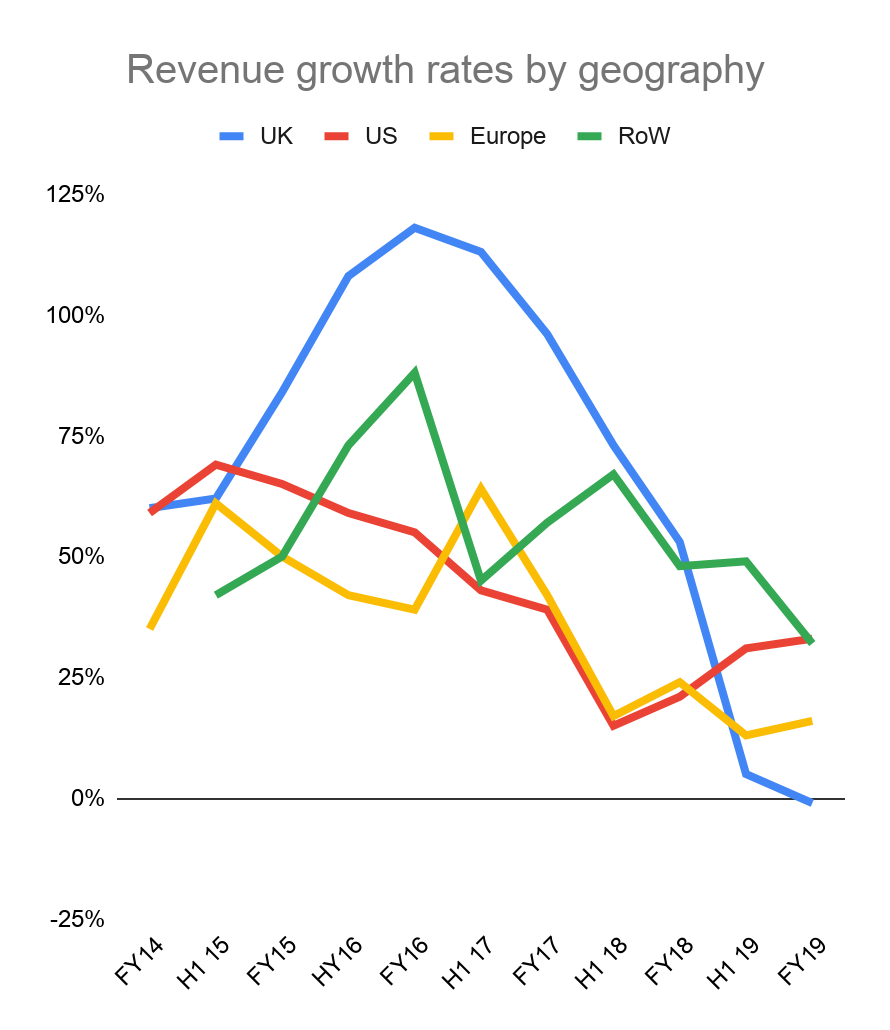
Fever-Tree’s quality characteristics are largely beyond dispute. It has high margins, high returns on capital, good levels of cash generation, and a strong balance sheet that should allow it to weather the current economic conditions (or, rather, lack of economic conditions).
The only real question concerning this side of things is whether the group’s brand is enough of a moat to protect its high market share and margins. Management itself noted in its HY19 update “the enormous amount of competition that [premium tonics] has attracted over the last ten years.”
Are moderating growth rates the beginning of the end or are they just a bump in the road?
Segments
UK
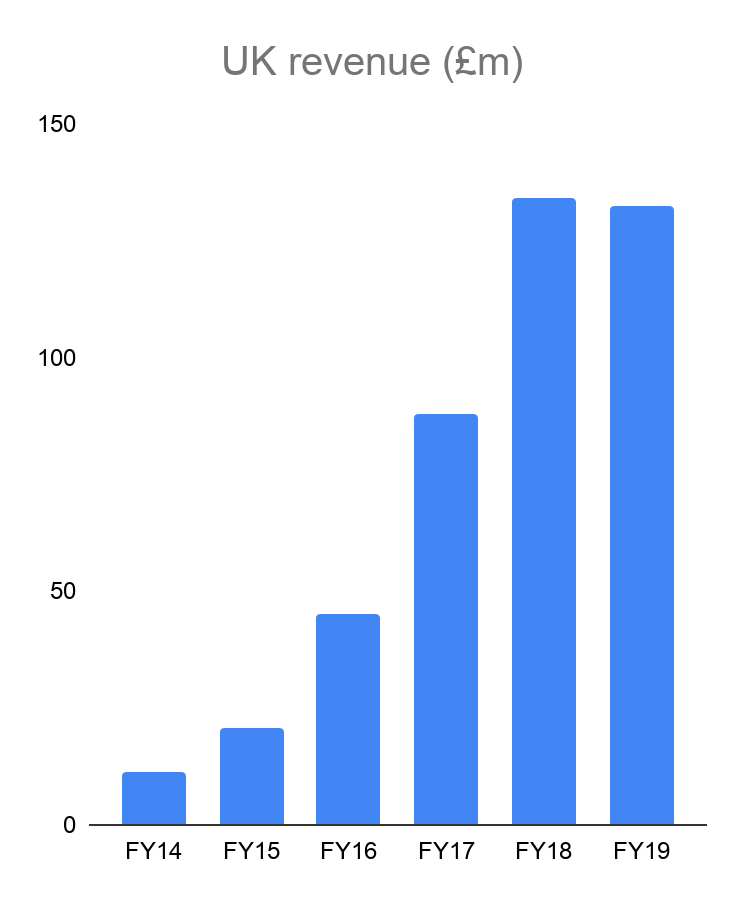
We can see the UK - responsible for 51% of group revenue - is now in negative growth. Management references “the enormous amount of competition that this category has attracted over the last ten years”, although it does add that Fever-Tree continues to outperform this competition.
At the group’s half year results, Warrilow et al said that the first four months of FY19 saw double digit growth in line with “where we were expecting to be this year, which was broadly 12.5% growth”. They expected growth rates to moderate in FY19 - but I doubt they were an outright decline in UK revenue. In fact, at the half-year point, management was confident of returning to c12.5% growth.
Perhaps, then, Fever-Tree is finding its core UK market more difficult than it is letting on?
Fever-Tree says that, having made such great gains in distribution, there is clearly far less white space available and the gin trend that has so far put a rocket under growth will not be able to maintain previous rates of growth.
In the group’s year-end trading update, it confirms that:
Whilst Fever-Tree remained the clear market leader, the expected improvement in trading during this important period [Q4] did not materialise with the macroeconomic uncertainty leading to a subdued end to the year across both the On and Off-Trade.
Whilst we expect conditions for the category to remain challenging in the first half of 2020 reflecting the current level of consumer confidence, our brand strength, operational improvements, distribution opportunities, and our innovation pipeline, alongside softer comparatives in the second half, provides us with confidence in returning to growth during the year.
US
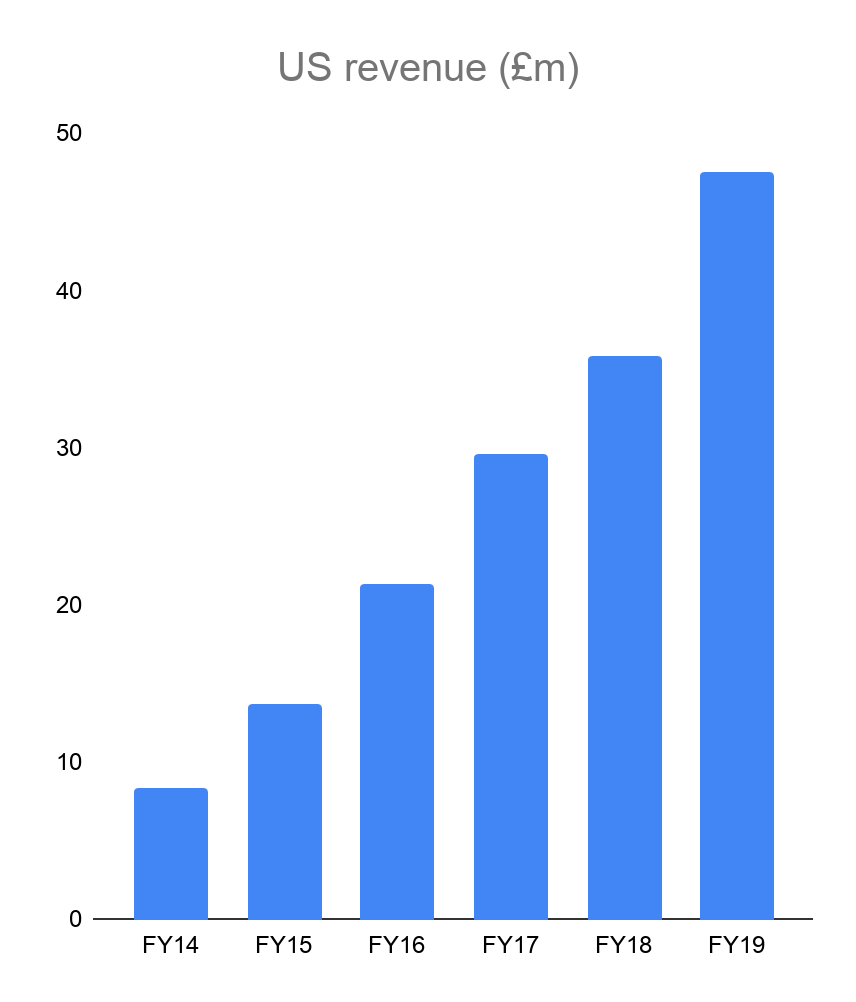
Fever-Tree is Increasingly confident in its ability to deliver strong, steady medium to long term growth in this region. Ginger ale and tonic are both growing strongly and the former in particular is a big opportunity.
Fever-Tree has made progress in widening and deepening its distribution network and continues to drive category growth. Further investments are slated for 2020 but the group notes that embarking on trials with key customers will “result in a one-off impact on net revenue growth in 2020 and as a result, we are revising our growth forecasts for the US business to low double digit for the year ahead before returning to previously expected growth rates thereafter.”
A one-off hit, then, for what is expected to become “a very significant region” for the group.
Europe
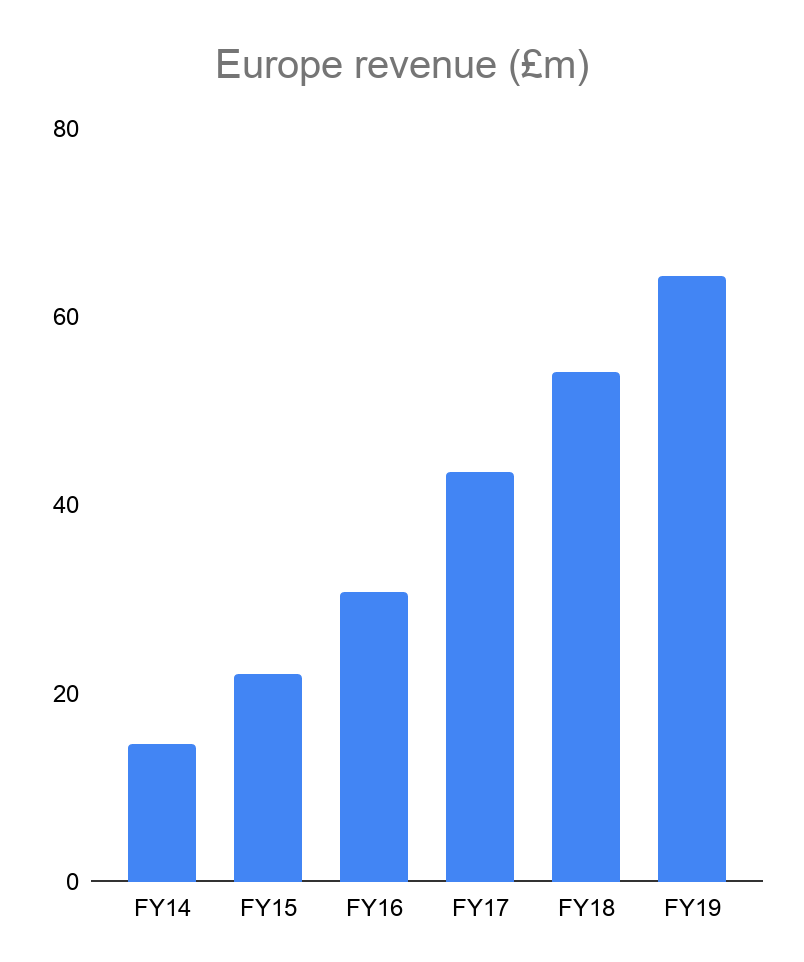
Europe is a significant opportunity similar in size to the US. Management says the brand is now In 25k outlets out of universe of c50k accounts. So perhaps Europe sales can double from here to around £120m? Benelux, Spain, Italy, Denmark, Nordics are all showing good growth and potential.
Management says that here, the premiumisation trend is gaining momentum, it is outperforming premium competitors, and is driving the growth of the category.
Rest of the world
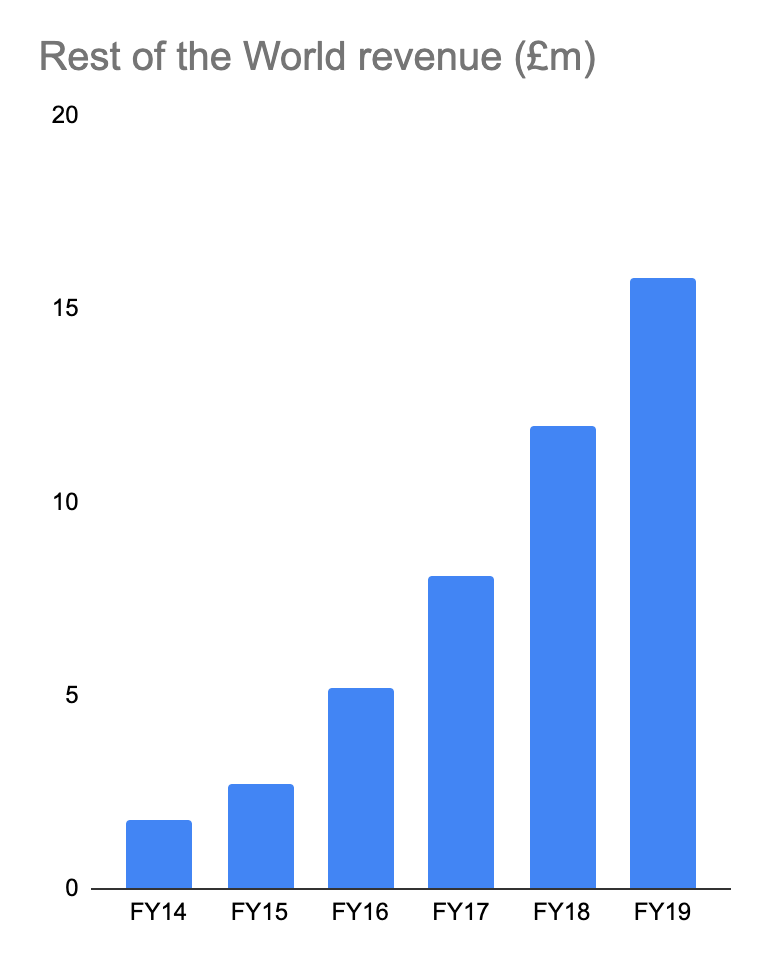
The key markets across the rest of the world for Fever-Tree are Australia and Canada, where the group continues to invest and take share. There is also an opportunity in Asia. The group has recently made senior hires in all of these regions but for now, this segment remains much smaller than its three other geographies.
Can it continue to grow?
Trading performance has been unimpressive over the past year but the group continues to invest in the brand for the longer term, most notably in its growth regions. That said, I can’t shake the impression that a positive spin is being put on moderating growth. The numbers are less impressive than the tone, in my view, and it is the deteriorating trend that really gives me pause.
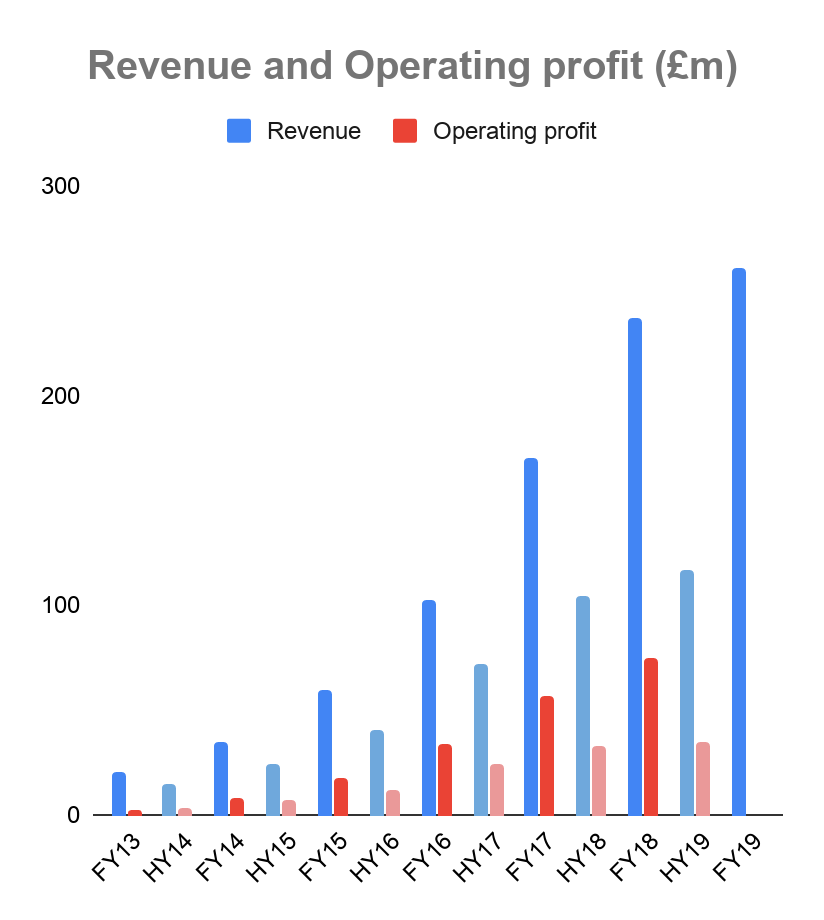
Beneath all the big talk of global opportunities, the blunt truth is that board expectations on growth and margin have come down over the past couple of years in line with the city consensus.
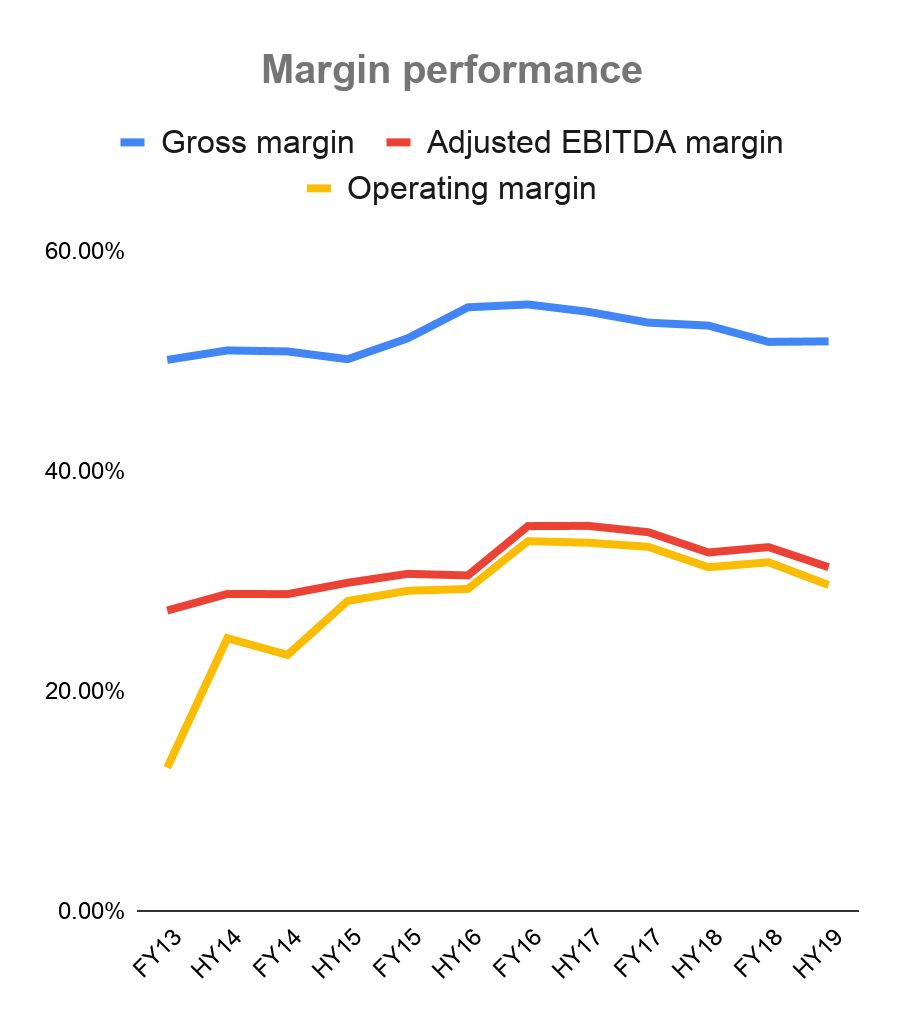
Management says that 50% gross margin and 30% EBITDA margin is defendable for this business in the long term. Central overheads will continue to decrease as a proportion of revenue as the company scales, and these savings can be reinvested in marketing etc. To the group’s credit, margins have held up well so far.
Is it good value?
The way I see it, there are two big questions to answer:
- Does Fever-Tree have a moat? If not those high margins will soon come under pressure
- Does Fever-Tree have runway for growth? If not that share price multiple will have to come down
Although Fever-Tree looks like a high quality operator with a global opportunity, I still hesitate over price.
Historically, being strict on valuation has led to a lot of sitting on the sidelines while the share price rockets. A lot depends on the scale of Fever-Tree’s global opportunity and how well it can execute its expansion across multiple regions. This is no easy task so there is execution risk here.
Given the group’s increasingly cautious tone in recent years, I would hesitate to give Fever-Tree’s shares too high of a rating. That said, it is a lot less expensive than it used to be and the group still has some very strong quality characteristics. These include:
- A strong balance sheet with net cash
- Strong cash generation
- High margins
- High returns on capital
- Solid liquidity
If you look into the future and assume a mature Fever-Tree is generating something like £150m of revenue from each of the UK, Europe, the US, and the rest of the world, that makes for total sales of £600m.
Apply a 30% operating margin to that to get operating profit of £180m. Assuming no interest and a 20% tax rate, that would give profit after tax of £144m. If you divide that by the FY18 average weighted shares in issue, you get about £1.24 of earnings per share.
So, a Fever-Tree with a mature presence across all four existing regions, at 1,191p, would be trading on a PE of 9.5 times. That projection of earnings should probably be discounted back over a period of, say five years however, to reflect execution risk. Applying a discount rate of 10% over five years would give a present value of future mature earnings of 77p.
That is not a hugely attractive entry point, unless I am understating the scale of Fever-Tree’s opportunity, which is entirely possible.
Couple this with the recent poor trading momentum, however, and I am minded to hold off. That said, Fever-Tree has the balance sheet and business model to at least survive current conditions, which is more than a lot of companies can say these days.
Conclusion
When I began my analysis, I thought I would like Fever-Tree a lot more at 1,191p than I do now.
I do think Fever-Tree’s quality characteristics should give it some kind of share price premium. I think its brand could be a moat. It has moved quickly and is scaling up. Growing cash generation is being funnelled back into marketing and so the brand is strong. It has a strong balance sheet with no debt and net tangible assets of c£200m.
If it can defend its market share and high margins that increases the value of the company.
Cash generation, balance sheet strength, and management experience gives Fever-Tree a fair chance of taking advantage of a global opportunity. There is also the possibility that a larger player will come and snap this brand up.
The above must be balanced against the cold hard fact of recent declining growth trends across its regions, however.
There could be a good opportunity here, but I come away from it all with the impression that management commentary does not quite sync up with the trading picture right now. For this reason, I am wary, and I feel like further research is required.
Disclaimer
This is not financial advice. Our content is intended to be used and must be used for information and education purposes only. Please read our disclaimer and terms and conditions to understand our obligations.

10 comments
According to The Times today, Coca Cola has decided to drop their premium Schweppes 1783 Tonic range.
I guess there are different ways to read this - they don't believe there is sufficient or dwindling market for premium brands (not good for Fevertree) or they've capitulated and decided they can't compete with premium brand tonic leader (which would be good for Fevertree).
eInteresting article and 'food' for thought.
Nick Train has recently opened up new positions in Fevertree as well as PZ Cussons.
Hi Jack. I think one of the big questions going forward for Fevertree is the disposable income of its clientele - many will chose a cheaper mixer, and this is where they may well stumble against the bigger brands- a price war. They are a niche brand and will need to create a marketing strategy that works for them. They will never compete in the mass market and need to find partners on the drinks front.
Great summary of all the parts needed .
Best regards,
Mark
Great article Jack. Really good read. I held Fevertree for much of the growth period ( on and off, but mainly on) with a trailing stop that occasionally kicked me out. I did really well and along with Nvidia in the US and a couple of others in this period, it was one of the main stars in my portfolio. I do feel that, although it is still a great company, these days are over. It will continue to do well ( and deserves to) but it will be a much more pedestrian picture now they have achieved this size and further growth will be much harder, and slower to achieve. I would still own them, and they are bound to rise when the market does (but not as compelling a proposition as some other might now be). One good thing with Fevertree is, for a company of this size, they are low cost to trade ( no stamp duty, low spread, usually). So people could take advantage of dips once the economic recovery is properly confirmed and underway.
Thanks again for the article.
Thought provoking article. However it’s clear Fever tree is toiling. Going into this crisis it’s off trade sales trend was negative & the on trade has now been decimated by closures.Declining rate of sale in the off trade despite range extension suggests its popularity is stalling. Also it has not yet reached the heights many expected in USA where each large urban markets require the right distributor parter & frankly there has to date been less of a ‘G & T ‘phenomenon. Post virus & in a recession ( or worse) will folks place premium drinks high up their agenda ? Not convinced.
It has a bullet proof balance sheet & could attract a takeover offer but only if PE comes down further towards value range. Wouldn’t touch above 900p.
Another excellent article on an interesting company.
I think the two key investment questions are: (i) will gin sales continue to grow? and (ii) will they succeed in America?
The soft drinks industry does seem attractive to investors - Buffett and Coca-Cola and the premium PE ratings that companies in this sector attract. I'm sure that the downside is protected at some price as it will be an attractive takeover target.
Thanks shipoffrogs,
This space clearly attracts some smart, "quality" investors so I'm keen to do more digging... Is Fevertree Drinks (LON:FEVR) that company right now? The falling growth rates and need for international expansion (which tends to be trickier than success in the home market), coupled with a valuation that still prices in quite a lot of growth, is enough for me to sit on the sidelines at present.
I tried to get some decent market research into the outlook for the global premium spirits and mixers markets but couldn't find anything in time for this article. If you see anything let me know.
It does not taste as good as either of the 2 Schweppes products or Nordic Ice. The latter being my preferred brand. Unfortunately I had not not fully developed my buy criteria when it was a rising star. It was not even and ethical decision! Mea Culpa
Recent news is that grocery stores find alcohol sales booming so maybe Fevertree will not suffer the Corona hit like so many other companies but discretionary spending will be reduced so a more expensive brand may give way to you know who. Also there will be a reduction in sales to hotels and pubs.
I tend to agree that Fevertree Drinks (LON:FEVR) does not look particularly compelling at these prices given that valuation upside is dependent on higher risk international growth. Two key thoughts always come back to me on Fevertree Drinks (LON:FEVR) being:
1. No one is ever going to order a Gin and Fevertree, in the way that they order a Guinness, a Jack Daniels (and coke), a Baileys, etc etc. Competition is coming in a big way and so I question their longevity as no one is specifically ordering their product (as much as it is quite nice).
2. The growth explosion of Magners Cider a few years back provides a potential similar trajectory for £FEVR. All of a sudden, cider was booming and then it went out of fashion and sales of Magners dried up. After having gone through a G&T boom it feels like it could quickly be replaced by some other new trend and then Fevertree sales will shrivel.
A key skill of the intelligent investor is to differentiate between in-fashion businesses and enduring businesses. My guess is we look back in 5 years and Fevertree was a business that quickly became very fashionable but failed to endure for the long-term.