Finding certainty in an uncertain market

UK markets are particularly difficult to navigate at the moment. A combination of poor investor sentiment, government missteps and a problematic geopolitical landscape make investment decisions challenging. Several currently competing narratives add to the uncertainty, pulling investors in different directions:
Uncertainty
Value vs Outlook
On many measures, UK stocks and smaller companies in particular, are incredibly cheap. However, consumer confidence is weak in response to higher taxes and the challenges of funding all the government spending commitments such as pensions, schools and defence. This makes the outlook for many UK stocks highly uncertain. Investors may buy shares in a company on a forward P/E of 6, but if those earnings estimates are halved, a forward P/E of 12 may no longer look attractive. Unexpected profits warnings are catching out many investors at the moment.
US Protectionism
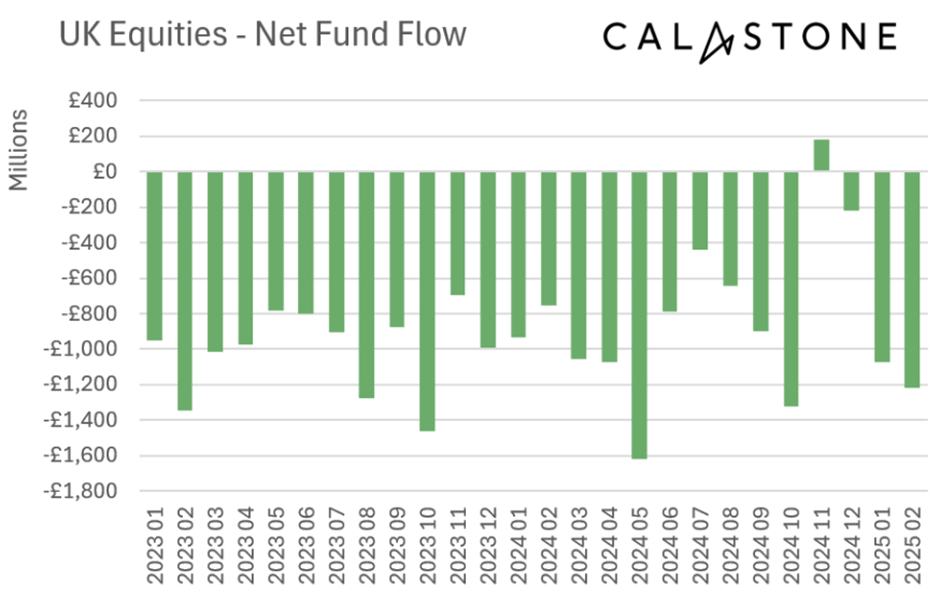
There is a certain irony to a UK market that didn't soar with the US in recent years but sells off in sympathy as the US markets tumble. It may be some salve to note that the UK indices are outperforming the US ones in 2025. However, as they say, you can't eat relative returns. The reality is that the increasingly protectionist policies coming from the US may well be bad for the UK. The UK may have avoided the worst of the headlines so far, but some industries will be impacted, and the randomness of decision-making means we may be next. With these challenges, fund flows into UK equities remain negative, as this chart from Calastone shows:
Momentum works, until it doesn't
Given the messaging from the US and the response from Europe, many defence stocks have seen their share prices outperform recently. However, it is far too soon to see the effect of any changes in outlook in financial results. Several defence companies have warned this week, such as Qinetiq (LON:QQ.) and MTI Wireless Edge (LON:MWE) . It seems that investors were wrong to hope that trading conditions for defence stocks would improve, at least in the short term.
Similarly, small mises against forecasts for high-flying investor favourites such as Beeks Financial Cloud (LON:BKS) and Warpaint London (LON:W7L) have seen these stocks lose over 30% of their value in the last three months. Momentum is a powerful effect, and it can be even more savage on the downside than it is beneficial on the way up.
Cost-cutting versus revenue growth
Many companies that are growing EPS or hitting expectations are doing so by cutting costs. This makes sense. With weak demand, cutting costs and building financial strength is far better than hoping things will turn around. This invariably means job losses, which causes three issues for investors. The first is that companies often adjust out the cost of redundancies, which makes the short-term earnings impact of cutting costs look much better than the underlying cash flow. Secondly, only so much of the cost can be taken out of a business before it negatively impacts long-term prospects. Finally, when everyone is making redundancies, it means that consumers as a whole have less money to spend, which may weaken demand for a company's products or services even further. This is how we get recessions, where a downward spiral of weak consumer confidence leads to lower employment, which leads to weaker consumer confidence…
Certainty
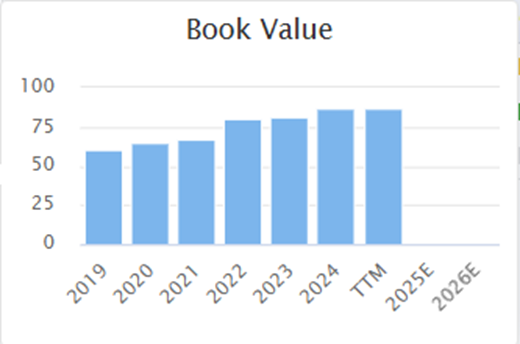
Even in such an uncertain investment landscape, investors can gain certainty by focusing on the assets of a business instead of near-term earnings forecasts. Knowing what the assets of a business are is relatively easy; these will be broken out on the balance sheet. Stockopedia provides the history of the Book Value of a company:
Together with the current asset-based valuation metrics:
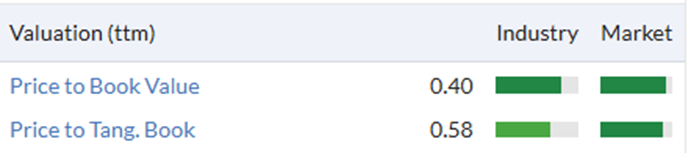
Investors who want certainty can buy stocks when a business trades below its Book Value or even below its Tangible Book Value. During bull markets, such bargains may be hard to come by. However, in weak markets, such stocks are often available in abundance. The idea behind asset-based investing is to look through the current economic conditions to a time when assets are more productive again. This harnesses the power of capitalism. Managers of unproductive assets are incentivised to improve their prospects by adapting strategy, cutting costs or working capital, or selling off assets to those who can use them productively.
Buying stocks at a discount to Book Value and waiting for them to trade at a premium sounds simple, and indeed, it is. However, there are some impediments to using this as an investment strategy. For example:
Tangible versus intangible assets
One of the critiques of balance sheet-based value investing is that it often fails to fully capture the value of intangible assets. For example, a company may have a very valuable brand. However, the advertising that built that brand over the years will have been expensed, not capitalised, and balance sheet measures will miss this. In contrast, if a company acquires a brand, then the price paid will usually exceed the book value of the acquiree, and the difference will appear as an intangible asset (goodwill) on the acquirer's balance sheet. The modern world increasingly relies on intangible assets to generate returns for shareholders. This may well be one of the reasons that the Value factor (buying the lowest decile of stocks on P/B) has underperformed for several years in the US.
However, stockpickers are not just following a quant strategy. My own view is that when following this strategy, it is better to focus on tangible assets and buy when companies are trading at a discount to Tangible Book Value. If a business also has valuable intangible assets, so much the better, I am getting these for free. For example, Sanderson Design (LON:SDG) has a valuable catalogue of designs from over a century of operations, yet how these are accounted for on the balance sheet may not fully reflect the value that these currently generate from licensing income. This is clouded by a core manufacturing business that is currently loss-making, hence the shares trade at a discount to TBV.
Assets may not be worth the balance sheet value
There is often no substitute for knowing a little about a business. So if there is property on the balance sheet, then knowing when it was last re-valued, or knowing the location and any other potential uses for the land. The plant and equipment of a mining company in some distant land may have very little value as an alternative use. However, it may have the potential to be very productive in the right commodity markets.
Even current assets, such as inventory or receivables, may not be worth what is on the balance sheet in extreme scenarios. For this reason, some investors like to add in a margin of safety, valuing a business by only a proportion of each type of asset, depending on how readily it may be turned into cash. This strategy is great for businesses which are able to be wound down, but often severely limits an investor's investment universe. Buying extremely cheap businesses can be a great strategy. However, the success of asset-based investing rarely relies on those assets being realised in cash. Instead, it relies on the tendancy for those assets to become productive again, generate earnings and cash flow and for the market to ascribe a higher valuation to the transformed company.
The company may not last long enough to turn around
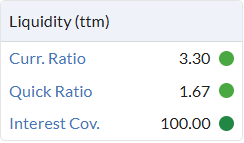
Buying companies based on a discount to tangible book value tends to ensure a certain amount of balance sheet strength. However, such businesses can still go bust. Very large losses or asset write-downs may be a rare downfall. However, such a business usually fails because of insufficient short-term liquidity. They may have significant non-current assets, but if these are illiquid or inaccessible, it won't stop the business from becoming insolvent. Therefore, investors who focus on turnaround situations also need to focus on measures of short-term financial strength. Investors need to pay close attention to the Current and Quick ratios.
I wrote more about how to assess financial strength here.
Management may be resistant to change
Some companies may never manage to make their assets productive. Occasionally, this is because of some inherent quality of the business. However, I think this is relatively rare. For example, in 2017, MS International (LON:MSI) looked like a poor business that had failed to grow revenue for a decade and had a single-digit ROCE. Today, this is viewed as an excellent business by many investors, and the only thing that has changed is the arrival of more orders in their defence subsidiary. When a company's assets stay unproductive, it is usually because the management doesn't want to take the actions to make them so. It is a bad sign when an unproductive company has a large shareholder who can block any attempts to force actions to turn around the business. This type of business is colloquially referred to as a Value Trap, and investors should avoid this type of investment no matter how good other metrics may appear.
Judging whether management is willing to take the necessary action is best gleaned by speaking to them. However, sometimes, changes in strategy are obvious. For example, Camellia (LON:CAM) looked like a value trap with a controlling shareholder for many years, but recently, it has engaged in a concerted effort to simplify its business and sell off non-core assets.
It takes patience
Perhaps the greatest quality a value investor can possess is the willingness to look stupid in the short term in the pursuit of long-term gains. No one knows when economic or political conditions may be more favourable, and the problem with waiting until they are, is that investors will probably miss the bulk of the returns. For example, markets fell precipitously in February 2020 in response to the COVID-19 pandemic but had bottomed by the end of March, up to 18 months before most businesses returned to regular trading. Investors who waited until normality returned at the end of 2021 would have bought towards the market peak, not the nadir. Instead, asset-based value investors buy a basket of stocks which are likely to benefit from mean-reversion in corporate performance and wait until this happens, trusting that the market will reflect this in the price…eventually.
Screening
The good news is that many of these factors can be screened for, and I have created a P/TBV screen to identify candidates:
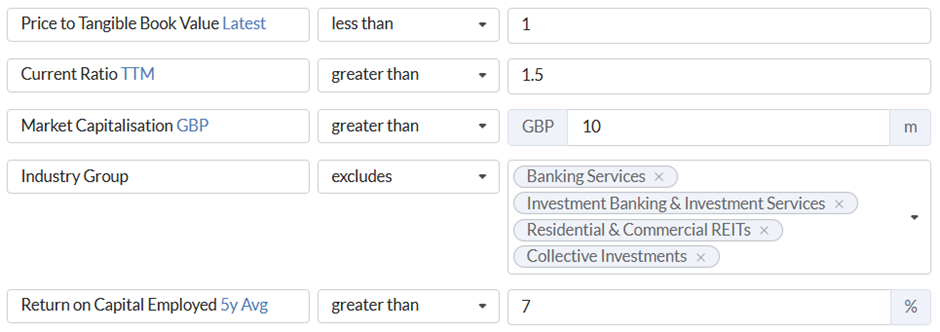
At the heart of this is the requirement for a stock to be trading at a discount to Tangible Book Value, with a current ratio above 1.5, hopefully indicating the financial strength to withstand the current short-term issues the company faces. I exclude microcaps, banks, funds, and REITs. This is not because these are necessarily bad investments at the moment but because they require different valuation methods from trading companies.
Controversially for a value screen, I include a Return on Capital measure, asking for the 5-year average to be greater than 7%. I am trying to exclude value traps, where a company's assets have been permanently unproductive, and there is little sign of this changing. Instead, I look for companies that may have had good returns on capital in the past but are going through a weak patch. This factor aims to catch this effect, although it is not perfect. For example, the ROCE measure successfully rules out a company such as FIH (LON:FIH) that has never had an acceptable return on capital, as far as I can see. However, it also rules out a company such as Hunting (LON:HTG), which suffers from a very long demand cycle, perhaps incorrectly as a value trap.
The screen currently generates 42 ideas for further research:
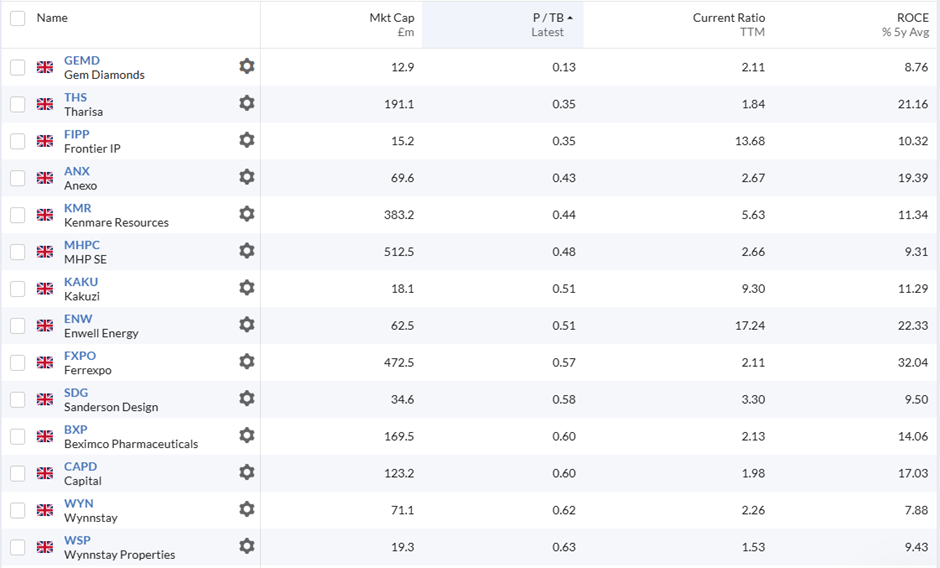
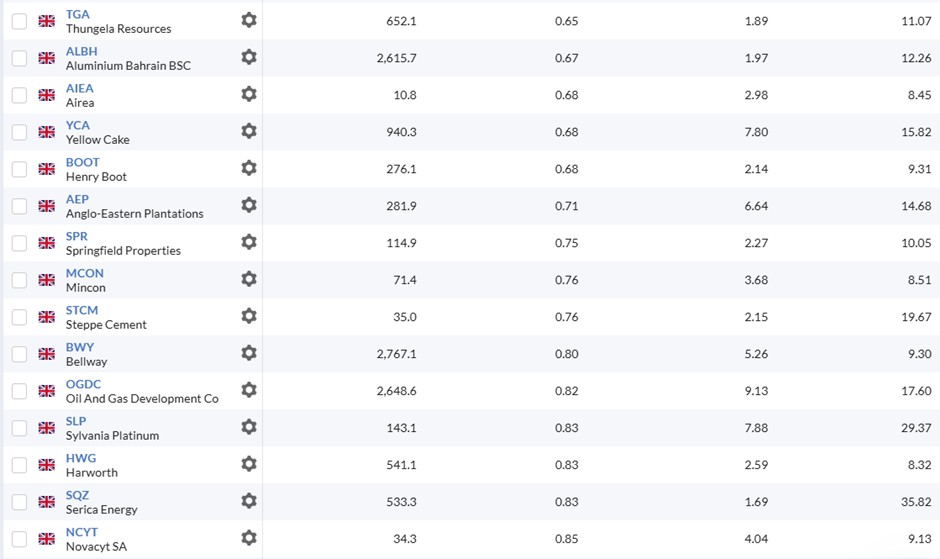
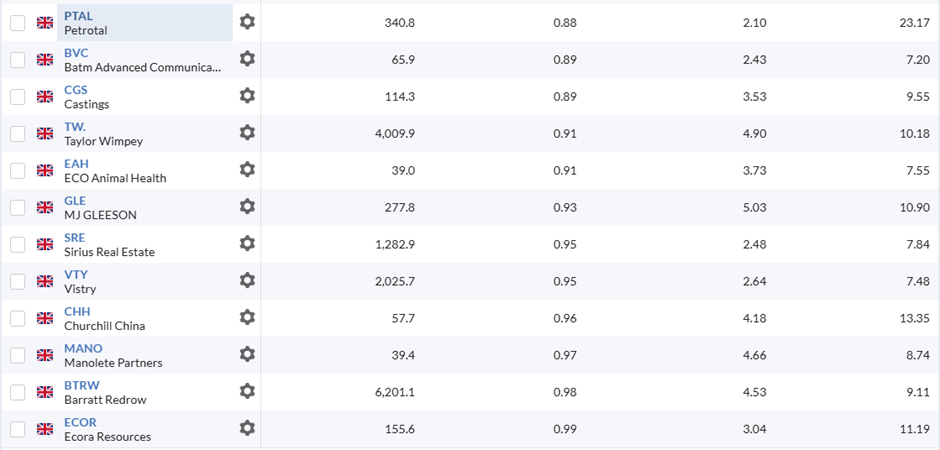
Not all of these will be great ideas, but there will undoubtedly be some gems in there, where the market is pricing in the assets never being productive again, but a turnaround is underway. Happy hunting!
[Disclosure: Mark owns shares in Camellia (LON:CAM) Capital (LON:CAPD) Sanderson Design (LON:SDG) Serica Energy (LON:SQZ) ]
Disclaimer
This is not financial advice. Our content is intended to be used and must be used for information and education purposes only. Please read our disclaimer and terms and conditions to understand our obligations.

2 comments
Nice article always an insightful read its remembering it all. Just look for green dots eh
Thank you Mark, great article. We have 7 on your list, investing right now needs a certain amount of determination and optimism. Isn't "Investing should never be comfortable" a motto shown on Stockopedia sometimes?