Finding opportunities in current market conditions: Volatility, oil producers, and tangible assets

Last week, I looked for companies trading at low multiples of their growing earnings and tried to determine whether they would be affected by recent global events. This week, I'm continuing in this vein, looking for possible opportunities in difficult markets.
Volatility as your friend
When investors talk about volatility, they usually mean stocks going down. There is an old stock market saying that share prices climb the stairs and go down in the lift. Over the past few weeks, many of us have experienced that wobbly feeling in our stomachs as the lift has descended rapidly.
However, some companies benefit from these downward moves, as these tend to drive trading volume. You only have to look at the problems Hargreaves Landsdown has had recently to see how keen investors have been to trade lately. The number of listed UK stockbrokers is now quite limited, with HL taken over and Jarvis forced to sell X-O to Interactive Investor for less than 2xFCF. Interactive Investor is owned by the recently re-vowelled Aberdeen (LON:ABDN), but this company is also an asset manager whose AUM will be negatively impacted by market moves. One listed stalwart remains: AJ Bell (LON:AJB)
Looking at the chart, the market has hardly priced in an unexpected boom time:

While the company may not be Bargain of the Century, it is more modestly valued than in the past, for such a high-quality business:

At the spicier end of the industry, we have the spread-bet companies. Many of these also include growing stockbroking businesses that will benefit from higher volumes. However, it is the leveraged parts of the business that will really see the positive impact, as these tend to see higher direct trading volume and a desire for investors to hedge exposure elsewhere.
I recently wrote a brief Stock Pitch article on CMC Markets (LON:CMCX) that lays out the thesis in more detail.
All three UK-listed spreadbetters (IG group (LON:IGG) Plus500 (LON:PLUS) CMC Markets (LON:CMCX)) have done well over the last month, but perhaps less so than one would expect:

The reality is that these are still equities, and they get traded as part of index basket trades. So you may even get the share prices of these stocks going down on a bad day for the wider markets, even though such moves are likely to be good for their underlying businesses. This may be an effect that nimbler investors can exploit.
Oil companies
Investors may wonder why oil companies haven't soared, given the headlines about oil prices and potential fuel shortages stemming from the closure of the Straits of Hormuz to most ships. Well, the answer is that markets expect the impact to be short-lived. While the spot price for the key benchmark of WTI may be approaching $100/bbl, it is expected to fall back rapidly over time. It is the shape of the forward curve that matters to long-term producers:
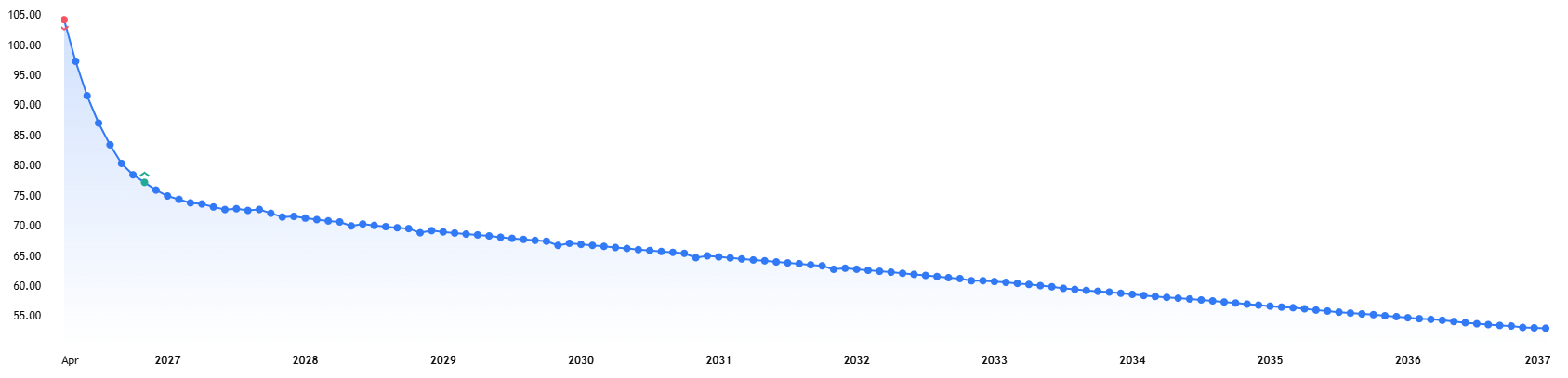
[Chart: Trading View]
This doesn't mean that there isn't an opportunity in current markets. This forward oil price curve was for oil between $60-$65/bbl all the way out before the current crisis. It is the average increase across the curve that matters, and here it has gone up by something in the region of $12/bbl, and perhaps closer to $15/bbl on an NPV basis.
Oil producers with high near-term production, high costs, and in safer jurisdictions will particularly benefit. I will use Jadestone Energy (LON:JSE) as an example because the company meets these criteria and provides us with its sensitivity to oil prices (and I hold, so I've looked at this already!).
In a recent update, Jadestone said:
Every US$10/bbl move in the underlying Brent assumption changes the 2025-2027 free cash flow guidance by ±US$90 million, which is in line with the original sensitivity given in February 2025.
FCF is likely to be minimal in FY25, which means the bulk of this will fall in 2026-2027, where the oil price has increased by around $15m across the curve. This suggests roughly $135m additional FCF net to Jadestone from the recent oil price increase, which is roughly £100m.
Jadestone's share price has responded positively to recent oil price gains:
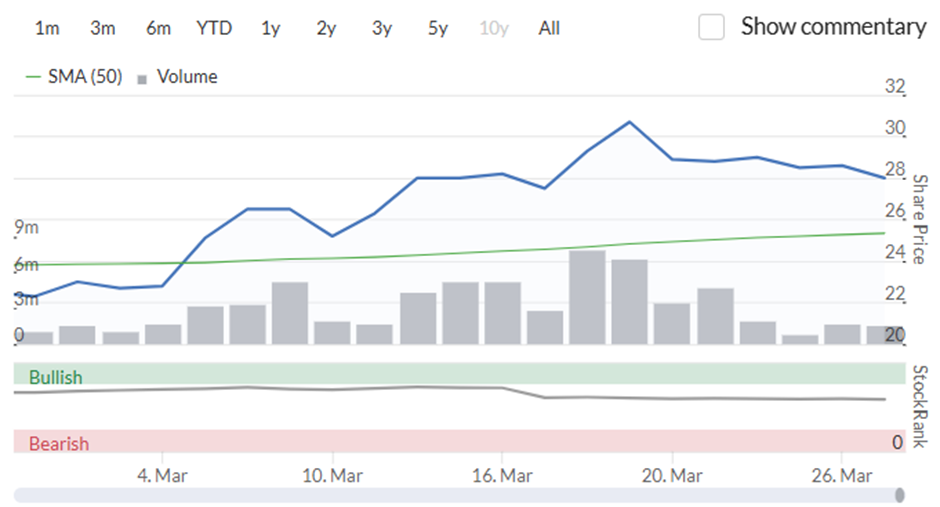
However, the share price is only up around 20%, which is a roughly £30m increase in market cap versus a £100m improvement in FCF.
The disparity between what oil markets are pricing and what equity markets are pricing may well create opportunities for investors. However, this strategy requires some diversification. It has not all been plain sailing for Jadestone, whose price may be weaker than expected due to some operational challenges. For example, this week the company announced that one of its producing fields was damaged by a cyclone. Losing production during a huge short-term spike in oil prices may limit the upside. While the cost of lost infrastructure and production appears to be insured, it is not clear what oil price these insurance payments will cover.
Another factor to consider is that the equity markets may be right and the oil markets may be wrong. Still, the good news is that oil markets are relatively liquid, so advanced investors may be able to hedge this for a risk-free profit (at least if investors diversify away individual company risk). And companies themselves may choose to hedge their production to lock in those unexpected profits, too.
Tangible Assets
One of the problems with equity investing at the moment is that uncertainty is increasing. Last week, I identified a number of companies that were cheap, forecast to grow earnings, had reasonable quality characteristics, and are unlikely to be directly impacted by current world events.
However, these companies may not be immune to secondary effects. If higher oil prices cause inflation, which in turn leads to higher rates and reduced business confidence, this may affect the short-term profitability of even excellent businesses.
However, even fairly extreme dips in business confidence are unlikely to erode the value of a business's assets. Indeed, in an inflationary environment, the value of assets such as inventory will appreciate. It may be time to dust off an old favourite of mine: my Price-to-Tangible Book Value screen. These were the criteria I usually set:
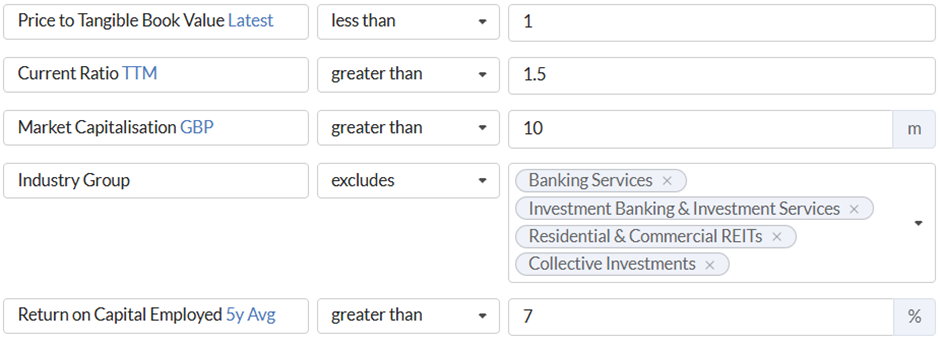
These are the reasons I gave for these choices when I created this screen:
At the heart of this is the requirement for a stock to be trading at a discount to Tangible Book Value, with a current ratio above 1.5, hopefully indicating the financial strength to withstand the current short-term issues the company faces. I exclude microcaps, banks, funds, and REITs. This is not because these are necessarily bad investments at the moment, but because they require different valuation methods than those used for trading companies.
Controversially for a value screen, I include a Return on Capital measure, asking for the 5-year average to be greater than 7%. I am trying to exclude value traps, where a company's assets have been permanently unproductive, and there is little sign of this changing. Instead, I look for companies that may have had good returns on capital in the past but are going through a weak patch.
The screen currently generates 32 results:
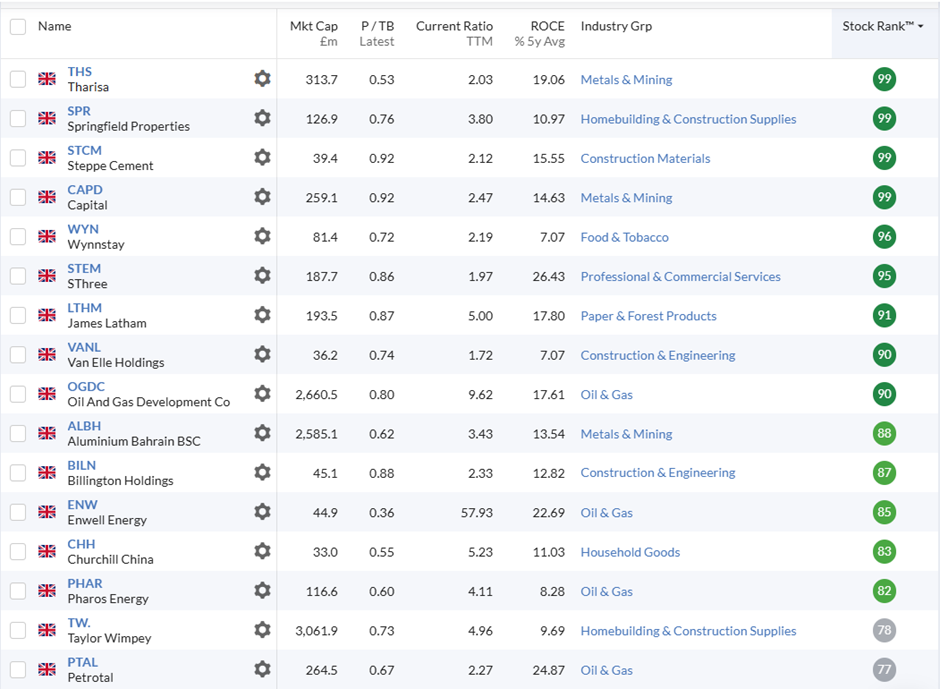
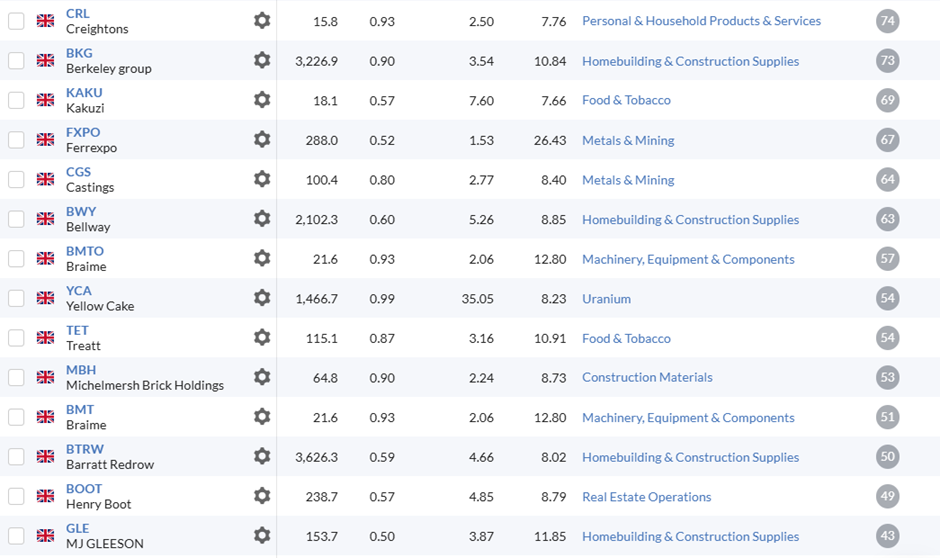

There are some notable themes. Several housebuilders appear on this list, as they trade at a discount to their large landbanks. These companies will undoubtedly suffer from higher UK interest rates, which will decrease affordability and dampen demand. For investors to conclude that these are undervalued will require more detailed work on the type and location of their land holdings. However, it is worth noting that some of them trade at around half their tangible book value, and this represents a large margin of safety against adverse moves in land prices.
Some companies, such as Churchill China (LON:CHH) or Castings (LON:CGS), are high energy users, and increases in wholesale UK gas and electricity prices will hit them hard. Investors may need to consider whether current UK energy policies make operating these businesses permanently uncompetitive in the UK. If this were the case, the value of their fixed assets would likely be overstated.
However, there are plenty of other companies on this list trading below a conservative estimate of net asset value, and don't suffer from these challenges. These may well be attractive to value investors who want downside protection from asset backing and the long-term upside of mean reversion when better economic conditions return.
[Disclosure: At time of writing, Mark has long positions in Billington Holdings (LON:BILN) CMC Markets (LON:CMCX) Jadestone Energy (LON:JSE) James Latham (LON:LTHM)]
Disclaimer
This is not financial advice. Our content is intended to be used and must be used for information and education purposes only. Please read our disclaimer and terms and conditions to understand our obligations.

8 comments
We have 7 on your list Mark, I expect them to fall further today after the best American President ever, in his own opinion, delivers yet another conflicting message.
Thanks for the article? Isn't Billington Holdings (LON:BILN) under similar energy cost pressures as Churchill China (LON:CHH) ? Or will they be able to pass on the increases in project costs to their customers?
Not hugely in a direct sense, fabrication takes energy but it’s not a huge part of the cost. Steel prices may well rise, but these will mostly passed through to customers or be hedged. Whereas actually casting metal or firing pottery faces much higher energy proportions. All of this is relative though. A one person business running a laptop has higher costs of energy, it just isn’t typically a big part of the cost of the work they do.
"Still, the good news is that oil markets are relatively liquid, so advanced investors may be able to hedge this for a risk-free profit".
Do you mean by having a longer short on the oil price and a shorter long on an individual company? That's been my strategy so far but I'm having to stay firm in the face of an eye-watering running loss on the short side of that trade!!
Yes, something like that. Truly risk free would probably be a complex strategy matching the duration of producing assets and the dated contracts. And even then, there’s a risk that the oil companies don’t return excess cash or do something daft with it. The other way to limit losses on the hedge would be to use options. But this has a time cost as well.
At then end of the day, I think something like Jadestone has enough optionality without complex hedging, being a high cost producer that has suddenly lucked their way into significant excess profits, and this hasn’t been reflected in the market price. As others have pointed out, there’s enough issues with the company to be wary, but that’s also why it is potentially one of the best ways to gain this optionality. But if others have similar cases where the FCF has increased multiples of the market cap on something like a $15 oil price increase across the curve, I’d love to know about them.
Had to laugh when you wrote that the oil markets are relatively liquid
I'd be a bit careful with Jadestone Energy (LON:JSE). Their ARO is huge (over $600m last I checked). That's unusually large for size of co. Given their chequered operational history one has to question whether they're the best co to carry out a successful asset retirement campaign. Although they do trade at a significant discount to NAV (which should include the ARO liability). I think that investors will always view their huge ARO costs as an anchor, permanantly weighing it down.
Excellent article Mark.
Interesting list of bargain companies. Plenty fortraders and investors to choose from. Looking ahead , in 2 years time, I see most housebuilders mentioned above offer good value at today prices. I have them all and therefore, I am biased!