Focusrite: a quality compounder

Summary
- A quality company that has compounded sales and income at high rates over the last decade with a return on equity significantly above its cost of capital.
- Recently, higher costs and a strong post-pandemic comparative means that EPS forecasts are for slight declines for this year and next.
- However, there is little sign that the company has gone ex-growth over the medium to long term.
- The short-term outlook, plus the possible presence of a forced seller, has driven the price down to a level where it may represent good value for the long-term investor.
Profile
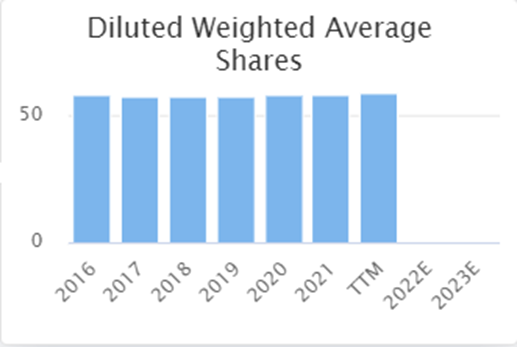
Focusrite (LON:TUNE) is an AIM-listed supply of hardware and software to the audio industry. It began in 1985 as a supplier to professional studios. The current Chairman, Phil Dudderidge, acquired the company in 1989 with the aim of expanding the business to serve commercial and hobbyist musicians as well. He has succeeded by growing the business, not just organically, but by acquisition. The pace of inorganic growth has accelerated in recent years, with four companies added since 2019. However, importantly for shareholders, this has been achieved with no dilution:
Today the company focuses on two areas: Content Creation and Sound Reproduction
Content Creation
Focusrite provides hardware and software for music, streaming and podcasting content creators. There has been a trend in the music industry for content that would once be recorded in a studio to be done at home. The company provides both types of equipment, but the line has been increasingly blurred. On top of this, the trend for podcast content continues to grow, and listeners increasingly expect podcast audio to be high quality. Focusrite's equipment enables podcast hosts to create this with minimal effort. Covid provided a boon for the content creation side of the business as musicians could only produce content themselves as studios closed and live events ceased.

They trade under the Focusrite, Focusrite Pro, and Novation brands in this sector. They also have a software offering called Ampify which they bundle with their hardware.
Sound Reproduction
This division includes Synthesisers from Sequential, Amplifiers from their latest acquisition Linea Research, speakers from Martin audio, and studio monitors from ADAM Audio, such as these:

In contrast, sales in sound reproduction were severely hit by Covid. This is unsurprising, as the live events, nightclubs, churches and hospitality venues for which this part of the business provides live sound equipment were all closed. However, demand from this sector is now showing signs of revival.
Focusrite featured in several of my Top 20 lists for quality companies based on its high and consistent Return on Equity. It had one of the fastest sales growth rates and demonstrated positive operational gearing. This makes it a strong contender for a high-return stock using my Runway, Moat, Operational Gearing framework. However, it was not particularly cheap. In this article, I will investigate whether it is worth paying for this quality compounder.
Runway
With 24% compound annual growth in revenue since 2012, Focusrite has been a great success story. This has come both from organic growth and acquisition. Sales growth accelerated in 2020 and 2021 in response to the pandemic but is forecast to plateaux for this year and next, despite a recent acquisition:

In 2022H1, sales are geographically split across Europe, North America and the rest of the world:

So, the big question is can they return to sales growth or is their market now largely saturated following the exceptional demand in 2021?
Asia Pacific grew particularly strongly this year, with a 13.6% increase in revenue. In addition, they have increasing opportunities in Australia and Latin America. So, the potential for geographic expansion remains. However, this hasn't been enough to overcome the weakness in North America and Europe, causing an overall 8.7% decline in organic constant currency revenue for H1. The company also says that the "live sound market [is] starting to show signs of revival", which suggests that there is more to come from this part of the business. In many cases, it is not predicted to return to pre-pandemic levels until 2024. Their Sound Reproduction products have been particularly affected by component supply issues recently, suggesting that demand may be outstripping supply in some cases.
Across the various target markets for their products, the company estimates the Total Addressable Market (TAM) in content creation to be around £2bn:

Given their current sales, this represents an average 6% market share overall for content creation markets. This is significant but not excessive. While some market share gains are possible, it will require a growth of their markets as a whole for them to grow at a significant organic rate. Nevertheless, the signs here are positive, as continued music streaming and podcast growth is forecast:

Loudspeaker market value is also forecast to grow over the next few years:

Live Events has a similar, if not slightly larger TAM than content creation, and here their market share is around 2%. This provides a greater opportunity to capture market share in a growing market.
Overall, the company has a good but not exceptional runway ahead of it. At some point, their end markets may turn, and they may start to reach the limit of market share gains, particularly in content creation. However, they have proven wise purchasers over the years, and there is scope to expand their runway via further acquisitions.
Moat
The Return on Equity for Focusrite averages around 30%, which is an outstanding figure, showing a considerable historical ability to deploy capital at tremendous rates of return:

(2022/2023E figures are estimates based on Brokers' forecasts in Stockopedia and Equity from the H1 Balance Sheet).
In 2020, the ROE took a nosedive. However, this is a year with high exceptional costs:

So, if I adjusted these out and took adjusted Net Income, this figure would look a lot better. This may not be ideal either since this company is a serial acquirer, and acquisition costs should perhaps be considered a normal part of their business. And although Goodwill write off is non-cash, this may flatter the future ROE as this comes off the equity. Adding back the Goodwill impairment and "one-off" costs to Net Income and the Goodwill to Equity gives a smoother underlying picture:

The trend here is still downwards, suggesting that the company may be losing its competitive edge. This is something to watch in the future, but the absolute level remains well above their cost of capital. Another sign that a company has a sustainable competitive advantage is a high gross margin, and here the story is more promising:

The current 46% is a strong figure for a business producing mainly physical products. But, equally importantly, this is trending upwards over time. The H1 margin bridge shows that they have managed to pass on higher prices than their cost price increases. The gross margin fell due to higher freight costs and some component spot buys (classified as "other" here.)

Given the recent drop in container rates, this should now be acting as a tailwind, not a headwind, for Gross Margin.
So what is the moat that the company possesses? I believe part of it is technology-based. The company has patent protection over some of its technology, including some filed this year. However, their patents are not extensive. I believe that their main moat is their brands. They have built a reputation as a provider of quality kit that does a job well and produces excellent audio quality. For example, their Scarlett 2i2 3rd Generation gets 4.7 out of 5 from 34 thousand reviews:

This appeals to both amateurs and professionals who want kit that works well, with minimal effort, and produces professional sound, allowing them to focus on the real creative value they can bring to a project. They are willing to pay a little more for this than a less well-known brand. While brands provide an excellent moat, in a world of online reviews, they are not as strong as they have been in the past. The company will have to continue spending money on R&D to ensure they remain ahead of competitors.
Operational Leverage
While sales have grown by 24% per annum compound over the last decade, gross profit has increased by 27% per annum and net income by 30% compound over the same period. This means that the net margin has expanded over this time:

This suggests that the company is able to keep admin costs under control while growing sales, and this feeds through to the bottom line. However, the high amount of acquisitive growth tends to make this effect less pronounced than in a company that grows purely organically. Overall, the company has a modest amount of operational leverage, which aids EPS growth.
Ownership
Chairman Philip Dudderidge holds around 19.3m shares, which is 32.84% of the share capital. However, the executive directors hold minimal amounts of shares. The CFO is relatively new. However, the CEO has been in the position since 2017 and only holds 0.13% of the shares. These are worth £630k, which is about one times his gross salary, including fees. In 2021, board costs came in at £1.7m or about 3.5% of Admin Costs, so this doesn't appear excessive. I would have preferred a more diverse shareholding amongst the key directors. However, the Chairman is clearly aligned with shareholders and can block unwanted offers or other corporate actions.
Of the most interesting external shareholders is Sandford DeLand, who run the UK Buffettology fund:

Clearly, the Buffettolgy fund can't own more than the parent company, so it looks like there is a data provider error on that one. However, the regulatory news confirms that as of 25th October, the Buffettology fund owns 5.8m shares or just under 10% of the share capital. This is the second biggest holding in the fund:

However, the fund has been selling the stock. They sold 1% since their last declaration in June. Given the illiquidity of the stock, this may have been responsible for the weakness in the share price this year:

While it's certainly possible that Buffettology fund manager Keith Ashworth-Lord has lost faith in the business, I think the most likely explanation is that he has been a forced seller. The Buffettology fund has underperformed the market over the last three years, which is the sort of timeframe that leads investors to reconsider their allocation. Combined with poor general market conditions, this can lead to outflows. In an open-ended fund, these outflows must be met from cash on hand or by selling assets. As one of the larger holdings, Focusrite shares are likely to be some of those that must be sold to fund redemptions.
Valuation
Focusrite certainly isn't a cheap stock, and its Value rank is just 19:

However, there is always some natural tension between quality compounders and their Value Rank. This is because the Value includes P/BV and P/TBV, and this type of stock should never score highly on these metrics:

This means that the only stocks that tend to score very highly on Quality and Value ranks are cheap people businesses and resource companies in the middle of a commodity boom. These may still be great investments, but they are not what we are looking for here.
The dividend yield is only 0.7%. However, this shouldn't concern investors since they are investing capital into organic and inorganic growth at this stage. Assuming they have similar opportunities in the future, then this cash is much better being reinvested in the business than returned to shareholders. The P/S of 3 and TTM EV/EBITDA of 12 are on the high side, meaning that investors should be cautious about the valuation. The 2023 forecast P/E is 18. To work out if this is warranted, I turn to the following chart from Morgan Stanley:

This chart is based on a Return on Incremental Invested Capital of 20% and a Cost of Capital of 6.7%. While I think 6.7% is low for the cost of capital here, the Return on Equity has averaged above the 20%, meaning the delta is similar for Focusrite. So, with a P/E of 18, the market is currently pricing in a profit growth of only 5% pa for the next 15 years. This looks low compared to the last decade, where net income has grown by 30% for the last decade. However, profit growth is forecast to be negative in the short term, so something may have fundamentally changed with the business making growth no longer possible.
Recent Trading
The broker EPS trend shows an upgrade in November 2021, followed by a small downgrade in September this year:

This was in response to the following trading update:
As a result, we expect revenues for the full year to be in-line with the Board expectations at approximately £180 million, up from £173.9 million in the prior year…
…As a result of these factors, we now expect EBITDA 1 for FY22 to be slightly below the Board's expectations.
The reasons given are the usual ones given by manufacturing companies this year:
As previously reported, there are a number of global, industry wide factors continuing to drive up costs, including scarcity of key semiconductors and other components, and high freight costs. These have created downward pressure on gross margins, partially offset by price increases which we expect to continue into the next financial year (FY23). In addition, reflecting the increased scale of the Group, including recent acquisitions, we have continued to invest in our systems, people and direct sales channels in order to drive growth.
They have already shown their ability to pass on costs better than many companies, and I expect freight costs to come down in 2023.
Peel Hunt and Investec are brokers here, so mere mortals don't have access to the notes themselves. However, the EPS forecasts for 2023 have mostly tracked 2022, which suggests that brokers have not modelled this in detail but just assumed similar performance. If the investment in the "systems, people and direct sales channels" does start to deliver growth in 2023, cost increases are fully passed on, and freight costs come back down to more normal levels, then there is scope for these estimates to be upgraded. The company will release results tomorrow, so investors may get an updated view on this then.
Risks
Finally, it would not be prudent to finish without considering the risks. The Stockopedia algorithms flag the company as both safe and unlikely to be manipulating their earnings:

I agree with these assessments. The only caveat is that the cash balance will be roughly zero at the year-end due to the acquisition in the period plus increased working capital. Also, the company is a serial acquirer, so excluding acquisition costs as non-recurring looks a little aggressive. I do not expect these factors to affect the outcome materially, though.
Perhaps the most significant risk is that the company has gone ex-growth. If this is the case, the high multiple means that the company is overvalued and will fall as the company derates over time. Again, it seems unlikely that this is the case, but investors may want to wait for brokers to agree with this view or for the Momentum Rank to pick up.
The company reports full-year results tomorrow, and given that the recent trading update indicated that they were likely to be slightly below expectations, investors may want to assess these results and the outlook before making an investment decision.
While the gross margin is trending upwards, the return on equity appears to be declining over the long term (although it remains significantly above their cost of capital). Investors will want to watch this for signs that their competitive advantage may be being eroded.
Finally, there is a risk that the Buffettology fund remains (forced?) sellers. While this doesn't affect the fundamental valuation of the business, the size of their holding in an illiquid stock would mean that it would represent a significant share overhang and could weigh on the price for some time.
Conclusion
Focusrite is a quality company with a history of rapid sales and earnings growth over the last decade. The current period has been challenging as cost increases have occurred in a period with very strong prior comparatives. Although sales growth is positive, acquisitions mean that organic growth is negative. However, the company appears to have a strong moat, which means that it can rapidly pass on cost increases. Once this period of dislocation is over, if they can grow at near historical rates, they will be shown to be undervalued, even if the current forecast growth rate and multiple are not obviously compelling.
Disclaimer
This is not financial advice. Our content is intended to be used and must be used for information and education purposes only. Please read our disclaimer and terms and conditions to understand our obligations.

11 comments
Another acquisition today, taking the group into audio software for the first time. Earnings enhancing in the current year too.
https://www.londonstockexchang...
Just my thoughts. Possibly because of lockdowns, people were stuck at home, so ordered home studio gear. I noticed a lot of new albums came out in 2021, some artists released 2 or 3 albums, because they could not play live.
Also non musicians were buying Hifi more and streaming music at home.
If you look, the profits leap in 2021.
G4M was similar.
Mark. Now we've had the trading update, what are your further thoughts, if you don't mind me asking?
Sorry for the late reply; lots going on at the moment, and as a non-holding looking at the Focusrite (LON:TUNE) results was lower on my list.
In short, I don't see anything in these results that invalidates the thesis. Revenue was a slight beat, perhaps helped by acquisition, and EPS maybe a slight miss depending on how you decide to make the adjustments, particularly around the amortisation of acquired intangibles.
However, they have done incredibly well to hold the exceptional gains in revenue from their boom period in 2021. Gear4music Holdings (LON:G4M) faced the same boom conditions, and their EPS has fallen off a cliff. Plus they are more expensive, especially once you account for their debt.
Gear4music Holdings (LON:G4M) appears to be a much poorer quality business with a much weaker moat that faced an exceptional period, and investors got carried away assuming it was the new normal. You can argue that investors in Focusrite (LON:TUNE) were also irrationally exuberant, but at least they were buying a business that has a strong moat, even if they were potentially overpaying.
In terms of the short-term outlook for the business, it does indeed look like there will not be strong growth again for a while, given the headwinds. However, the question is would Buffett care about a weak short-term outlook? I doubt he would. He would care more about if their moat had been eroded or had their runway significantly lessened. And here, recent results look more promising for the company.
That said, I don't hold the stock. The 19xP/E is just a little rich for me for any stock. Particularly in a market where decent companies are available to buy at single-digit P/Es. These sorts of stocks rarely trade cheaply, however. A quick look at Treatt (LON:TET) shows that it is a quality company with a very similar medium-term outlook to Focusrite (LON:TUNE) after an exceptional 2021. Yet Focusrite (LON:TUNE) looks a better company on almost every metric, and Treatt (LON:TET) has a forward P/E of 28. Perhaps my unwillingness to pay up for such a business is a bias that I should work hard to overcome.
Thanks for sharing your thoughts Mark. My concern, inevitable near term slowdown aside, is whether the business will sustain this much higher income long term. And indeed push on with growth from the higher level. Management claim to be confident of sustainable organic growth from here but time will tell.
Perhaps my unwillingness to pay up for such a business is a bias that I should work hard to overcome
I own a good selection of high quality US industrials where the p/e is normally in the mid-20s - not to mention the even pricier Halma and Spirax - and they have been very good performers and a very unstressful hold over a considerable period. All depends on your investing style of course but I’m a believer in looking for the highest quality in the most attractive markets and ignoring short term noise (like recessions!).
Paul Scott covered the results in the SCVR today if anyone hasn't noticed.
I'm a happy amateur customer, in my view their products offer good value for the money they cost. The brand has had a very good reputation for many years. Still pricey for my investment style and current uncertainty but definitely on my radar.
The market doesn't appear to believe they either have a moat or can replicate historical growth rates going forward. Stock price is down 45% YTD and 54% from its all time high back in August 2021. I held but sold in July having bought at the beginning of 2022 taking a hefty loss of 24% in the process but things have got worse since then! IMO it would be a brave investor to buy into this share at the moment given the upcoming pressures on consumer expenditure and rising interest rates for what is expected to be a growth stock.
Isn't that a sign of when Buffett would be buying?
Do you know why it got so expensive during the pandemic, doubling in price?