Frasers: A retail MAsh-up

Following my look at JD Sports Fashion last week, it seems logical to follow up with a look at the other major UK sports retailer:
Summary
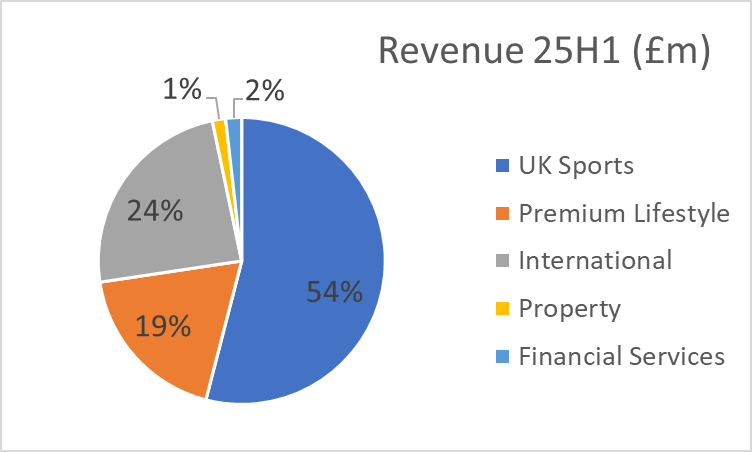
- Frasers (LON:FRAS) is a FTSE250-listed retailer. Many will know it in its former guise of Sports Direct. This still represents the bulk of the business, with UK sports retail forming the majority of revenue and over 70% of the operating profit.
- Recently, the company has been driving a strategy of diversification and premiumisation, moving away from its roots as a value retailer. Its purchase of and partnerships with more premium brands is personified by renaming the company Frasers in 2019.
- For many years, the company has been synonymous with its CEO and founder, Mike Ashley. While he handed over the reins in 2022, he only did so to his son-in-law. With a continuous share buyback reducing the share count, his holding is now at 73%, and it is fair to say he still retains significant influence over the business.
- Deal-making remains at the heart of the business, where the typical strategy involves taking significant equity stakes in struggling retailers and buying them out. They have also been active buyers of retail businesses that have fallen into administration, using their scale and financial security to turn these around.
- Not everything has worked out. For example, they were the biggest holders in Debenhams when it went into administration and were outbid for the name and assets of the business by Boohoo. Frasers are now the largest holders of Boohoo, with 29%, and have been having a rather public battle with the founders there. Boohoo shareholders recently rejected the appointment of Mike Ashley to their board. This week, it was announced that Boohoo is going to take the Debenhams name.
- Frasers is an interesting value play. It is very conservatively financed for a retail business and trades on a P/E of just over 6. The Value Rank is 83, but it is let down by the company's preference for share buybacks over dividends and the lack of growth.
- Like many UK retail stocks at the moment, it will not appeal to momentum investors with a Momentum Rank of just 26. However, it is a reasonable quality business whose scale and brands give it a competitive advantage, and it generates a return on capital consistently above its cost of capital. If it can return to growth, it will likely add shareholder value.
Profile
The company started in 1982 when founder Mike Ashley opened a sports and ski shop in Maidenhead called "Mike Ashley Sports". By the end of the last millennium, the chain had rebranded as Sports Soccer and had over 100 stores across the UK. The company also became a brand owner, buying up sportswear brands such as Donnay.
The company became Sports Direct and floated on the UK Stock Exchange in 2007, with Ashley maintaining a majority stake. He continued as CEO until handing the reigns over to his son-in-law, Michael Murray, in May 2022. This was controversial, as a bonus scheme announced at the time would award Murray £100 million if the company's share price hit £15 for 30 consecutive trading days in the next four years. At the time, this faced significant pushback from institutions, although it now looks improbable that the shares will trade anywhere close to that level in the remaining time. It does underline that this is run like a personal fiefdom, and minority shareholders are along for the ride, for both the good and the bad.
Deal-making remains at the heart of the business, where they have been active in the equity markets. Their typical strategy involves taking large equity stakes in struggling retailers, forcing changes or eventually buying them out. They have also been active buyers of retail businesses that have fallen into administration, using their scale and financial security to turn these around. Sometimes, they have simply acquired brands from administrators and developed their own products using those names.
After purchasing the department store group House of Fraser, the company was renamed Frasers in 2019. This signified their desire to leave their roots as a value retailer behind and move more upmarket to generate higher margins. They call this their "Elevation Strategy", which has three "core pillars": Sports, Premium and Luxury. This focuses on improving store experience, digital implementation and products.
Despite these diversification efforts, the company still generate the majority of its sales from UK Sports retail:
The concentration is even more stark when I look at operating profit:
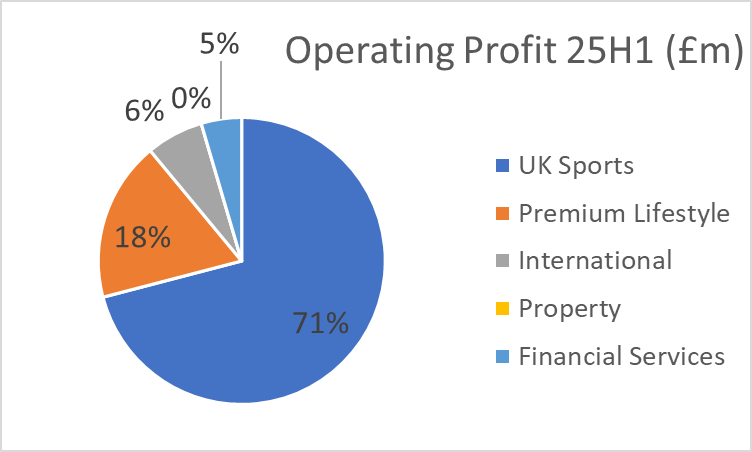
However, it is worth noting that the lines between some business segments are becoming increasingly blurred. For example, the company is reimagining the department store with a Frasers concept store featuring Sports Direct, USC, Game, Evans Cycles, and Sofa.com. Financial Services is largely the Frasers Plus offering, which supports all of the marques with buy now, pay later finance.
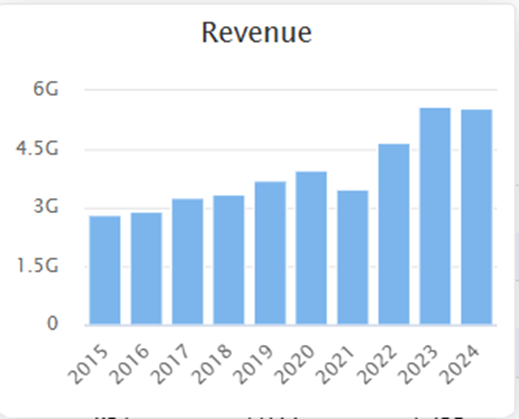
Despite all this deal-making, the long-term revenue growth isn't particularly impressive:
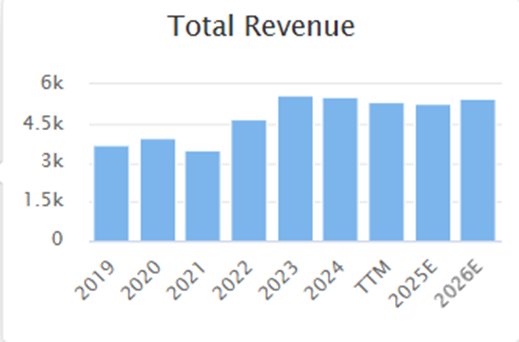
It is forecast to be largely flat in the near future, too:
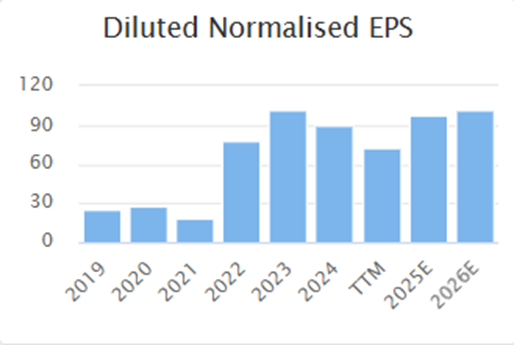
Long-term EPS looks a little better but is highly variable:
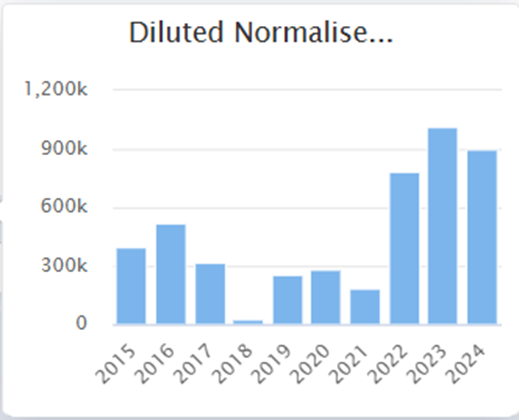
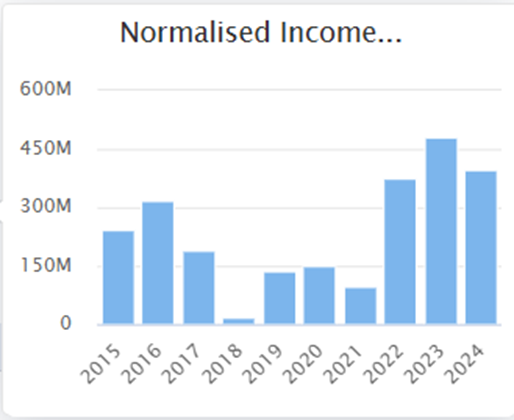
The declining share count exaggerates the recent growth, with the company preferring to buy back shares rather than pay dividends. The Net income after tax is less impressive in a historical context:
EPS is also forecast to be largely flat over the next couple of years:
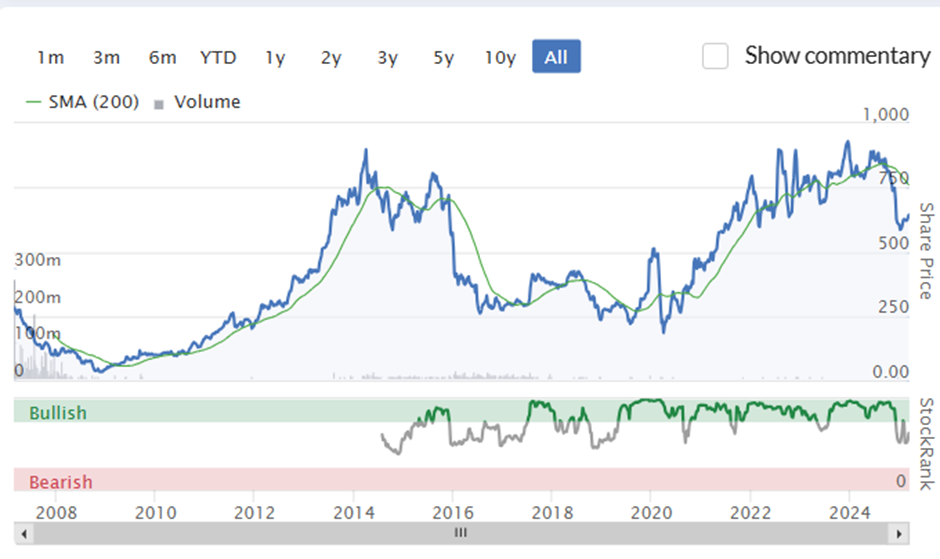
All this means that while the share price has done ok over the last few years compared to many companies, it is still below 2014 levels despite a much lower share count:
With a market cap close to £3b, the company is one of the largest in the FTSE250:
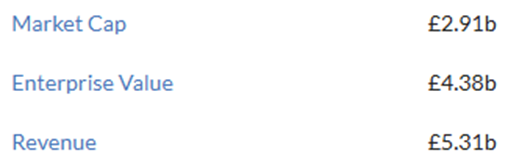
However, the shares would need to appreciate by around 45% (with no changes in the share price of similar-sized companies) to enter the FTSE100 automatically. This seems unlikely in the short term. However, an exit from the FTSE250 looks highly unlikely, even in the long term.
The StockRank is ok, but not great:
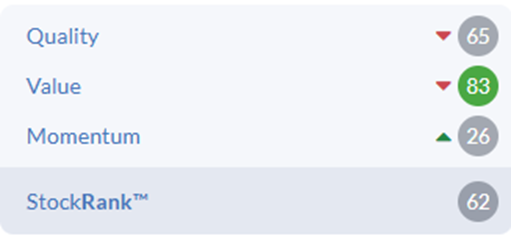
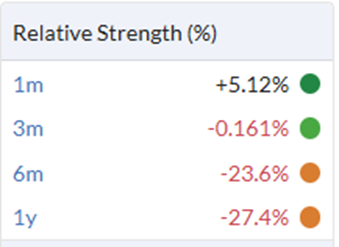
Momentum is the weakest rank, mainly due to the drop in share price over the last six months:
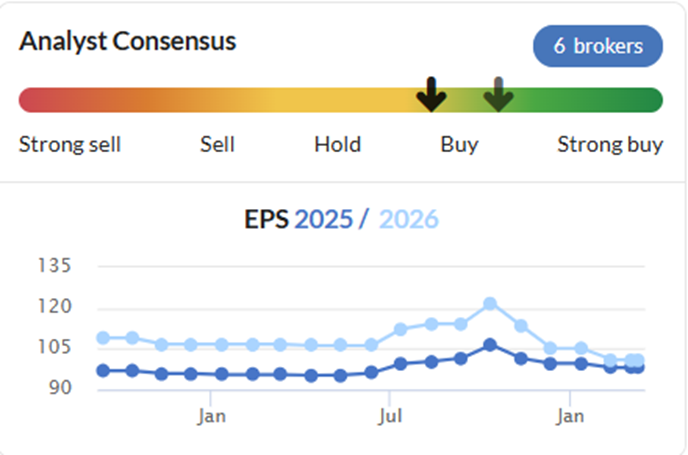
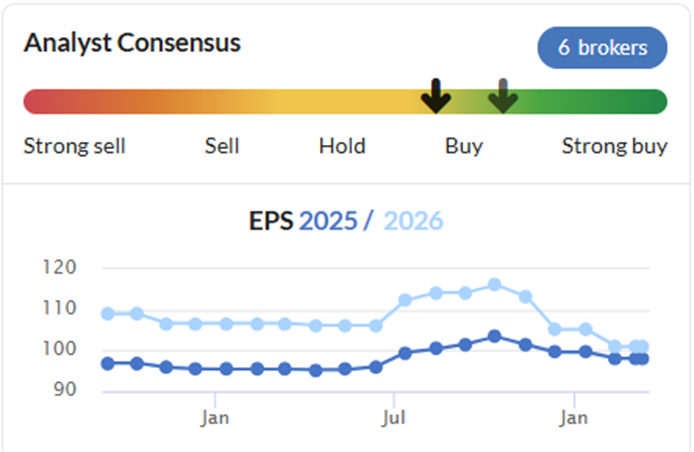
The broker forecasts don't really show a clear trend. Analysts seem to have become more optimistic about the company in October last year before the reality of retail malaise set in. The company reported a small profit warning together with their interim results, which appears to have dented confidence in the company (or at least analysts' predictions about it!)
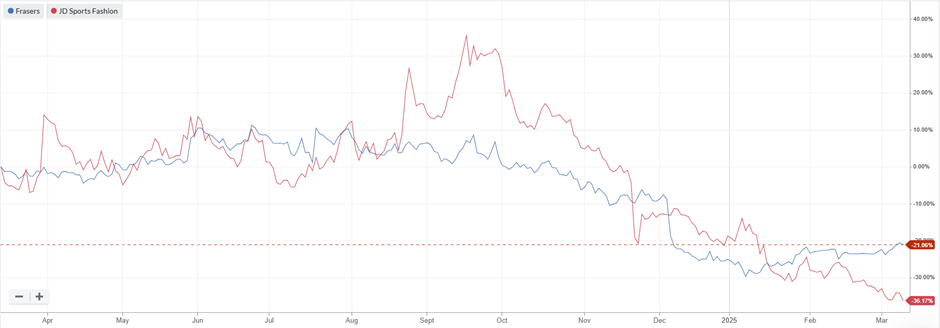
Compared to JD Sports, which I wrote up as a StockPitch last week, the shares have largely tracked each other over the last year, but Frasers has outperformed in the last month or so:
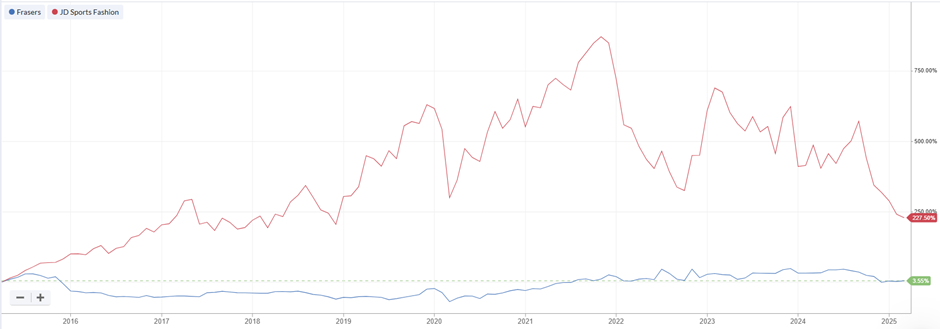
However, it is worth noting that despite recent weakness, the performance of JD Sports has been far more impressive over the last decade:
Business Model
The company describes their vision as "to build the planet's most admired and compelling brand ecosystem", but frankly, this sounds like marketing nonsense! More understandable is their "Elevation Strategy". This focuses on brands, products, and digital and store experiences. Their aim is to put the old Sports Direct model of selling sports equipment and clothing at the cheapest price behind them. Instead, they have three new "pillars": sport, premium, and luxury". Selling higher-end brands and products has become as important as sporting goods.
These are the key elements of this strategy:
Brand partnerships: building relationships with the best brands in the sports, premium, and luxury sectors.
Store experience: Investing in creating flagship stores with digital tech and an improved layout.
Digital: Investing in digital innovation.
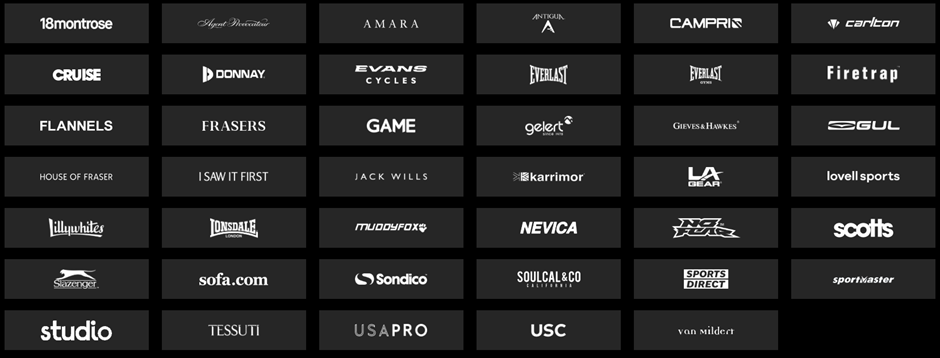
Brand acquisition: The company has never backed away from being a brand owner as well as a retailer. I was surprised by some of the brands they own:
Membership schemes: In 2023, they launched Frasers Plus, which is a buy now, pay later credit supplier and reward scheme.
Competitive Advantage
The Quality Rank is good, but not great, and has been declining recently:

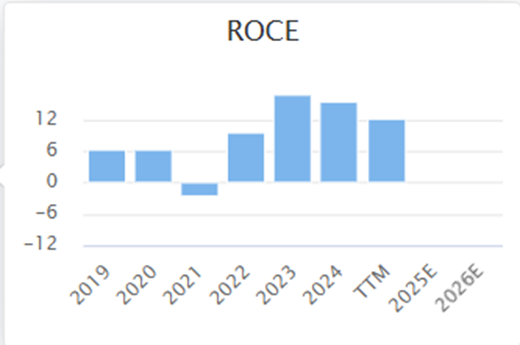
The Return on Capital has also been good in the last few years. However, this has been declining since 2023:
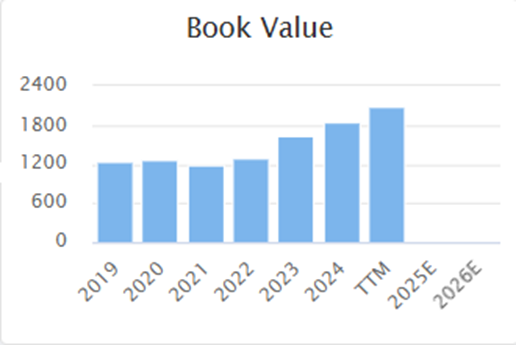
This is partly due to a growth in Book Value:
But also weaker TTM earnings:
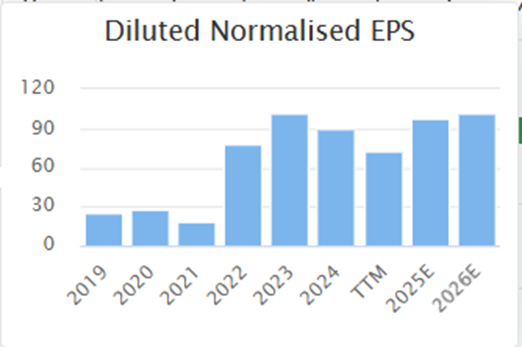
Assuming these forecasts are realistic, then I'd expect ROCE to return to the mid-teens level. The growth in book value is largely related to increased investment property assets and listed equities held by the group. These tend to be more strategic in nature, as they facilitate buying brands or struggling listed companies and perhaps should be excluded from calculations of returns on capital for the retail part of the business.
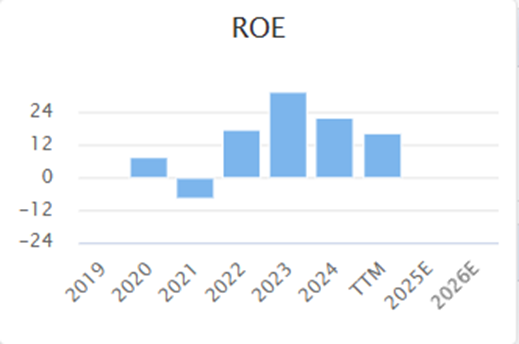
The Returns on Equity are even better, as they are enhanced by the net debt position of around £700m:
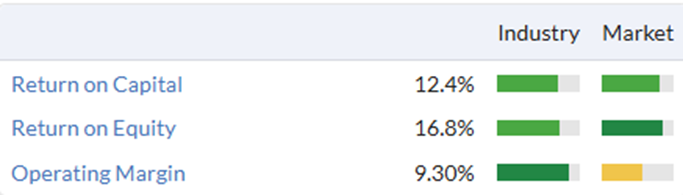
Overall margins here indicate that this is a sector leader within retail:
The Quality Rank isn't higher because the Piotrsoki F-Score is only 5/9:
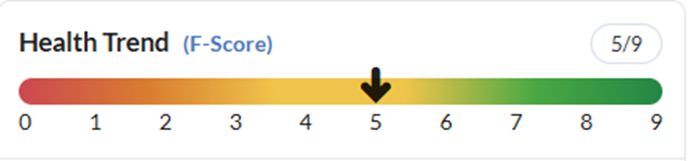
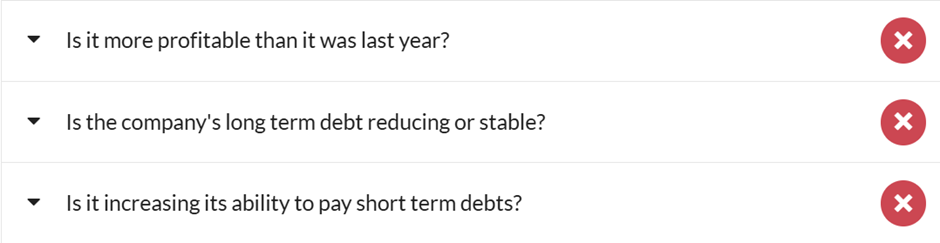
The failures on this metric are related to the short-term weakness in trading, which is understandable given the market backdrop:

Despite the presence of net debt, the algorithms rate this as unlikely to be at risk of bankruptcy. Nor is it likely to be an earnings manipulator :
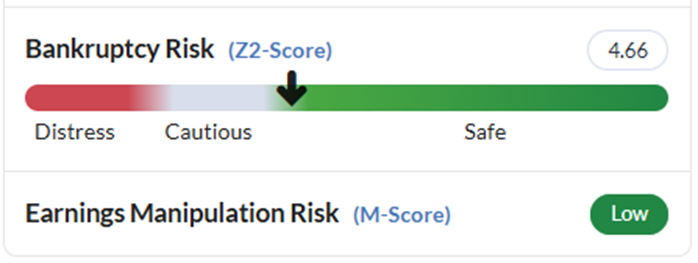
The only concern from the M-Score is the quality of assets:

This seems to be caused by the purchase of intangible assets and listed equities. While, in general, investors need to be careful that acquisitions are not being used to move cash to related parties, this doesn't appear to be the case here.
Financials
Growth and Profitability
Stockopedia shows revenue CAGR as being a pedestrian 8%:
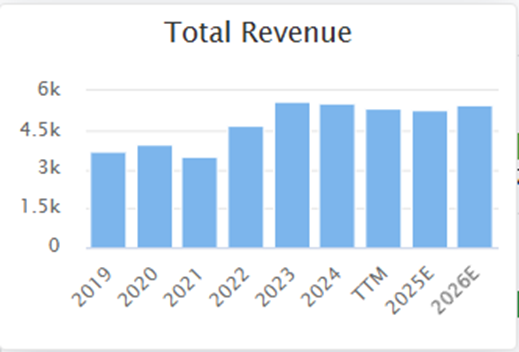
Nor is this forecast to grow especially quickly. The longer-term trends look a bit better:
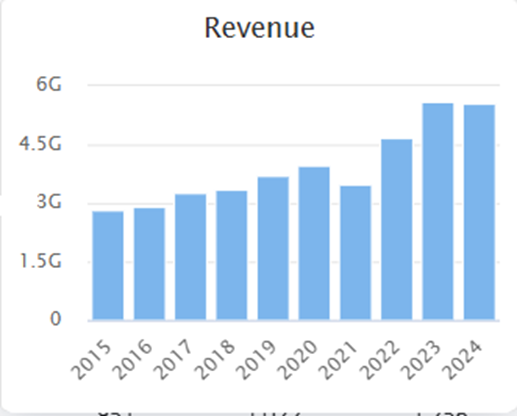
But, despite all the corporate activity, this hasn't shown up in exceptional sales growth. The medium-term EPS growth rates look much better, with the StockReport showing a 28% 5-year CAGR of 28%. However, this is mainly due to a one-off jump in 2022:
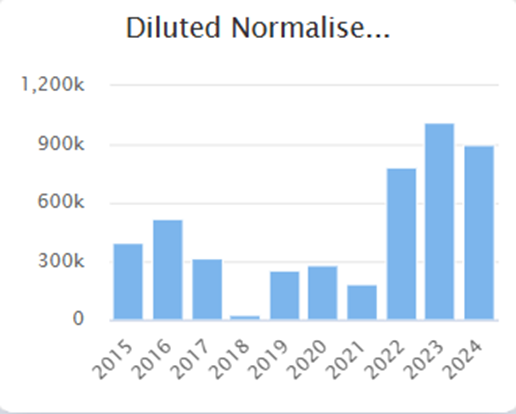
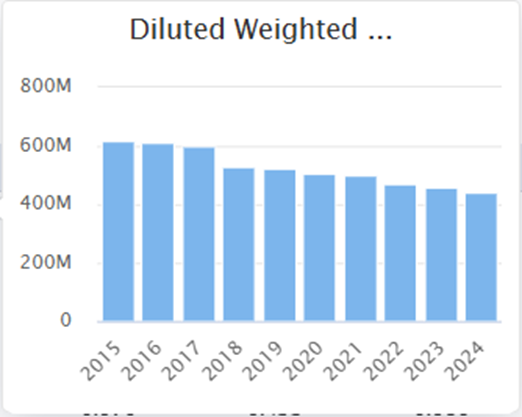
Further increases in EPS are helped by the reduction in share count, which may add shareholder value but means that EPS growth isn't down to improvements in underlying profitability:
Balance Sheet
The current ratio here is very good for a retailer:
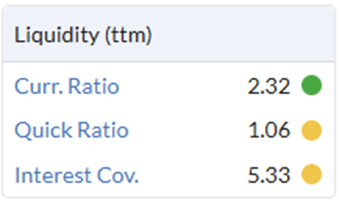
The quick ratio is low, and interest cover is rated yellow, but I don't see any cause for concern with these figures, as the business has significant liquidity available to it.
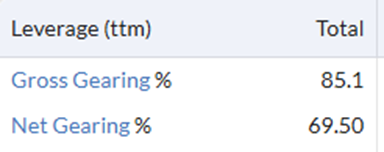
Gearing seems reasonable, especially as debt has largely been used to purchase assets such as property or listed equities:
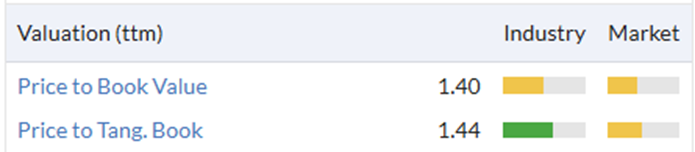
The company trades at a premium to TBV, but it is not huge, so this could start to protect the downside if trading deteriorates significantly:
Cashflow
This is a high cash-generative business, with operating cash flow often exceeding normalised EPS:
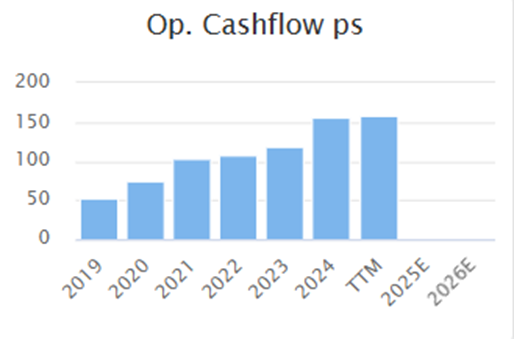
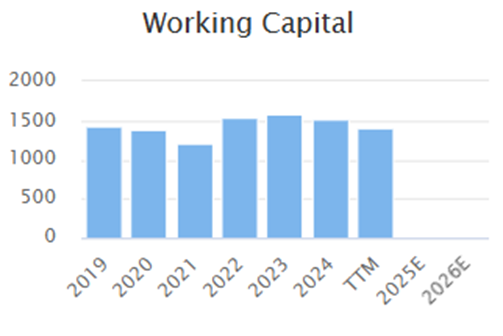
This is also increasing more smoothly than the accounting EPS, suggesting that growth in the underlying business may be more stable than the EPS suggests. Working capital is mainly flat over the past few years, meaning that this isn't a significant factor in the growth of operating cash flow:
Capex is more variable but has always been below operating cash flow over this period:
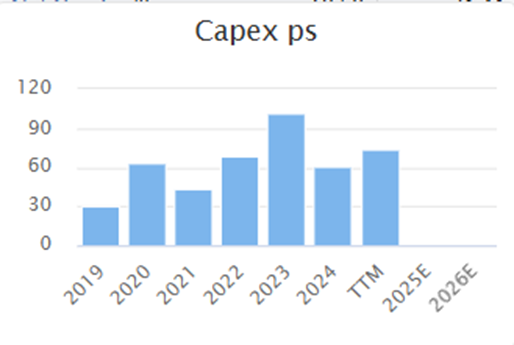
This means that the company is a consistent generator of free cash flow:
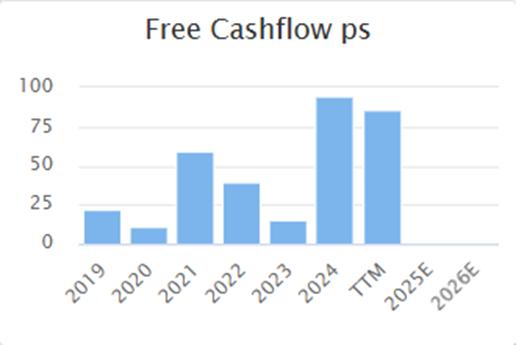
Most recently, this means that the company is trading on a P/FCF of around 8, which seems good value:

However, it is worth noting that this excludes capital spent on acquiring other companies or listed investments. In the last half-year, the company spent a whopping £449m on listed equities, which is why net debt is up to £725m despite
Dividends/Buybacks
The company last paid a dividend in 2009 and has no intention of paying one in the future:

Instead, excess capital is used for share buybacks which has significantly reduced the share count over the years:
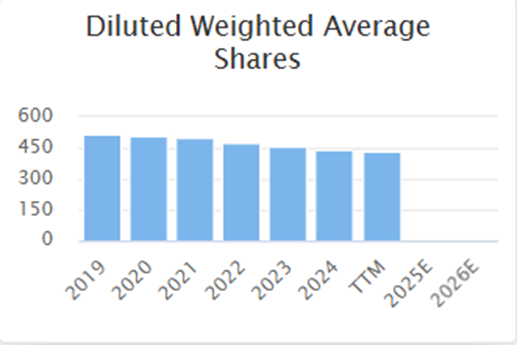
Unlike many companies that end up failing to deliver shareholder value by buying stock when it is expensive and not when it is cheap, Frasers has a pretty much continuous buyback. However, they announced a buyback in July 2024 of up to £80million but have failed to purchase any shares so far. This probably means they are considered in a close period due to various offers they have made for companies such as Mulberry or N Brown Group, but it may also mean that they don't currently have the cash to implement the buyback due to the level of corporate activity.
Ownership Structure
The major shareholder in Frasers is MASH Holdings, which is controlled by Mike Ashley. This is now up to 73% from an initial 65% post-IPO due to the effect of the buyback:
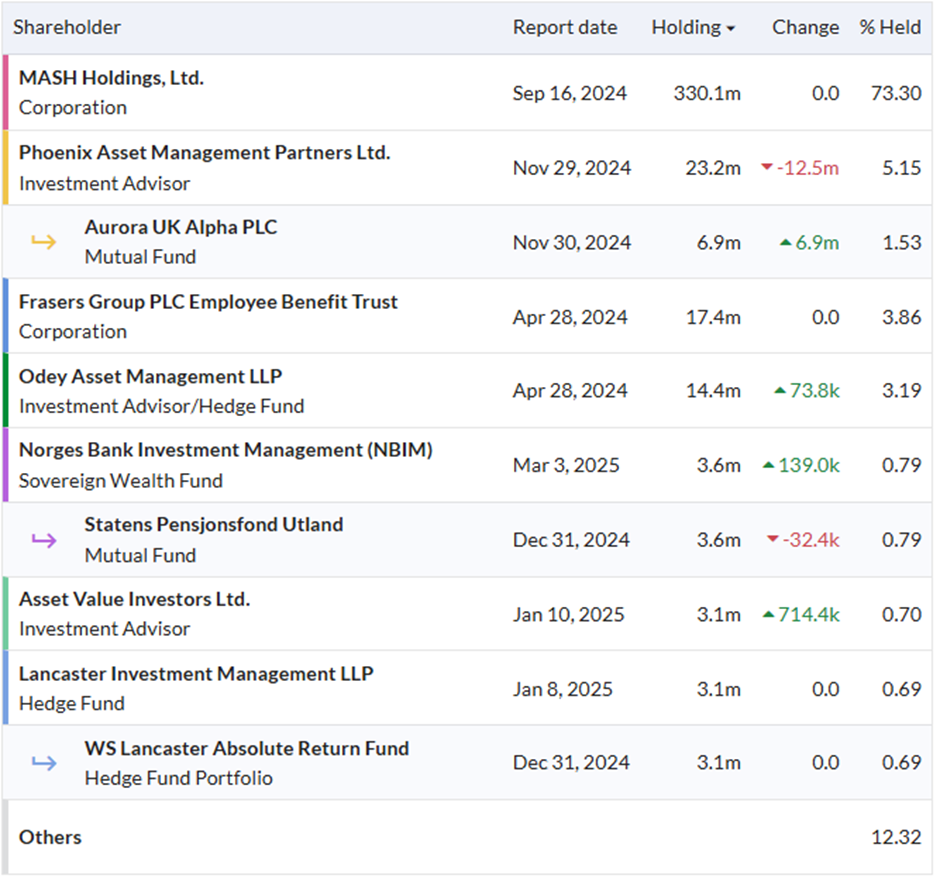
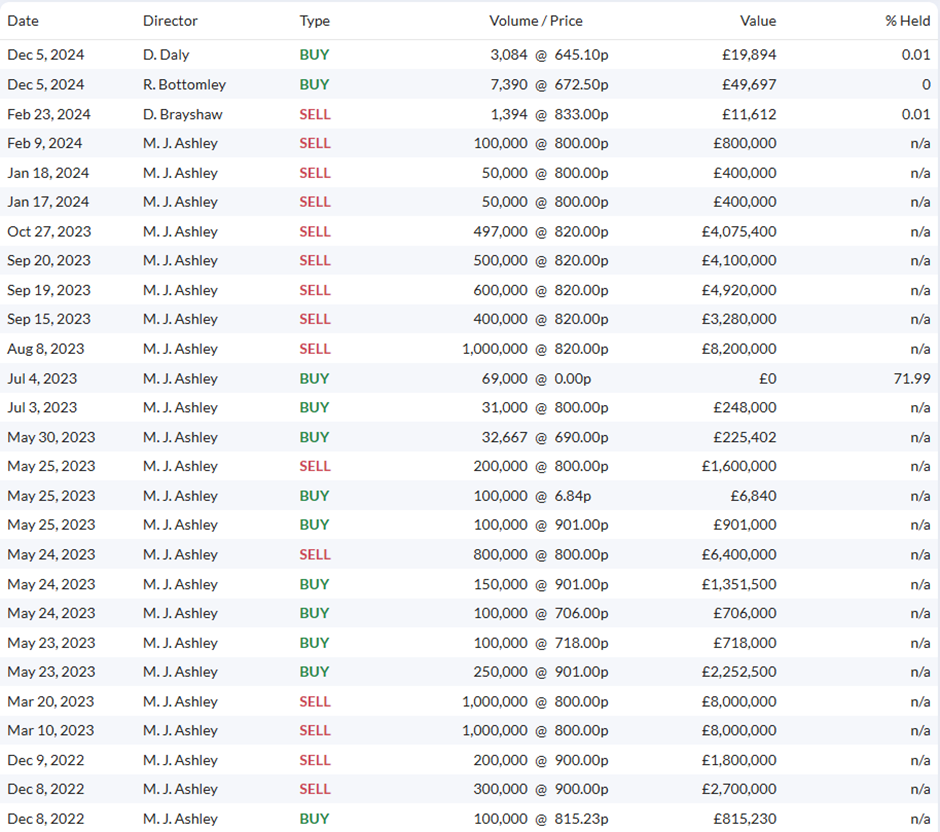
Due to the controlling stake, the rest of the register is rather sparse for the average FTSE100 company. In terms of director dealings, these have been dominated by Mike Ashley, who has both bought and sold over the last few years. Although there are no transactions around the current share price apart from a couple of smaller director buys at the end of 2024:
On the other side, there is no disclosable short position, but this is due to a hedge fund dropping just below the 0.5% threshold for declarations recently:
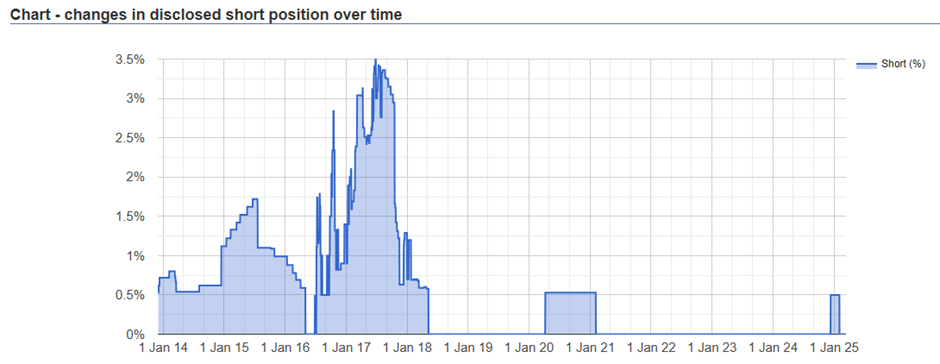
[Source: https://shorttracker.co.uk/company/GB00B1QH8P22/ based on FCA data.]
GLG is a trend-following hedge fund owned by Man Group:

As I said with JD Sports, the presence of quant or trend-following shorts in the company doesn't worry me as they largely follow the price action and do not make a fundamental judgement on the company.
Valuation
The value rank is reasonable but not outstanding:

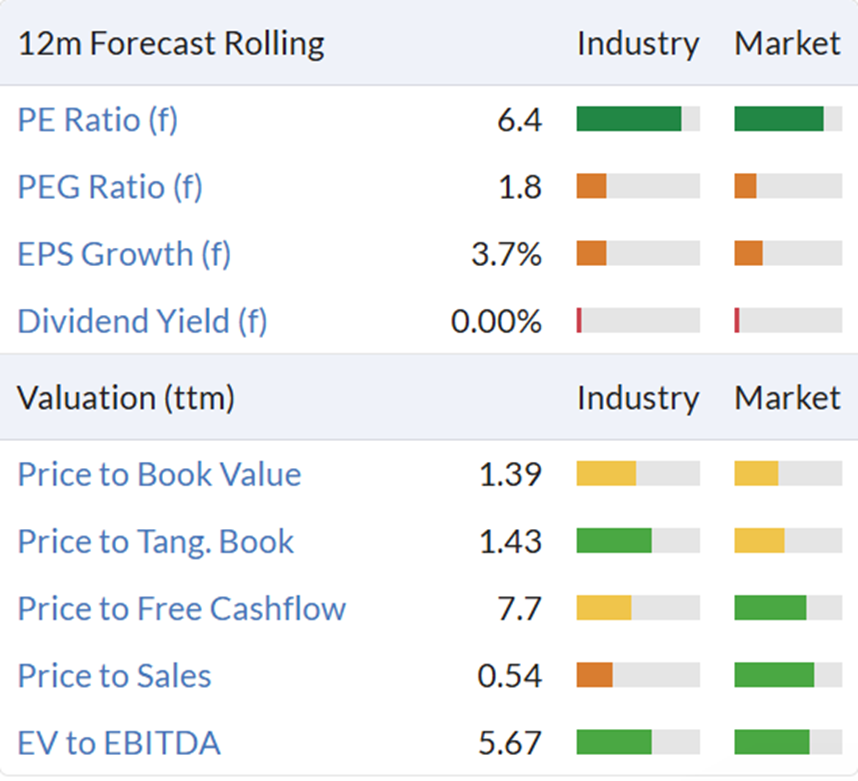
While the company is very cheaply rated on earnings and cash flow metrics, the lack of dividends and weak EPS growth are why this is not rated more highly by the algorithms:
Although there is a gap between adjusted and statutory EPS, looking at the last annual report, the adjusted figures look fairly reasonable:
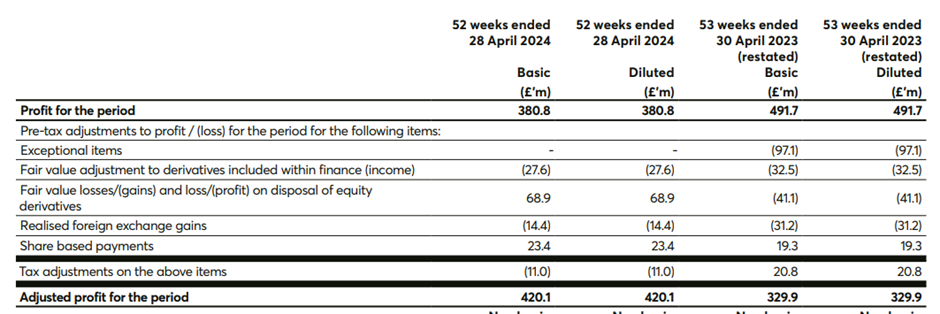
Importantly, most of these adjustments are non-cash.
Risks
Controlling Shareholder
If JD Sports having a controlling shareholder at just over 50% worries minority investors, the 73% shareholder here will give them heart palpitations! Given the family links, it seems like the controlling shareholding gives even more influence here. If share buybacks continue in the future, this could easily push MASH Holdings above 75%, allowing them to push through most changes. It seems unlikely that they would delist the shares, but it is possible if they view the stock market as more of a distraction than a benefit.
Employee Treatment
Over the years, there have been several accusations that the company did not treat workers well. For example, Guardian investigations in both 2016 and then followed up in 2020 allege that Sports Direct, as it then was, underpaid workers, or had other poor practices, such as staff being unable to leave premises during breaks.
Conditions and pay may well have improved since then, but a quick look through Glassdoor reviews suggests there is still a lot of work to do to motivate and retain employees:
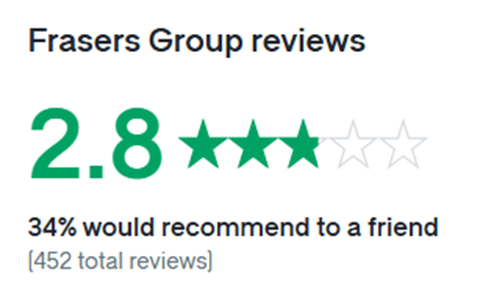
With only 34% of employees who leave a review recommending that a friend would work there, it must be hard to attract or retain top talent.
Management Controversies
In a 2017 court case, it was claimed that Mike Ashley "once hosted a management meeting in a pub where he drank 12 pints and vomited into a fireplace". Whether this is true or an urban legend, it seems that the business culture was such that this seemed a plausible claim. With Ashley no longer CEO, the workplace culture may now have evolved. However, with him as a board member and major holder, it seems unlikely to have changed entirely.
Recent Trading
The latest trading statement came with the Interim Results announced on 5th December. Where they said:
FY25 APBT is now expected to be in the range £550m to £600m.
This worked out to be a small profits warning, although it seems to have taken time for this to be reflected in the consensus:
The reasons given are now well-known to investors in UK retail stocks:
…both ahead of and after the recent Budget, consumer confidence has weakened and recent trading conditions have been tougher.
While FY25 forecasts appear to be back to where they were at the start of this financial year, it seems to be the larger downgrade in FY26, which has caused the share price to fall. Here they say:
Further out, we expect to incur at least £50m of incremental costs going into FY26 as a result of the recent Budget, but we are working hard to mitigate these in order to maintain our profitable growth ambitions.
I'm not entirely sure why this was a surprise to brokers, as the change to Employers' NI was known immediately after the October budget. This may well be a situation where investors gain an edge by being able to estimate impacts before they end up in the consensus.
Sentiment
The Momentum Rank is low:

A lot of this is down to the recent weakness in the share price:
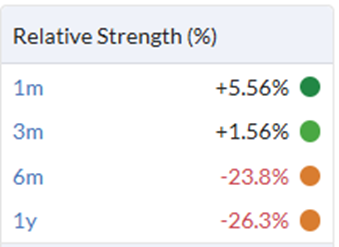
However, that drop in the FY26 consensus is not helping matters. Despite the recent small rise in Momentum Rank, there is a long way to go before recent weak consumer sentiment reverses and the company is firing on all cylinders again. Cautious investors may want to wait until there are signs of broker upgrades again before considering investing.
Conclusion
Despite being on a P/E or only just over six, I struggle to get excited about this business. While this is a conservatively financed family-controlled enterprise that has grown sales significantly over the years, the long-term returns to shareholders have been relatively modest. All of the deal-making, acquiring brands and companies from administrators, equity investments, etc., haven't delivered any real returns for shareholders over the last decade. The strategy of moving to more premium and luxury brands and products may be a good one, but it is a space where competitor JD Sports Fashion already operates. Although it is also struggling of late, JD Sports has generated better long-term returns and is on an even cheaper rating. Frasers also seems more risky, with the possibility of a deal blowing up, reputational damage, or the buyback taking Ashley above 75% and a delisting being on the cards. That said, the business is highly cash-generative, even in difficult market conditions, and if the buyback restarts, it would support the price and drive EPS higher. Any return to growth would make the P/E of 6 look too cheap, and a reasonable return on capital means that growth would add shareholder value; I just feel that JD Sports has a greater chance of delivering that growth in the medium term.
[Disclosure: Mark has a long position in JD Sports]
Disclaimer
This is not financial advice. Our content is intended to be used and must be used for information and education purposes only. Please read our disclaimer and terms and conditions to understand our obligations.

3 comments
"A retail MAsh-up"
Mash holdings and M(ike) A(shley) - i love it. Thanks for the write up Mark. I'm sticking with Mike.
GLG isn't a trend follower, FYI. AHL is Man's trend following arm. GLG is fundamental.
They do long/short equities though so could be long Boohoo short Frasers on anticipation of a takeover or similar. Or they could be short for fundamental reasons. We'll likely never know!
Hi Cautious Value,
Thanks for the correction. Yes, you are right, likely to be some kind of arb with some of the potential corporate actions. Although Frasers don't tend to issues shares for acquisitions so won't be a straight arb but perhaps a more complex strategy.
I agree, we'll probably never know.