Gambler. Follower. Researcher. Craftsman. Which are you?

If you’re anything like me, you probably didn’t start investing with a perfectly thought through plan. You may have looked at fund managers and thought you could do better. Maybe you invested in funds, but were disappointed by the results.
You wanted more control and higher returns, with a bit more risk.
So you started picking shares.
And that’s where the trouble begins.
Stage 1: The Gambler – betting on a hot idea
This is how many of us start. We come across a share tip, from a friend, broker note or a bulletin board, maybe a confident Youtuber. It’s a convincing idea. We want in.
Sometimes it works, but often the theme has already played out by the time you buy in. You don’t even know you’re late.
This isn’t investing. It’s gambling on hope, which too often ends with a loss - yes of capital, but also of confidence, which can be hard to rebuild.
Stage 2: The Follower – trusting authority
After a few bets fail, you smarten up. You start following people who actually know what they’re doing. People you respect. Premium content. Expert Newsletters.
This is definitely a step-up. The very best investing insights are often shared by real investors, investing their own money. But even here, there are traps.
Because following others isn’t the same as genuine understanding. We can often just buy into the story.
We are all hard-wired to believe in stories. They are how we make sense of the world. We seek story arcs in our investments - a viable turnaround plan, a heroic new CEO, a market that must be disrupted. But Nassim Taleb warned of the “narrative fallacy” in Fooled by Randomness - we see patterns where they really don’t exist, stories where there’s only noise.
So if you find yourself projecting a Hollywood ending onto your favourite share, while ignoring the red flags - buyer beware. It really can pay to be a skeptic.
Story stocks vs the statistics…
It’s impossible to truly define a “story stock”, but they are often jam-tomorrow, pre-profitability shares. London’s AIM market is full of them. For some reason, companies that are pre-profit, or pre-revenue are even easier to project narratives onto. Stocks like Sirius Minerals - that tens of thousands lost money in - or the new wave of bitcoin treasury companies that are all over AIM.
While story stocks are intangible, we can use low StockRank shares as a proxy. We’ve tracked the performance of these shares for more than a decade, and anywhere from two-thirds to three-quarters of them fall in price over any two year period depending on the rank.
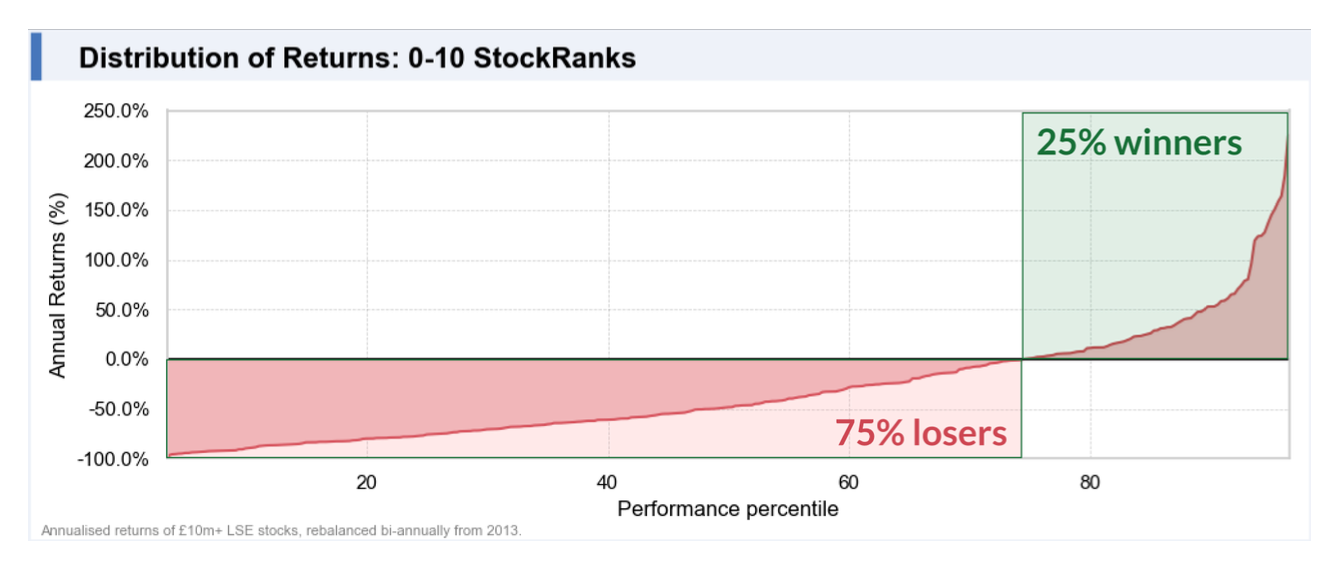
We all want to believe our favourite blue-sky stock will be a lottery ticket, but the stats just don’t back it up. Only 5% of pre-profit low ranked stocks end up doubling or tripling.
Stage 3: The Researcher – digging deeper
Moving beyond, you now take your investing more seriously. You practice a skeptical mindset. You learn to read financial statements. You source broker research. You study investing books. Maybe you create your own financial models.
You are doing the real work now. You feel smarter, and you start to have an edge. But even now there's a catch - doing more research doesn’t guarantee better results.
There’s a great study from 1973 by Paul Slovic. He asked horse racing experts to predict winners when given increasing amounts of data. At up to five data points on each horse, their accuracy improved. Beyond that? Their confidence kept increasing, but their accuracy completely flatlined.
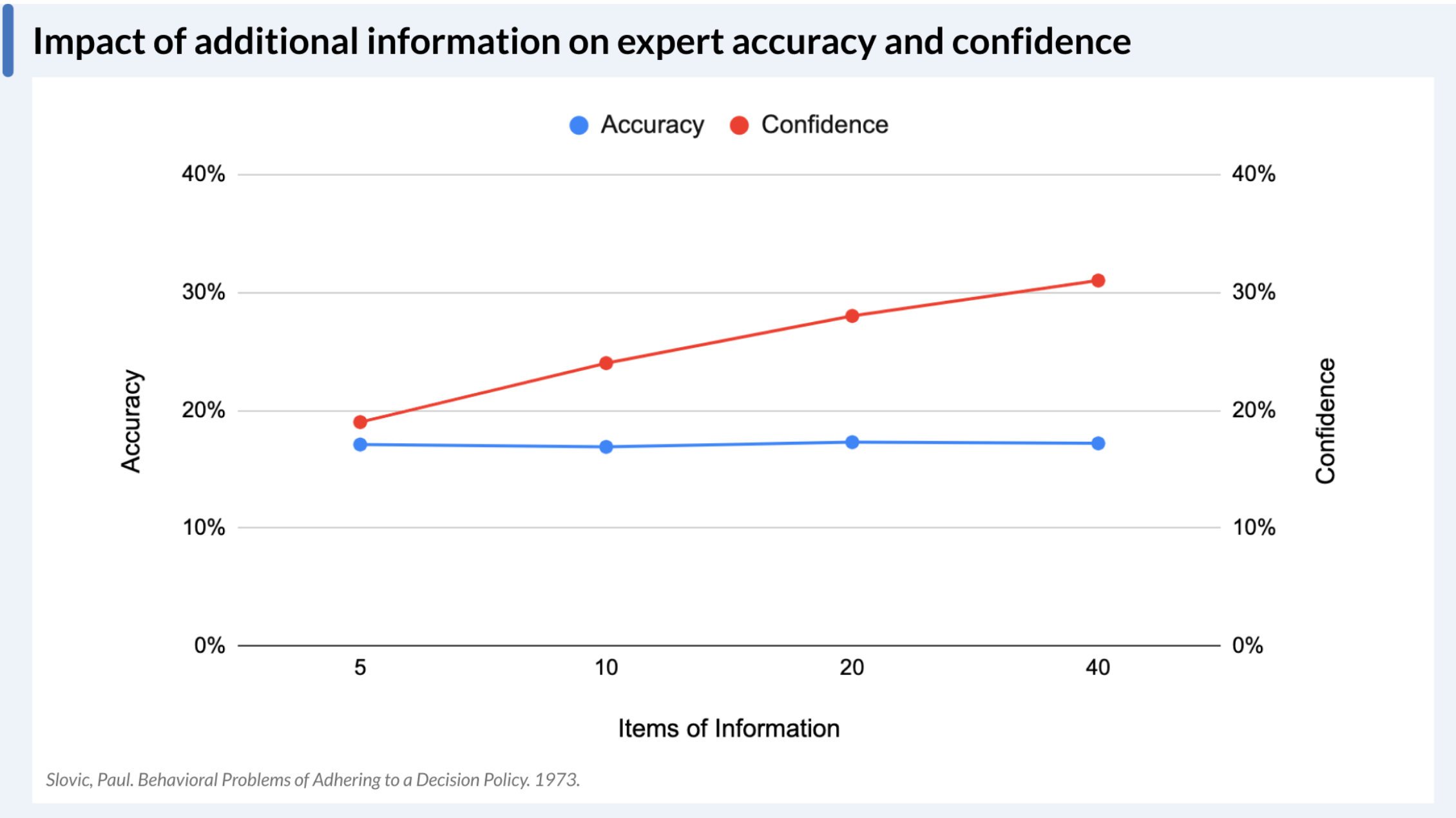
It’s a really hard to swallow truth - more research makes us more confident, not necessarily more correct.
So if you find yourself doing hours of research and becoming more and more convinced in your convictions - just remember that confirmation bias can occasionally be very expensive. As we’ve seen time and again, even big winners can end up completely reversing in price, and over-attachment becomes painful.
I’ve been there. In 2008, just before the financial crisis, I had 50% of my portfolio in a single AIM-listed biometrics stock. I’d done the work: bought the product, built the DCF, met the CEO. I “knew” it would multibag. Just give me ten minutes with my younger self and I’ll save him a huge amount of money.
Stage Four: The Craftsman – Turning Insight Into Rules
So when you’ve done your fair share of gambling, following, and over-researching - you may reach a point where you stop asking “what do I think about this stock?” and start asking “what really works in the market?”
It’s a subtle shift, but it’s everything. Most of the great investors lived this shift. Graham. Buffett. Slater. O’Shaughnessy. They didn’t just gather information - they defined investment criteria based on the evidence of what really works.
Because when you start researching what really works - across all markets in history - there are only a few core return drivers that consistently pay off in stock selection. Our QVM framework captures a core three:
- Quality – good, profitable stocks tend to outperform unprofitable, junk.
- Value – cheap stocks (versus earnings or assets) tend to outperform expensive stocks.
- Momentum – shares with positive price and earnings trends tend to outperform.
Of course, not every stock with these kinds of characteristics succeeds, so the Craftsman ensures solid diversification across their portfolio and disciplined selling rules to capture those returns through time.
The Craftsman moves from stock-picking based on opinion to rule-building based on evidence.
We publish the performance of the StockRanks over time, but the only way to generate those kinds of returns is to “behave your way” to capturing those returns. It requires a solid, repeatable investment process.
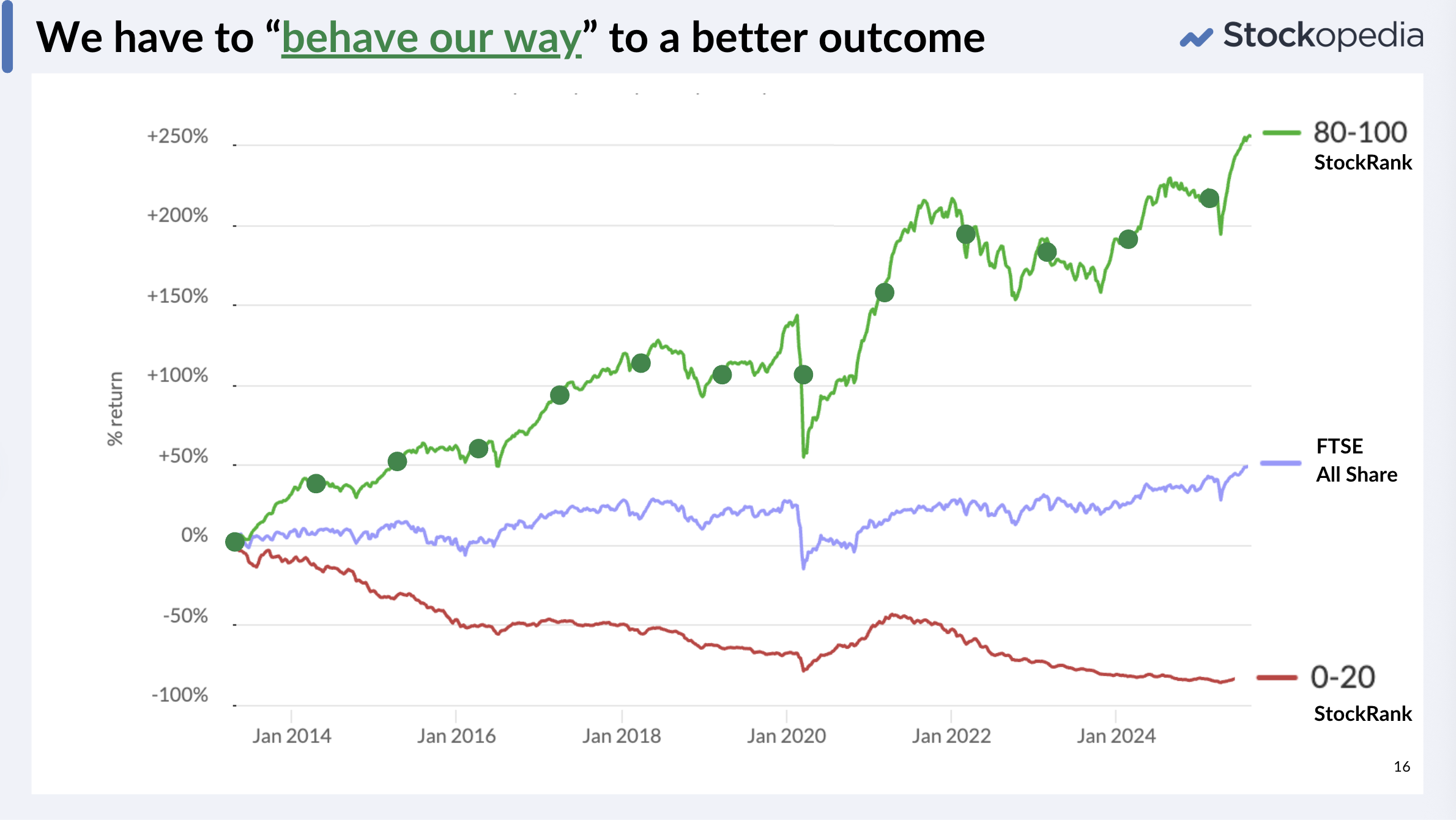
Even Charlie Munger, Warren Buffett’s partner, and one of the wealthiest stock market researchers that ever lived once said:
“No wise pilot, no matter how great his talent and experience, fails to use his checklist.”
What always set the best investors apart wasn’t necessarily how much they knew about their investments - but it was how they turned their knowledge of what really works into a repeatable process.
Four levels of investing
Below is a graphical model of the above. Of course, any model is just a model, but I find having models extremely helpful as a guide to dealing with the chaos of reality - and especially market reality.
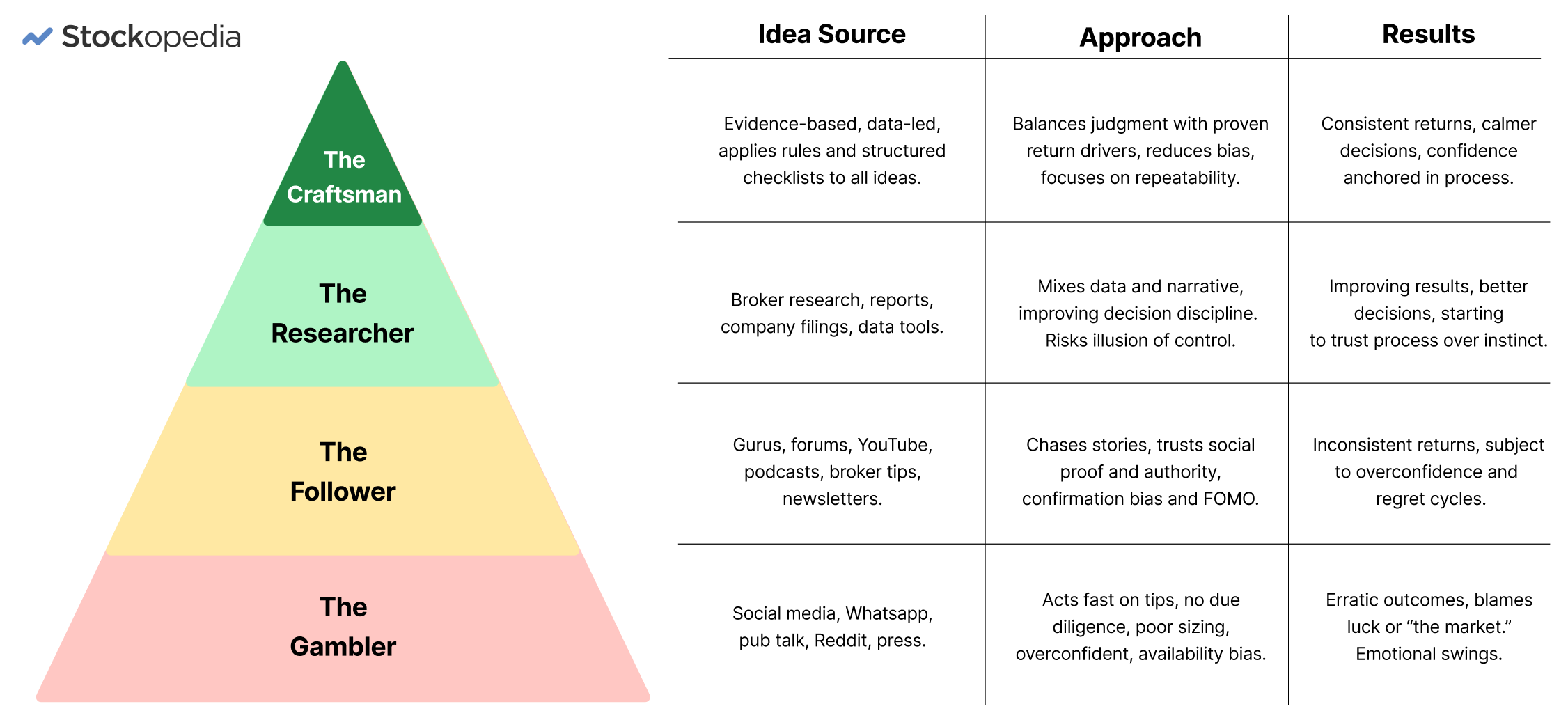
Creating your own rules and checklists can be a very personal thing.
I often repeat many of the rules I use in the stock market - including those in the NAPS Portfolio as one way to capture market rewards… but it would be great to hear what works for you in the comments below.
Disclaimer
This is not financial advice. Our content is intended to be used and must be used for information and education purposes only. Please read our disclaimer and terms and conditions to understand our obligations.
24 comments
I read this and didnt like the answer !
I'm a lazy craftsman......I let STOCKO do all the work and when something pops into my screen, I buy it, unless the daily report marks it as RED. Don't really care what the company does. It appears to be working.
What are your results like and when do you decide to sell ? Thanks
HNY LLG.
According to chatgpt (see how lazy I am) my CAGR over the last 6 years is 12.22%.
This year I am going full NAPS with around half my portfolio, so the selling part is easy, everything goes on 29 Dec 26.
With the remaining half of the portfolio, I adhere to the Naked Trader tight stop loss of 20% on the shares highest point. It saved me a lot but cost me dearly this year with Serabi Gold (LON:SRB) and Metals Exploration (LON:MTL) but allows me to sleep well.
Otherwise I am looking to pull the trigger when anything falls below either an 80 Stockrank or drops to neutral, especially if the momentum rank is falling.
Thank you for the article.Still a novice.The more you know the more careful you become.Less you understand the more reckless you are.Chasing a fad like A1 can be rewarding as well as destructive.I was trying to use A1 to predict the intrinsic value of the A1 companies, even they are not sure.I know you have created a structure to investing with stock rank value ,momentum and quality .However it does not hold when I try and invest using these parameters.I personally think there is no structure to investing ,too much liquidity in the markets have increased share prices ,Mr Trumps investment in A1 may raise it further disproportionately. The worst thing that happened was Covid and before that quantitative Easing to prevent recession.and financial crisisThis led to inflation and consequently resulted in quantitative tightening .The banks benefited from all this hence the rise in share price.Gone are the days when companies that grew organically because of the superior product, superb distribution channels and the right price (profit not eaten up by inflation.)Long term investment is quite difficult in this environment. I always use to think that prices going up (inflation) is better than prices coming down(deflation).Now I feel innovation is a product of recession.
You left out a layer: "thinks he knows betterer"
It is usually a he and has been me.
Now I am a craftsman who frequent blames his tools.
My son who is 19 having watched me for 10+ years knows what he is: an S&P500 investor as most people should be and as I should have been.
Thanks Ed.
I agree with what you suggest about the limitations of research. A company for which I worked had a period under American ownership and the owners were obsessed with the current month's result. I was the lucky chap who got the job of producing a forecast. Information flowed to me from all parts of the company yet even I didn't know what was going to happen next!
I split (in a spreadsheet) my portfolio into 3, called Sustain, Growth and Gamble. Each split is under 10 shares, and I guess that explains why even the Sustain portfolio jumps up and down a lot. Sustain shares are meant to be stable, dividend payers, and preferably but not necessarily, growing. They've done OK this year largely because defense shares are there. The Growth shares are meant to be growing at least 10%, and are not necessarily divi payers. This is the area I have most trouble with partly because I feel many growth shares are over priced and therefore risky. The Gamble sub-portfolio is meant to be half the size of the other two and it is there to assuage my gambling itch. They did terribly last year, but this year have done surprisingly well. The best gamble share has been Pensana (LON:PRE) which has zero revenue but includes the magic words "rare earth" in the description.
I try to research before I buy but I find research is much better at telling me what not to buy than what to buy.
I was Gambler then Follower in quick succession. Then I was low level Resrarcher and now I guess I am still there. Certainly wouldn't claim to be a Craftsman. But a strategic approach to investing with a strong VM bias, all UK, has done 60% over two years. I'm impressed by the 18% annual VM growth Stocko has achieved, so I guess Parasite might be the stage I have currently reached!
Thanks Ed. Great article. My stock picking has improved with using Stockopedia. However, there are times when I think, why waste your time, just stick the money in my ETF Isa. I don't invest life changing sums in shares and I do quite enjoy the gamble, so I will stick at it and try to keep learning and improving.
A timely reminder to those who venture into the equities jungle Ed. Gambler - Follower -Not dedicated enough for Researcher -- Craftsman is out of reach too. Imo Brucie5's -- Strategic Mediocrity nails me and perhaps should be in your pyramid. I think I suffer from Stockopedia Dependency although I'm better off since joining.
This is absolutely fascinating, thanks Ed. After thirty odd years of investing and making every conceivable mistake in the book, I like to think that there is a glimmering of learning amidst the various shambles of my own investment journey, which has enabled me finally, to live off my dividends. But there does remain the mystery along the way, of how the most hugely researched shares come to spell such disaster, and this explains it. Not just that beyond a certain amount of data, outcomes a re subject to variability, but that the sheer weight of such data "overmining", if i can put it like that, actually makes it more likely that an investor will place too much risk on a single situation, or indeed, investment style.
Hence the disasters that overcome many noted investors, many dead, but some very much alive - I hardly need mention names. I follow at least one of them.
And while I have to accept your conclusion about the best guides to good investments being the Q/V/M metrics, I would just add that an income approach can also work well, particularly if you are in position to reinvest the dividends to produce compounding. In this regard, I have come to believe that "strategic mediocrity" can work as a strategy, if it meets your objectives of a steady to rising income, the continual optionality of adding to value situations inside and outside your folio, and last but not least, the priceless blessing of a night's sleep relatively unaffected by market gyrations.
I recently came across the term "Natural Income Strategy", which is an approach that seeks to provide a certain level of dividend yield from a largely passive, diversified folio of holdings. If the inherent weaknesses of applying this in an absolutist way (namely, no rebalancing or stop-lossing; and drawing down all the income) can we slightly tweaked towards a degree of flexibility (some strategic reallocation of asssets+guard against any obviously losing situations or overweighting; plus reinvest at least SOME of the dividend) then you get the best of two worlds. Though it may not set your own world on fire - and preferably won't!
Great post ! I will check out the Natural Income strategy. Thanks.
Or just buy gold or better still Silver.
Physical nice if can hold it, ETFs no brainer.
Pan American Silver (NYQ:PAAS) First Majestic Silver (NYQ:AG) a nice starter. Wheaton Precious Metals (LON:WPM) fantastic buy but waiting for a fall back (which may not happen :(.
Buying at the top with the "noise" around is very hard.
As well as selling when under water.
Submarines, phones, satellites, AI, Robots, data centers, cars, etc etc - silver silver gold silver silver - rare earths but not sexy.
Oh and batteries - my personal "Jarvis" to look after me in old age needs a power supply. Lithium the only play in town.
Thanks for this post, I have just started this approach with my ISA's for a retirement tax free income and I am surprised at how well it has done in terms of Dividend and Share Price returns over the last 12 months. I invested in lower volatile high yielding shares that have paid steady dividends over the last 20 years and 80% are up on share price alone. I wasn't aware of the Natural Income Strategy but will take a look. Thanks for highlighting, I do think there is further scope for growth when interest rates finally come down.
Great article Ed, Thank you.
More research makes us more confident but not more correct. This is a research based wise comment I have heard from Ed a few times.
This is a product of Information overload, having lots of choices doesn’t necessarily makes you picking the best. Doing lots of research leaves less time for thinking.
It’s also true in business, Tesco offers 100,000 items and Costco 10,000. Look at their performance over any timeframe.
Reminded me of Farage famous speech in the European Parliament addressing Rompuy.
Who are you?!
All the best
Sorry, you’ve lost me there Yiannos1.
Please elaborate, or, even better, respond to Ed’s request for what works for you.
Research; don’t invest in what you don’t understand. That’s why I pass by sectors such as pharmaceuticals.
Don’t check performance daily or weekly. Once a month plus when your companies make announcements. Don’t overtrade; good ideas are few and far. When you invest it should be for growth over time.
Be diversified however be prepared to step back from some sectors if you regard the macro environment as unhealthy. Rightly or wrongly I’m presently out of house builders and their suppliers.
Have your own financial models and written justifications for the shares you own. They sure as hell force you to both understand the decisions you made and to revisit them from time to time.
Basically, it is a shot gun approach with strict buying and selling rules to capture market returns. For me, buying a selection 20 growth stocks across different sectors at reasonable prices with positive relative price strength while selling when the share prices hit pre-determined stops loss / trailing stops or on profit warnings. As the market adage goes cut the losses short and let the winners run and hope that the aggregate return from portfolio would beat the market over time.
Thanks Ed. There is one rule I always adhere to nowadays. Before investing , make sure you know the Stocko rating score. At least then you can then access the level of risk you are accepting by ignoring a “green” colour. The Naps Portfolio speaks for itself. It is sobering to read these reminders. It is so easy to stray. At a heavy cost.
Gambler to Follower, skipped Researcher, now a Junior Craftsman on a lifetime apprenticeship!
Well put Paul. We are all apprentices! The day we stop, we are fools.