Games Workshop (GAW): A game of two halves

 Games Workshop (LON:GAW) , like a number of companies, is one that's interested me for a while. It's sat on my watchlist inoffensively for a year or so now as the price has slowly crept upwards, but the last week has seen a break in that trend. Games Workshop dropped from their peak of 723p a share to currently trade at 528p a share, as their half yearly results disappointed investors. It's not too hard to see why; revenue is down just over 10%, operating profit is down 30% and management aren't offering any near-term light at the end of the tunnel; they say structural changes will continue to depress profits as the rejigging takes place; though they don't mention how long those changes will take to implement.
A brief overview of Games Workshop, for those who don't know them; they're a producer of models, primarily, but the real value is a level deeper than that. They have created 2 main 'worlds' - a sci-fi and a fantasy - complete with differing races, lore and histories - with a rather substantial amount of detail built up in the 30 years of operation. Gamers essentially build an army using models built up of one of the races and battle each other using the fiendishly complicated ruleset. This, to me, is where the value is provided. Making nice models is an element, of course, but in producing thematic and diverse armies - and supporting a whole hobby around the creation of them - there are a number of network effects. There is value created in the models beyond simply the aesthetic. I have a modicum of insight into GAW, too; I've a bunch of the models sitting on a shelf from a fledgling interest a few years back (too time consuming, as it turned out) which gives me some small understanding of the business more than I might have. That's a positive. On the more negative side, in the words of the inimitable Paul Scott over at Stockopedia:
the slightly odd customers that these shops attract are probably very loyal, as they are locked into that nerdy lifestyle, and probably won't be getting married any time soon...
... my marriage prospects have apparently taken a substantial nosedive in the wake of this revelation. Still; what with the dusty stacks of annual reports, arcane books on long-dead economists and Excel spreadsheets embossed onto my eyes, I'm not sure EV Towers was a particularly appealing pad to potential lovees anyway. More time for investing, I suppose!
I'll split this post into two halves; the first talking through the bull case - the company has a number of fantastic characteristics - and the second my refrain and conclusion.
The pros
As I mentioned above, Games Workshop is a company with an incredible attractive business model. All business owners want to be able to differentiate a replicable product; to be able to take something simple and persuade consumers that it is worthy of a premium price. Coke do this - through the power of decades of incessant marketing and product placement, we're now convinced (and tastes are wonderfully self-reinforcing) that what is a relatively simple mix of readily available ingredients is worthy of a ludicrous gross margin. Games Workshop do it slightly differently, and I think there are two main features, both of which I noted above. They possess both:
- A huge and expansive bank of intellectual property behind the models, including the game and story
- A base of collectors. A game is nothing without players (though some people just buy the models to paint/admire) - and there are gaming clubs around the country where people meet to play GAW's games. This is the network effect in practice.
Either way, this gives them fairly substantial pricing power. Gamers are willing to pay a lot for their models; walk in to one of their stores if you want to see just how much!
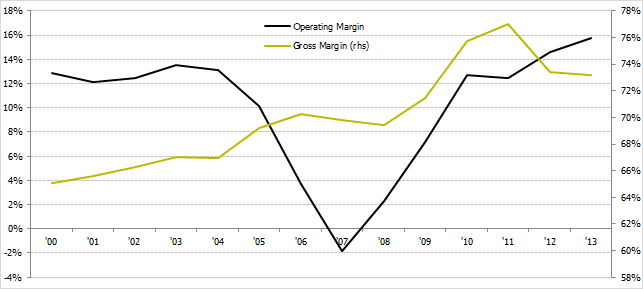
The chart above shows what that does for you - gross margins trending upwards from an already significantly 65% to above 70%. Operating margins aren't quite so spectacular, but are still decent. The noticable dip comes about from the Lord of The Rings - the group broadened out and created a LoTR-themed table top game to coincide with the movies. As interest in that waned - and it did wane, unlike the resilience of the Fantasy and 40K games which have endured - the expansion the group had undergone had to be undone on the back of rapidly falling revenues. That cost the company in those years. Fortunately for us, given the long history of the company, we can simply look at a period before and after the LoTR saga and chop out the middle to give us some picture of growth rates:
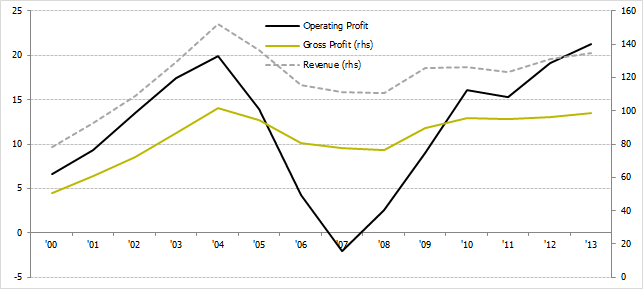
I don't have any particular objection to literally drawing a line which connects the start and end points of the graph above and calling that the long-term growth rate. I don't think we have any better indicator of the group's likely growth, and since it excludes LoTR, I don't think there's much noise involved. On this basis, revenue has grown at a compound annual growth rate of 4.3%, gross profit at 5.2% and operating profit at 5.9% - the latter two obviously being higher because of the improving margins.
The company has average an adjusted RoC (with all the usual alterations) of just over 10% in that period. We can probably add a couple of percentage points on if we strip out the LoTR years and the contraction which happened afterwards - overall RoC dips slightly because of the substantial increase in operating assets over the period, even though the group did profit from the arrangement.
You might quite reasonably be thinking that the elephant in the room here really is the answer. What's the point of extrapolating from the past like this when we have more obvious, up to date data staring us in the face? GAW released a poor trading statement, after all. Perhaps the last few years were just a cyclical high and we're toing and froing back down. The problem comes because management have a credible explanation - and an explanation that's particularly credible given their past actions. Take a read through these - the Chairman's preambles - if you want to see what I mean. They're clearly Buffett-esque (Kirby appears to be a fan). So when the company talks about a reorganisation, and improving the business for the future, your first thought might not be 'typical distraction techniques' - it might be 'well, he did say he ran it for the long-term and that he couldn't care less about the short-term share price..'.
Frankly, for a business with Games Workshop's competitive position, I think they could probably earn more on capital at a better operating margin. Given a business restructuring, the management team seem to think so, to. If that's the case, all the price dip has been is a solid buying opportunity - a P/E of 10 for a quality company.
The cons
I have a few reservations about Games Workshop. I believe in everything I said above - except for, perhaps, the last paragraph. The group's run round the block with restructurings like this before, and I see no particular reason to think that this time is anything particularly worth of note. It's chopping costs out of the business, which they've struggled with in the past, and trying to make the whole deal more efficient. But it's the changes themselves that I'm more curious about, and my cons section will - unusually for me - be rather airy-fairy.
Frankly, I'm a little reserved about management's plans regarding the stores. Put simply, they're trying to reduce the number of hobby centres and instate more one-man stores; cheaper to run, obviously, but removing a real differentiator in the business for me. I haven't been to a one-man store, so I claim some ignorance on this, but I just don't see how a single manager can create the same atmosphere the larger stores have - an environment where members of staff were playing games with customers (a great selling technique when each customer is potentially so valuable - see margins), holding painting workshops and so on. To me, Games Workshop is a company which thrives on its goodwill. It's perfectly possible to play a game of Warhammer with a regiment constructed of 2p coins and some nails you found in the back of your garage. Clearly, that requires a lot of imagination. There are alternatives, though - I'm far out of the loop, but I do recall Mantic games being spoken of in regard. One of their regiments, for instance, comes to 75p a model for what are essentially alternative versions of this unit, at £1.25 per model from GW. If you compare the models both companies produce, you'll see a rather convenient overlap - for GW models, you can often find a Mantic equivalent.
The problem is that you cannot stop someone from playing GW's game with non-GW models. The game itself is hard to monetise. The next obvious question is thus; how many people play for the game, and how many play because they like to make/paint the models, and GW provide the best models? I have no idea. If the first group are more prevalent, Games Workshop's models face more competition than might immediately be obvious; particularly if the store plans go ahead. The constant increase in gross margin went hand-in-hand with a rise in prices, though where the tipping point is where players start to baulk is as yet a mystery.
My other main curiosity is how they will be affected by that great tech trend everyone loves to harp on about - the rise of 3D printing. I absolutely hate jumping on bandwagons - I think people tend to hugely overreact to new bits of kit and vastly overstate the pace of change. Still, though, this particular invention has the potential to be destructive. 3D printers can already be make models of an extremely impressive quality; if, in 5 years time, they're as common in our houses as the 'futurologists' (a word that makes me shiver every time I read it) would have us believe, all an individual has to do is print out a whole army for what is certainly likely to be less than £1.25 a model (and they're the 'basic' soldiers, I should note). I shot off an email to GW asking about this question; their response in bold:
Secondly - a little more long-term - does the group see any threat from 3D printing given the very high gross margin nature of the group's products?
No.
Oh. Ok, then.
Conclusion
I think GAW is a good company, but I don't think it is as good a company as I thought it was before giving them a thorough research. Returns on capital aren't as impressive as I expected them to be given what I know about their enormous intangible assets, intellectual property and market position.
I suspect much of what you think about the company will come from your opinion of management - Kirby's preambles, linked above, paint the picture quite nicely. I like the tone, the honesty and the commitment to long-termism. I have no particular qualm with his lack of desire to speak to the city and analysts - perfectly understandable, I feel. I also like the obsessive focus on recruiting quality staff - the company's biggest difficulty, he notes. Good staff are a hugely undervalued asset in most businesses, in my opinion, apart from the platitudes spouted in annual statements thanking them for their hard work. I also like the dividend policy - pay out when you have genuinely surplus cash, never otherwise, and don't bother with those who think that you should pay out the same amount (or more) yearly regardless of market conditions. The last bit has always patently been bunk, but it seems to have become enshrined in market mentality that to do otherwise is a sign of corporate weakness. It doesn't bother me at all.
If we do believe management that this half year's falls are due to disruption in the transition to one-man stores are down to the fall, and not anything more sinister, we can pencil in a return to previous levels of profitability, too - and on that basis, I think it is cheap. I'm still not entirely convinced by the transitional explanation for the drop, though; it seems very large given the number of store closings/openings. Maybe I'm just being a short-termist, influenced by the falling share price and unable to see past the dip. That and the 3D thing give me pause for thought.
I open it to the floor, then - am I committing all the sins a value investor should avoid? Ignoring a past filled with 'but this time it's different's the company has sailed through, and fretting over a 3D craze the company - potentially - could even profit from, not perish by? Getting nervous at exactly the time the buying opportunity has arisen?
Hrmm. It requires more thinking on my part.
Disclaimer
This is not financial advice. Our content is intended to be used and must be used for information and education purposes only. Please read our disclaimer and terms and conditions to understand our obligations.
No comments yet
No one has commented here yet! Why not be the first one?