Gear4music - a fallen star about to come good?

Gear4music might be about to turn a corner.
Anybody out there with a young child learning the drums will be painfully aware of this online musical instrument retailer.
The group was founded in 1995 by current CEO, Andrew Wass, who retains a chunky c34% shareholding in the £40m company. Back then, Wass was a sound recording engineer who spotted an opportunity to supply small recording studios and educational establishments with digital recording solutions.
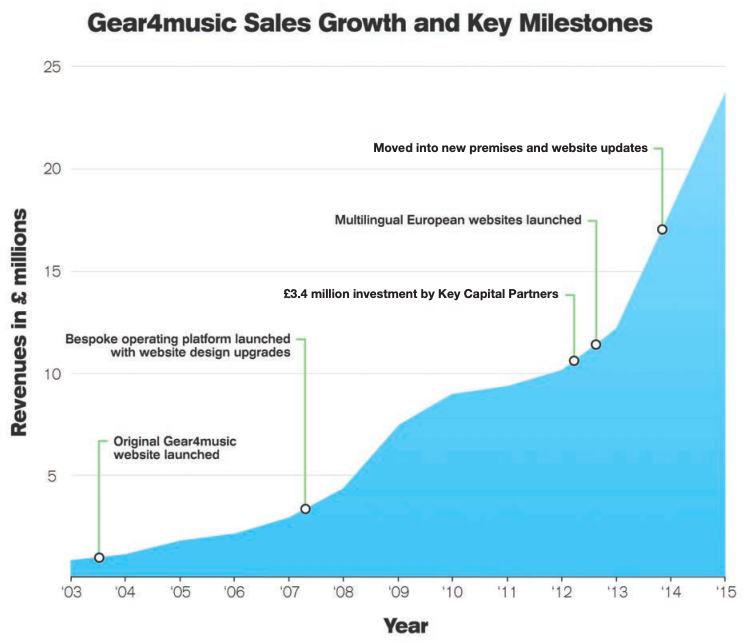
In 2003 Wass began to look into retailing own-brand beginner level musical instruments. He wanted to make them more accessible by selling at lower prices than in traditional music shops. Wass placed a bulk order for guitars, listed them for sale, and notched up an encouraging £0.65m of revenue in year one. He was onto something.
From this point on, sales grew strongly every year.
In March 2012, private equity group Key Capital Partners invested £3.4m to enable further development of G4M’s ecommerce platform and expansion into Europe. Some 18 country-specific websites were created for customers in Ireland, France, Spain, Portugal, Germany, Netherlands, Belgium, Denmark, Norway, Sweden, Finland, Italy, Switzerland, Austria, Poland, Czech Republic, Slovenia and Slovakia.
Source: Admission Document
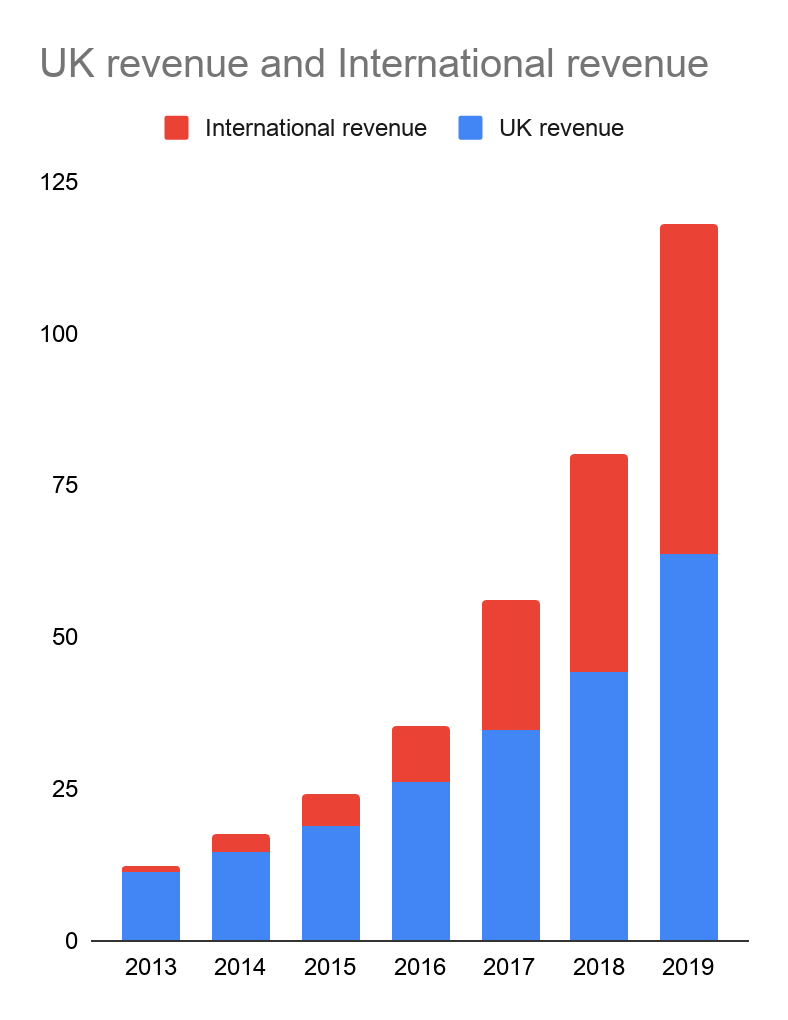
This rapid top line growth continued post-IPO. Here’s the table - strong growth by any standard.
2013 | 2014 | 2015 | 2016 | 2017 | 2018 | 2019 | |
Revenue (£m) | 12 | 18 | 24 | 35 | 56 | 80 | 118 |
YoY growth | 44% | 37% | 46% | 58% | 43% | 48% |
Market overview
It looks like there is plenty more blue sky to aim for.
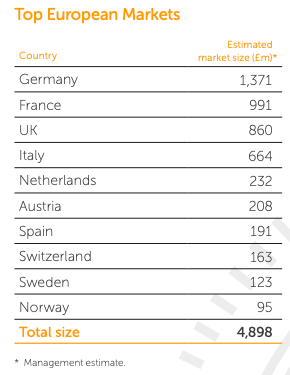
In December 2017 Music Trades estimated the global music products markets in 2015 to be $15.9bn. The top ten European retail markets for musical instruments and music equipment (including the UK) are estimated by G4M management to be worth £4.9bn. There is the added tailwind of a profound shift towards online retail.
Source: 2019 Annual Report
There is still growth to be had in the UK in consolidating a fragmented market.
Meanwhile in Europe and the rest of the world, there is plenty of opportunity. The group has invested money into building its showcase and distribution networks across the continent and efficiencies should arise as trading scales up.
At this rate, I’d say G4M’s International division is one or two years away from surpassing the UK in terms of revenues.
FY19: faltering margins lead to share price crash
For all the talk of double digit revenue gains and global opportunities, however, the growth story at G4M faltered last year. Sales are vanity, profit is sanity - and so far, G4M has very little to show for itself in terms of the latter.
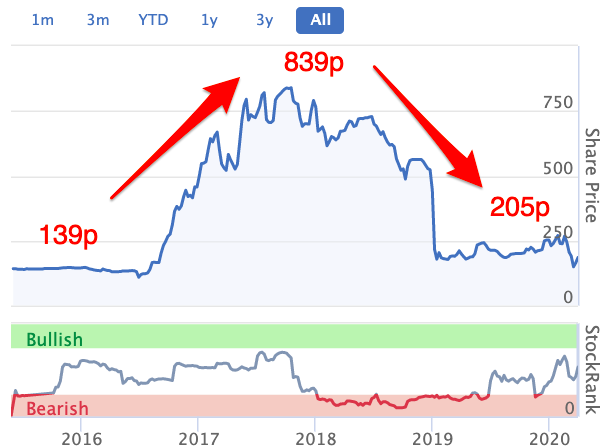
Investors reached a “show me the money” point in 2018/19. Like FeverTree, this is another stock that has marched all the way up to the top of the hill and all the way back down again...
Profits just haven’t materialised - if anything, margin trends have deteriorated recently. Gear4music has so far sacrificed margins in order to take market share - first in the UK, then in Europe.
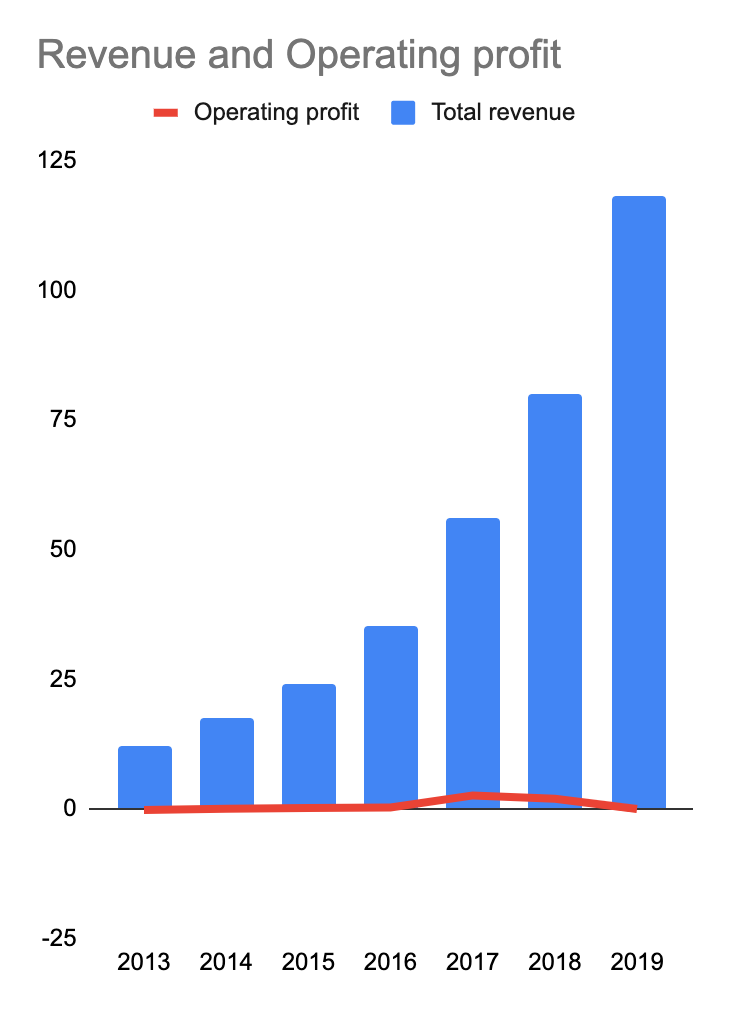
The FY19 gross margin of 22.8% disappointed many and G4M has been quick to declare margin recovery as a primary objective for FY20 and beyond.
Fortunately, many of the group’s issues (to do with warehouse capacity and courier contracts among other things) are issues that can be easily and quickly addressed by management. In fact, the group said in its current trading and outlook section of the FY19 report that it was already “beginning to see positive trends establishing themselves, which give us confidence in our refocused growth strategy.”
FY20: green shoots
The increased focus on improving gross margins and managing its cost base appears to be paying dividends. In terms of trading, G4M is on the up and management now expects profits for the financial year ended 31 March 2020 to be ahead of previous expectations.
The group is navigating the current lockdown successfully, thanks in large part to “the huge effort our incredible staff have made during this very challenging time.” Wass himself said in the year end update:
“In addition to the economic benefits of uninterrupted trading, we are driven by the knowledge that learning a new instrument or improving musical skills can bring enormous mental wellbeing benefits to people of all ages, particularly in challenging times like these.”
So perhaps G4M might even benefit from current conditions?
We will have a more detailed trading update for the 12 months ended 31 March 2020 on 23 April 2020, but for now the body language at G4M is positive and this could be one fallen star to keep an eye on.
Conclusion - enhanced profitability on the horizon?
It must be a tricky balancing act, rapidly ramping up revenues and building up operations while growing profits the whole time. It is something G4M has not yet managed but is now actively addressing.
This is the crux of the matter: either G4M can improve profit margins or it can’t. Your view on this is central to whether or not this company is an investable proposition. For now, the group remains firmly in “ramp up” mode and continues to use up more cash than it generates.
(per share) | 2014 | 2015 | 2016 | 2017 | 2018 | 2019 |
Net operating cash flow | 3.7 | 7.69 | -1.84 | 0.549 | 0.755 | 12.3 |
Capital expenditures | -4.26 | -4.78 | -8.28 | -10.8 | -43.9 | -21.4 |
Free cash flow | -0.56 | 2.91 | -10.12 | -10.251 | -43.145 | -9.1 |
As a result of this, G4M has repeatedly had to raise funds:
CFI | 2014 | 2015 | 2016 | 2017 | 2018 | 2019 |
Issuance of stock (£m) | 0 | 0 | 0.032 | 0 | 4.19 | 0.105 |
Issuance of debt (£m) | 0.286 | -0.204 | 4.57 | 1.68 | 5.88 | 4.33 |
The group has not yet established itself as a viable operation in my eyes, but I do think it might be approaching this point. In the meantime, the group’s modest valuation of 0.34 times sales offers some protection for risk-tolerant investors.
In order to prove itself, G4M needs to become reliably profitable and free cash flow positive. So far, the group has not had to dilute its shareholder base too much, but for as long as it needs to raise cash to fund expansion, equity dilution remains a risk.
One encouraging point to note is that founder CEO Andrew Wass owns about 34% of the company, and other board members own another 1-2%, so management is aligned with shareholders.
It will have to defend its UK market share and continue to grow into Europe and the rest of the world so that it can realise economies of scale and generate margin gains from increasing volumes. Here, the group’s top line growth rates are encouraging although plenty of execution risk remains.
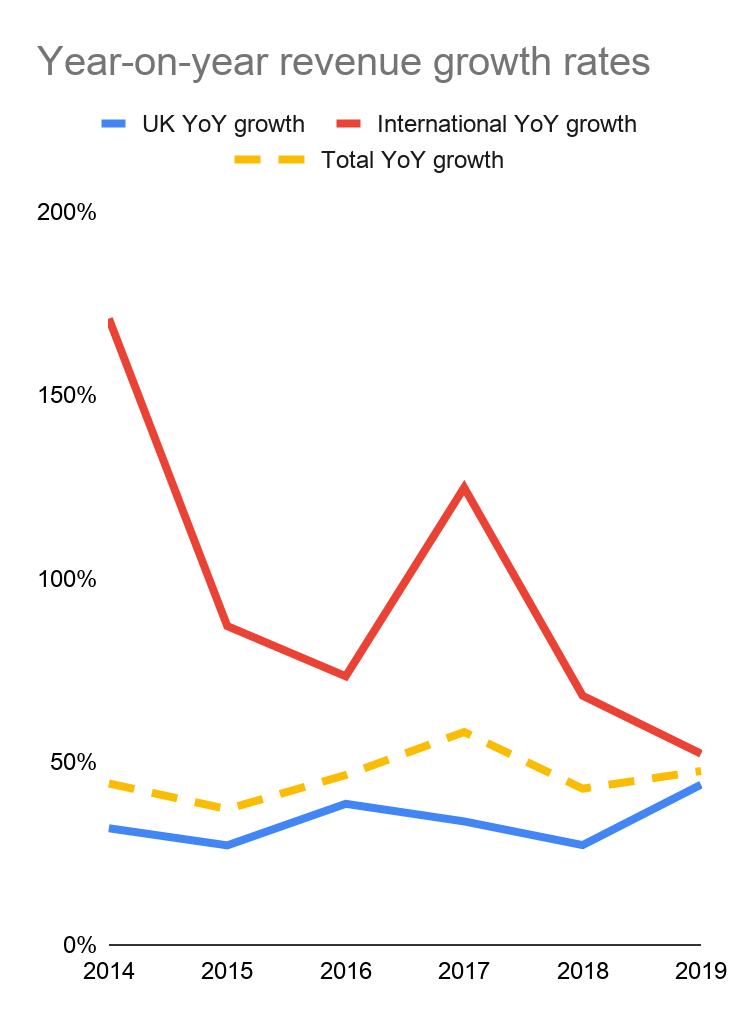
If margin-enhancing initiatives take root, G4M shares could be undervalued and there might be a material opportunity here for the risk-tolerant investor.
With a market cap of just c£43m (0.34x sales), G4M shares look like an interesting risk:reward proposition, particularly given the stellar track record of revenue growth. The final piece of the puzzle is to prove to the world it can generate the profits to match. On that note, I look forward to the group’s full year update later this month.
Disclaimer
This is not financial advice. Our content is intended to be used and must be used for information and education purposes only. Please read our disclaimer and terms and conditions to understand our obligations.

7 comments
I’m a musician (very much amateur) and have set up a church PA. I also have three sons who are budding musicians. I am classic target market and am a fan of G4M having bought my son’s drum kit and a lot of PA kit from them. They have the potential to be the Amazon of the online music world. My concern is that they are competing too hard on price and they are simply not profitable enough. Most guitarists set out with a cheap guitar and if they stick with it and improve, they buy a better guitar. If playing the guitar is a serious hobby then you don’t mind paying £300-£500 for a decent acoustic. That’s where G4M can earn their margin. There is far too much focus on the cheap entry products pile it high sell it cheap and not enough of the better quality better margin stuff in my view.
I wrote this back in Jun 2018 ...
https://www.stockopedia.com/content/gear-4-music-perhaps-not-369704?order=createdAt&sort=desc&mode=unthreaded
Margins ought to be much better given the nature of the product. So I don't understand why they aren't more profitable than they are.
difficult to get interested in a co.that goes for turnover instead of profit when they do try to up profit sales then drop in tantem if they dont i think then the time to sit up
I understand this view. The track record since listing has been mixed. I think you can take the view that either a) management is learning in real time how to scale up a viable business and we are seeing Gear4music Holdings (LON:G4M) 's growing pains, or b) there is no viable business and revenue growth flatters to deceive.
We might begin to see hard evidence of the former in the upcoming company results. Those that fall into camp "b", though can already point to G4M's virtually non-existent margins, lack of free cash flow, and persistent capital raising after c5yrs as a listed entity.
I can see both sides, so right now my view is "wait and see", with one eye on results later this month. As you suggest, probably the key to G4M for many is to see evidence of a trend in both revenue and margin growth
Mortimer recent statements and trading updates show a focus on margin which of course is being enjoyed on the very significant volume that the company grew from Zippo hence the current opportunity
Gear4Music suffered warehouse failure Christmas last year since then management have slowed sales growth and grown margins as evidenced in their interim results and trading updates. The market having driven the share price to 800p before cratering to 165 is being careful before it trusts management again but the last comment was that online sales in Italy were benefiting from the lockdown their and customers being forced to buy online