Greggs (GRG): Value company, value stock

 Greggs (LON:GRG) is a company well known by most in the UK - it's a high-street (and increasingly off-high street; we'll come to that later!) baker famed for catering towards the hard value end of the spectrum. It's a sector I admit I have a little experience with personally, and I have often observed that Greggs does a pretty good job differentiating themselves from the rest of the high-street. The 'higher-end' is clustered with faux-authentic pasty outlets and ubiquitous coffee shops, but if you fancy something cheap and relatively warm (don't start this again..) to my mind Greggs is probably your best bet. I think it's essentially a monopoly, though the differentiating lines in real life are always more complicated than in theory. It's probably safer to say that they have a well-differentiated niche.
Given that, it's no surprise Greggs interests me. Companies with defensible niches can earn better returns than companies buffeted by the winds of competition, and large companies which fall into this category are doubly beneficial - a small, well-run company can be muscled out - a big, dominant player which is operating efficiently can only be taken on at great cost. See Howden Joinery for an example of where, while returns are strong, the barriers to competition still appear to make them well protected.
All isn't rosy, though, otherwise Greggs wouldn't be cheap. While I don't think they were ever particularly expensive, their shareprice recently took a hit with a less-than-positive trading statement. Like-for-like sales are down quite substantially, and management noted that they believed profits would be to the 'lower end' of market expectations. Helpfully (and coincidentally something Howden also do) they actually state what they think market expectations are - in this case, in the range of £47.5m to £55.2m. Frankly, these forecasts seem rather bullish in the first place, which makes me wonder which measure of profit they're talking about - operating/PBT/net. Still, it's mostly an irrelevance, and flavour for discussion, since there's nothing particularly dramatic in there.
The decline
 To me, the graph alongside is far more interesting data than the relatively short-term gyrations of their first quarter revenues and profits - it's more noteworthy, and more elucidating.
Returns have dropped pretty steadily since the start of the recession. The question for me is simple - why? Two obvious answers spring to mind immediately. The first is forgiving for Greggs - it places the blame on the economy. Times have been tough for consumers, and a company focusing on the value end of the spectrum will likely find its consumers squeezed more than most. Since Greggs had market power, they earned supernormal returns pre-recession - they enjoyed their position. Now times are tougher, they are less able to exploit that spot - and so they absorbed some of the input costs and dropped margins. If this is true, we can expect the pain to be mostly mean-reverting when the economy picks up again.
However, there's also a possible underlying story here. Consumers are moving away from the high-street - we know this much - and the highstreet is where Greggs are focused. The decline in footfall might not be just because of the recession - Greggs might be becoming less relevant. If we mistakenly attribute all of the decline to a bad economic environment, we might be waiting for a recovery which never occurs.
The evidence
Realistically, the question of which of those scenarios is more prevalent isn't really one we can answer. We can try, though, to glean something from history, and how Greggs has been managing the downturn.
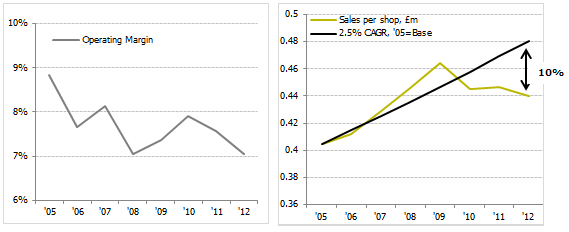
The graph on the left shows operating margin. This appears to be trending downward in a similar way to returns on capital (not surprising given the calculation!). Given how profits have increased, this makes the mechanism fairly obvious - revenues have grown quicker than margins have declined. How have revenues grown? The next graph gives us some intuition into this, too - because it doesn't appear to be related to sales growth per outlet. We'd really prefer to see sales per sq.ft figures, but I couldn't find the data in the annual report, and so we're stuck with number of outlets (which is vulnerable to changes in mix re: store size). Still, we see a definite trend here - sales per shop rises rapidly towards '09 and drops off sharply since. I've added a 2.5% CAGR line as a lazy approximator for inflation, since in reality sales per shop staying flat is a volume decrease since prices will likely be rising every year.
Reading between the lines here, and as revenue growth is being driven by more and more stores, the really curious question is whether the new stores are as profitable as the old ones. Since 2010, they've opened almost 200 - a pretty big investment given they only opened 168 between 2005 and 2010. Greggs say they're adapting to the changing retail environment by moving to the people - places of work and leisure - and away from the high street as it declines. This clearly makes sense, though my contrarian instinct suggests that the high street will be alive and kicking once money starts flowing. Regardless, they're still growing, so they're confident.
The bottom line
My meandering musings on their prospects might be interesting if you have a strong opinion, but I'll be sensible and throw them away for the conclusion - I don't want to make predictions on the prospects of the high street, the likelihood of economic recovery, or whether 'Greggs - the brand' is in long term decline. Rather, I'll put my eggs in the basket of statistics and historical performance. That basket says that Greggs is cheap. Even if returns stay at this lower level, it's cheap - and that seems like a reasonable baseline scenario. You don't need to pencil in any recovery in footfall or margins for the price to be attractive here - you just have to not pencil in too much more of a decline. That seems perfectly justifiable to me - Greggs is exactly the sort of company I think prospers after downturns - they have a low-cost business model based on efficiency, and they've continued to grow.
They're reasonably leveraged, with quite a large number of leased stores, but not to the point of worry - they have no other debt, and a company like this ('consumer defensive') tends to be more stable than most in revenues and profits, anyway.
In short, I think this is a chance to buy into a good company at a decent price. It's a bit of a snide comparison, but the current share price is over 20% lower than it hit in 2006 - a year when they made 30% less profit on 25% less revenue, and I'm not convinced it was particularly expensive then, either. You might say that doesn't sound like a huge share price difference - I'd say that, in 2006, there wasn't much prospect for people having more money in their pocket and wanting to spend more on the highstreet - when you've had prosperity for so long, there's one way things are likely to go. In 2013, I think the tables have turned. Now their performance represents a reasonable baseline on years of steady and profitable growth.
It's obviously no small-cap discovery that's set for the stars, but I think they're here to stay.
Disclaimer
This is not financial advice. Our content is intended to be used and must be used for information and education purposes only. Please read our disclaimer and terms and conditions to understand our obligations.
No comments yet
No one has commented here yet! Why not be the first one?