Hargreaves CEO "we need to up our game!"

Graham did a great post on yesterday's SCVR on Hargreaves Lansdown (LON:HL.)'s interim results. He and I seem to have come to pretty much the same conclusion. But we certainly got there taking different route's :-). Here's my reading of the results after sitting in on the analyst presentation yesterday.
Interim results were 'meh'. But make no mistake, the (relatively new) CEO is implementing a big shakeup. The opportunity is there. This is all about execution.
Hargreaves Lansdown’s interim results for the six months to 31 Dec 23 (H1-24) were badly received by investors. The share price fell over 7% on the day of the release.
But I reckon too much of a focus on some disappointing metrics in the short term might be a mistake. The real meat of the release and the analyst presentation was in CEO Dan Olley’s changes to HL, and his plans for future. There was a refreshing honesty about HL’s weaknesses, a clear message that big changes are underway, and signs that the ‘old way of doing things’ is under some pressure.
I’ll tackle the results first, then dive into the updated strategy and execution.
Slow-ish growth, but not THAT bad
Net new business AUA for the six months was +£1.0bn. Markets were a tailwind which added £7.2bn, bringing total AUA to £142.2bn (up 6% over six months).
The new business number was probably the biggest disappointment for investors, which was down 38% year-on-year and Q2 (+£0.4bn) was down on Q1 (+£0.6bn).
But in fairness, it was a period of tough trading conditions with a grim macro-economic environment, and nervous investors. For a large incumbent, the growth rates weren’t that bad compared to peers. (Note: H2-23 used in the charts below refers to calendar H2-23, and equates to FY H1-24 for HL).
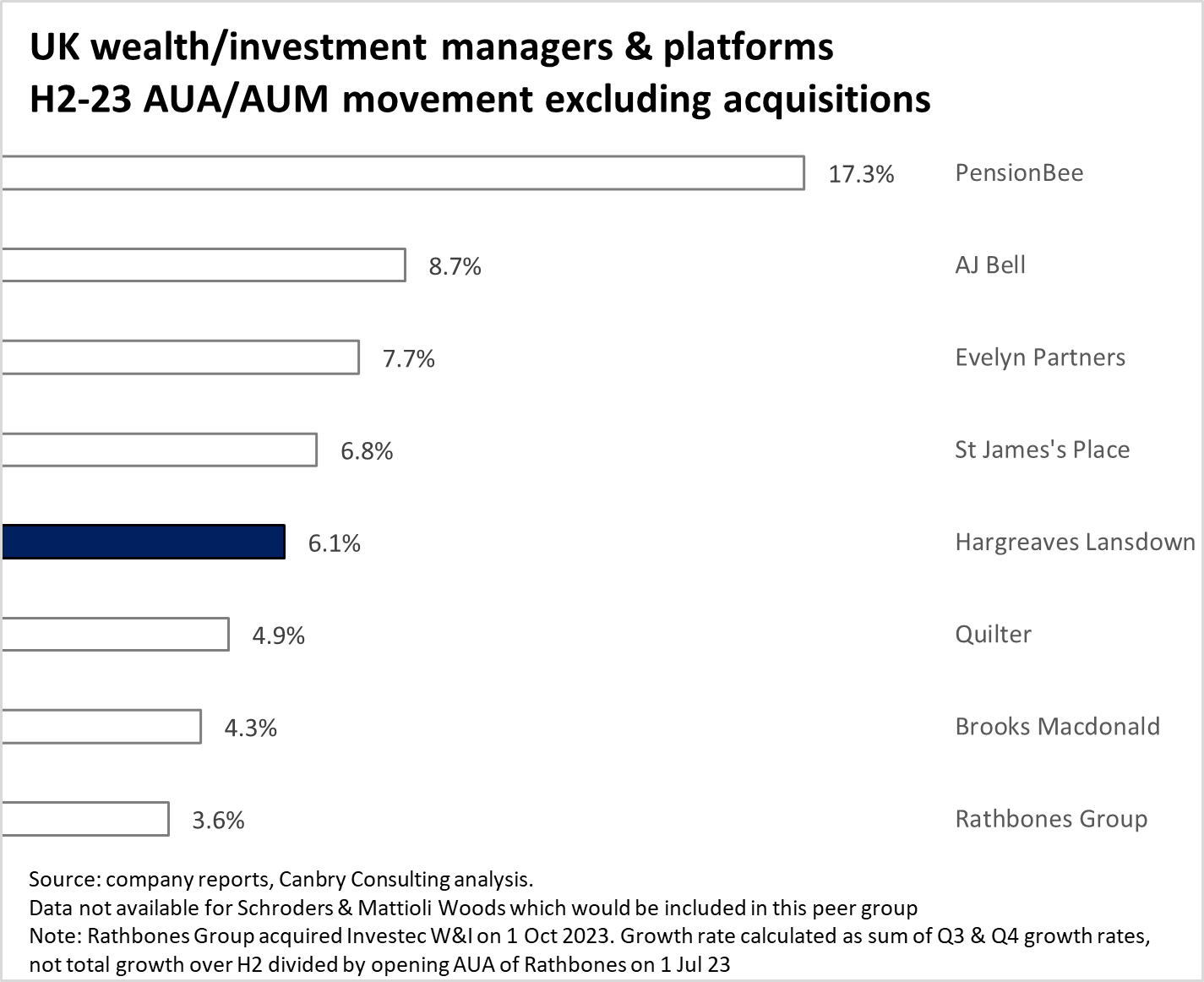
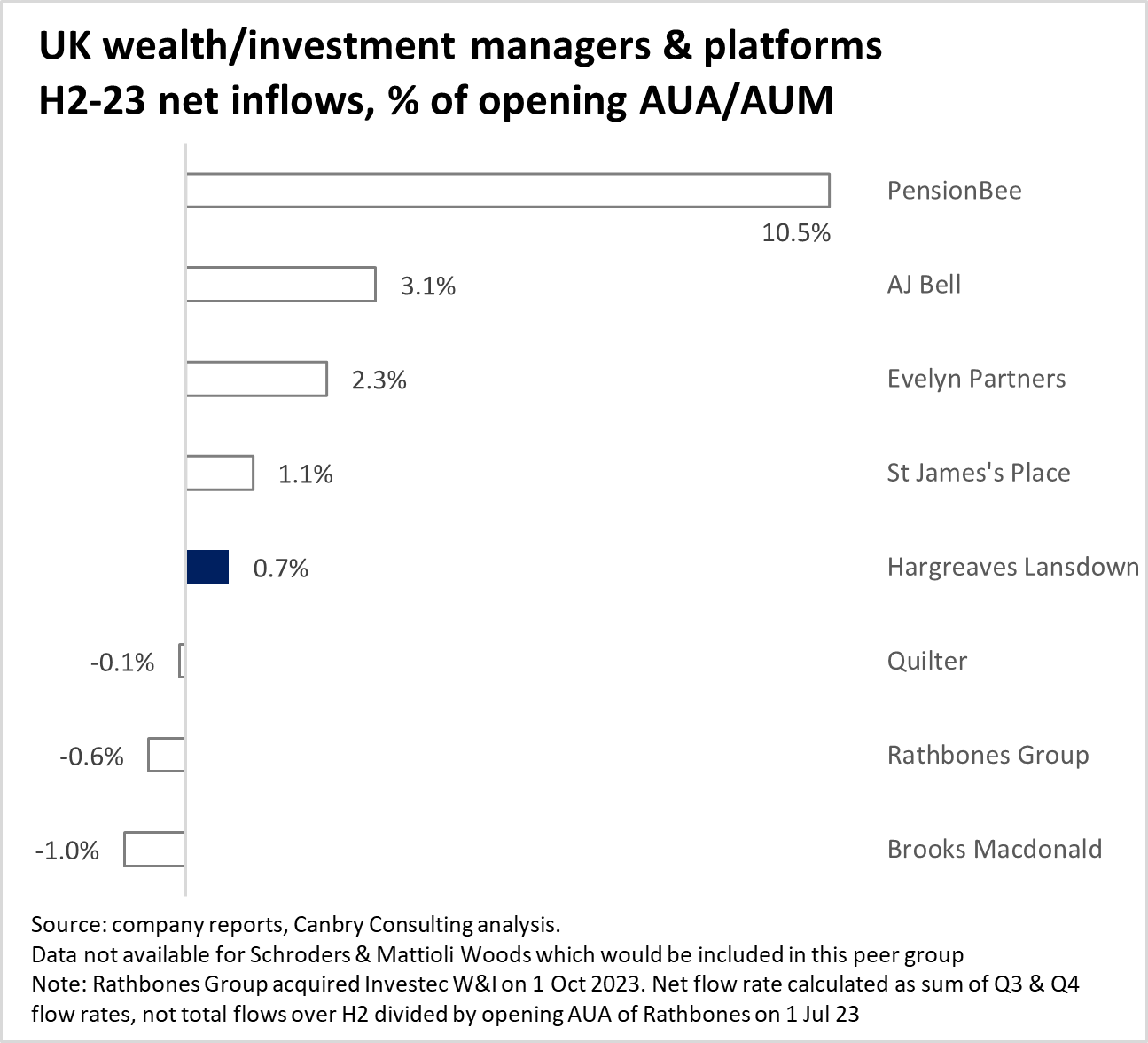
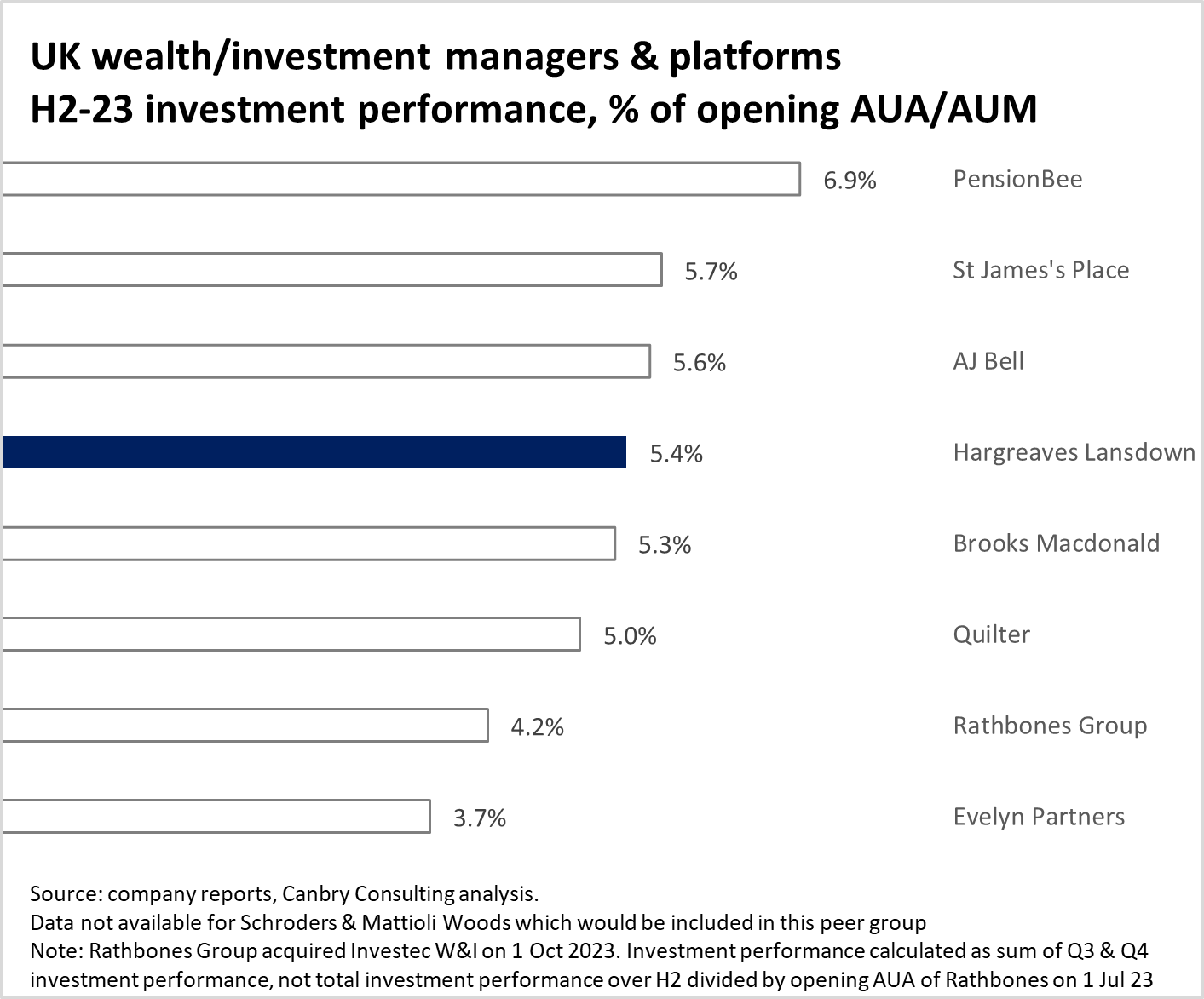
Additionally, net new clients were substantially higher in Q2 (11.9k) versus Q1 (8.2k), although still well below the quarterly average of FY23 (16.8k). Over the half-year period HL attracted more net new customers (20k) than competitor AJ Bell (18k), although AJ Bell’s customer growth rate is far higher as it has a smaller customer base (484k vs the 1.8m of HL).
There is some nuance to HL’s net new business flows though. In its presentation to analysts, CEO Dan Olley said:
“We do not have an inflow problem but we do have an outflow problem.”
It reported that gross inflows were up year-on-year, with outflows up by even more.
HL has put this down to the market backdrop and product mix, saying that clients have been impacted by the cost-of-living squeeze.
“Outflows were highest in the products that our clients use for more transient saving and investing, such as our Fund and Share Account, driven by cash withdrawals to deal with cost-of-living issues and/or to pay down debts. The period also saw an increase in transfers to banks and building societies to take advantage of Cash ISA products.”
More on HL’s response to this later.
Mixed back of financial metrics
Turning to financial results, there weren’t really any metrics that jump out, other than an impairment charge and its impact on statutory profits, and the ongoing ‘strategic investment spend’, which are discussed below,
HL recorded revenue growth of 5% to £368m, driven by higher average AUA and a higher net interest margin on cash in clients’ accounts. Underlying costs were up 10% (in line with guidance), and underlying PBT was up 5% to £222m.
Statutory PBT however was 8% lower year on year at £183m, with this metric including £22m of ‘strategic investment cost’ (in line with guidance), £14m of intangible impairments and £3m of restructuring cost.
HL is in a net cash position of +£536m, up 7% over the 6 month period.
But there’s more to the ‘strategic investment cost’ and ‘intangible impairments’ than the pure numbers. These are both closely related to the shakeup CEO Dan Olley is effecting on HL. He is six months into the job, has conducted a detailed review of the business, and is making some big changes.
Shakeup underway
Olley is certainly bullish about the longer-term prospects of HL, and what I wrote in a previous post still holds. He emphasises that the market opportunity in the UK is huge, with an addressable and growing market of over £3 trillion (which suggests HL has captured just 4-5% of this). He uses his experience of previously living in the US to make the point: “in the US, everyone I know invests, they’re engaged with it … what has amazed me since I first joined HL is how many people I know in the UK are the complete opposite, putting money into investments can be bottom of the list.”
He talks about HL having strong foundations: it has a good product range, is trusted by clients, often the first choice main provider among investors, and the business already has scale.
But Olley was also open about areas of weakness. He highlighted issues of concern being a deceleration in net new business growth (the business is still growing, with gross inflows strong but client retention levels decreasing), and decreasing operating leverage, with cost growth exceeding revenue growth.
So what’s he going to do about it? Olly has set four priorities:
- Delight clients, drive growth – continue to evolve our value proposition to delight our clients and through that, drive our growth;
- Save to invest – always strive to be a fitter and leaner business;
- Increase execution pace – deliver for our clients everyday, improving our proposition on an ongoing basis;
- Right people, right roles – make HL great for colleagues; the right culture, with the right people in the right roles, focused on the right priorities to deliver the strategy.
These are a bit jargon-ny and what nearly every CEO might say. But when you dig into what each priority really means, there appears to be some concrete plans being implemented. I’ve gone into some detail below.
Delight clients, drive growth
My take on this is that HL wants to stop the bleeding of outflows (potentially a relatively quick-win), while working to ratchet up the level of new investments among clients and UK consumers more generally (probably an opportunity that might ramp up more slowly).
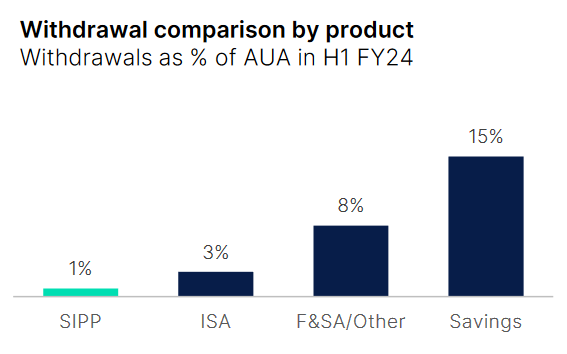
Some context relevant to this is that HL’s Savings accounts have a very high withdrawal rate (especially to Banks and Building Societies), and that ISA outflows have been driven by clients moving to Cash ISAs, which means there is work to do on HL’s cash offerings.
Also, SIPPs have a much lower churn rate than other products, HL has grown its SIPP business more slowly than some competitors, so growing the pensions business is now a big focus.
It’s working on a few levers to address these issues:
- Expanding/enhancing products. New products include a multi-bank cash ISA (fixed-term, easy-access and limited access) and ready-made pension plans (which are HL-managed portfolios gradually de-risked as retirement approaches).
- Increasing/improving content to drive flows. This is well underway. The programme to offer and make people aware of the opportunity in gilts (in a high interest rate environment) has attracted £1.8bn of AUA. The new ‘Five to watch’ campaign attracted £100m in the first month. And HL has introduced a six-week free course on how to invest with confidence.
- Making the process of investing easier. The Easy bank transfer functionality has facilitated £1bn of investments since launch. The improved regular savings functionality in the HL app, launched in Jan 24, has resulted in nearly £500k (per month) of new savings.
- Improving service levels. HL has beefed up its helpdesk staff numbers and reduced the answering times of calls.
- Improving the digital experience. It has re-designed site navigation and web-journeys with a 21% uplift in the conversion rate of transfers-in, and the new search page in the mobile app has resulted in a 51% increase in purchases of HL’s ready-made-investments.
If these actions continue to be successful, they should translate to higher net new customers added, higher AUA growth, and higher retention rates. Those will be the acid tests of success.
Save to invest
In blunt terms, this is about cutting costs and fat.
HL claims to be taking the knife to third party spend, such as IT licenses, recruitment agencies and contractor spend.
It’s automating processes that currently require a significant amount of manual work.
And Olly talks about ‘sharpening accountabilities’. Maybe I’m over-interpreting, but that sounds like implementing a more ruthless approach to individual performance management.
The ‘invest’ part of this priority is then about using savings to reinvest in the platform.
Increase execution pace
The way projects are being assessed and implemented is also changing.
Olly has binned two projects - software that was developed to support a client financial health check tool, and the development of a tool to improve efficiency for Financial Advisors. HL had capitalised £14m of spend on these projects, creating an intangible asset. That gets written off with a corresponding impairment charge (contributing to the drop in statutory PBT mentioned earlier).
And he has re-jigged how project teams are set up and managed. For example, ring-fenced project teams have been set up to implement projects without the distraction of the day-to-day running of the business. Again, performance management looks like a focus in this area with a new Objectives and key results approach, to ‘drive alignment and performance’.
HL is already claiming some big wins from these changes, such the rollout Amazon Connect being accelerated and delivered in half the time originally estimated, decommissioning the legacy telephony system ahead of plan to save on dual running costs, and implementing Salesforce within the Complaints and Client Service team within four months (a key advantage being that this is in place over the busy tax year-end period).
The acid tests of success for the Save to invest and Increase execution pace priorities will be higher operating margins, and increased operating leverage.
Right people, right roles
The last priority is about getting the right people in place. And Olly has not been shy in making sweeping changes to the executive team, including:
- Richard Hebdon as Chief Digital and Technology Officer – joined HL from RELX, the global information services provider, where he was Chief Technology Officer for a division of LexisNexis.
- Afonso Nascimento as Chief Strategy Officer – who has been with HL as interim CSO for the last three months driving the strategic agenda and digital transformation (he has strategy and financial services experience from Boston Consulting Group).
- Lucy Thomas as Corporate Affairs Director (from March 2024) – currently Director of Corporate and Regulatory Affairs at TalkTalk, and prior to this in senior roles at Edelman and at the BBC where she was a producer on programmes such as Newsnight and the World at One.
There is also a strengthened technology leadership team and new appointments in the client-facing solution development teams and the digital automation and transformation teams.
Most of those appointments feel to me like they are there to implement a big change programme.
***
I reckon HL is a stock to keep an eye on. It currently carries a fairly low PE ratio compared to peers.
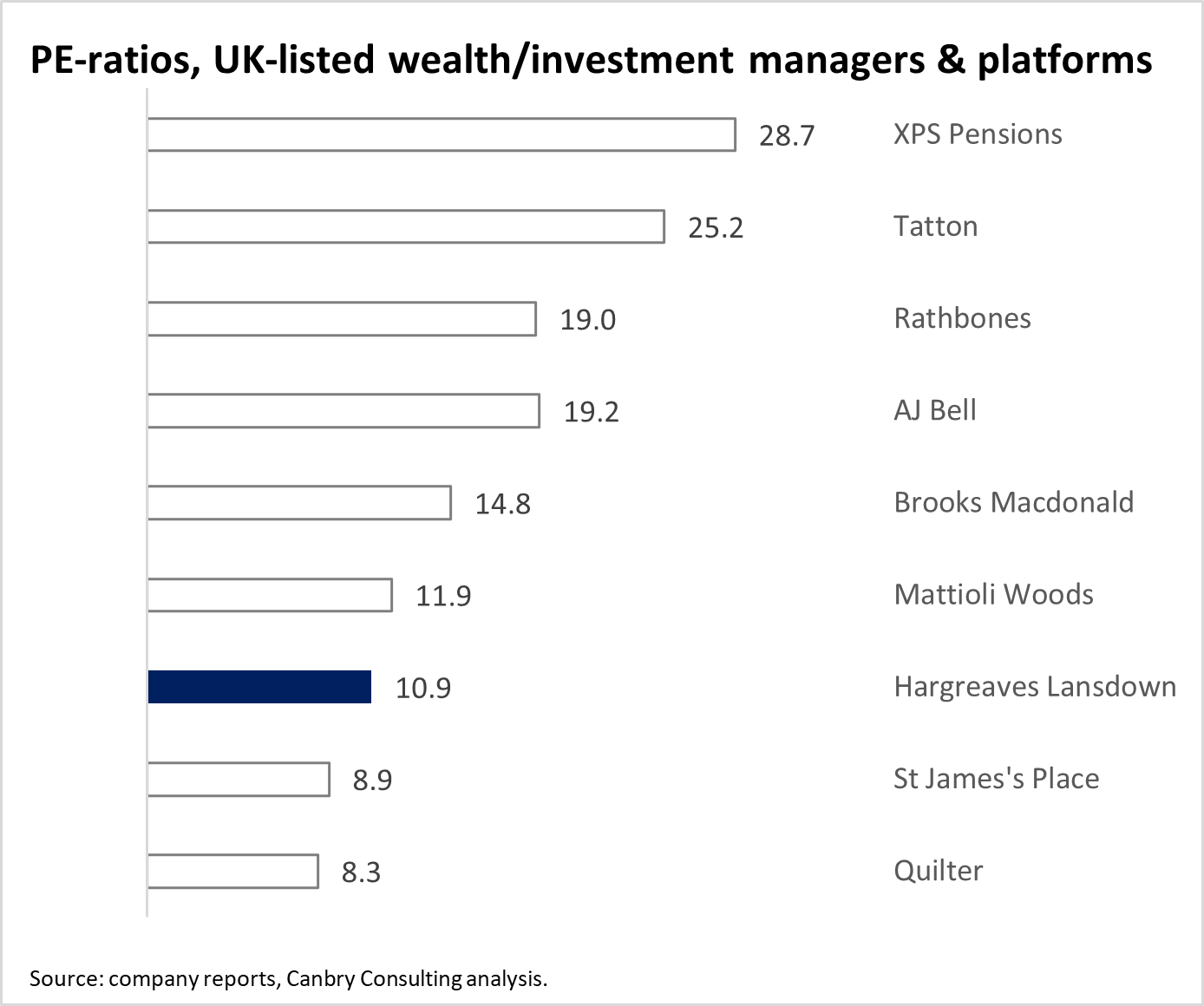
And while there may be some short-term pain as some of these changes are implemented (they are not all low-risk), if Olly can implement his plan successfully, there’s a chance HL could re-rate. Encouragingly, he’s prepared to measure his success on some some hard metrics, not soft and woolly achievements:
"Looking further forward, we will measure our success in the delivery of our strategy through seeing a step up in AUA growth, increasing our client satisfaction and retention, driving operating leverage through a different cost trajectory for the business and enabling sustainable operating margins over the medium term."
As he said in the analyst call: “We need to up our game”.
This article was originally published on TheInvestors.blog which provides analysis for shareholders of asset and wealth management companies. This is not investment advice. Please read TheInvestors.blog disclaimer here.
Disclaimer
This is not financial advice. Our content is intended to be used and must be used for information and education purposes only. Please read our disclaimer and terms and conditions to understand our obligations.
12 comments
The HL website is very tired. There does not seem to be any effort being put in to improve or modernise it. Lots of broken links (404 error) especially on US stocks, grim charting and bad information. No news for US stocks. A general feeling that they do not care about their clients. I used to send them lots of messages about specific web site problems, but have now given up. I have multiple family ISAs, SIPPs and drawdown with HL, but I am now investigating a move due to these problems plus their uncompetitive fees.
Personally I would rather pay £30 a month for Stockopedia, than £30 a trade on H&L. This is H&L problem IMO as the competition on Trading 212 & Freeshare is that I can do it on there for cheaper/free.
Until H&L offers more for the money or competes with trading fees, it's on a downward spiral IMO.
For an online trade I pay £11.95 (plus stamp duty if appropriate). I don't recognise £30 as a trading fee for ordinary shares. I think the phone dealing charge is about £40 but it can be well worth it if you are doing a "put through" trade where you are selling and repurchasing a significant amount of stock in another account. The advantage comes from a nominal difference between the bid and ask price you pay. I've used it to considerable advantage where a larger CGT bill is avoided by getting the deal done at a better price.
I think HLs main problem now is they are not competitive at all for those just getting started with investing. Investors with large portfolios are okay because of the platform fee cap, but if I have a small-mid sized portfolio, why would I pay a 0.45% platform fee and £11.95 per trade (unless I only use direct debit) when there are other platforms offering commission free trading and no platform fee?
More people than ever before are getting into investing and I can't see why someone new would ever come to the conclusion that HL is the best choice when comparing accounts. The only account they offer that has competitive fees is their Lifetime ISA.
It is a shame because I like the platform and I do use them for my LISA, but the fees are not competitive at all for a S&S ISA or a SIPP.
Hargreaves' fee structure is on the expensive side, especially their fixed FX fees.I guess you can negotiate if you do a lot of nominal business with them.I like Jarvis Securities (LON:JIM) but still use Hargreaves Lansdown (LON:HL.) due to knowing the platform and pure inertia.The broken links can get annoying at times though and not being able to find the odd security on the platform.
I don't know how Trading212 operate, and who's funding them if they are still unprofitable.. (?), since i think payment for order flow is still illegal in the UK.However 'free trading' doesn't exist.They either benefit from payment for order flow (why Ken Griffins and Citadel are so wealthy) and/or poor fills and/or poor spreads, investing your univested cash.
Trading212 are actually very profitable surprisingly. Off the top of my head, I think they had a net profit of around £20m last year. I think they mainly make money from FX fees, up until recently skimming interest on cash, and probably mostly their CFD arm.
Edit: just checked Companies House. They had a profit of £41m for year ended 31 December 2022.
I don’t recognise the £30 trading fee either.
It has to be said that HL are not chasing trading business which has a high attrition rate as punters self-destruct.
HL have gone down the route of developing a platform for long term fund holding clients.
According to the FCA daily short position report, there are disclosed short positions in HL amounting to 6.9%. This puts HL in second position for most shorted share in the UK market, behind Petrofac and sharing second position with Kingfisher. Millennium International increased their position on 21 Feb. This makes me a little uneasy about committing funds at this stage, particularly since I'm not certain that there aren't any further potential (large) costs of the Woodford debacle.
Pensionbee (LON:PBEE)
Apologies for hijacking this thread but its interesting to see that pension bee is at the top of the lists here ref the stats. Thats probably somewhat to be expected as they are early growth stages compared to all the others. I think they are trending towards breakeven/profitability in 2025 too. I dont hold but its starting to look intersting investment.
Hi, yes good point. Pensionbee (LON:PBEE) is a bit of a special case as it is absolutely earlier stage than the other peers and quite a lot smaller. So growth rates would be expected to be higher. But having said that, their growth rate has been pretty impressive since their IPO and despite difficult market conditions, they have pretty much delivered on what they promised at their IPO in Apr 21.
They hit breakeven profitability on a monthly basis last quarter of 2023 (on their adj EBITDA measure, not statutory profits), and are guiding full year adjusted EBITDA profitability for full year 2024. You can read my latest research note on them here. https://www.equitydevelopment....
Pensionbee (LON:PBEE)
Thanks for your post P Bryant - just the person to ask a question too perhaps.
It seemed very odd to me that in 2025 there is a most excellent growth in revenues pencilled in of £13 mill - but "adjusted expenses" for 2025 are also expected to be up £12.5 million.
Perhaps i have missed it (apologies if that is the case) but i cant see any mention whatsoever as to why the adjusted expenses are expected to rise by such a huge amount that year - if its not on stuff like discretionary adverts or extra planned customer acquisition costs - it kinds takes 90 % of the gloss of the great revenue numbers increase if it all exits the company in unexplained extra overheads.
Very comprehensive analysis, thank you for taking the time to publish.
I have accounts with HL and find them pretty good for my needs. One aspect that niggles is that they no longer include trades data in their summary page for a given stock. They say "recent trade data is unavailable. We will be replacing it, however in the meantime the information is available on the London Stock Exchange website." This situation has been on going for ages, at least a year, maybe a lot longer. Telling folk to search for information on another site doesn't seem smart to me.