Hunting for compounders - MKS and TED

There is a saying sometimes attributed to Winston Churchill, ‘never waste a good crisis’.
Recent lockdowns have caused companies with creaking business models to take some hard looks in the mirror and to really focus on what they must do if they are to prosper in the years and decades ahead.
Towards the front of that pack are a few established Retail players now looking to rapidly evolve. The way consumers act in certain ways has changed beyond recognition and some of these behaviours might be here to stay.
Below I’ve taken a look at two former High Street stars whose share prices have come undone. Both Marks And Spencer (LON:MKS) and Ted Baker (LON:TED) are saddled with expensive lease estates but behind the scenes there is operational progress like never before.
Both talk with a renewed sense of strategic focus, but is it too little too late?
Marks & Spencer (LON:MKS)
Revenue: £10.18bn
Market cap: £1.8bn
QV Rank: 84
What went wrong?
For many decades, Marks And Spencer (LON:MKS) was a shining star in the UK retail scene and to this day it generates copious amounts of free cash flow for holders. But its core big box retail operations are one of the most visible losers in the structural trend towards online shopping.
It’s a poor chart but there are signs that the share price has found a floor and perhaps it is over the worst of the share selling.

It is playing catch up online and has been soundly beaten by competitors such as Next, Boohoo, and Asos.
How has it been fixed?
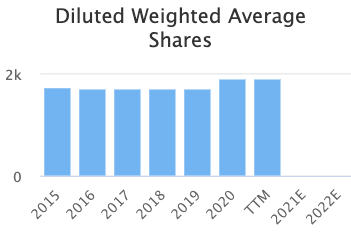
MKS remains profitable and significantly cash generative - so if this is as bad as it gets, it’s not actually that bad. This cash generation means that, even though sales are on a downward trend, there has been minimal shareholder dilution.
Debt levels have stepped up from £1.5bn in 2018 to £3.9bn in 2020 although the underlying picture here is obscured by IFRS 19 lease accounting changes. FY20 net debt excluding lease liabilities was £1.46bn, which is down slightly.
This year Marks announced its ‘Never the Same Again’ programme which will accelerate changes. In FY19 the group also made a ‘transformative’ investment in Ocado.
In recent years 54 legacy shared stores have been closed, the group has migrated from mainframe infrastructure to cloud-based systems. It has also implemented new warehouse management systems. So there has been deep operational change.
What is the potential upside?
Shares have fallen a long way. A recovery to 2015 highs of 550p implies good potential upside from its current level of 123.5p.
Over the past five years, MKS has been resiliently free cash flow generative. The average has been 38.12p. Next trades on a free cash flow multiple of 9.07. Let’s apply a 20% discount to that multiple for a recovered M&S - that’s a multiple of 7.26.
Multiply the averaged free cash flow figure of 38.12p by 7.26 and you get a potential target price of 276.75p. This target is only valid, of course, if it looks like M&S can recover, but that’s enough potential upside on the table to warrant closer inspection.
Directors and shareholders
After nearly three years of transformation, the Marks management team looks stronger and is rich in high level experience.
Chairman: Archie Norman, appointed September 2017 - instrumental in transforming a number of British businesses including Kingfisher, Asda, and Energis. Has also served as chairman of ITV.
CEO: Steve Rowe, promoted to CEO in January 2016 but has worked at the company since 1992.
CFO: Eoin Tonge, joined in June 2020. Previously CFO of Greencore where he oversaw ‘the divestment of Greencore's US operations; strengthening the company's balance sheet... and simplifying the business to focus on its core market-leading propositions in the UK’.
Chief Strategy and Transformation Director: Kate Bickerstaffe, joined in April 2020 and is co-heading the important ‘MS2’ transformation programme. She has previously worked at SSE and Dixons Carphone.
The group also has Justin King, CBE as a non-executive. Some might remember King as the Sainsbury’s CEO from 2004 to 2014.
There has been some institutional activity, with RWC, BlackRock, Schroders, and Vanguard buying. Jupiter Asset Management has been selling.
Strategy
Chairman Archie Norman describes Marks’ new ‘Never the Same Again’ programme as a way ‘to harness our new habits and use the lessons of this crisis to make what feels like three years progress in one.’
Some of its measures include:
- Central leadership streamlined and strengthened; support centre costs reduced
- M&S on Ocado delivered: favourable customer response and synergies on track
- Streamlining of store costs and improved productivity
- Sparks loyalty programme relaunched and grown to over 8m members
- New 'MS2' division within C&H to drive online growth
CEO Rowe wants the business to think and act like an online pureplay like Asos or BooHoo and says ‘We think about range and promotions differently, we think about end-to-end supply chain differently, we think about media spend and marketing differently. We’re seizing the momentum in M&S.com to turbocharge online growth.’
Talk is cheap, but this is a highly experienced management team putting their reputations on the line, so I’d like to think they mean what they say. There can be a big difference between articulating the strategy and enacting it though.
MS2
- MS2 combines online, data and digital trading in one team adapting to an online model
- It heralds ‘a step-change in online product, presentation, pricing and social marketing including recognition that the online business will need a focused range’
- There will be ‘maximum usage of one of the best customer databases in the UK to drive digital customer engagement and build loyalty’
- Domestic and international online will be run as one rather than separately
- There will be more brand partnerships such as that recently struck with Nobody’s Child.
M&S chair Archie Norman describes this as ‘the most important organisational change we’ve made in a couple of years’.
Recent trading
Half-year report For 26 Weeks Ended 26 September 2020
‘Robust performance in unprecedented times as transformation accelerates’
- Group revenue down 15.8% to £4.09bn compared to consensus expectations of £3.99bn,
- Adjusted loss before tax of £17.4m (vs. consensus loss of £55.7m) and statutory LBT of £87.6m,
- Food like-for-likes up 2.7% and adjusted operating profit up 19%,
- Ocado Retail revenue up 47.9% and growth in profitability; M&S H1 share of net profit £38.8m,
- Clothing and home like for likes down 39.3% but with an improving performance post spring lockdown:
- Q1 revenue -61.5% LfL;
- Q2 revenue -21.3% LfL;
- C&H online sales up 34.3% and now #2 in the market
- Adjusted operating profit of £61.8m and free cash flow of £77.6m
So the group reports its first loss in 94 years but the solid performance in Food, faster-than-expected online growth in C&H, and tightened cost management have all resulted in good cash generation.
Furthermore, the group’s long term estate optimisation programme will continue to result in offline network efficiency and rent reduction.
The Ocado partnership is also promising and M&S is investing to add 40% more capacity on Ocado for 2021 to catch the change in consumers’ behaviour better. With lockdown returning, Marks expects a strong Q3 for Food.
Conclusion
The underlying business is supported by resilient free cash flow:
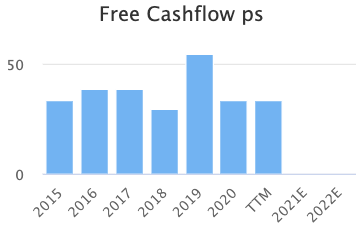
If you take the six-year average of 38.1p, that puts its shares on a multiple of 3.1x 6y average free cash flow. That seems a solid margin of safety while we wait for operational changes to bear fruit.
Marks has been operating continuously since 1884, including through two world wars. I’d back it to survive rather than go bust but there’s plenty to do. On balance, I can see management building a more relevant and resilient business in future, especially given its continued free cash flow.
Ted Baker (LON:TED)
Revenue: £630.5m
Market cap: £199.9m
QV Rank: 78
Pitch
What went wrong?
A truly dramatic fall in share price here, from highs of c2,500p just a couple of years ago down to the 100p mark today:
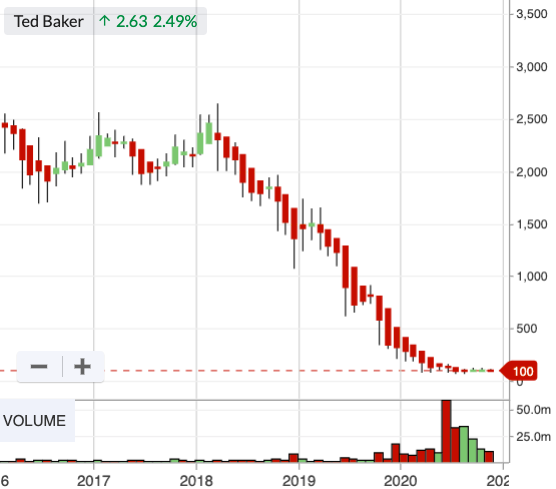
‘Global lifestyle brand’ Ted Baker (LON:TED) is a former High Street and stock market darling. But now Ted is well into distressed territory and investors continue to question its viability even after a recent steeply discounted fundraise.
And that’s a key point - look at the highs in the chart above of c2,500p. Then consider that Ted has this year more than trebled its share count by placing shares at just 75p. It completely changes the potential upside.
It had to sound the alarm on profits four times in 2019, the founder-CEO has left the business, and it has had to deal with multiple investigations and reviews from ‘unwelcome hugs’ to overstated stock levels.
It’s a lot to come back from, but some respected institutional names have stuck by it, the group has raised fresh funds, and there is new management in place. Is it enough?
How has it been fixed?
The new management team has been busy since the departure of David Bernstein and Lindsay Page (Chairman and CEO respectively) in December 2019.
Here are some key developments:
- Two restructuring programmes were launched aiming to deliver £30-35m of cost savings;
- Dividend suspended and capex reduced;
- New Chair, CEO, CFO, Chief Customer Officer, and Chief Creative Officer appointed;
- Set out and commenced the new strategy: ‘Ted’s Growth Formula’
Directors and shareholders
Chairman - John Barton joined on 1 July 2020 having previously served as Chair of Next and also as independent director of both WH Smith and SSP. He currently serves as Chair of easyJet.
CEO - Rachel Osborne joined in November 2019 and was appointed CEO on 30 March 2020. Previously CFO at Debenhams and Domino's Pizza Group.
Chief financial officer - David Wolffe joined Ted Baker on 2nd January 2020 and was appointed CFO on 18 May 2020.
This management team looks to have good experience on the face of it and could be up to the task of knocking the company back into shape.
The new strategy involves reducing costs and increasing cash generation. To this point, Ted has set out some clear financial targets for FY23:
- 5% medium term revenue growth,
- EBITDA margin of 7-10%,
- At least £30m of annual free cash flow,
- Net debt/EBITDA of 1x or lower.
Activist investor Toscafund has also built up a 28% stake in the brand.
Recent trading
- Group revenue was down 36% for the 14 week period from 26 January 2020 to 2 May 2020 and down 55% in the subsequent 11 weeks to 18 July.
- Retail sales (including online) were down 34% in the first 14 weeks followed by 50% decline in the 11 weeks to 18 July.
- eCommerce rose 50% in the first 14 weeks and +35% for the 11 weeks to 18 July.
- Wholesale sales remain weak and down 40%, more recently -75%.
- Licence income recovered from -34% in the first 14 weeks to -29% in the most recent 11 weeks.
As at 11 July, net cash was £56.7m after the group raised £173m of net proceeds from the capital raise and property sale.
The group does have substantial lease commitments in excess of £130m though and, even accounting for lockdown, the negative trading momentum is a concern.
Conclusion
This one looks riskier than Marks. The group’s financial health is improved but the trends in trading are still a concern. On that point, I’m going to wait on the sidelines and keep an eye on upcoming trading updates.
The group aims for £30m of annual free cash flow by FY23, or 16.3p per share assuming no further dilution. Fellow branded Specialty Retailer Burberry (LON:BRBY) trades on 21x TTM free cash flow.
Let’s apply a 10x free cash flow multiple to reflect the substantial risk. That would imply a target share price of 163p per share by FY23 against today’s share price of 108p.
It looks as though the heavy dilution (from about 50m shares to nearly 185m shares) takes away a lot of the potential upside here. You can find similar possible returns from less risky investments in this market in my view - but that’s just my opinion so feel free to disagree in the comments!
I do think there will be some attractive recovery opportunities in the Retail space, so any further stock suggestions are welcome.
Disclaimer
This is not financial advice. Our content is intended to be used and must be used for information and education purposes only. Please read our disclaimer and terms and conditions to understand our obligations.

16 comments
"Marks has been operating continuously since 1884, including through two world wars. I’d back it to survive rather than go bust but there’s plenty to do. On balance, I can see management building a more relevant and resilient business in future, especially given its continued free cash flow."
Felt brave enough to take a medium sized position in Marks and Spencer (LON:MKS) today, helped by some bullish signals on the chart.
Many thanks, Jack, for a great article on M&S. Remarkably, your analysis was written around 9 months ahead of Friday's trading update, which provided good evidence that the investments in recent months and years are finally bearing fruit and building the top line.
And if the stream of write-offs and one-off adjustments, that depressed profitability and returns for many years, becomes a thing of the past, then your emphasis on cash profit will be a great call.
From a valuation perspective, the comparison to Next is not the only one that is striking. Sainsbury's and Morrisons' multiple of cash profit is now in a different league to M&S's, especially if one uses pre-Covid cash generation e.g. in 2019 as the benchmark. Is such a gulf in valuation justified by the underlying quality of the businesses and their prospects?
Quite agree, and your point on pre Covid metrics is vital. That said, the current run in the share price looks to me like it’s based on thoughts of private equity interest - the Morrison’s Sainsbury’s read across. Not out of the question.
Either way it’s good occasionally to be able look at stocks in the traditional way…..
My first comment on here. Very interesting rereading your note Jack. I watched the FY presentation yesterday (26/5) and saw a lot of what you were suggesting - with a lot of confidence from management thrown in. What’s interesting to me is now the scope for positive jaws (revenue and cost lines looking good) Very tempting to argue it’s all down to macro, but in this case the self help looks more important. Great call anyway
Many years ago I bought clothes and food from £mks. I still buy the food occasionally but the clothes I stopped buying over 20 years ago. However the brand still has a connection with me as a Northerner by birth if not by location these days, so I do watch it frequently. However, I still struggle to see why any one should invest one pound in them.
They constantly seek to reinvent themselves by paying highly for a new fashion designer or model but it never matches with the stores the ones that I would naturally frequent . The stores in Winchester and Guildford (surely prime retail territory) lack warmth and engagement. The buildings are old and in need of major refurbishment.
I note the point on the deep operational changes and a move to cloud will reduce capex but has it improved the availability of clothes that I would want to buy. For me it is a no but I do continue to watch with interest.
My experience of M&S in last 6 months; Guildford Store is a total disaster - probably THE prime store in THE prime shopping destination in Surrey. It's shabby, poor layout, old fashioned. I think food might be in the basement. M&S in Basingstoke (Major popular Mall) modern and much better, but still somehow missing something. M&S out of town in Camberley Surrey - actually the best of the three. Visited twice in last few weeks - they have stayed open, because they sell food, but you can buy clothing and xmas gifts etc. Was busy, because it's one of the few places open. The food section looked amazing - all of the food looked great and was reasonable value. I think the future has to be FOOD and on-line first. Clothing stores need to be a place to browse and check out the clothes in person, but ultimately buy on-line.
I think Marks And Spencer (LON:MKS) is attractively priced for when people start returning to its stores to buy clothing and home. It only needs to get to a reasonable level of previous profitability on clothing and home to potentially make 80-100% here in my view.
These are my extremely rough back of an envelope calculations about why I am personally targeting c.200-240p share price over next 12 months. I don't know if I am just being far too simplistic here and if someone with more time wants to sharpen these up or explain my errors then you are extremely welcome.
Let's look at the H1 net profit results, published 4 November, across its three areas:
^I have ignored other divisions as these are the main contributors to profit but note international there is a £30m (worse) difference compared to last year.
Last financial year H1 the company made a total operating profit (before adjustments) of £270m which translated to a 7.1p adjusted EPS. (Plus 16.7p full year but as year end is 28/3 it included a couple of weeks of lockdown).
So even if we get back to C&H being say 50% of 19/20 operating profits, with Ocado profit uplift and food performing well, you can see this starting to edge towards a full year 20p EPS for say 21/22 if the vaccine works.
So for me this share is now a play on clothing and home just getting back to some sort of profit. If it can get back to the profits seen in 19/20 and more, then with Ocado tacked on you could see this share re-rating fairly significantly from current levels.
Of course C&H has been decline for a while now. I personally can't see that trend being significantly reversed but rivals going to the wall may mitigate some of the decline and don't forget on some items Marks And Spencer (LON:MKS) does very well: it is the most popular store for lingerie for example. I do wonder if there may be some cross-selling opportunities on Ocado here too - some knickers with your bananas perhaps? I probably went too far there.
I personally don't care too much about fellow readers' comments about its clothing and home being a bit dated or out of fashion. I can't see many drivers to change the long-term decline in C&H revenues, except maybe an improved digital experience. I'm in this for the short-term return to a reasonable level of profitability on clothing and home rather than any reversal of the long-term trend. 200-240p would do me nicely.
Thanks Jack, interesting stuff.
I bought a few Marks And Spencer (LON:MKS) after recent interim results, which were nowhere near as bas as I was expecting. The food + Ocado 50% businesses are probably worth considerably more than the market cap. They just need to sort out the clothes & homewares business, which has been struggling for a long time.
The M&S brand is super-valuable in my view, it just needs to be better run. As you say, the work being done to modernise the company, by newish management, looks impressive.
This recent results video is very interesting, and shows just how much is going to revitalise the company: https://webcasting.brrmedia.co...
I think MKS is a prime bid target too. I'm probably going to increase my position over time, but want to monitor things with just a small opening size position for the time being.
Ted Baker (LON:TED) - that one's a dead loss, in my view, much like Superdry (LON:SDRY) - both companies went into covid/lockdown really struggling, so their losses this year are likely to be horrendous. More dilution coming maybe next year for both, I reckon.
Best wishes, Paul.
The M&S brand is super-valuable in my view, it just needs to be better run.
Paul,
I agree that if you look at M&S as an asset play that isn't going to go bust, it looks a much more interesting proposition. I also think that doing a valuation based on clothing and home being worth nothing i.e. Ocado + M&S Food business only, as you suggest, is the best approach.
I'm just conscious that it's really difficult to avoid anchoring by looking at the chart and to not be put off by the long term decline of the business pre-Covid. Look at the number of years there have been large adjustments to EPS - that's really off-putting, as are the very low margins. On reflection, I will go away and have another look but only from an asset perspective with Stockopedia showing PBV < 1 and PTBV = 1.
All the best, Si
Over the past five years, MKS has been resiliently free cash flow generative. The average has been 38.12p. Next trades on a free cash flow multiple of 9.07. Let’s apply a 20% discount to that multiple for a recovered M&S - that’s a multiple of 7.26.
Multiply the averaged free cash flow figure of 38.12p by 7.26 and you get a potential target price of 276.75p. This target is only valid, of course, if it looks like M&S can recover, but that’s enough potential upside on the table to warrant closer inspection.
Jack,
An interesting article even though I have absolutely no interest in either company - both are complete bargepole jobs and will never see the light of day in my portfolio.
I'm not convinced your FCF comparison with Next (LON:NXT) has any merit though. Basing analysis on FCF for a single year is dodgy at the best of times and whilst you did the right thing averaging it over a number of years for M&S I don't believe you did the same for Next. I make the average FCF for NXT about 15 based on the last six full years FCF (FY 2015-20).
Obviously, if you're of such a mind, this could make Marks And Spencer (LON:MKS) look even better value by comparison and make your target price £4.57 (38.12p * 12), however the comparison doesn't work due to other factors IMHO. For instance, look at the ROE, ROCE and operating margin of Next (LON:NXT) over the last 6 years and compare with £MKS. These two companies may as well be in different industry sectors because the profitability ratios of Next (LON:NXT) are on a different planet.
All the best, Si
Cheers for the comment Si, food for thought. £NXT level valuation is definitely a stretching target for Marks And Spencer (LON:MKS) . And fair point on the FCFs - I make Next's 6y avg out at 433.5p which gets to your 15x multiple.
What I find interesting at these levels for Marks is the resilient FCF generation, the experienced management team, the years of operational turnaround already under its belt, and (at least what sounds like) a sensible digital-led strategy to provide fresh impetus. Of course, you need to start off with the assumption that genuine progress is being made under the surface rather than it being empty management rhetoric and a rearranging of deck chairs on the Titanic.
Put that beside the steep share price drop in March and I think it is worth looking at - certainly worth a closer look at 128p than it was at 200p at the start of the year.
Marks And Spencer (LON:MKS) - other than Sketchers for shoes Mark's clothes are my go to - but over 60 so not news. Bought online first time and see they had Clearpay facility - no interest payments spread over three months - I think run exclusively by £TSK - so worth checking if other retailers are using the system, SportsDirect maybe. I use PayPal normally but a bit nervous and would rather deal direct.
As a newby on furlough back in June I bought £GRFR and Glaxosmithkline (LON:GSK), just like grandad (who had BP and M&S for years) - and sold after getting bored and losing money - but maybe now recovery or contrarian as Stocko would say. Either way would not buy anything based on government 'fillips'.
On old school - Rolls-royce Holdings (LON:RR.) - a GREAT BRITISH COMPANY as the Al Murray would say. Bit of a 'Grand Old Duke of York' methinks but the very best of luck to them (and the UK).
Both of these brands have the same problem. Their traditional fashion consumers are abandoning them. In the case of M&S, they are getting older and dying. They have singularly failed to attract a new generation of customers. My kids never shop there (kids - read 30s and 40s) and I only go there for knickers and socks (habit of a lifetime, I wouldn't know where else to go). The only growth they have seen in recent years is in food and that is the tail that has been wagging the dog.
Similarly with Ted, and I love the Ted brand. They were once the 'it' brand for men, but again, their main cohort of customers is getting older. They are family men now and they don't have the same money to spend on fashion and their tastes have moved on. The same issues face Superdry. There might be some recovery potential, but for both of these growth, or lack of it, is an ongoing issue. Ones to avoid. Their best days are behind them.
Own £Ted shares, iconic brand and the quality of their clothes are excellent and haven't changed. Think there is a lot of upside.
Thanks Jack, its on my watchlist to keep an eye on!