Hydro International (HYD): Water, water everywhere

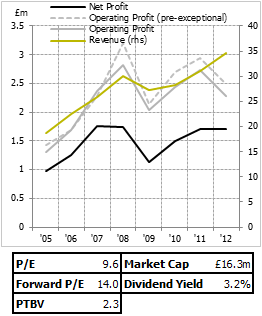 Hydro International (LON:HYD) are a company all about water; they design and retail (outsourcing manufacturing) a number of products aimed at the controlling or cleaning of water, and sell them around the world - though overwhelmingly in UK and US markets. Here's the quaintly named 'Hydro Town', if you fancy a more detailed idea of exactly what it is they provide; and there's a video on their homepage detailing a flood-prevention scheme in Glasgow which shows one of their products. At first glance, then, I surmise two things about the markets in which operate. Firstly; I suspect, rather like Yougov and unlike Vislink, that the recession has seen a significant slowdown in demand. Glasgow City Council commissioned the flood prevention project, and it looks like U.S. municipalities commission much of their work over there. Rightly or wrongly, centralised capex has been tightened quite considerably given the fiscal situation recently. The commercial sector isn't exactly brimming with confidence, either - corporates always defer investment when things get ropey, and the sort of products Hydro provide strike me as being distinctly 'long-term benefit' as opposed to short term cost cutting.
Over a decent time period, though, the company's been on the growth path - at least the last decade. The recession, while not plunging the company into the abyss of losses, saw what would probably be considered more of a stabilisation - net profits have centred around £1.6m for the last 6 years, in a reasonably tight band when it comes to the noisy world of earnings. The company is interesting from two perspectives, then. At first glance, if we were to look at a metric like EV/EBIT, the company is rather cheap indeed; the company has cash on book equivalent to about a quarter of its market cap, and a low level of borrowing. Net cash as of the interims was about £3m, though the cash figures are quite volatile. On the EBIT side of the equation, there's also a slightly favourable adjustment we can make. Much like last time, with Yougov - see the good discussion in the comments section about this, though - Hydro amortise some acquired assets at a cost of £0.2m on the income statement. I think this cost satisfies an accounting need but not an economic truth, so I exclude it. Either way - the EV/EBIT multiple is something like 5 on the basis I've outlined above.
I should say I don't think stripping cash out of the companies enterprise value is particularly wise here; cash should only be excluded if it's excess to the company's operational requirements - something I'm not sure is entirely true in Hydro's case. I can never be sure of that, and some of the cash probably is excess, but at least some seems to be required to satisfy seasonal working capital requirements. Timing differences can be punitive for small companies - their contracts are worth several millions.
Hydro is more interesting when viewed from the lens that, unsurprisingly, the company wants to be viewed with. From their annual report:
Hydro delivers high value-added products and supporting services to specialised global water markets where technology and application know-how provide the opportunity to generate growth and sustain high returns through strong competitive advantage. Markets typically have high barriers to entry and demand supported by long-term resilient growth drivers.
The company has historically earned a high return on capital, even through the recession, though the trend has been distinctly downward since 2008. To put it in perspective, if the company earned its average post tax return on capital over the last 9 years on its current capital base, assuming no finance costs - which is reasonable given the net cash vs. borrowings situation - we're looking at a earnings yield of something like 15.3%. That's clearly a good figure.
The problem, of course, is that the past doesn't always match the future. The company has just wrapped up a major project for Thames Water and, with no equal-sized project in the works, is predicting next year to be materially worse than this year in terms of revenues and profits. Given that I'd already noted that the company had been on a downward trajectory for the last 5 years on a returns basis, another year of decline virtually guaranteed isn't fantastic. The interims, which look good at first glance, are bolstered by the bringing forward of a major contract, and will just serve to make the second half figures even more depressed. The order book is up, though.
More fundamentally, I wonder what impact the group's distribution agreements will have. A lot of the company's revenue growth over the last few years seems to have come from its distribution agreements - where international partners sell their products in exchange for a cut. These are, by definition, lower margin - so the quality of that revenue is decreasing.
The group is motoring ahead, though; they note that admin expenses are £0.4m higher due to 'continued investment.. including new personnel', though also reflecting £0.2m of difference in government R&D grants. Perhaps the slowly improving confidence in the economy will time up nicely with their expanded asset and cost base; though the fiscal situation of the US and UK government seems like more of a longer-term problem, particularly given how heavily it's been thrust into the collective consciousness. Their international development might prove prudent.
I sort of missed the boat with this one - a couple of months ago, when the share price was 90p instead of 115p, I think the balance of risks was probably pretty good. My gut feeling is that the company will probably do quite well in the long term - their balance sheet is solid, their products and structure do seem to have some traction given their historic returns and the economic explanation for their slowdown is legitimate. I don't really want to buy at this level, though. I'd quite like to wait for the full-year results, which I think will be below market expectations, and reassess then. If I'm right about that last bit, the share price will look more attractive after.
Another for the watchlist.
Disclaimer
This is not financial advice. Our content is intended to be used and must be used for information and education purposes only. Please read our disclaimer and terms and conditions to understand our obligations.
No comments yet
No one has commented here yet! Why not be the first one?