In search of Quality and Value

Introduction
At the London Investor Show in October, I attended a discussion in which one of the speakers suggested, in what I thought was a rather dismissive and disparaging way, that artificial intelligence essentially delivers an average of the information available to it.
In my first attempt to start a discussion on the use of AI to complement other approaches to investment research, Ed commented that the "community have seen this sort of content before and have tended to complain about the discussion stream being spammed with templated AI-generated content".
Such comments make me wonder to what extent investors are underestimating what contemporary AI systems can achieve. People may say they "use AI" but how exactly do they use it?
The objectives of this post are, therefore, to:
- Explain what I think are the different levels of AI usage.
- Highlight the limitations of using conventional metrics to identifying quality companies trading at a fair price.
- Propose an evidence-based integrated system to address these limitations.
- Provide a foundation for discussion among like-minded practitioners.
AI Usage
If you use AI primarily to ask questions, obtain explanations or summarise information, its responses may indeed appear to reflect conventional wisdom. Ask it whether a company represents an attractive investment and you may receive a balanced account of the arguments for and against, followed by a suitably cautious conclusion.
There is nothing inherently wrong with this. Such responses can be useful, particularly when exploring an unfamiliar subject.
But they reveal only a fraction of what is possible.
What if the principal limitation isn’t the information available to AI, but the way in which people interact with it?
For example, it would seem this - which is based on an iterative dialogue:
You are an institutional strategy researcher reconstructing a public company’s management strategy from fresh public evidence.
This is independent discovery. Do not assume a pre-existing strategic framework. Search the web yourself. Prefer primary evidence: annual and interim reports, results presentations, investor-day material, official strategy pages, regulatory filings, management speeches/transcripts, capital-markets material and other company publications. Use high-quality external sources only when they materially add context or challenge management’s account.
...
is likely to produce a richer answer than trying to be too exact on the questions you want the agent to answer.
For the purposes of this post, five levels of practical AI competence are proposed:
- Level 1. Information retrieval and explanation. AI is treated primarily as an answer engine, capable of summarising existing knowledge and explaining unfamiliar concepts.
- Level 2. Interactive exploration. Rather than accepting the initial answer, the user asks follow-up questions, examines alternatives and begins to challenge the reasoning.
- Level 3. Collaborative problem discovery. AI helps the user understand and redefine the problem itself, uncovering assumptions and requirements that were not apparent at the outset.
- Level 4. Methodology development. The conversation produces structured, reusable artefacts, such as documented investment screening rules, which can be progressively refined and tested.
- Level 5. Integrated research systems. AI assists in extracting source evidence, structuring it as JSON, storing it in databases such as MongoDB, developing Python analysis and producing repeatable reports using Jinja2 templates.
These levels are not a measure of intelligence, nor do they imply that every investor should aspire to become a programmer. They describe increasingly sophisticated ways of using AI to support investment research.
The most important transition may be from treating AI as a source of answers to treating it as a partner in investigating questions whose answers—and sometimes even whose precise formulation—are not yet known. This is illustrated in Table 1.
Specification-first |
Discovery-first |
Define the structure in advance |
Begin with a research question |
Tell AI how to approach the problem |
Explore alternative approaches with AI |
Fit the findings into a pre-defined framework |
Develop a framework from the findings |
Revise the specification when necessary |
Let the specification evolve with understanding |
AI executes an established methodology |
AI helps develop the methodology itself |
Table 1: From Specification-first to Discovery-first use of AI
This transition requires relatively little technical knowledge because AI can undertake much of the technical work. The investor must nevertheless assess the assumptions, evidence and results.
It begins with a willingness to question the first answer, challenge assumptions and explore possibilities that were not anticipated when the conversation began.
Quality and Value
The Holy Grail for many investors is to:
- Identify quality companies with a sound balance sheet (see Figure 1) and appropriate governance structures.
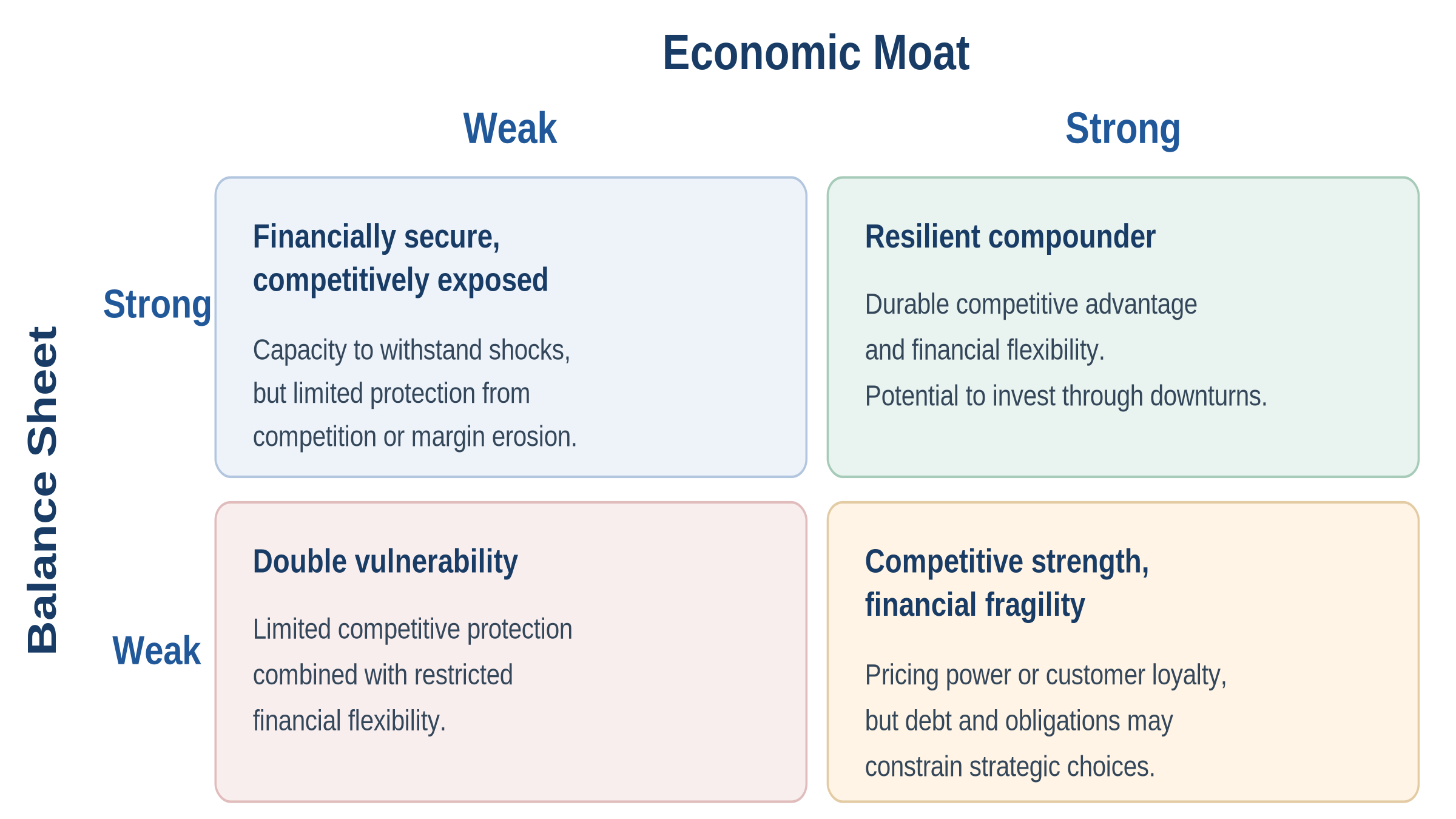
Figure 1: The relationship between Balance Sheet strength and an Economic Moat
- Selling at an attractive price.
- Hold for the long term.
The conventional approach to identifying such companies tends to be based on using financial measures to identify:
- Superior economic performance
- Performance consistency
- Financial resilience
- Favourable momentum
Value is generally based on a consideration of:
- Intrinsic economic value
- Current market valuation
- Prospective investment returns
The limitations of this approach are:
- Backward-looking evidence. Historical profitability, returns on capital, cash generation and financial resilience may provide evidence of quality, but cannot establish whether those characteristics will persist.
- Limited understanding of causality. Financial measures reveal economic outcomes without necessarily explaining the business activities, competitive advantages, strategic decisions and resource commitments responsible for them.
- Insufficient recognition of strategic change. Companies are dynamic systems. Management decisions, competitive responses, technological developments and changing market conditions can fundamentally alter their future economic characteristics.
- Dependence on uncertain forecasts. Estimates of intrinsic value and prospective returns depend on assumptions about future growth, profitability, capital requirements and discount rates. These assumptions may be internally consistent without being strategically plausible.
- Inadequate treatment of capital commitments. Conventional measures may not adequately capture the extent to which future cash generation is constrained by existing obligations, strategic investments, financing requirements or commitments that are difficult to reverse.
- False precision and correlated measures. Combining financial indicators into quality scores, or producing point estimates of intrinsic value, can create an impression of analytical rigour that exceeds the underlying evidence. Many indicators are also correlated, so combining them does not necessarily provide independent confirmation.
The deeper issue
There is a distinction between three questions:
Question |
Conventional approach |
Additional investigation required |
Is this a quality company? |
Has it demonstrated superior financial characteristics? |
What causes those characteristics, and are those causes sustainable? |
Is it attractively valued? |
Is its market price below estimated intrinsic value? |
Are the economic assumptions underpinning that valuation credible? |
Will it create shareholder value? |
Are prospective returns attractive? |
Can its strategy generate sufficient distributable cash after funding its commitments? |
This third question is particularly important. A company can possess an excellent business, report strong accounting profits and still pursue a strategy that destroys shareholder value.
Equally, a financially resilient company does not necessarily possess a durable competitive advantage.
An evidence-based approach
An evidence-based approach approach is proposed to address these limitations. Publicly available information is used to develop an integrated understanding of a company’s business, strategy and financial position by:
- Identifying its principal business activities, resources and capabilities.
- Inferring its strategy from those activities, management decisions and observable commitments.
- Assessing the strength and resilience of its balance sheet and governance structures.
- Examining the relationship between its strategy and financial resources.
- Evaluating how existing and prospective strategic commitments may affect future cash generation and financial flexibility.
- Synthesising the evidence to assess its capacity to create sustainable shareholder value.
Individual reports are created for each of these elements.
The complete workflow may be invoked with a single command for any listed company and runs in near real-time.
Developing an integrated research system
An integrated research system uses an “AI agent” supported by a framework that describes the architecture within which the AI agent operates
AI agents
An AI agent differs from a “bot”or “AI chatbot” in so far as it uses an AI model, tools, information and guidance to pursue objectives, make decisions and execute multistep tasks. Its value is it can represent a persistent research capability whose knowledge and methods increasingly exist independently of any particular AI model. That means the underlying model can be changed without abandoning the accumulated methodology.
It consists of a:
- Name which provides a recognisable identity and a consistent point of reference.
- Personality which establishes how the agent communicates, interacts and expresses itself.
- Role which defines its responsibilities, expertise and relationship with the user.
- Character which establishes its intellectual disposition: whether it is inquisitive, sceptical, imaginative, methodical or willing to challenge assumptions.
The Architectural Framework
The framework shown in Figure 2 describes the architecture within which the AI agent operates. It comprises the:
- Workflow
- Foundation components
- Outputs
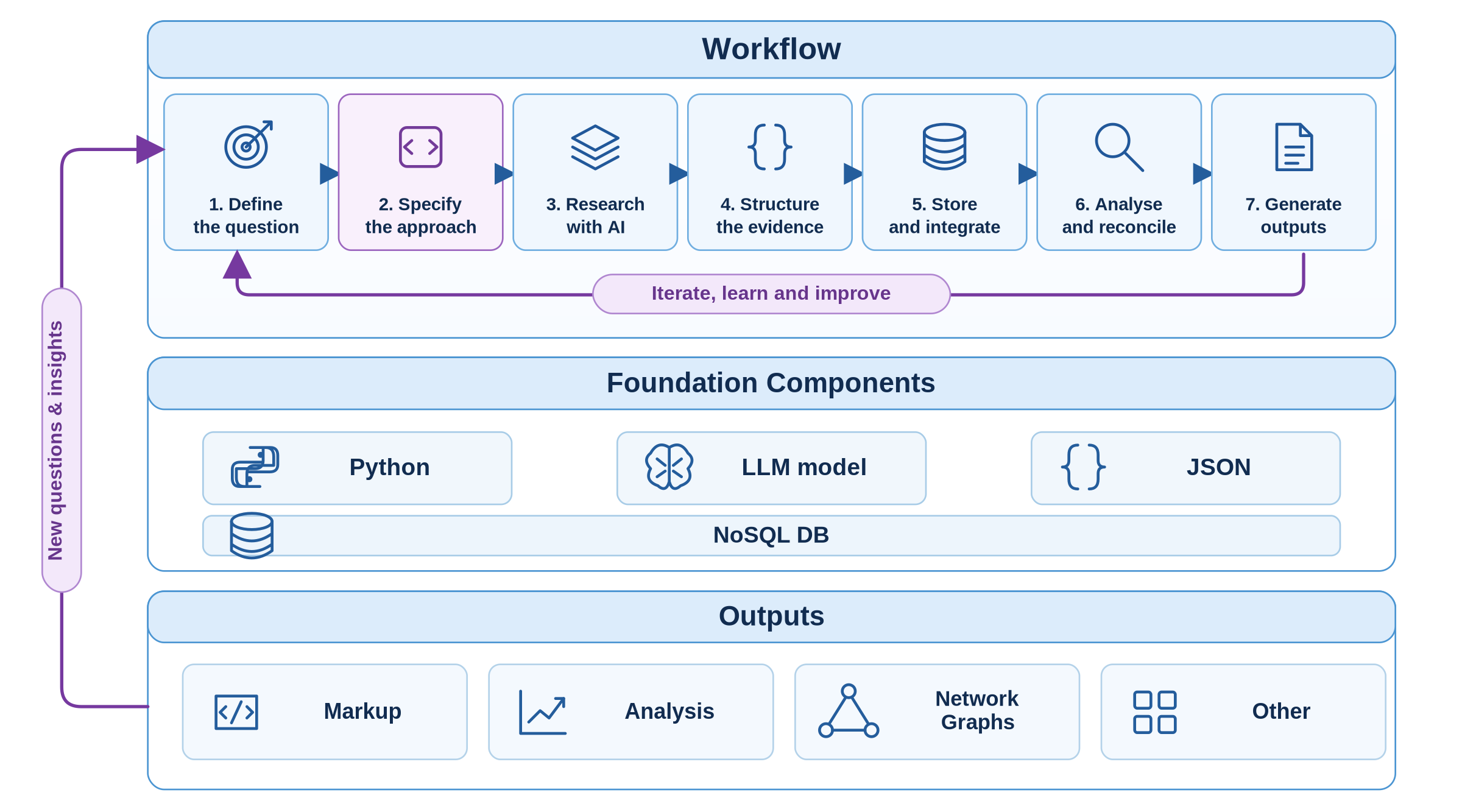
Figure 2: Integrated System Framework
- The question definition is embedded in a Python script.
- The Python script invokes an LLM to undertake research, drawing on its existing knowledge, contemporary publicly available evidence and, where appropriate, the results of previous investigations.
- The results are returned as a JSON object. This is a lightweight, structured, machine-readable format that allows results to be captured, preserved, exchanged and reused independently of the AI models, software tools and reporting systems that produce or consume them.
- These objects are stored in a NoSQL database. This offers a number of advantages:
- Flexibility. Different research artefacts can have different structures without requiring database tables to be re-designed.
- Extensibility. New research methodologies and JSON schemas can be introduced while retaining existing research.
- Integration:. Python and AI models can exchange structured research with MongoDB relatively easily.
- Persistence. Research findings survive individual AI conversations and can be reused.
- Synthesis. Research can be retrieve and combined from different collections to investigate relationships across a company’s activities, strategy and finances.
The content of the database can be used to:
- Generate reports based on markup languages.
- Perform analysis.
- Generate network graphs.
- Draw data into almost any analytical environment to, for example:
- Investigate dependencies, causal hypotheses, critical relationships and strategic vulnerabilities.
- Test relationships, identify trends and estimate uncertainty.
- Undertake classification, clustering, anomaly detection and prediction.
- Model uncertainty and dependencies between investment beliefs
- Investigate whether strategic actions actually influence financial outcomes
- Explore how business activities and strategic decisions behave under changing condition
Finally, chaining is supported. For example, part of the output from an Institutional Summary report for Qantas may identify these issues in relation to Project Sunrise.
What are the board-approved hurdle rate, maximum incremental cash exposure, payback period, adverse-case loss limit and expiry date and which commitments remain discretionary?
to which a provisional conclusion is
Project Sunrise is an approved and substantially committed strategic investment with a credible commercial rationale, but its publicly disclosed economics do not yet establish that it will create shareholder value.
Framework development
I found the best way to start developing this framework was to begin by learning how to work with an agent. For example, a conversation along these lines
You are an investment research collaborator called Athena.
Your role is to help me investigate companies, understand their business activities and strategies, and evaluate their ability to create shareholder value.
Be intellectually curious, rigorous, constructive and sceptical. Challenge my assumptions and your own conclusions.
We will develop a research framework together. It should encourage independent investigation rather than prescribe a fixed sequence of questions.
Begin by helping me investigate one company. Identify what we need to understand, propose an initial approach and explain what evidence would be required.
Distinguish established facts from interpretations and hypotheses. Where evidence is insufficient, say so.
We will review the results together and improve the framework as we learn.
provides a useful starting point.
As your experience develops, an agent can be used to help develop the technical infrastructure.
The purpose of this post is not to suggest that AI should replace established approaches to investment research, nor that investors should delegate investment decisions to AI.
Rather, it is to explore whether contemporary AI systems, when used within an evidence-based research framework, can help investors address questions that conventional investment metrics alone cannot satisfactorily answer.
I intend to illustrate the approach through investigations of individual companies and would be particularly interested in discussing the methodology, its limitations and how it might be improved.
Disclaimer
This is not financial advice. Our content is intended to be used and must be used for information and education purposes only. Please read our disclaimer and terms and conditions to understand our obligations.
8 comments
Hi
The structuring of 1. AI's role in the research ( institutional strategy researcher) 2. a specific job or task to undertake as this expert and 3. what you want it to assess or report on as a result of 1 & 2. is the approach I have been using. As a general approach not specific individual company research as yet.
The advantage of AI for me is you can then assess the results and ask follow up questions, much like an annoying customer that reads everything you write! It is this drilling down and gathering of information where AI is (for me) most useful.
Thanks Julian for all of the thought and effort you have put into this and then sharing it with us. It is much appreciated.
It is very useful and given me lots to think about.
David
Hi David
Thank you for your kind words. You're most welcome,
Please don't hesitate to reach out if I can be of any further help.
All the best
Julian
Hi Julian,
You've put a lot of thought into this.
Can I ask ...
What type of investor is this aimed at?
A Hunter who wants to know everything about the business?
or
A Farmer who knows that holding a basket stocks that scores highly on factors such as Q & V can outperform without the need to know about the business?
What is the expected output of this model?
Is it something that requires qualitative analysis (by a Hunter type investor) or is it more qualititative, e.g. a QV score?
My concern is ... if it's the former then many Hunters will not want to cede the analysis / decision making to an AI and if it's the latter ... we're on a site that provides factor based scoring for stocks.
For me as a Farmer, the questions you ask as laid out in the table in The Deeper issue section of your post are answered by Stockopedia's ranking systems.
Maybe I'm missing something?
Thanks
Phil
Hi Phil,
Many thanks for your comment. You raise some interesting and entirely legitimate questions.
The framework is aimed at the curious, but lazy, investor who is interested in answering the question “why?”. Not simply knowing that a company scores highly, but understanding why it does so and whether the underlying characteristics that justify that score are sustainable.
I think your points are well made.
Human judgement versus AI
The purpose of employing AI is to extend the scope and depth of the research available to the investor, not to abdicate responsibility for investment decisions. To me, human judgement remains paramount.
There is an important distinction between delegating research and delegating investment judgement.
Does Stockopedia already answer these questions?
I would question whether the questions I raise in The Deeper Issue section of my post are wholly answered by Stockopedia’s ranking systems.
For example, Stockopedia assigned Fever-Tree (Fevertree Drinks (LON:FEVR) a QualityRank of 95. The framework’s qualitative analysis painted a rather more nuanced picture.
This is not to suggest that Stockopedia’s QualityRank of 95 is wrong. Rather, the two approaches are seeking to answer somewhat different questions.
It seems to me that there is an important distinction between measuring quality and understanding its underlying causes and sustainability.
I think of Quality (Q) as company-driven and Value (V) as market-driven. Ultimately, what we are all trying to determine is whether, and under what circumstances, Q justifies V.
Governance
I am placing increasing emphasis on governance because historical financial performance does not necessarily provide us with a sufficient basis for judging whether those running the company, those reporting its performance and those holding them to account can be trusted.
The picture for Fever-Tree is particularly interesting.
The matrix distinguishes between the formulation of governance arrangements and their execution in practice. Having well-formulated governance arrangements is one thing; demonstrating their effectiveness is quite another.
I suspect much of this is difficult to capture through conventional financial metrics.
What is the expected output?
At this juncture, the intention is not to develop another factor-based scoring system.
Rather, it is to demonstrate to like-minded investors how to develop their own evidence-supported framework that can shed light on whatever interests them about a company. In my case this is::
Whether this approach can demonstrably improve investment returns is, of course, a question that remains to be answered.
I entirely recognise the legitimacy of your approach as a Farmer. Equally, there may be circumstances in which even a Farmer would find it useful to understand why a particular company scores highly and what might cause it to cease doing so.
In conclusion
I think of Stockopedia, along with platforms such as Simply Wall Street, as providing a valuable analytical skeleton. The intention behind the framework described in my post is to add flesh to the bones.
I see the two approaches as complementary rather than competing.
Knowing that a company has a high QualityRank is valuable. Understanding why it merits that ranking, whether the underlying characteristics are sustainable and whether that quality justifies its market valuation is, I would suggest, a different endeavour.
Many thanks again for prompting me to think further about this.
Hi Julian,
Many thanks for your thoughtful response and I can see how this would help an experienced Hunter.
Personally I think the vast majority of Jo Public are too busy managing their own life to even find a stock to be driven through an AI approach and then weighed before investing.
But I think it's good to formalise thinking for your own process and no doubt others will find it useful. I know codifying my approach in spreadsheets, etc. has really helped me to stay disciplined and saves me tons of time.
I wish you well in your endevaours.
ATB
Phil
Julian,
You have obviously expended considerable effort on this topic. Ultimately, investors need to make buy, hold and sell decisions rather than simply gather more information. How would you demonstrate that your approach improves those decisions rather than merely producing more extensive research? My concern is "paralysis by analysis," where even more information makes it harder, not easier, for the investor.
We have some evidence that Quality, Value and Momentum factors possess predictive power for future investment returns, despite their limitations. Does your framework have the potential to develop new factors that could be converted to scores and tested in a similar way?
Hi
Many thanks for your observations.
I wonder whether there is a distinction to be drawn between developing a better stock selection algorithm and developing a capability that improves the quality of investment judgement?
My interest is principally in the latter.
Whilst I recognise the evidence supporting the predictive power of Quality, Value and Momentum factors, I am not sure that the natural evolution of the framework I describe is necessarily to identify additional factors and convert them into scores.
Take governance, for example. The effectiveness of a company's governance arrangements, and the investment implications of any weaknesses identified, may be highly dependent on the nature of its business, its strategy and its financial commitments.
The absence of a readily quantifiable characteristic does not imply the absence of investment significance.
I think there is also a distinction to be drawn between the quality of an investment decision and its eventual outcome. Poorly considered investment decisions can produce excellent returns and well-considered investment decisions can produce disappointing returns.
What interests me is whether we can improve the intellectual rigour with which we arrive at those decisions, make explicit the assumptions upon which they depend and identify the circumstances under which we should reconsider them.
On the subject of paralysis by analysis, I would argue that the intention behind the framework is quite the opposite.
The challenge is not to generate more information but to discriminate between what is consequential and what is incidental to an investment decision.
An important feature of the framework is its ability to synthesise the underlying research and identify what I refer to as the decisive investment question. For example, for Oracle, this was:
Will Oracle’s contracted cloud demand generate risk-adjusted returns above lease, power, hardware, financing and dilution costs under credible downside assumptions for utilisation, customer concentration and termination rights?
If extensive research can be distilled into one or two questions, the answers to which materially influence a buy, hold or sell decision, I would suggest that we have reduced, rather than increased, the potential for paralysis by analysis.
As to demonstrating the effectiveness of the approach, one of the features of the framework is that it preserves the research, assumptions and investment judgements made at successive points in time. This provides a basis for subsequently examining not only the outcomes of our decisions but also the quality of the reasoning that informed them.
Whether this ultimately translates into superior investment returns remains an open and empirically testable question.
I am not necessarily looking for another factor that predicts investment returns. I am looking for a better basis upon which to exercise investment judgement.