Ingenta: software for the publishing industry

Many subscribers will have attended one of the Mello investor events. One of the highlights is always the BASH, where a panel of investors pitch ideas, and the rest of the panel gives their feedback. The audience votes on whether they are convinced by the investment case. In the last Mello in May, Damian Cannon, who is well-known to Stockopedia subscribers for hosting the Stockopedia Stockslams, presented a company I had never heard of, Ingenta (LON:ING) . This was unusual given that I thought I had a broad knowledge of most of the UK small caps. All of the BASH panel liked the idea, including me. However, the BASH audience was unconvinced, and most poll participants voted it an "avoid". Not to be one to be put off by the majority view, I bought some shares in the company after their recent results arrived and appeared to contain no nasties. But before making it a larger position, I wanted to see if the audience was on to something. Hence, I am writing this StockPitch article.
Summary
- Ingenta (LON:ING) is a micro-cap, AIM-listed software and IT services provider, mainly to the publishing and music industries.
- The company has a long history, having listed in 2000, but it is one of mixed success. In recent years, it has struggled to generate any topline growth. However, profitability has been transformed under the current CEO, Scott Winner.
- A P/E of around 9, which drops to around 7 adjusted for net cash, seems too cheap for a software business with around 80% recurring revenues. Broker Cavendish calculates a sector average of over 25x.
- The accounts are simple and conservative, and I found nothing to be concerned about in them. For example, the company expenses all of its R&D costs. The only adjustments they make are for FX and tax rates. However, the treatment of these adjustments by Stockopedia's data provider appears to have recently given the company a much lower Quality Rank than it deserves.
- The company has plans to grow the top line organically in the medium term. In addition, earnings-enhancing acquisitions may be on the cards. However, with the CEO and CFO owning almost no shares, there is considerable doubt about how much they believe their own words in this respect.
- The recent weak price action means that this won't appeal to Momentum investors. However, there appears to be no currently known fundamental reason behind this weakness, so the share price could easily recover as fast as it fell.
Profile
Ingenta (LON:ING) is an AIM-listed software business that provides tools and services to the publishing industry. Their clients include top publishers, such as Cambridge University Press, McGraw Hill and Penguin Random House, and more recently, music record labels such as Revolver.
Ingenta was founded by Mark Rowse in 1998 as a provider of online distribution technology for published scientific, professional and academic research. Ingenta Content hosts over 5 million articles and 16,000 publications from around 140 publishers and is accessed by over 25,000 institutions worldwide. Its acquisition strategy meant that Ingenta became an early leader in digital library platforms and associated services. Today, that market is served by Ingenta Edify, a custom-built hosting solution.
Martyn Rose became chairman in 1999, a position he still holds today, as well as over 28% of the shares. The company was listed on AIM in 2000 with a £120m market cap and, in the same year, acquired Publishers Communication Group, a marketing and sales consulting firm for the publishing industry. Rowse became a non-executive in 2007 following the reverse acquisition of VISTA International by Ingenta plc to form the current Ingenta business. In 2012, they changed their name to Publishing Technology before reclaiming the Ingenta name in 2016.
The company reports in two segments: Ingenta Commercial and Ingenta Content. This is how it describes these areas:
Ingenta Commercial
Ingenta Commercial provides a variety of modular publishing management systems for both print and digital products. Its core area of expertise is Intellectual Property management, including the associated contracts, rights and royalties, and we are looking to leverage this expertise by expanding into adjacent verticals. For example, we have already deployed our conChord solution, which is designed for the music industry, and we see further opportunities in other verticals where IP management is an increasing concern for customers.
Ingenta Content
The Ingenta Content suite of products enable publishers of any size, discipline or technical proficiency to convert, store, deliver and monetise digital content on the web.
The historical picture is slightly muddied by the company reporting in two extra segments up until 2023, but here are the recent revenue trends:
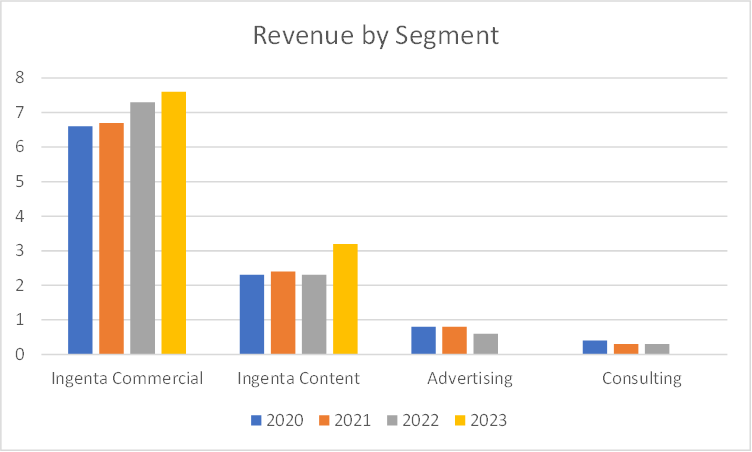
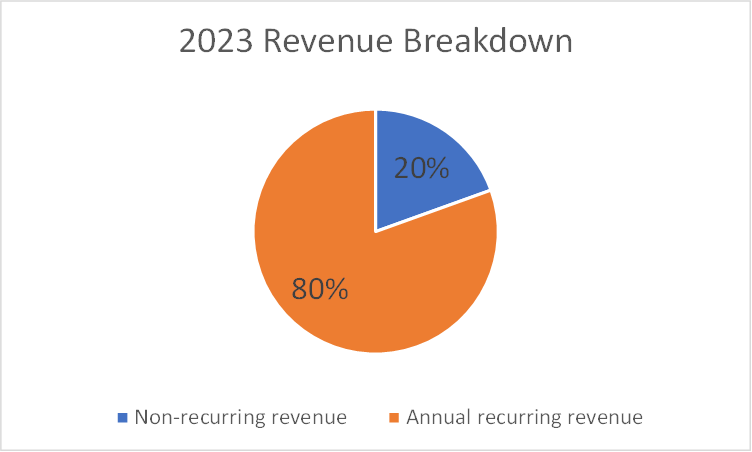
Advertising and Consulting are now split across the two current divisions, so a direct comparison is now difficult. In addition, both divisions also have recurring and non-recurring revenue streams, so thankfully, the company breaks this out separately. 80% of revenue in 2023 was recurring in nature, so this highlights that this company has stable and high-quality revenue streams:
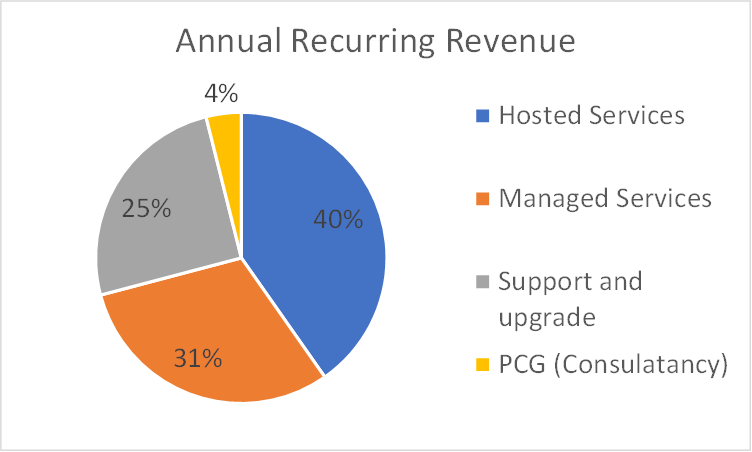
Here is how that 2023 recurring revenue breaks down further into the type of service offered:
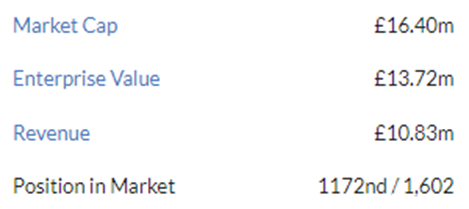
With revenue of around £11m and a market cap of around £16m, this company is a microcap:
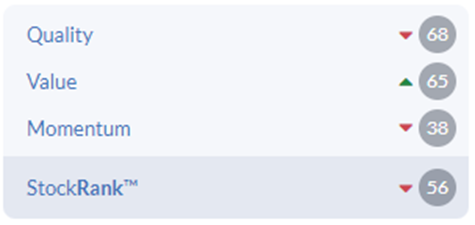
The StockRank is nothing to write home about, with a decidedly average 56:
However, this was a SuperStock at the start of this year:
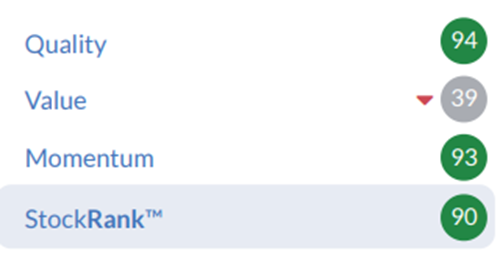
Nothing appears to have fundamentally changed with the business during this time, and the drop may be partly due to tax and FX effects on the reported figures, which affect how the algorithms judge the business's fundamental momentum.
The long-term chart shows a company that never lived up to initial expectations on listing:
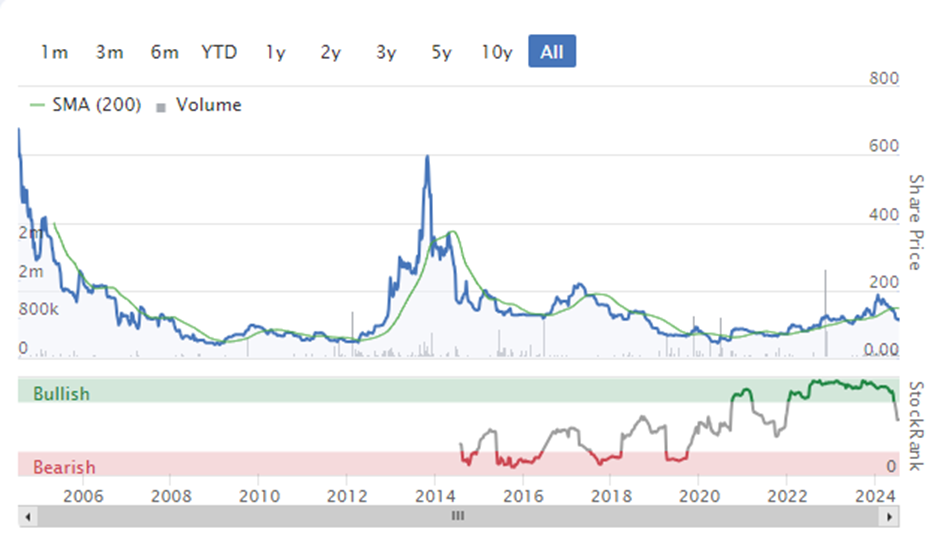
The share price in the early period partially reflects the initial disappointment of a dotcom float. Unlike many 2000 IPOs, this was a real business, although not unaffected by market conditions. Takeover speculation at the end of 2014 led to a spike up to 600p, but the company said they had not received any offer. They had taken on too much debt at this point, and a placing followed in 2015 at 120p per share. After a brief recovery, the shares fell back into losses:
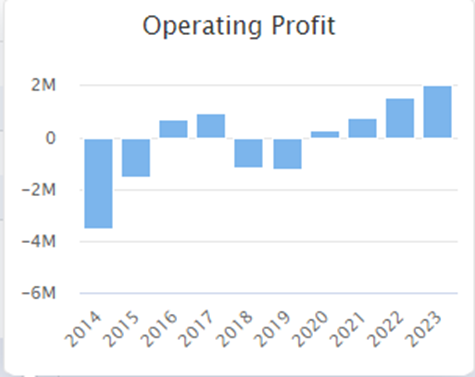
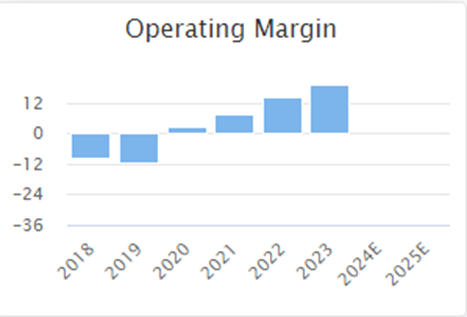
Current CEO Scott Winner was promoted to the position in 2018 and has led a significant turnaround in the business. However, this has been led through operational margin improvement, not sales growth:
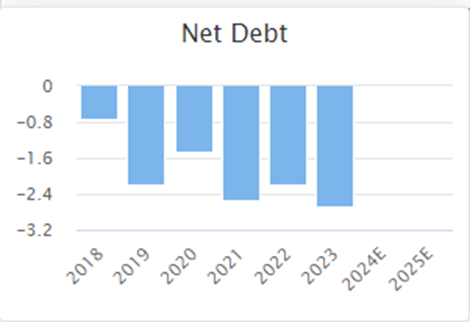
And a focus on cash flow, which has led to a net cash balance:
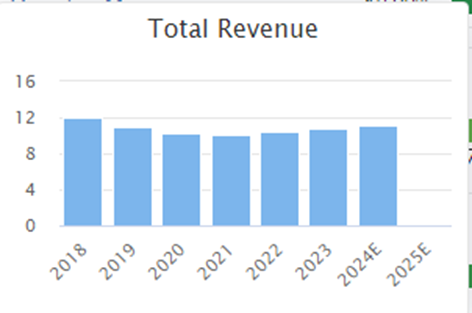
This has allowed them to retire 11% of the shares in 2022 via a tender offer at 115p. However, the topline has yet to return to see any growth:
Business Model
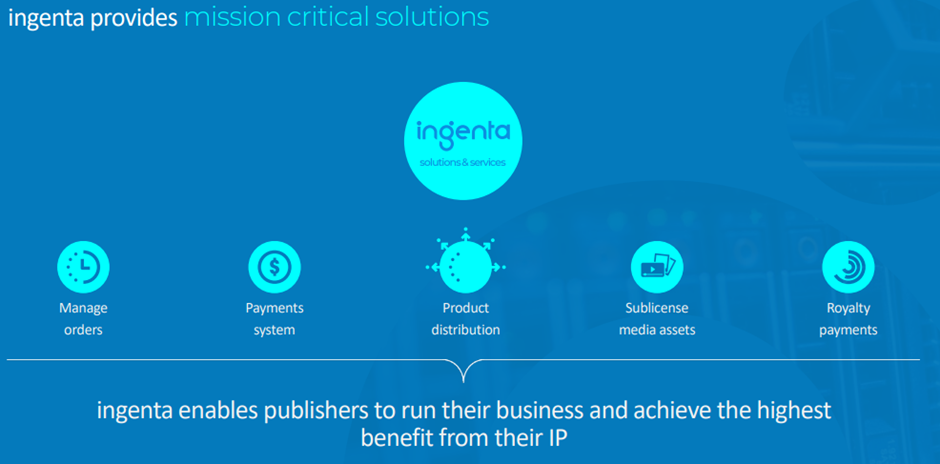
Ingenta aims to provide the tools and services that are vital for book and music publishers to sell and track their IP. They sell products in five areas:
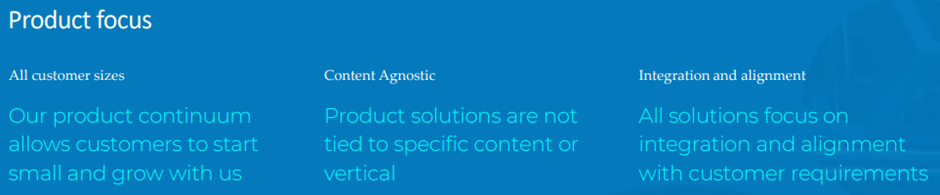
Their strategy is to make products that work for all customers and all types of products and seamlessly integrate with any other systems a customer may use:
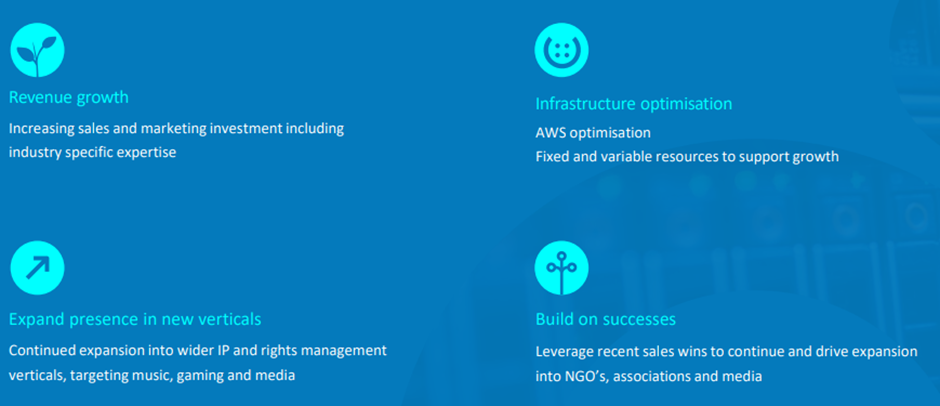
They believe that there is scope for their tools and services to be used by a wider customer base. They have recently targeted music publishers, branching out from their previous focus on book publishers. Gaming and media IP, as well as NGO content hosting, are also key target areas:
Competitive Advantage
The Quality Rank is okay but not outstanding:

However, the returns on capital here are great, suggesting that this business has a strong competitive advantage:
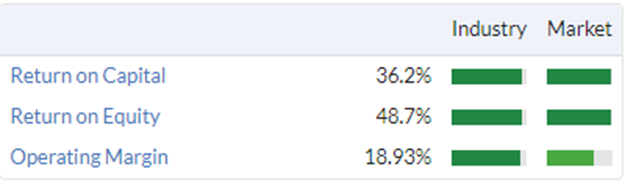
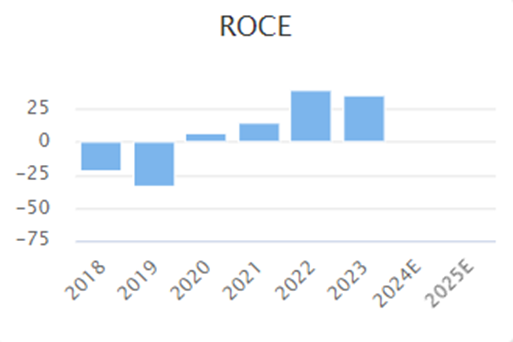
These figures are perhaps a little flattered by the treatment of adjustments by Stockopedia's data provider. However, these numbers are excellent even with more conservative adjustments, as the long-term trend shows:
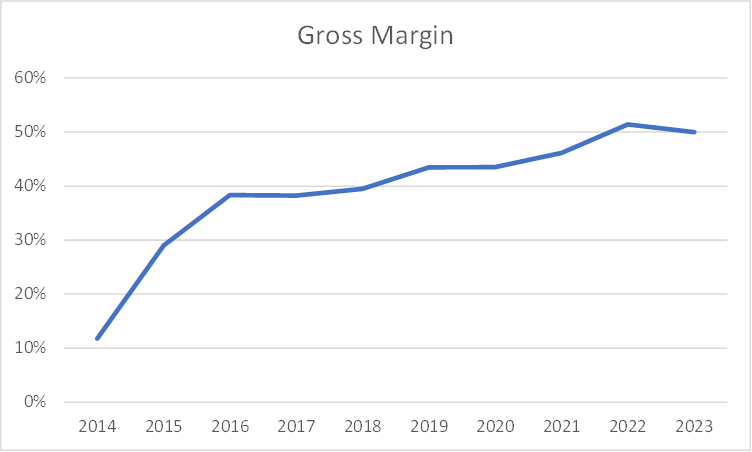
Another popular measure of whether a company has a moat is the gross margin since a high figure means a company can charge much more for its products or services than they cost to make. Here, the current figure of around 50% is good, but more importantly, this has been rising over time, suggesting they have been reinforcing their moat:
The Quality Rank is also let down by the low Piotrsoki F-Score, which stands at only 4/9:
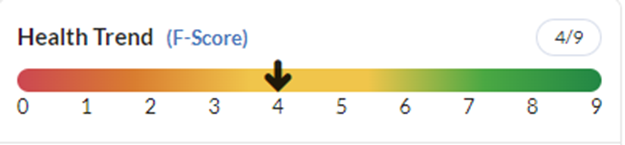
Let's go through the current five failures:

This fails because the cash flow return on assets is lower in 2023 than in 2022. This is driven by favourable working capital movements in 2022, which partially reversed in 2023.

This failure is because the tangible assets to equity ratio is not defined for 2023. This company has no debt in either 2022 or 2023, so debt should be considered stable here, and this failure looks anomalous.

Again, this appears to be a calculation failure. The company did not have to raise funds from shareholders during 2023.

This is valid. There was a small reduction in gross margin in 2023, but from 52% to 50%, it is relatively slight.

This appears to be driven by a minimal reduction in asset turnover, so again, it is valid but relatively minor.
The company also suffers from being flagged as a potential earnings manipulator:

This is due to the impact of one aspect of this measure:
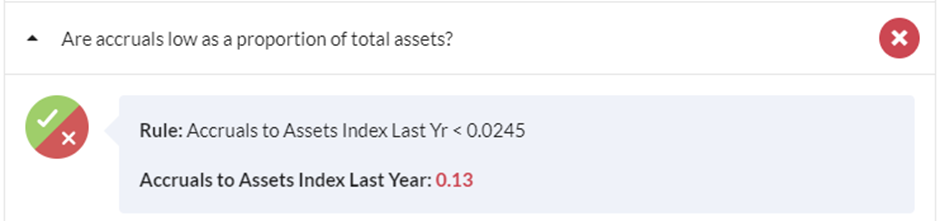
This is perhaps because the company has around £2m of contract liabilities. While this needs careful watching, it isn't unusual for companies to get paid upfront for recurring services or software licenses. These are some of the simplest accounts I have seen, and it seems unlikely that they are manipulating earnings.
One thing that may cause concern is that the company were required by auditors to restate their 2022 accounts due to inappropriately applying some of the accounting regulations. It seems they had recorded a provision for work they knew they needed to do to migrate some legacy software but had not yet been undertaken. However, this is not appropriate according to the accounting standards. The effect was to increase their PBT by £300k. So, while having to restate accounts is not ideal, it seems they were too cautious in their treatment of costs rather than too aggressive.
In short, this appears to be a much better quality company than the F-Score and M-Score are suggesting and hence, I wouldn't be surprised if the Quality Rank is back up in the top decile soon.
Financials
Growth and Profitability
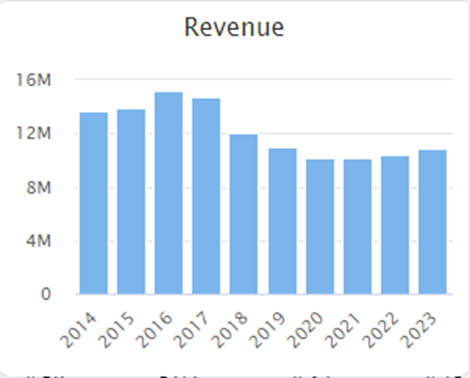
This is a company that hasn't even kept up with inflation in terms of sales growth. Stockopedia shows a 5-year CAGR of -2%. Although the company has grown slightly over the past few years, it is still a long way below previous highs:
However, normalised EPS is much healthier, with the StockReport showing a phenomenal 51% 5-year CAGR.
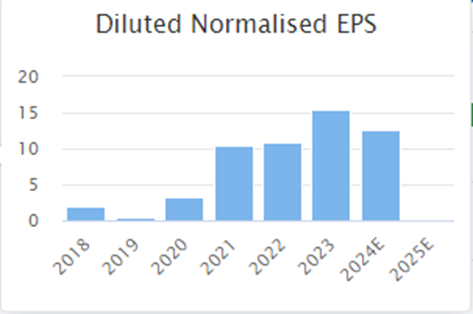
This isn't all smooth growth, though, and is flattered by the big jump in 2021, as the corporate turnaround gained traction:
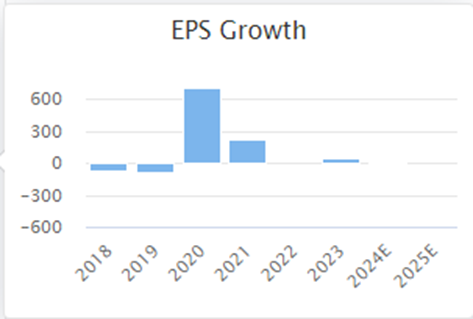
EPS is forecast to fall 18% in 2024. However, this is actually a function of how Stockopedia's data provider has made their adjustments. The company themselves adjust down their 2023 EPS for tax and foreign exchange movements:

Ingenta's house broker, Cavendish, has a 12.7p adjusted, fully diluted EPS forecast for 2024 versus 12.6p reported for 2023. This isn't going to excite any growth investors, but it means that a decline in the underlying performance of the business seems unlikely in 2024. Indeed, these forecasts may be conservative. In the recent results, the company said:
The performance in 2023, particularly within Ingenta Content, has increased our optimism for 2024. We have added to our growing base of NGO customers and made significant inroads into the North American market with a prestigious, globally recognised scientific publisher with whom we anticipate an active pipeline of future business. Ingenta Commercial is also building momentum as we continue to welcome more customers from across the globe onto our conChord music IP platform. To further exploit opportunities as they arise, the Group will aim to increase investment into its sales and marketing efforts, to accelerate revenue growth in 2024.
Balance Sheet
Although the current ratio is marked as amber here, 1.36 represents a perfectly reasonable value for this sort of business:
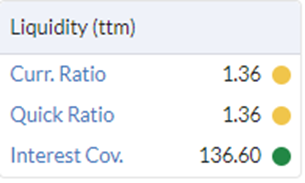
Software companies where licensing or hosting fees are paid in advance often have very low current ratios. For example, the UK accounting software giant Sage (LON:SGE) has a current ratio of 0.72. In light of the nature of the business, the balance sheet here looks pretty robust, with no signs of financial distress.
It is worth noting that this business has no tangible assets to speak of. So if the financial situation significantly deteriorates in the future or profitability plummets, there is little in the way of physical assets to protect the downside:

Strong cash generation and 80% recurring revenue make this possibility unlikely, though.
Cashflow
This is a high cash-generative business, with operating cash flow often exceeding normalised EPS:
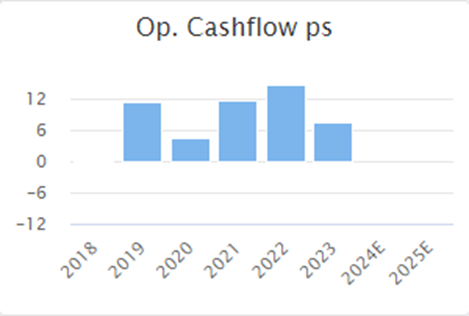
Timing of working capital requirements leads to some variability in cash flow, which is why 2023 was less impressive after a great 2022.
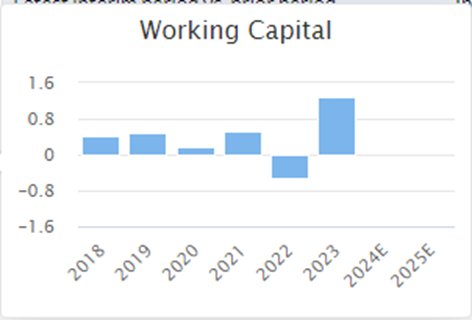
But ultimately, these are relatively small compared to revenue. In addition, capex requirements are very light:
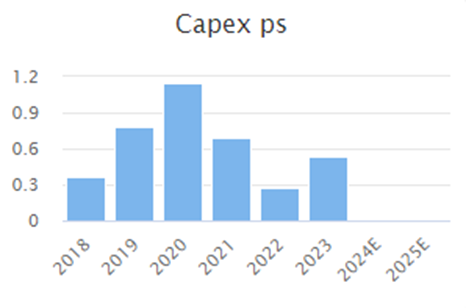
This means that the majority of operating cashflow becomes free cash flow:
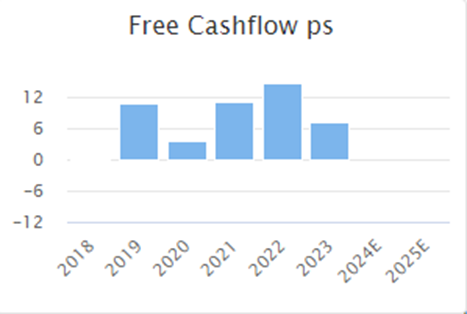
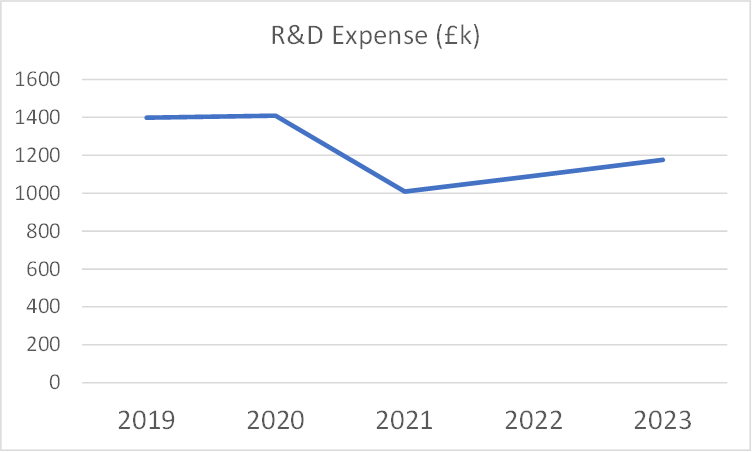
However, it is worth noting that the company doesn't capitalise any intangibles, such as software development. This reflects the highly conservative nature of the accounting here. Last year they expensed around £1.2m of R&D costs. This may flatter profits and cash flow if these are reduced suddenly. However, In this case, these figures look consistent with the last few years:
Stockopedia rates the P/FCF of 15.6 as green against the Software and IT Services sector and amber against the market:

Again, this will appear better in a year without significant working capital flows.
Dividends/Buybacks
After a long break, the company started paying dividends again in 2017. First annually, and then bi-annually in 2021:
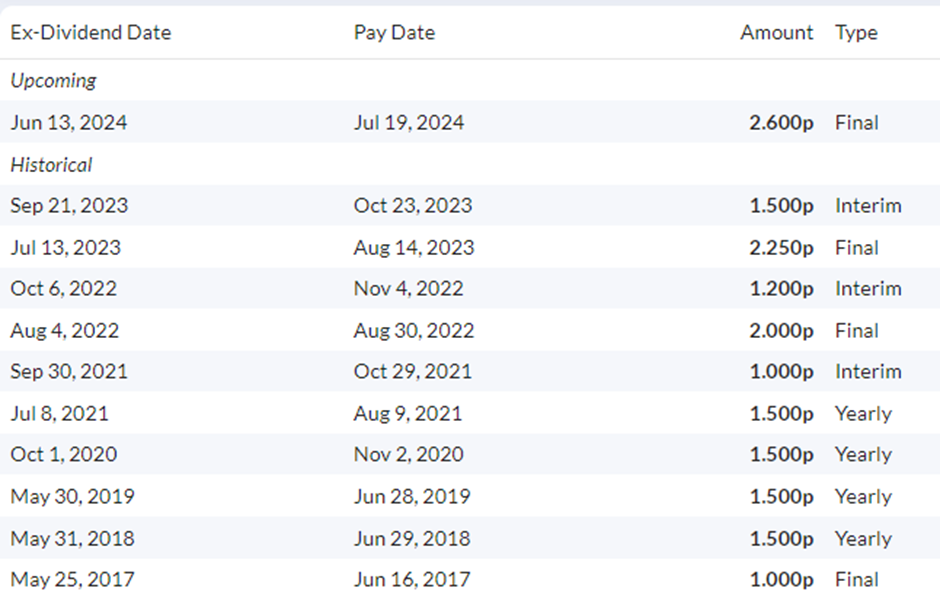
This has been increased recently but still only represents a relatively low yield for such a cash-generative stock (although, again, not bad for its sector):

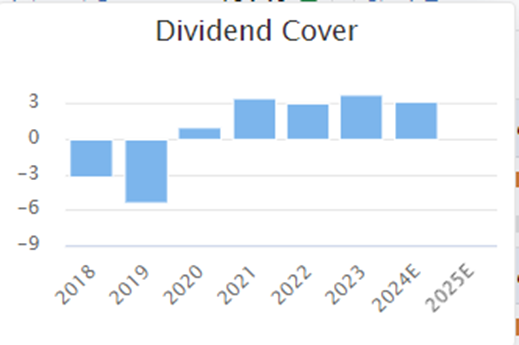
The dividend has been well-covered over the last few years and should be maintained, if not increased:
Instead, management has chosen to require shares via buybacks and a tender offer. They conducted on-market purchases of shares in 2019, 2020 and 2021. In 2022, they tendered for 11% of the shares at 115p per share, which was significantly over-subscribed. After a long break, buybacks appear to have resumed this month, with 25k shares purchased at 114p per share. Apart from the tender offer, I can't help feeling that management has been a bit lacklustre in this regard, given the lowly rating of the shares. They may be holding back due to the possibility of making an acquisition. In their recent results, they said:
The Board will also consider future earnings accretive acquisitions to accelerate growth in new or existing verticals.
Ownership Structure
There are two major shareholders. Chairman Martyn Rose has over 28%, and investment fund Kestrel Partners, who are represented on the Board by Sebastian White, hold over 22% of the shares:
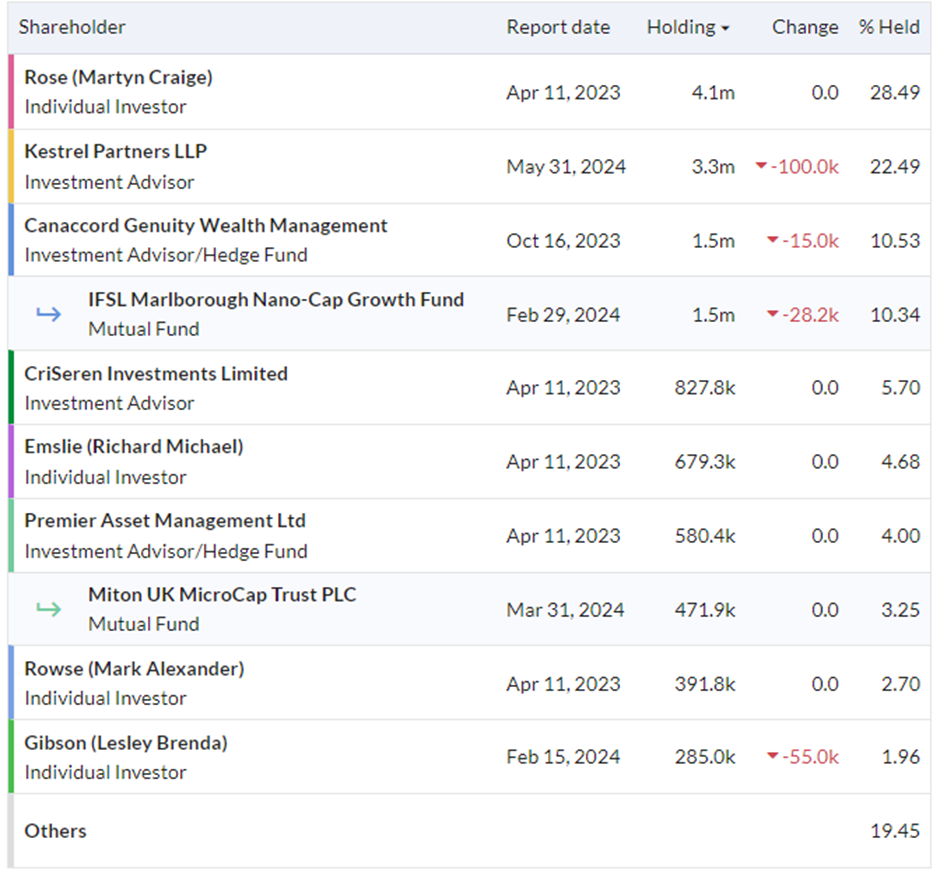
This means that these two shareholders can control the destiny of the business. They are not a concert party, so there should be no risk of delisting. However, they can block unwanted interest from private equity or others in the industry. Founder Mark Rowse still holds around 3% of the shares, but it is notable that no other directors hold meaningful stakes in the business:
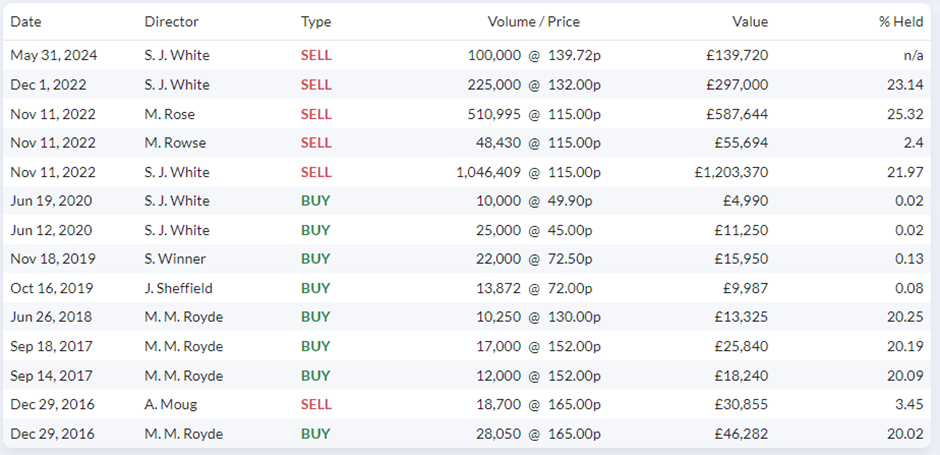
Kestrel Partners have been selling on behalf of clients, so this isn't particularly notable. However, Kestrel, Rose and Rowse all sold shares in the 2022 tender offer. The CFO & CEO have bought shares once and in insignificant amounts. No doubt, they would argue that their options align their interests with shareholders, but if they really thought this was a great investment, they would be willing to put their own money in, too.
Valuation
The company is very cheaply rated on a number of metrics:
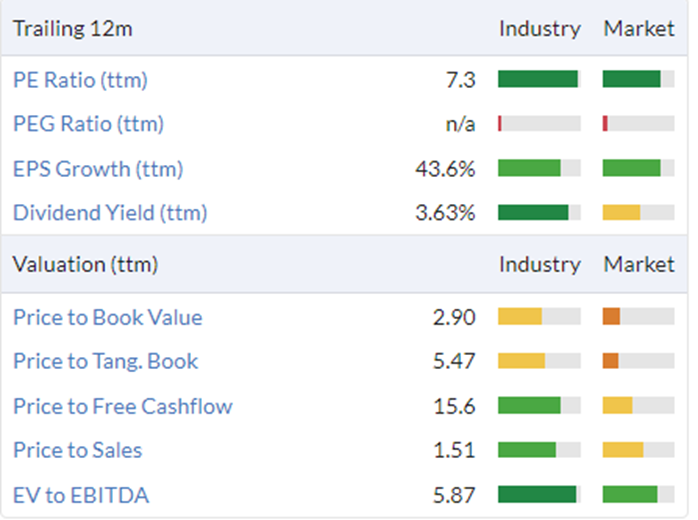
However, the P/E of 7.3 is a function of the adjustments made by Stockopedia's data provider and that there is only one year's worth of forecasts in the market. The forward P/E of 8.9 is probably the better figure to take. Although, this adjusts down to 7.4 when the net cash is taken into account.
As already described, this is not a tangible book value play, so this provides little downside protection. This seems to cost the company a higher rating for its Value Rank, which is nothing special:

Despite this, a cash-adjusted P/E of 7.4 would seem too low for a business with such significant recurring revenues. Their broker, Cavendish, notes that the sector trades on 26.5x earnings. There are reasons why this may be a little optimistic, given the lack of recent topline growth. However, it does highlight how cheaply the market currently rates this company.
Risks
The company is serving industries facing challenges. Digital assets are now as important as physical ones. While Ingentas products may actually benefit from the trends as they enable the tacking of royalties across all platforms, an industry in flux may be reluctant to invest.
Ingenta itself is relatively small. They say that customers like to pick best-in-class software modules and demand interoperability. However, if a large software house made similar tools available for free or engaged in an aggressive price-competitive strategy, Ingenta may end up being a loser, even if it had the best product.
The company has focussed on the music industry as a key growth area, yet the number of clients they have in this area is relatively small. This may indicate the length of time that it takes to make sales in this industry, but it could also indicate a lack of demand.
Recent Trading
This is how the company describes their current trading in their final results released at the end of May:
· Ongoing implementations on track, with two further Ingenta Content go lives in Q1 2024.
· Strong pipeline of project work being built for later in the year.
· Trading in line with expectations with our focus on delivering sales growth.
They go on to give some more details on these additional Ingenta Content projects:
Annual revenue increased strongly from £2.6m to £3.2m, driven by £0.5m of new customer implementation revenues. Of the implementation work, two customers went live in the year with the remainder scheduled for 2024. These projects are anticipated to yield ongoing annual recurring revenues of £0.5m.
These amounts are not huge but add to the increasing recurring revenue streams. Overall, it sounds like things are shaping up well, but any growth will come in H2 if it arrives in the current year. Increasing sales activity seems to be a key focus:
To further exploit opportunities as they arise, the Group will aim to increase investment into its sales and marketing efforts, to accelerate revenue growth in 2024.
However, they also say there are some delays in hiring:
Adjusted EBITDA was £2.2m (2022 restated: £2.3m), which was higher than budget as we delayed staff hiring because of the difficulty of finding suitable candidates, particularly in sales. Our current plan is to engage third-party consultants, especially for strategic sales positions.
Paradoxically, this may actually lead to better short-term profitability. However, the market is unlikely to re-rate the company unless sales growth is achieved, and this may be delayed by the lack of suitable candidates.
Sentiment
The Momentum Rank is fairly poor:

A lot of this is down to the weakness in the share price over the last six months:
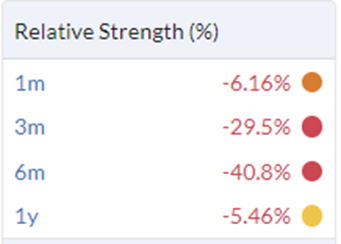
While there has been no getting around the poor share price performance recently, This seems to be unrelated to any fundamental change in the business. The broker consensus is largely flat, apart from a minor change due to tax effects:
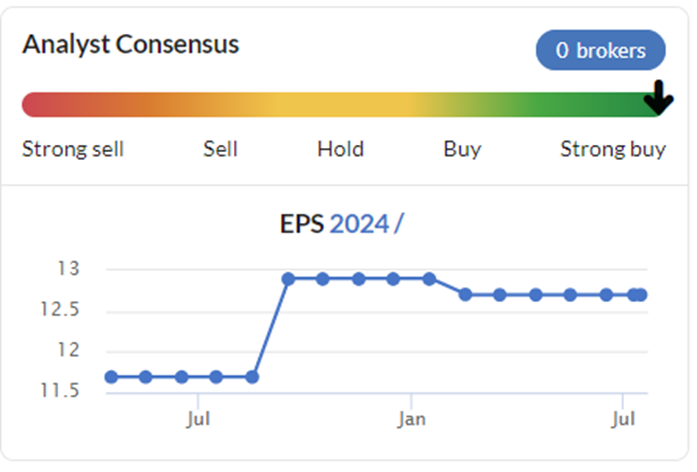
It is also possible that the algorithms are picking up the unadjusted figures for 2022 and making the fundamental trend look weaker than it actually is. Either way, given the weak share price, this isn't going to appeal to momentum investors. However, when the share price was stronger at the beginning of the year, the same fundamental trends gave the business a Momentum rank of 93. So, momentum investors may well be buyers again in the future. However, cautious investors may want to wait for upcoming 24H1 results or the share price to show some strength before investing.
Conclusion
Famous Value investor Mohnish Pabrai says he likes to look for what he calls Dhando investments. He describes these as:
Heads, I win! Tails, I don't lose that much!
This strikes me as such an investment. The conservative accounting and balance sheet strength makes this a low-risk bet. Over the long term, it would seem difficult to lose money in a company trading on a cash-adjusted P/E of around 7, which has 80% recurring revenue streams. However, if they can drive faster topline growth, a re-rating closer to sector averages would see significant gains.
It is not a perfect stock. For example, the management has been in a position for a long time, and the CEO and CFO hold hardly any shares. This casts doubt on how achievable that topline growth will be. In addition, the shares have been inexplicably weak since the company released their in-line final results. This suggests that some kind of overhang may be weighing on the short-term share price. Or, it may be that the market fears that current market forecasts are unachievable. The company is relatively tightly held, and there is likely to be an opportunity cost for holders here, particularly for wealthier investors who may not be able to exit easily if a profits warning or a better opportunity comes along. I intend to go to the AGM to discuss some of these concerns with management.
[Disclosure: Mark owns shares in Ingenta (LON:ING) ]
Disclaimer
This is not financial advice. Our content is intended to be used and must be used for information and education purposes only. Please read our disclaimer and terms and conditions to understand our obligations.
10 comments
Any thoughts following the September H1 figures? There seems to have been a reduction in income across all activities and it seems that spare technical resource has been added to the sales effort (which is sensible). But there seems little to support Martyn Rose's optimism other than a couple of recent sales.
Thanks for this - a great introduction into Ingenta! I had also not heard about it until now....
Thanks for the hat-tip Mark. You've put in a lot of work here and covered all of the quantitative angles very nicely. A few more qualitative things that I might mention:
1 - The price spike in Dec/Jan was down to Ed featuring Ingenta (LON:ING) as one his NAP picks. Being illiquid and small the shares went on a bit of ride and have been drifting back down to historical levels ever since.
2 - Having listened to the meeting recordings on IMC and taken part in some recent Zoom calls I think future growth is all about penetrating additional verticals such as music, film and gaming. Management have been talking about this for quite a few years now though with not much to show for their efforts.
3 - The publishing side of the business is pretty much a cash-cow at the moment with little growth likely. There may also be some exposure to historical fixed-price or perpetual contracts but I don't have any more detail. Perhaps they are negligible given the quantum of recurring revenue?
4 - The balance sheet is good and the accounts are pretty clean with no debt. They also have something like £20m of tax losses to use up which will help support EPS for quite a few years to come. On this front the directors have done well with their focus on efficiency and cost-cutting.
On the whole I agree with your conclusion that this is a stable business with real upside potential. I am however unsure whether the current management can deliver that growth as they seem to be targeting many different customer bases in the hope that something sticks. Maybe it will but I would prefer it if they offered a solution that customers are desperate to have rather then being in the position of having to sell hard just to get anywhere.
Fantastic in depth analysis. I assume it's a niche software with limited competition
One of the key lessons I learned in business was to sell to companies with big revenues and profits. Publishing is not where I’d expect to find those.
Ingenta (LON:ING)
Held this for a while but did not really understand why it suddenly almost doubled to £2 and exited my position . Definitely not going to get involved again ; very illiquid with no growth prospects and a rather grey area on their accounts lately.
Not going to go bust but increasing their revenues from £10.5m to £11m in 4 years it looks to me that this is another pointless listing in the UK market.
All the best
One only has to look at Bloomsbury Publishing (LON:BMY) to see that there are some highly growing, highly profitable publishers...
There's a whole bunch of publishers making hay at the moment, with the revival of books led by the romance fantasy genre...
Great article.
You say they don't have many customers. That sounds like a major risk to me. Do you have any more details on how many they have and what their customer concentration is like?
Thanks Mark, a great write up. It seems a nice business at a (very!) fair price but I wonder if the markets they service are simply too small. I also wonder whether to address distinct verticals they need to do a lot of bespoke work, indeed possibly at a client by client level? In the payments businesses I’ve worked in we had a business with similar integrated/recurring revenues with clients across a variety of verticals, but we seemed to bump into these customers and built to win the client rather than having a well developed vertical focus with a product and sales plan adequate to generate sustained growth. I’ll certainly look more deeply at this as it looks a great little business.
thanks again
Jonny
Thank you for all the effort put into this. Although this might be a good time to buy in there may not be as great an upside as in other options.