International SIF: Wins, losses + the surprising impact of exchange rates

“Where did all the growth stocks go?” Editor Ben Hobson’s feature last week on growth strategies for subdued markets really resonated with me.
As I’ve commented before, my SIF strategy has really struggled in recent months. At one point, only one UK share passed all of my screening rules. Ben’s piece explains why many of the Guru growth strategies followed by Stockopedia have performed poorly in recent months, becoming unusually concentrated in just a few stocks.
I’m happy to be in such respected company. But there are signs of improvements. My screening results are gradually expanding. Unfortunately there still aren’t any stocks I can consider buying.
Instead, I’ve decided to bring forward this month’s coverage of my International SIF. This is a model portfolio that’s attempting to replicate the success of the UK SIF by investing overseas. So far, results have been poor. But I’m refining the portfolio’s geographical allocation and hoping to see some better results going forward.
This week I’m going to look at stocks due to be sold from the International SIF. I’m also going to revisit previous results to see how exchange rates have affected my returns so far. The figures may surprise you. They did me.
Stocks on the block
My trading rules for the International SIF mean that I buy and sell stocks in alternate months. February was a buying month, so March is a selling month. This means that I must review stocks held for 10 months or more. Four companies meet this criteria:
Ence Energia Y Celulosa SA (MCE:ENC) - The Spanish pulp mill operator has been a winner for me over the last year. Should I keep holding?
Tianneng Power International (HKG:819) - This Hong Kong-listed battery maker has been a poor buy. But a StockRank of 98 suggests things could improve.
Mytilineos Holdings SA (ATH:MYTIL) - A Greek industrial conglomerate with a broad range of interests.
Keller Group (LON:KLR) - This FTSE 250-listed groundworks specialist seemed like a good buy to me, but has fallen prey to classic sector problems.
Ence Energia Y Celulosa SA (MCE:ENC)
This £1.3bn pulp mill operator appears to have issued a strong set of annual figures recently. According to Thomson Reuters, net profit rose by 41pc to €129.1m in 2018. Sales climbed 12.5pc to €832m, so it looks like the group’s profit margins improved considerably.
At the time of writing, these figures hadn’t been uploaded to Stockopedia’s data feed, which was still showing the TTM figure for the period to 30 June 2018. But the full-year numbers do appear to be in line with consensus forecasts. Happily, 2019 forecasts suggest continued growth:
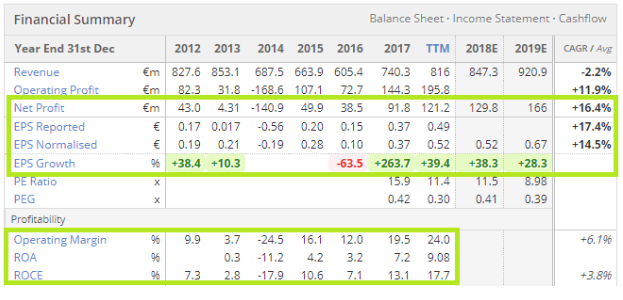
This snapshot shows an impressive trend of rising profits and increased profitability.
This stock still passes all of my screening tests, so will remain in the International SIF for at least two more months. I’m happy to keep holding.
Verdict: Hold
Price return to date: +9pc
Tianneng Power International (HKG:819)
Shares in this Chinese battery maker fell by about 30pc at the start of September 2018, despite posting half-year figures in August which appeared to show an increase in sales and earnings.
One reason for this may be that the business is being rated for a structural decline. Broker Nomura downgraded Tianneng in September, citing the group’s retreat from the lithium battery business.
The company has historically focused on lead acid batteries, which are the kind traditionally used in cars. But modern electric vehicles and most rechargeable devices use lithium batteries and it seems fair to assume that this is where the best growth opportunities lie.
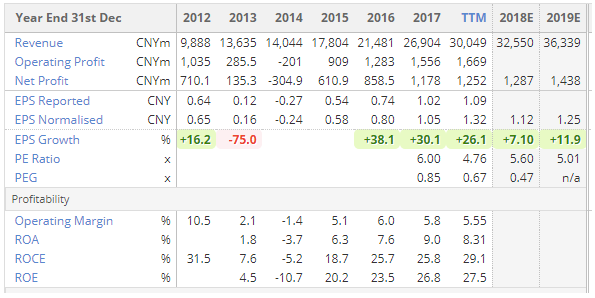
The stock’s financial summary shows attractive profit growth and high returns on capital:
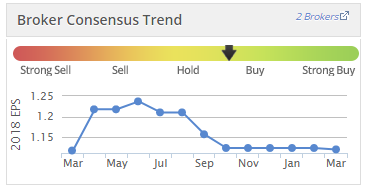
But the broker consensus trend is poor and the number of brokers covering the stock has fallen to two. This breaches my screening requirement for three estimates, which I use as a hedge against my ignorance of foreign markets.
As a result, Tianneng Power International has been sold from the International SIF for a thumping loss.
Verdict: Sell
Price return: -31pc
Mytilineos Holdings SA (ATH:MYTIL)
This Greek industrial group has interests including aluminium, defence and renewable energy. Figures published in November for the first nine months of 2018 appear to show a 23pc rise in EBITDA, with a 6pc rise in revenue.
Analysts expect modest earnings growth for 2018 and 2019, but no figures have yet been published for FY18.
Understanding the outlook for such a complex foreign group is way beyond my remit here. What I do know is that a poor share price performance over the last year has left Mytilineos Holdings with a negative one-year relative strength score. As a result, it no longer passes all of my screening tests and has been sold.
Verdict: Sell
Price return: -15pc
Keller Group (LON:KLR)
Groundworks specialist Keller has cost me real money, thanks to the 36pc loss it delivered for the UK SIF folio, where I invest some of my own cash.
Unfortunately the result for the International SIF is even worse. I won’t revisit this story here. You can read my original coverage of the firm’s October 2018 profit warning here and my UK SIF sale report here.
In short, the lesson learned is that despite the group’s undoubted technical strengths, it’s not immune to classic construction sector problems.
Last week’s full-year results contained no new surprises and gave the stock a welcome pop. But the shares fail my screening tests on multiple counts. I’m happy to sell.
Verdict: Sell
Price return: -42pc
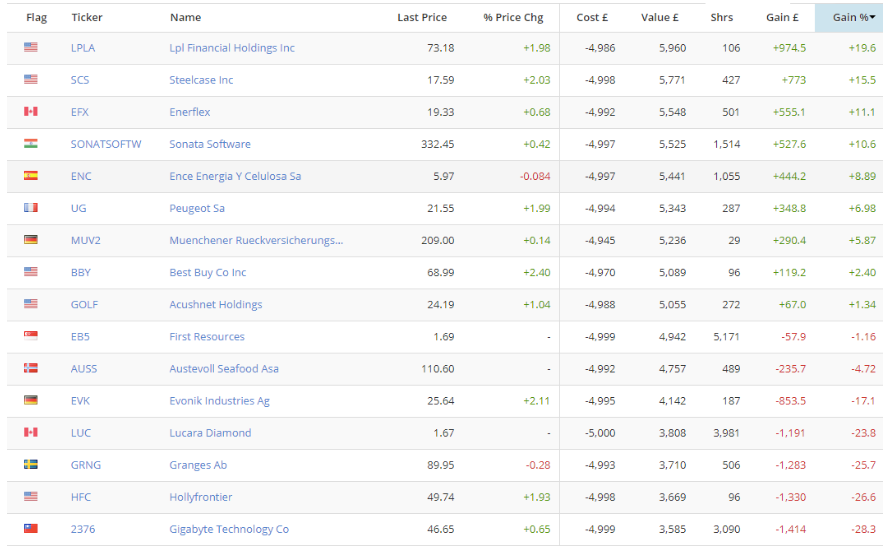
Here’s how the International SIF looks following this month’s changes. I’m pleased to have cut some of the worst losers and to have a growing body of stocks showing profits. Let’s hope it continues!
How have currency movements affected results?
The quality of reader comments on Stockopedia is superior to anything I’ve come across elsewhere. I’m continually grateful for it, and it’s one of the highlights of writing on these pages.
The final part of this article was prompted by just such a comment from Howard Adams on last month’s International SIF piece. Howard reminded us that currency movements can deliver profits and losses, even if the underlying shares are flat.
He asked how this had affected my results so far. I had to admit that I didn’t know, but luckily I did have the numbers I needed to revisit this.
This table shows all the stocks that have been bought and sold in the International SIF to date. The return from each stock is shown in GBP and in the stock’s native currency. The final column shows the gain or loss resulting from the foreign exchange effect:
Company | Ticker | Profit/loss GBP | Profit/loss excl. FX | FX effect* |
JAFCO Co | TYO:8595 | -29.7pc | -33.6pc | 3.9pc |
Gazprom Neft PAO | LON:GAZ | 13.0pc | 11.6pc | 1.4pc |
Faurecia SA | EPA:EO | -22.8pc | -23.1pc | 0.2pc |
Konecranes Abp | HEL:KCR | -17.1pc | -17.4pc | 0.2pc |
Sandfire Resources NL | ASX:SFR | 3.8pc | 4.1pc | -0.4pc |
International Consolidated Airlines | LON:IAG | -2.0pc | -2.0pc | 0pc |
Derichebourg SA | EPA:DBG | -54.7pc | -55.4pc | 0.7pc |
Federated Investors Inc | NYQ:FII | -24.6pc | -31.7pc | 7.1pc |
China resources Cement Holdings | HKG:1313 | 50.6pc | 48.4pc | 2.2pc |
Inghams | ASX:ING | 13.5pc | 14.9pc | -1.4pc |
Globaltrans Investment | LON:GLTR | -3.2pc | 9.7pc | 6.5pc |
Kohl’s Corporation | NYQ:KSS | 18.7pc | 8.9pc | 9.8pc |
Leopalace21 Corporation | TYO:8848 | -37.4pc | -40.4pc | 3.0pc |
Foster Electric Co | TYO:6794 | -43.9pc | -46.6pc | 2.7pc |
Tianneng Power International | HKG:819 | -31.4pc | 35.1pc | 3.7pc |
Mytilineos Holdings | ATH:MYTIL | -14.8pc | -13.4pc | -1.4pc |
Keller Group | LON:KLR | -41.6pc | -41.6pc | 0pc |
Average: | -13.1pc | -15.4pc | 2.3pc |
*A positive number means an FX gain for UK investors
It seems that exchange rates have mostly moved in my favour, adding an average of 2.3pc to each result. Unfortunately this means that the underlying performance of the stocks I’ve chosen has been even worse than the portfolio’s results suggest.
Over longer periods, I’d expect FX gains and losses to even out. But these figures make it clear that if you get on the wrong end of a big currency trend or devaluation, even a good investment could be derailed.
This is one reason why I prefer to invest in UK stocks. Big companies that trade internationally usually have treasury departments to manage their currency exposure. By investing in their stock, I get the benefit of these efforts. If I invest directly overseas myself, I don’t get this protection.
As always, I’d welcome your thoughts on this. Have you had bad (or good) experiences with overseas investments?
Disclaimer
This is not financial advice. Our content is intended to be used and must be used for information and education purposes only. Please read our disclaimer and terms and conditions to understand our obligations.

4 comments
(HKG:819)
How would you read into the latest allegations against Tianneng Power International?
https://www.yicaiglobal.com/news/china-tianneng-power-rejects-fraud-claims-says-it-will-see-short-seller-in-court
I have close to 100% return on the stock, numbers still look solid, but with all creative accounting going on (Wirecard, Luckin Coffee etc), you get reluctant to hold onto such "winners". It has recovered since the news but I'm not sure if you should put any weight into that. Just curious how others would read into it.
Sell..Trim..Hold:)
Thanks for the article Roland. Very interesting.
I've commented in the past on the success I've had buying into international companies, irrespective of trading fees and FX movements. I generally don't concern myself with FX movements as most currency movements are gradual and I try to diversify the markets I invest in to cancel out the impact of these movements.
However, in light of the current political situation in the UK and the inherent GBP weakness I made a conscious choice in the last 6-9 months to make no, or very few, international purchases despite a great desire to pick up foreign shares that I think are undervalued.
My rationale?
I honestly thought that the threat of a No Deal Brexit was over-hyped and that once a deal was made, whether a managed exit or a cancellation of Brexit entirely, there would be a sudden strengthening in GBP. And that would be my time to buy.
Of course, this is clearly only my opinion, and once all is said is done I'm not even sure it will have been the correct one if I have missed out on foreign shares that have increased significantly in value in the meantime. But I've been happy to sit on the sides and let my current portfolio run its course.
Cheers
A
abtan,
Thanks for your comment. I've always felt that FX effects are likely to be neutral over long periods, but I have never tried to quantify the effect of exchange rates before, so it was interesting to do.
My view remains that FX is a non-issue most of the time. But in special situations such as Brexit or when the Swiss Franc was devalued in 2015, FX movements can have a very significant impact.
Cheers,
Roland
Hi Roland
Many thanks for taking a look at the FX effects on your international trades.
My international trades have been predominately US, but with some European, that is Euro denominated as well as local currency (European but non-Euro).
When I first tried investing internationally I expected some FX effects, but I (like you) was surprised at how large some effects could be (I note one of your US trades was over 9% effect).
The second point I encountered was just how rapidly FX effects could swing from being a positive/negative effect or visa versa. This has been quite noticeable around the movement of sterling during the Brexit period say against the US dollar, but in parallel this has also coincided with US dollar moves reacting to the China/US situation. These made for choppy times.
I think if an investing horizon is quite long term (and possibly quite a sizeable investment), then these FX effects might be acceptable risks for a particular type of investment i.e. where else will you find an Amazon?
But if investing is shorter-term and with smaller amounts then using a sterling-based account to access stocks in another currency, say US stocks, is quite a challenge IMO. For myself I am heading towards a Schwab US-dollar account.
Many thanks for your articles, always a good and useful read.
Regards
Howard