Investing in the Electric Vehicles theme

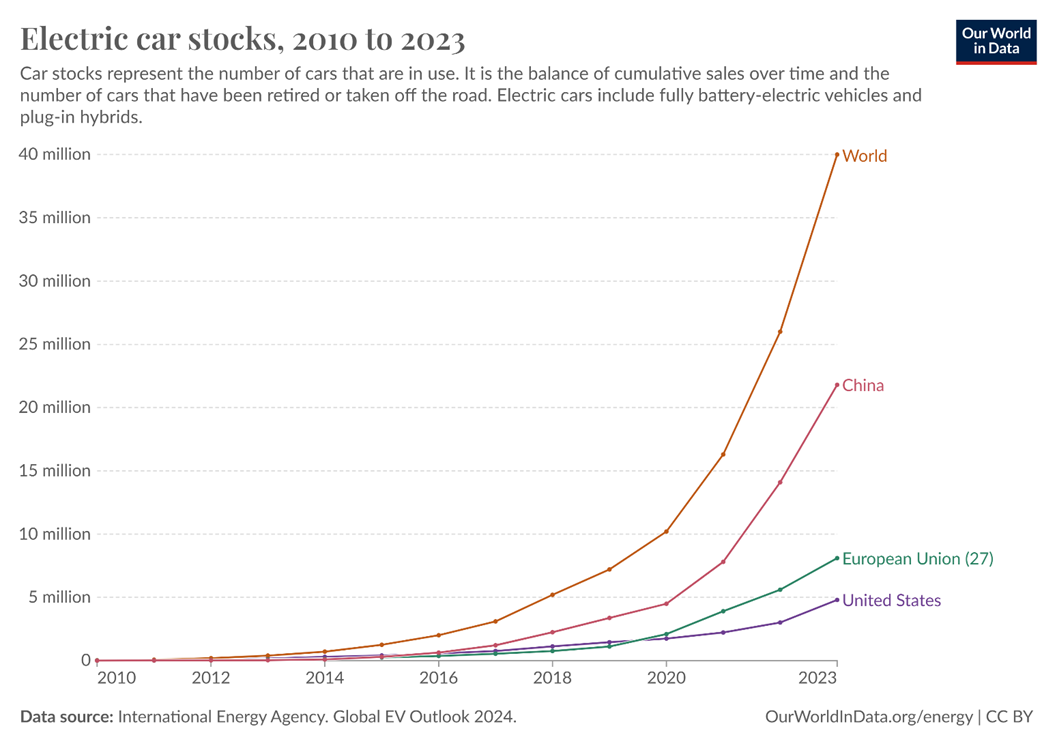
Electric vehicles (EVs) are gaining penetration at a rapid rate. China leads the way in terms of the absolute number of vehicles with about 22 million EVs on the road, and Norway leads the way in percentage terms with 29% of all vehicles being electric. In 2023, 93% of new cars sold in Norway were electric, with 85% being battery electric and 8% plug-in hybrids.
So what does this rapid growth imply for investment opportunities. Before making an investment in electric vehicles it is important to understand the entire ecosystem that surrounds the production and sale of electric vehicles. Some of the ways that an investor could gain exposure to the electric vehicle theme include investments in:
- Established or start-up passenger electric vehicle only manufacturers
- Legacy companies pivoting towards manufacturing EVs
- Commercial EV vehicle manufacturers
- EV charging infrastructure providers
- Component providers
- Raw materials
For investors limited to the ASX the only significant way to gain exposure is via raw materials. However for those investors who can access global markets there are many other opportunities.
Predictions
When it comes to the art of prediction, forecasters tend to overestimate change in the short term, but underestimate it in the long term. Predictions as to how the market for EVs will unfold are numerous and varied. For example:
In 2016, OPEC were predicting EVs would make up only 1% of all vehicles by 2040. That marker was passed in 2019.
Clean-energy research group BloombergNEF, forecast in 2021 that global sales of EVs would rise to 8.5 million by 2025. They were 13.8 million in 2023.
The International Energy Agency forecasts that the EV global vehicle fleet will reach 145 million by 2030. Currently 40 million.
Infrastructure Australia forecast that Electric vehicles will account for 70% to 100% of new vehicle sales by 2040 in Australia and make up 30% of the total vehicle fleet.
The electric vehicle ecosystem
The most obvious way to invest in the electric vehicle ecosystem would be to invest in one of the passenger vehicle companies dedicated to EVs. However there are many other ways that an investor can access the trend towards the electrification of motor vehicles. In order for electric vehicles to become mainstream there is a whole ecosystem that needs to fall into place. It starts with the sourcing of the materials to build electric vehicles through to the actual manufacturing itself and then the charging infrastructure necessary to keep the cars on the road. Each of these different elements form opportunities for investors.
Dedicated electric vehicle manufacturers
Tesla pioneered the market for electric passenger vehicles. In the first quarter of 2024, Tesla (NSQ:TSLA) accounted for 52% of EV sales in the US, but that is down from 80% in 2020. Chinese company BYD Co (HKG:1211) is now competing with Tesla for the title of world’s largest EV producer. BYD is listed in Hong Kong.
Below is a sample list of dedicated EV producers. The valuations of most of these companies have fallen very significantly in recent times. Only Tesla, BYD and Li Auto (NSQ:LI) are profitable and some do not even generate revenue yet.

Legacy vehicle manufacturers
Most of the legacy vehicle manufacturers have started producing EVs, but the extent to which they are focused on it varies considerably. Ford, GM, Stellantis and VW all have made significant investments in EVs, whereas Toyota has yet to fully commit fully to a battery electric future and has only dipped its toe in the EV water.
Commercial electric vehicles
As well as legacy manufacturers such as Mercedes, VW, Renault and others, who are making electric versions of some of their vans, there are a number of start-up businesses who are preparing to launch commercial electric vehicles. Some of these are already listed. Some have also gone bankrupt already.
Below is a sample of start-up EV manufacturers focused on commercial vehicles.

Rivian Automotive (NSQ:RIVN) also has a contract with Amazon to supply 100,000 electric delivery vans. Tesla also now produces an electric semi-trailer truck.
Arrival is a UK company that designed electric vans and buses from the ground up. They listed in 2021 by merging with a Special Purpose Acquisition Company. Despite not having sold a vehicle yet, they listed with a market capitalisation of US$13.8 billion. They filed for bankruptcy last month.
Charging infrastructure providers
As electric vehicles started to come on the scene, the issue of range anxiety soon followed. All vehicles have a limited range, however with a petrol or diesel vehicle there is a vast network of refuelling stations so finding fuel when you need it is rarely a problem. To overcome this issue with electric vehicles, governments, motoring organisations, and private companies have started building out electric vehicle charging infrastructure networks.
In a similar trend to what has been witnessed with EV manufacturers, start-up firms that provide EV charging infrastructure have started listing on public markets. This is still a young industry and the business models are still maturing. Some sell electricity, some sell equipment and software and some even sell advertising on the charging station screen. A small sample of listed entities is shown below.

Raw Materials
The major cost component for EVs is the battery. In 2010 a lithium-ion battery pack cost about US$1100 per kWh but this has fallen markedly since and was US$128 per kWh in 2023. US$100 per kWh is generally considered to be the point where battery electric vehicles reach cost parity with internal combustion engine vehicles.


Source: IEA (2024), Price of selected battery materials and lithium-ion batteries, 2015-2024, IEA, Paris https://www.iea.org/data-and-statistics/charts/price-of-selected-battery-materials-and-lithium-ion-batteries-2015-2024,
The markets for battery metals have been very volatile in recent years. Lithium-ion and lithium nickel manganese cobalt oxide (NMC) are the most common types of battery packs. However research is ongoing into alternative chemistries. The prospects of lithium were overhyped and prices soared, but then came crashing back to earth as a more realistic picture emerged. Some of the main Lithium producers are listed below.

Investing in a rapidly emerging theme can be exciting and potentially lucrative, but it also carries a lot of risk. Investments are based on assumptions about high growth into the future, however all forecasting is subject to a high degree of uncertainty. This is magnified in a new area like EV's where technology is constantly changing and improving and assumptions as to what will be the winning solution can easily be proven false.
Within the automotive industry the long term trend in most developed countries has been for a gradual decline in vehicle ownership. EV’s are looking to displace internal combustion engine vehicles, so in the short term should have a strong growth platform, but in the long term they will be subject to these same trends.
Many of the players in this space are new and unproven in terms of their ability to build a new business. Whilst there will be some major winners, there will also be losers. As an investment theme it carries a high degree of risk, but also the possibility of spectacular returns.
Important Information: Stockopedia Ltd ABN 39 757 874 670 UK business registration number 0637267 (“Stockopedia”) is an Authorised Representative of Daylight Financial Group Pty Ltd ABN 77 633 984 773 (“DFGPL”) which is the holder of an Australian Financial Services Licence (AFS Licence No. 521404).
Information in this commentary is current as at date prepared unless otherwise stated. However, please bear in mind that investments can go up or down in value, and that past performance is not a reliable indicator of future performance. For more Important Information please refer to the Disclaimer section of this website.
This communication may contain general financial product advice. It has been prepared without taking into account your personal circumstances, and you should therefore consider its appropriateness in light of your objectives, financial circumstances and needs before acting on it.
If our advice relates to the acquisition or possible acquisition of a particular financial product, you should obtain a copy of and consider the Product Disclosure Statement (PDS) before making any decision.
The author holds interests in the following stocks mentioned in this article: NCK. This position can and will change at any time without notice.
Disclaimer
This is not financial advice. Our content is intended to be used and must be used for information and education purposes only. Please read our disclaimer and terms and conditions to understand our obligations.
1 comment
It appears that all this climate hysteria and demonisation of the gas of life that makes up only 0.04% of the atmosphere, CO2, as somehow "dangerous" to the planet when plants thrive on it and previous levels were much higher than this is turning out to be, once again, Communism (fear mongering in order to tax, enslave and control us more). With all the EV's piling up on dealers' floors due to their high cost in terms of insurance and repair, Fisker filing for bankruptcy and companies like Hertz dumping EV's, it appears that EV's are not the miracle or the great investment they have been promised to be.
I found this post by Chris Macintosh of Capitalist Exploits on the "Greenwash Bubble" to be quite illuminating in terms of shedding light on all the lies about "climate change" and the dangers posed by "fossil fuels" (hydrocarbons).
If we are so worried about CO2 in the air perhaps we should rather buy a hybrid and just plant more trees instead of chopping them down and burying them in the ground as the eugenicist Bill Gates wants to do?