Is Germany going to transfer its allegiance from FCAS to GCAP leaving France the jilted lover left at the Altar?

Background
Germany is reassessing its role in the Future Combat Air System (FCAS), a joint project with France and Spain, due to persistent disputes over leadership, industrial workshare, and access to sensitive technologies. At the same time, Berlin is exploring possible entry into the Global Combat Air Program (GCAP), now branded Edgewing, led by Italy, the UK, and Japan.
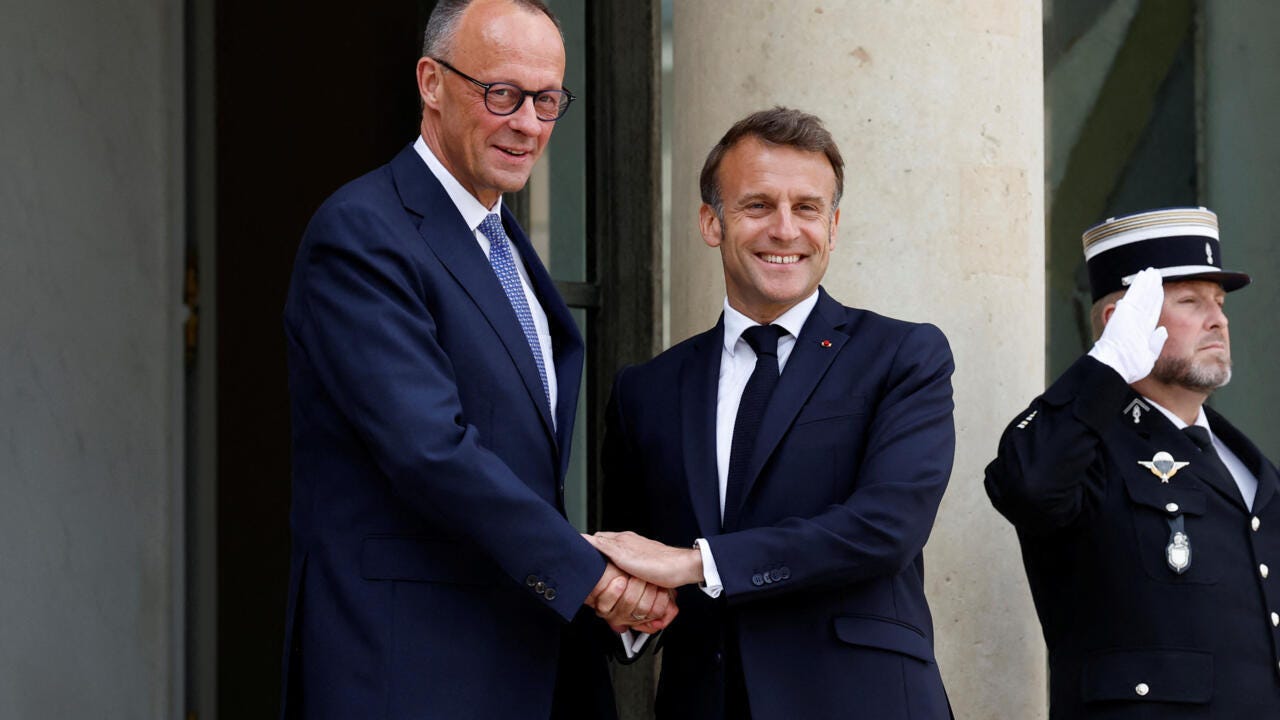
French President Emmanuel Macron and German Chancellor Friedrich Merz are scheduled to meet in the week of December 15, 2025 to decide the future of the troubled Future Combat Air System (FCAS) project.
Wikimedia Commons
GCAP Overview
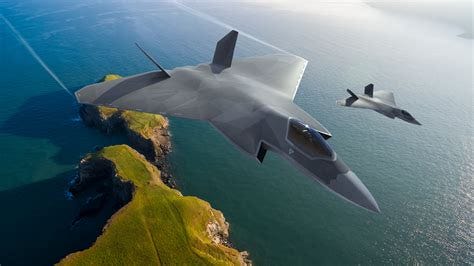
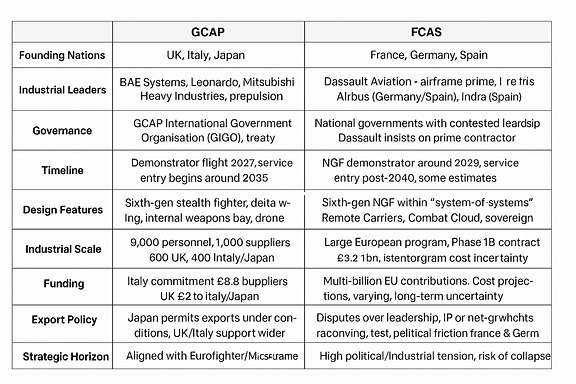
- Purpose: Develop a sixth‑generation stealth fighter to replace the Eurofighter Typhoon (UK/Italy) and Mitsubishi F‑2 (Japan) by 2035.
- Structure: Equal partnership among Mitsubishi Heavy Industries, BAE Systems, and Leonardo, with propulsion led by Rolls‑Royce, Avio Aero, and IHI.
- Scale: Around 9,000 personnel and 1,000 suppliers involved, backed by a trilateral treaty (2023) establishing the GCAP International Government Organisation (GIGO).
- Features: Integration with drones, advanced mission systems, large delta wing design, internal weapons bay, extended range, and high payload capacity.
- Funding: Italy has committed €8.8 billion; Japan has adjusted export rules to allow future sales under strict conditions.
British Aerospace Engineering
Industrial Consolidation
In June 2025, the Edgewing joint venture was formalized, giving BAE Systems, Leonardo, and Japan Aircraft Industrial Enhancement Co. equal shares. Development hubs are spread across the UK, Italy, and Japan, with significant R&D contracts already awarded. A new consortium—Electronics Evolution—coordinates sensor and communication systems.
UK: The UK Ministry of Defence confirmed £2 billion invested to date covering early design, demonstrators, and program structures. In addition, the UK has shared considerable existing IP with partners developed by BAE. The UK will host the GCAP International Government Organisation (GIGO) headquarters in Reading, placing the UK at the centre of governance. The structure of the GCAP programme anchors governance and industrial leadership via BAE Systems (LSE: BA.) and Rolls‑Royce (LSE: RR.) in the UK.
Italy: Italy’s Defence Minister Guido Crosetto announced a €8.8 billion commitment at a trilateral ministerial meeting held pn July 7th 2025, where Crosetto, alongside UK Defence Secretary John Healey and Japan’s Defence Minister Nakatani Gen, reaffirmed their nations’ strategic and financial backing for the Global Combat Air Programme (GCAP). Italy has an equal partnership with the UK and Japan in terms of technology IP, research and industrial returns. Leonardo has already received contracts worth €100 million for R&D. Italy’s substantial financial commitment ensures equal footing and industrial leverage through Leonardo (Borsa Italiana: LDO).
Japan: Japan has allocated billions of yen over five years in its annual defense budgets since signing the GCAP treaty in 2022. This is Japan’s largest defense project in decades, tied to retiring ~100 Mitsubishi F‑2 fighters by 2035. Japan had to revise revised export rules to allow GCAP aircraft sales under strict conditions (no active conflict, and requiring defence cooperation). Japan sees GCAP as vital to revitalizing its defence industry and securing Indo‑Pacific airpower at a time when China is increasingly assertive in the South China Sea. JAIEC is Japan’s designated lead systems integrator for GCAP. JAIEC represents a consortium of Japanese industrial and defence companies and is not a publicly traded company, but a unique Japanese construct common in SE Asia.
FGCAP Summary
FCAS Challenges
- Partners: France, Germany, Spain (Belgium briefly an observer).
- Goal: Deliver a prototype by 2028–29, with service entry around 2040.
- Issues:
- Dassault Aviation insists on prime contractor status, resisting shared leadership with Airbus.
- Disputes over intellectual property and technology access have slowed progress.
- France’s Defence Minister Catherine Vautrin questioned Germany’s capacity to independently build a fighter, sparking political friction.
- Costs: Estimates reach €100 billion for the full system.
- Uncertainty: German Defence Minister Boris Pistorius has warned FCAS could collapse if compromises aren’t reached.
Germany’s Aerospace Capacity
Despite French doubts, Germany retains a robust industrial base:
- Airframe: Airbus Defence and Space (Manching) and Premium AEROTEC (Augsburg, Varel).
- Engines: MTU Aero Engines and EuroJet Turbo GmbH.
- Systems: Contributions to Eurofighter upgrades, F‑35 fuselage production, AESA radar integration, and electronic warfare equipment. This ecosystem ensures Germany can sustain modern fighter operations, though long‑term planning depends on whether FCAS stabilizes or alternatives like GCAP are pursued.
Strategic Implications
Germany’s decision will shape Europe’s defence landscape. Joining GCAP could:
- Broaden investment and reduce costs for existing partners.
- Strengthen industrial collaboration with UK, Italy, and Japan. Given one key area of dispute with the French is the share of the industrial benefits this, alongside design disagreement with the French, will be a critical deciding factor for the Germans. There is likely little room for manoeuvre at this late stage on design, although the Germans do favour a heavier more versatile jet than the French which is consistent with the GCAP design, but there is likely more room for discussion over a fair sharing of the industrial benefits. Germany’s aerospace ecosystem (Airbus Defence & Space, MTU Aero Engines, Hensoldt, Premium AEROTEC) could add value in:
- Airframe production scaling (leveraging Airbus facilities).
- Propulsion support (MTU’s expertise in EuroJet engines could complement Rolls‑Royce/IHI/Avio Aero).
- Sensors & EW systems (Hensoldt radar and electronic warfare technology).
- Drone integration (Germany could specialize in loyal wingman UAVs, a critical GCAP component not fully allocated yet
- Provide a hedge against FCAS delays and disputes. Conversely, staying in FCAS maintains continental alignment but risks continued stagnation.
I will make a bold call and say I will not be surprised if Germany joins the well established and well functioning GCAP and would welcome a more integrated approach across European weapons development, industrial strategy and sourcing. The Europeans will continue buying the American F35 for the next ten years - there simply is no comparative and therefore no choice. However, there are few Europeans or Brits who would not welcome the development of a shared and sovereign European fighter jet solution for the next generation.
The author owns shares in BAE Systems (LON:BA.) and Rolls-Royce Holdings (LON:RR.) and through the Future of European Defence UCITS ETF Acc (LON:ARMY) , Italian defence company Leonardo SpA (BIT:LDO)
Disclaimer
This is not financial advice. Our content is intended to be used and must be used for information and education purposes only. Please read our disclaimer and terms and conditions to understand our obligations.
1 comment
Thank you….that was a really informative piece