Is the US really more expensive than the UK?

A common theme heard among podcasts and the financial press is that the UK stock market is incredibly cheap against a US market that’s looking overvalued . A cursory look at the valuation of the market averages seems to back this up.
At Stockopedia, we publish the median ratios for the index constituents on each index page. Looking at the numbers is telling:
- The FTSE 350 index (the largest 350 stocks in the UK) has a P/E ratio of 14.5x, with a prospective growth rate of 8.5%.
- The S&P 500 index (the largest 500 stocks in the US) has a P/E ratio of 21x, with a prospective growth rate of 11.5%.
This suggests that the typical S&P 500 stock is on a 45% premium to UK stocks. That’s certainly eye-opening. A value investor could easily jump to the conclusion that the UK is a better hunting ground.
But life is rarely so simple.
While I am a huge skeptic of the accuracy of analyst forecasts, these US stocks are forecast to grow at a 35% higher rate (11.5% to 8.5%). So at least some of the US premium is justified.
Alas, all is not as it seems
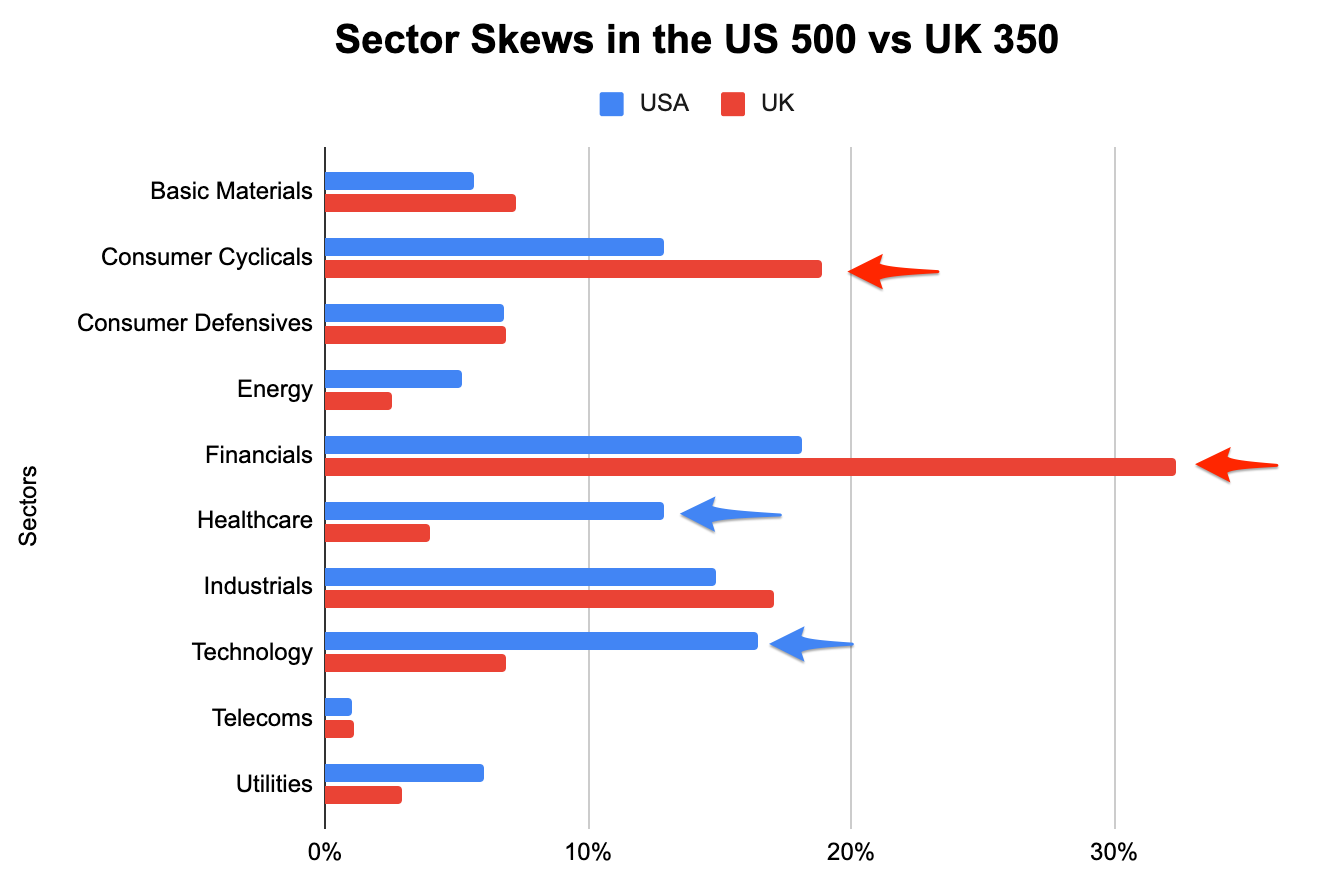
These numbers hide the fact that the indices contain very different sector compositions.
Even after removing the funds and trusts from our local UK index, there is a far higher count of financial and consumer cyclical stocks. These sectors often justify lower valuations. In the US, there is a higher skew to Technology and Healthcare stocks, which often justify higher valuations.
A hefty US premium?
To remove these sector skews, it is instructive to investigate valuations across sectors.
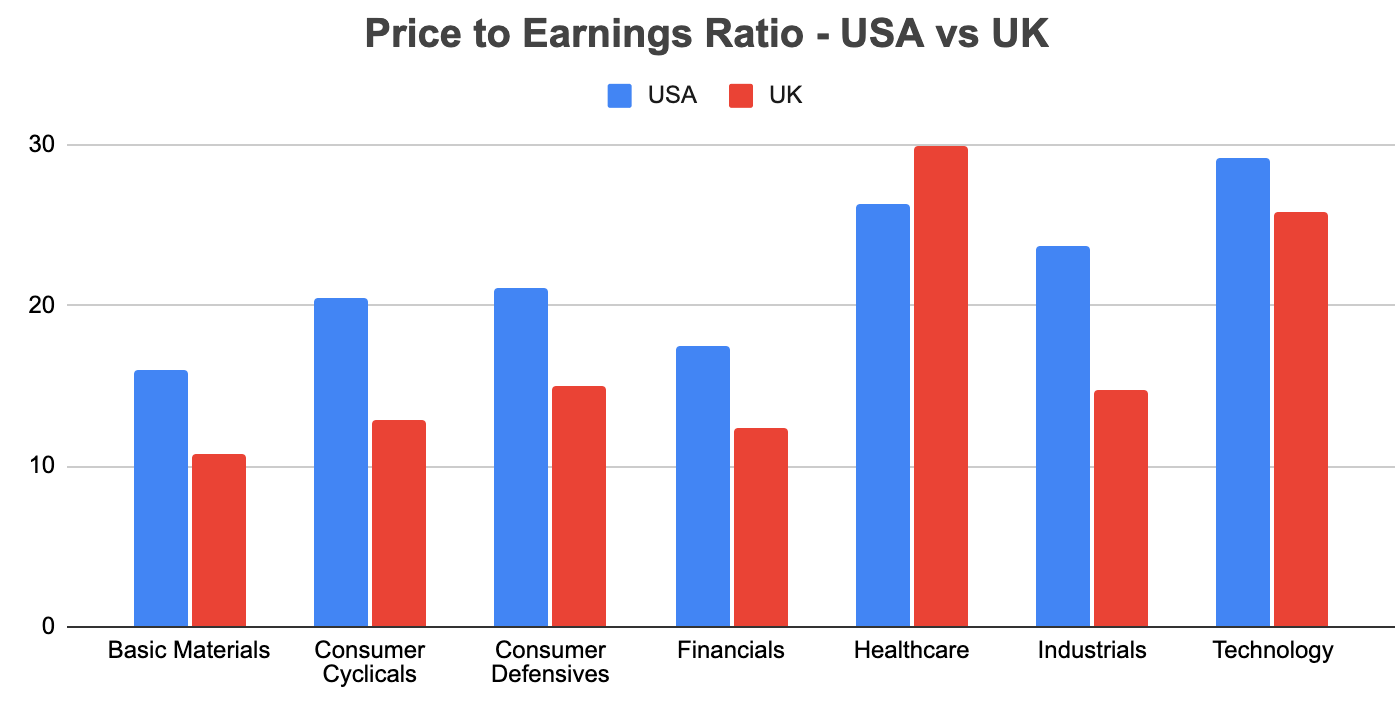
I’m going to ignore the Energy sector (as the average constituent in both regions is forecasting an earnings decline), and also the Telecom and Utility sectors as they are small across these regions. That leaves seven sectors.
On a P/E ratio basis, six of the seven remaining sectors are at a significant valuation premium in the US. Only the Healthcare sector stands tall in the UK.
Backed by stronger US growth?
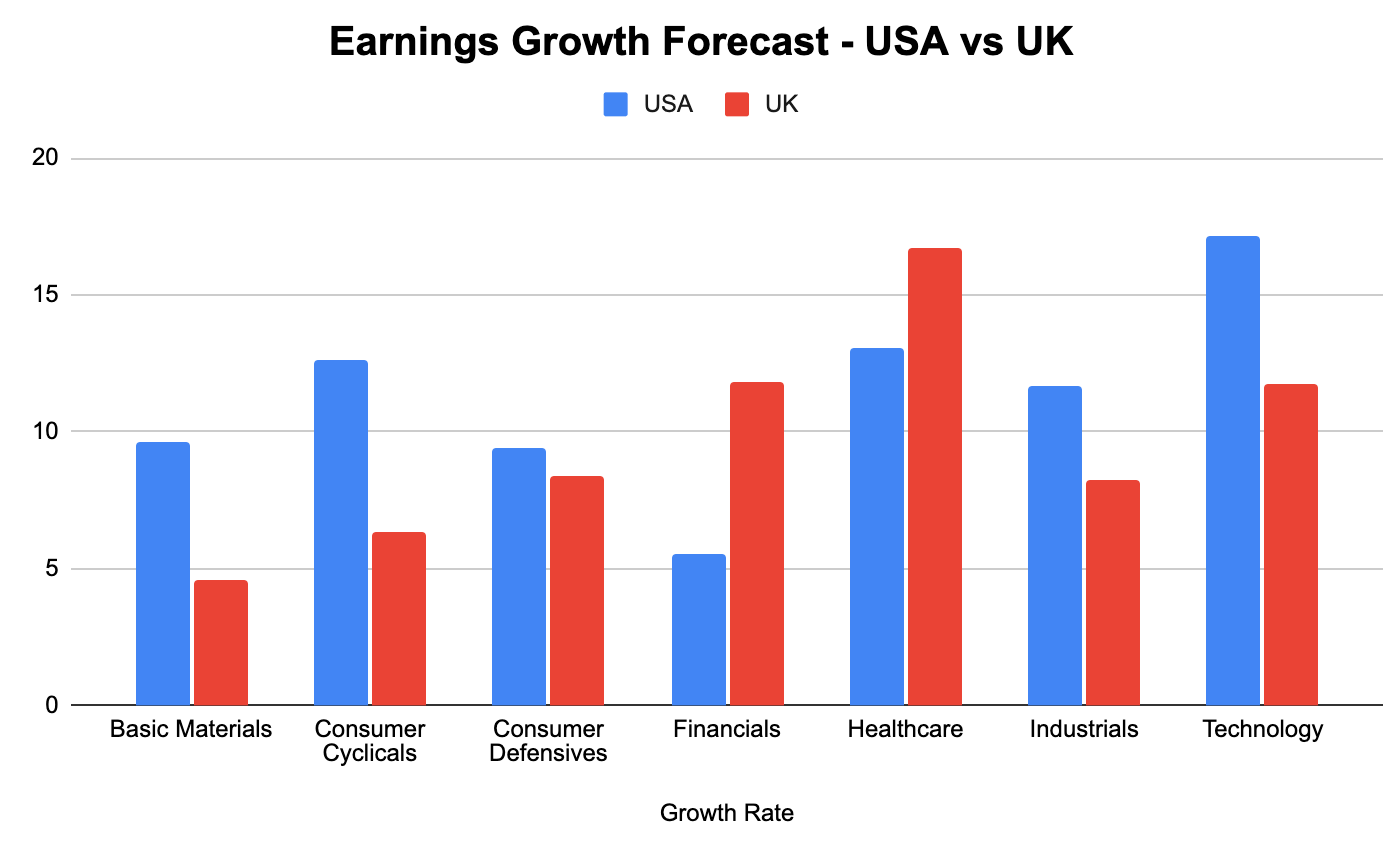
Some of those US valuations are vertigo inducing, especially in technology with a P/E of almost 30x. But those valuations are backed up by significant earnings growth advantages. The chart below highlights US growth rates well above the UK in technology, industrials and consumer cyclicals.
Is the US expensive when adjusted for growth?
A useful financial ratio to use is the PEG Ratio - which divides the Price Earnings Ratio by the forecast Earnings Growth Rate. We can think of it as a “growth adjusted PE ratio”.
The chart below illustrates this.
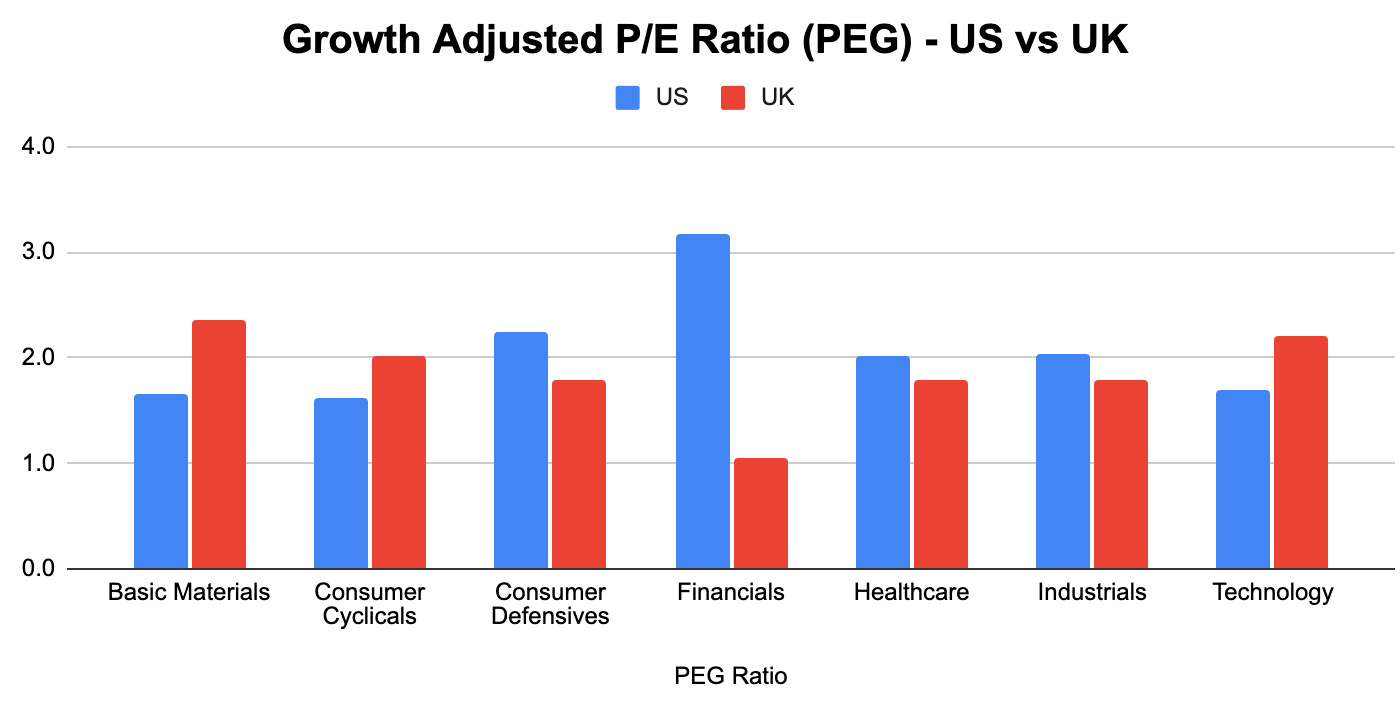
This chart seems to imply that by this back-of-an-envelope “growth adjusted” analysis, UK tech, consumer cyclicals and basic materials stocks are actually at a premium to their US counterparts.
Excluding Financials, the difference in PEG ratio across the six remaining sectors is only 4%.
Make of this what you will, but it certainly seems that the valuation premium in the US is not as large as meets the eye once you adjust for growth.
Lies, damn lies and statistics or a valid point of view?
I’m open to either and especially your thoughts.
Disclaimer
This is not financial advice. Our content is intended to be used and must be used for information and education purposes only. Please read our disclaimer and terms and conditions to understand our obligations.

41 comments
Great article. Suggestion: the S&P500 is very important, why not ditch one of the 4 UK indices on the today page and put in the S&P500, it would be more useful.
timarr - thanks, very interesting.
A very thought provoking article by Ed, as ever!
For me, the most shocking factor is the EPS growth forecasts baked into prices and Ed has flagged his scepticism already. Surely, these analyst forecasts are way too optimistic at c10% earnings growth? The global economy is slowing sharply after a 15 month inverted yield curve.
I wonder what the analysis would show using historical EPS numbers.
Yes, technology might achieve this but surely consumer cyclicals are not growing EPS by 15%
Pretty sure consumer cyclicals in US largest weights are Tesla & Amazon so possible. Expect Apple is in there too.
I'm a little sceptical about US expensive more concerned about concentration & concentration within sectors. Think when you exclude the outliers like the Secret 7 within the sectors, they will look far more aligned.
Dare say the call for people to make is do they want to be in cheap sectors or the UK + 7.
No expert but it would be a brave person who said these are overvalued and I want no part of them in my portfolio.
Sold MSFT for Bills in February over here - Bill had much better forward earnings yield!
Thanks Lawrence, a very interesting article
When it comes to future growth in companies and where they will be based think you have to take into consideration where the biggest companies are based at this time
USA has won the race when it comes to large cap tech no one else really in site and personally don’t see that changing short term
https://companiesmarketcap.com...
Top 7 us and 3 companies in top 10 not in USA and they are in China Taiwan and south Korea
https://companiesmarketcap.com...
All of the top 9 of top 10 biggest companies US 7 of those companies are tech area
If you were looking to start a tech company where would you go and they will continue to be the area we’re the fastest growing companies come from
Earnings growth is driven: -
1. Real inflation adjusted sales growth producing higher profits per issued share.
2. Expanding the issued share base- dilution - or shrinking the share base - buy backs - both distort the earnings record.
Is it not the case that US companies have been more active buyers of their shares than UK?
Will higher interest rates not cut back buy backs?
Thank you for your fascinating article, I also think we suffer from an overly critical media that magnify the negatives and hid the positives. US fiananciers use the UK as a happy hunting ground to find bargains, essentially asset stripping the UK.
Useful synthesis.
Nevertheless the analogy of a six-footer drowning in the 'pond' of an average depth of 5 feet applies.
Look at Cisco Systems (CSCO), a large cap tech with a respectable value rank and earnings growth.
Among the Financials, a lot could be said but the divisions between Banks, Insurance, Re-insurance (based often in Bermuda, the middle of the pond) and companies reliant on assets under management prevent generalization. I often use PRU (Prudential) as a benchmark because it typifies an overvalued UK financial plus has the evocative NYSE ticker of PUK.
Once results come in, however value metrics change, especially in the Pharma sector. US Healthcare in the management sector, ELV,CNC, MOH and others is very reasonable (except for patients without insurance).
This is an interesting analysis. As you mention, a key is how reliable are the earnings forecasts and are they more inflated in the US or the UK? I assume you are using bottom-up forecasts (from forecasts for individual companies) and this is probably all that is available at a sector level. But bottom-up forecasts are famously optimistic and far exceed the earnings growth forecasts by top-down forecasters. My hunch (and it is only a hunch) is that the discrepancy between top-down and bottom-up is bigger in the US than here.
Another way of looking at whether the US is more expensive than the UK is from going from new listings. ARM seemed to believe (and it is hard to argue with that) that it would get a higher valuation being listed in the US than on the LSE. (Now does this only apply to tech or all sectors??). A few smaller lower quality companies see their share price rise sharply on announcing a switch from AIM/LSE to NASDAQ. I am unclear if these minnows really trade better in the US - a recent example was SpectralMD which has a few days ago completed a merger into a US SPAC (now called Spectral AI - ticker MDAI), which saw its UK share price rise on the expectation of the US listing but once the listing happened valuation on Nasdaq fell back to around where it had been originally in the UK before the whole switch was contemplated.
Very illuminating, thank you. I have no doubt there are a number of good US opportunities but do wonder whether the enormous debt levels their government have taken on will impact the productive sector, now interest rates have returned to normal. It seems strange to say but perhaps it is possible the US growth will lag behind the UK in the next few years.
You can argue, as you have done, that the US market is not as expensive as it seems at first glance (when compared to the UK market). However, I would argue the US market is expensive when compared to its own historical trend data (eg CAPE ratio)
However, I would argue the US market is expensive when compared to its own historical trend data (eg CAPE ratio)
It is. But you're not comparing like for like. The S&P500 is drastically different in composition than it was 20 years ago. The quality of margins and cash generation is substantially higher today.
@bspowar
" I would argue the US market is expensive when compared to its own historical trend data (eg CAPE ratio)"
I do agree.
I'm not advocating that the US is cheap in this article. It's at a significant premium. That premium is currently due to growth expectations.
The history of forecasts is not a good one. Growth expectations are rarely accurate. The US could easily disappoint.
I'm much more contrarian when it comes to investing. Hence, my focus on value and momentum.
I'd rather be a buyer of UK stocks when momentum turns than of US stocks relying on continued momentum. Although I do wish I'd bought more US stocks in the past ten years!
The US market has changed vastly in the last 20 years: https://www.benzinga.com/gener...
Only 1 stock from the top 10 S&P500 in 2000, is still in the top 10 now. Technology companies now dominate, unlikely the UK, probably similar top companies as in 2000. Our decent tech. stocks get bought by foreign companies, such as happened to Arm Holdings (NSQ:ARM). So comparing the market to the past can be tricky, tech sector tend to be more expensive than many other sectors. UK stocks tend to give away profits in dividends.
I like it, but that is no excuse for spelling sceptic with a k as they do over there.
You don't say it, but a low PEG is desirable. Slater looks for PEGs of less than one.
Population grew by almost 400% in 50 years whereas in the UK merely by 50% , and a GDP that almost double prior to the 2008 financial crisis whereas in the UK hasn’t really gone anywhere ( waisting 5 years on an idiotic decision to leave the European Union ), then one can assume that there will always be much greater returns in the US stock market.
You are trying to question which is faster : the 1970’s Mercedes or the latest 2023 model.
Thanks
"waisting?????"
But yes Yiannos, the real problem in the UK has been very low growth for the last 50 years, for 47 of which we were held back by membership of the European Union.
Obviously you haven’t realised the UK’s growth rate in the 1970’s and 1980’s , 1990’s and even the beginning of the 2000’s.
Obviously , as well , you haven’t heard about the recent EU funding on technology and innovation that Prime Minister Sunak had to beg the EU to give it back to the UK. In fact FOUR very well known UK universities kept their doors open as British scientists working in them can apply again for funding and grants.
What a cheap excuse : held back by membership of the European Union?
How come the Republic of Ireland wasn’t held back and is slowly becoming the New City ( i suppose you haven’t realised that as well ).
Have you realised how many funds are running away from the UK stock market and thus making it more and more illiquid day by day (especially the small caps).
Have you realised that Saxo Bank ( with a very well known and popular European stock platform ) does not allow its customers to buy stocks in the UK ( they have even removed most of the UK stocks from their platform and only allow UK citizens to buy shares listed in the UK).
I can name another 100 valid reasons , but it’s not fair to the author of this very
well thought article.
If you think government government funding of technology and innovation actually works you are at best overly optimistic and have learnt nothing from the growth of tech companies
Coming to Ireland it got tech companies to base their EU headquarters there by low taxation nothing else
London still most attractive financial centre
And BNP advising clients to favour UK over EU
https://www.gbnews.com/news/eu...
https://www.statista.com/stati....
Still laughing as well with a fellow investor here.
Obviously you haven’t heard the word ‘penicillin’ and from which university was discovered , or from which university the father of artificial intelligence started his work.
The list is endless.
Better to leave it though as we certainly agree to disagree.
Good luck with your investments.
Haha
You are funny
In ten years time the biggest tech companies will still be US and Asian put all your money in EU tech if you want that’s your choice
And I wish you well with your investments too
I haven’t said anything about where I put my money.
In fact my last buys (last four days) are opening positions on Intel and Acadia pharmaceuticals ( both US listed ).
So it’s not the UK then ?
It’s the US and Asia now.
I thought that all roads lead to London!
Thought you had finished ?
Had to have the last word hey
I really don’t care what you do with your money to be honest
Another childish response!
This is what people do when they cannot engage in decent conversations that help the community here.
The words "pot," "kettle" and "black" spring to mind, yiannos.
Nice one Casemiro just scored!
But yes Yiannos, the real problem in the UK has been very low growth for the last 50 years, for 47 of which we were held back by membership of the European Union.
In fact the UK's productivity growth started slowing at the end of the 1960s. Since the late 1970s both France and Germany have managed productivity growth as good as that of the US, while the UK has been a laggard. Much of the fall off in UK productivity seems to have happened as the rebuilding after WW2 came to an end - but other European nations went through the same rebuilding cycle and seem to have come out of it better so it's hard to discern any kind of signal in the data. Whatever's happened in the UK seems to be largely specific to the UK.
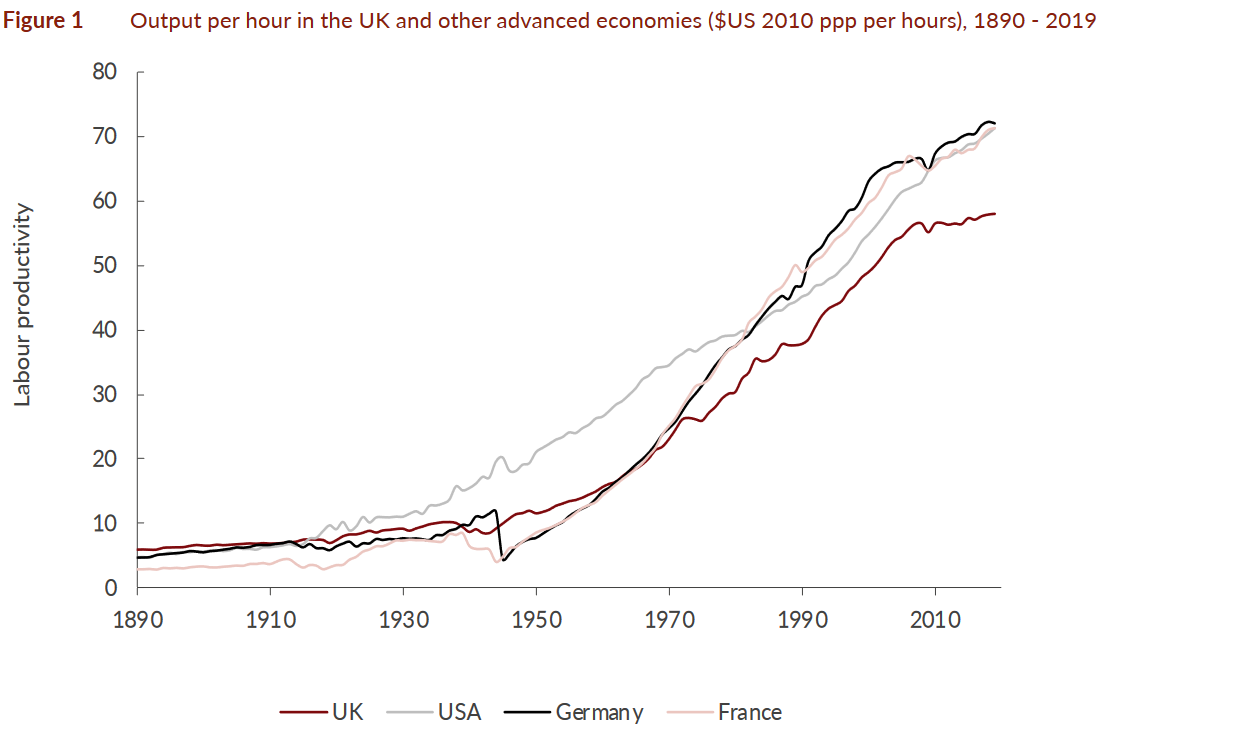
On the other hand it is worth noting how much more productive we are than 50 years ago. People always compare themselves to their neighbours, but in real terms we're much better off. However, the flatlining of growth in the UK since around the GFC is a huge a concern - it didn't have the same effect in the US, France or Germany but we've had virtually zero growth since - and that has huge ramifications for living standards, core infrastructure investment and a host of other areas. There are lines of argument that suggest this was a direct impact of austerity, others that point to the UK's over-reliance on financial services. As usual with these complex economic issues there's no real agreement, probably there's no single reason.Within the UK there are stark regional differences - London and the South East are among the most productive regions in Europe, while much of the rest of the country has very poor productivity. If levelling-up had been anything more than a bunch of rhetoric it would have been an excellent use of public money. However, given this stark difference - which leads to living standards declining in relative terms - it's not hard to understand the frustrations of people in the regions and their appetite for a simple solution in the form of Brexit. Sadly they're likely to be disappointed because the real issues are far more complex, but time will reveal all.
timarr
Like you say timarr the reasons behind the growth or not of an economy are rarely simple when it comes to productivity in UK unfortunately I don’t see the dominance of London and southeast and it’s lead in productivity and wealth ever really changing however much money is thrown at it UK just isn’t big enough to have more than one major world class city and that will tend to suck in talent and money the rest of UK economy will lag the further away from London the harder it will be
Old saying” all roads lead to London “and they still do and always will
When it comes to global growth UK is roughly where it was 50 years ago as a % of world gdp though lost 0.6 %
France and Germany both lost more
https://www.visualcapitalist.c...
Interesting rises and falls in the distribution of world wealth
As wealth shifts to emerging economies EU and rest of the west except USA will become less significant
https://www.statista.com/stati....
https://www.statista.com/stati...
Sorry no you are totally wrong
Sorry no you are totally wrong
Good to know, Thanks!
timarr
Hi timarr,
I apologise but my comment was not for you but for bullhead’s comments about that all roads lead to London.
The Turkish stock exchange has managed to raise more money this year than the London stock exchange! A country that has an inflation rate of 50% and a currency that lost about 70% of its value in the last 3 years or so , has indeed attracted more investment than London.
Indeed all roads lead to London!
Hi yiannos
I apologise but my comment was not for you but for bullhead’s comments about that all roads lead to London.
I did think it was a bit odd!
My view of London, and the UK in general, is that we have a significant rentier class that has control of both government and the main institutions, including the largest investment houses. You only have to spend a little time looking at the educational background of these people to recognise how much they have in common.
As with most rentiers, they have a vested interest in maintaining the status quo, not taking risks and ensuring their income streams are maintained, regardless of the impact on forward investment or wider society. This ultimately translates into poor capital allocation, poor investment returns, significant disparities in wealth and a lack of social mobility.
The UK has lots of clever people doing lots of clever things, it's just they never end up making much money here. It's utterly unsurprising that they go to the US looking for backing, it must be incredibly dispiriting hawking your ideas around a bunch of liberal arts graduates whose idea of innovation is putting ice in their Chablis.
That said, even a dead dog has some value. Some of the prices of UK stocks at the moment are simply stupid.
timarr
Yes I agree some of the UK stocks are undervalued , but they are because of liquidity issues (forced sellers basically have pushed the prices) and not for their excellent management and potential growth.
“it must be incredibly dispiriting hawking your ideas around a bunch of liberal arts graduates whose idea of innovation is putting ice in their Chablis.”
I really like that might have to quote it if you don’t mind
Big statement
Please explain why ?
I have already!
Hahahahahah
Very funny lol
Gave me a good laugh
Thanks
I agree with your analysis. I think another factor that plays into the consensus view that the UK is cheap versus the US is that recent historical returns have been so much lower in the UK. This is not relevant to future returns but anchoring bias is powerful.
Really interesting analysis, thankyou for putting it together