Judges Scientific: the Berkshire Hathaway of AIM?

Judges Scientific (LON:JDG) is the owner of an expanding empire of scientific instrument companies. By its own admission, the group is ‘obsessed’ with creating shareholder value.
You might think this is how all listed companies operate but the truth is value destruction is rampant. Somewhere out there lies a vast graveyard of failed companies that had lots of fun splashing shareholders’ cash.
Frequent equity placings, unwieldy debt burdens, ill-considered acquisitions and excessive compensation packages are just some of the ways in which listed companies can transfer wealth away from shareholders.
To know that a company bases its strategy and actions specifically on creating shareholder value is actually quite something. This is what Judges Scientific claims to do and, looking at this chart from the group’s H1 19 presentation, it appears to be doing a good job.
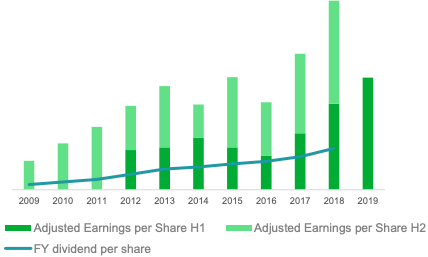
Unfortunately, the group does not give a scale for this graph. Going through the historic accounts, however, we can see that the group’s share price has grown at a compound rate of around 31% (from 104p to 4,420p) since the end of Judges’ financial year 2005 (the first year of its scientific instrumentation strategy), while earnings per share have grown at nearly 40% per year (from 1.7p to 180.6p).
In FY 06 a 3p dividend was introduced. By FY 18, Judges was paying out a 40p dividend, making for a CAGR of 24% over 12 years. Management hopes to increase dividends by at least 10% per year, and more when possible.
It is nice to note that management draws attention to its Dividend Reinvestment Plan (DRIP). This mechanism enables owners to automatically reinvest their dividends into additional Judges shares, which promotes long term ownership and allows holdings to compound.
Digging through the accounts, what we appear to have in Judges is a team of experienced acquirers that purchases companies with favourable economic characteristics, led by honest and competent management, purchased at attractive prices that can generate excellent returns, in an industry whose long term business characteristics they feel competent to judge.
Warren Buffett would be proud.
High QM stocks: in search of compounders
Of course, such a company does not often come cheap. There is no doubt that upon first glance, trading at 4,420p and on a forecast PE ratio of 21.9, the Judges Scientific share price looks expensive. Stockopedia classifies it as a ‘High Flyer’ quality-momentum stock. In fact, heading over to the Top QM Rank screen, we can see that JDG is currently the fourth highest QM candidate listed in the UK.
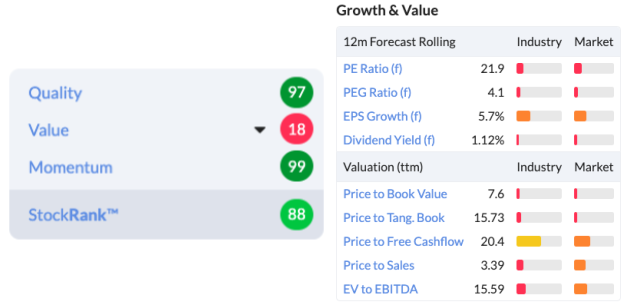
High QM stocks always look expensive. It comes with the territory. But it’s typically in this part of the stock market that the biggest winners and compounders can be found.
The key question for Judges is whether or not the group can continue to grow at anything like its historic pace over the next 15 years. Just to illustrate (and for fun), were the company to continue with the CAGRs calculated above, in a decade and a half, we would be looking at a stock trading at 253,800.05p, with earnings per share of 28,095.60p, paying out a trailing dividend per share of 1,007.83p.
So yes, Judges looks expensive - but if it can manage anywhere near its historic performance going forwards, then the rational investor would gladly pay a premium today.
How did it come to be?
The Judges story starts with 69 year-old founder-CEO David Cicurel, who currently owns around 12% of the company.
Pre-Judges, Cicurel spent his early career as a company ‘doctor’ performing corporate turnarounds in France, Switzerland and the US before moving to the UK. Here, Cicurel continued along the same path until the acquisition of FTT - a high quality, growing, safe business with a dominant position in its niche market (all for just £3.6m) - opened his eyes to the compounding potential of excellent businesses bought at fair prices.
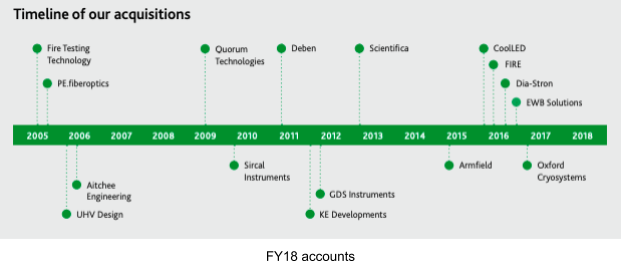
This eureka moment back in 2005 was the beginning of the Judges Scientific outfit we know today. Since then, a further 15 acquisitions have been made.
What does it do?
Judges buys small and medium-sized scientific instrument companies that enjoy dominant positions and high operating margins in their respective markets. They tend to export a lot of their sales.
According to Cicurel, there’s plenty to like about the scientific instrument sector. Long-term market drivers are rooted in the global expansion of higher education and the need for improved measurement ‘to support the relentless worldwide search for optimisation across science and industry’.
The way Judges carefully structures its deals to satisfy stringent valuation criteria is key to its ability to compound shareholder value. Price paid determines future returns.
Breaking it down in a little more detail, here’s how Judges creates value for shareholders with its ‘buy-and-build’ business model:
- Judges leverages its expertise and capital to acquire sustainable, dominant businesses for 3-6 times EBIT
- It finances acquisitions with existing cash resources and a chunk of debt (maximum 2.5 times EBITDA)
- The group cultivates a supportive environment where autonomous businesses can flourish and grow profits. Resulting cash flows (enhanced by acquired businesses) are used to promptly pay down acquisition debt
- Once debt is paid down, subsequent cash flows are used to fund internal growth opportunities, reinvested into further acquisitions, or distributed to shareholders
The repayment of acquisition debt and organic sales growth is where the ‘core value’ is created.
When it works, this model is a virtuous circle of compounding returns (as Buffett once put it, ‘envision rabbits breeding.’) Favourable tailwinds are created through the long-term organic growth of the individual businesses and this skews the odds more towards positive future performance.
Looking at Judges’ share price chart, it certainly seems to have worked so far.
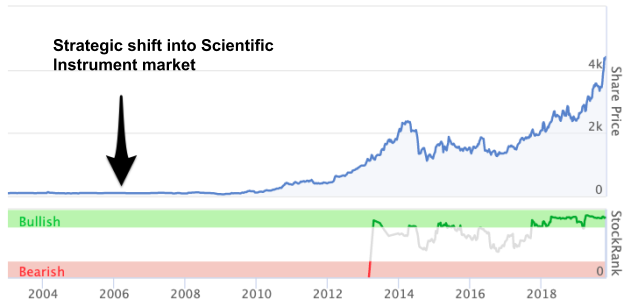
A word of warning, though: this strategy is very sensitive to the acquisition price paid. If Judges offers too little it will never get a deal, but if it pays too much the entire model can be corrupted. This is an important balancing act and requires from the investor a high degree of confidence in the ability of management to get it right.
When you want to retire who ya gonna call?
The scientific instruments market is a happy hunting ground for Judges. Each year, it presents David Cicurel and co with a selection of acquisition opportunities.
Imagine an engineer or a scientist who works in a big company. At 40, the employee leaves and becomes a founder-entrepreneur and builds a very successful niche company. What then at 60, when said founder wants to step down and crystallise some of that equity?
Enter Judges Scientific: the buyer of choice for scientific instrument companies. Over the past decade or two, the group has forged its reputation ‘as an experienced and well-financed buyer and a supportive home for businesses in our sector whose owners wish to sell.’
There is no shortcut to building such a reputation. It’s a valuable intangible asset.
And opportunities are abundant: there are around 2,000 scientific instrument companies in the UK alone (according to Judges, the UK is ‘centre of excellence for product innovation and manufacturing with world-leading businesses’ in this area). If we assume, crudely, that each company comes up for sale 20 years after incorporation that would be enough for an annual deal pool of (2,000 / 20) 100 companies.
Judges just has to sit back and watch these opportunities pass by on the metaphorical conveyor belt. Most of the time the deals on offer don’t satisfy its requirements - but those that do represent an excellent, one-in-a-hundred kind of opportunity: the determined seller of an excellent business meets the best buyer on the market.
Some years, as in last year, not a single prospect is deemed good enough for Judges shareholders. Other years yield multiple acquisitions (the record is four, in 2016).
Shades of Berkshire - capital allocation, liquidity and balance sheet strength
Quoting Buffett in this article is particularly relevant because there are striking similarities between Judges Scientific and Berkshire Hathaway.
That’s not to say that one day Judges will be worth $400bn, but it does suggest that JDG management might have the long term vision and sense of stewardship required to compound wealth for loyal long term shareholders.
The group operates as a tightly knit investment outfit. Much like Berkshire’s small Omaha team, the Judges crew makes selective investment and capital allocation decisions with the funds generated from its stable of high quality subsidiary businesses. It also uses its scale, liquidity and rock-solid balance sheet to provide financing to subsidiaries, which are by and large left to their own devices (or, as Charlie Munger might put it, are left to operate with ‘very extreme autonomy’).
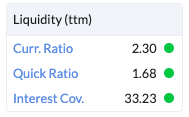
You can see Judges’ financial strength in its Piotroski F-Score of 8 out of 9. The group is further strengthened by its comfortable excess liquidity, as you can see in the Liquidity box of its StockReport:
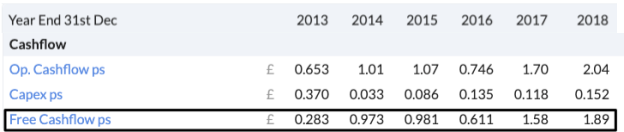
This extreme balance sheet strength is constantly replenished by an ever-growing fountain of free cash flow, powered by Judges’ many and diverse businesses. As you can see below, the amount of capex JDG has to spend to fund its operating companies’ growth really is remarkably low. The 2018 capital expenditure figure of £152,000 is invested across sixteen growing, successful businesses.
For the businesses it acquires, Judges provides advice and support, participates in succession planning and implements robust financial controls. This mix of autonomy and support appears to be a happy one. Judges’ various management teams are interviewed in this eight minute video on the group’s website - they paint a positive picture.
Recent trading
With shares trading at all-time highs, it will not come as a surprise that recent trading has been strong. Order intake is the bellwether of the business and this chart (from its half-year 2019 presentation) is one of the most important that Judges provides:
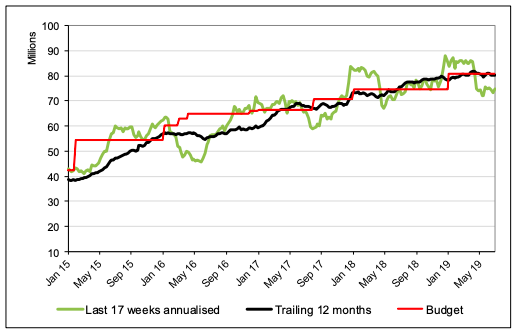
The red line shows Judges sales budget, while the black line is the trailing 12 months annualised sales and the green is the last 17 weeks.
As noted in its recent half-year trading update in September, the group’s order intake experienced a small contraction in the second quarter. Since then though, order intake has recovered to budget level (the red line). The uptick was enough for management to conclude that ‘adjusted profit before tax and EPS will exceed current consensus market expectations for the year as a whole.’
Threats
It would be remiss of me to paint such a positive picture of Judges without going into some of the risks and threats facing the company. Probably the most significant risk for the group is that an acquired company does not meet its expected profitability. To mitigate this, Judges is highly selective in its acquisitions and it performs detailed market analysis.
This discipline and rigour creates another risk, though: that of insufficient availability of target companies. As in 2018, there will be years with no acquisitions.
Then there are the uncontrollables. Judges’ many markets are subject to unpredictable economic and political forces. The weaker Sterling following Brexit, for example, has helped Judges over the past few years. At some point, this situation will be resolved and Sterling may well strengthen.
Then there is the troubled US-China trade dynamic. Management is on record as saying this is more important to the group than Brexit. Scientific instrument manufacturers are no doubt used to precision - well good luck measuring this risk.
Perhaps a more controllable risk is one of scale. Judges has very little competition for companies making less than £1m of EBIT, which is where most of the group’s acquisitions have been made. Judges typically pays between three and five times EBIT for this type of company.
As the group continues to grow, however, it will need to buy increasingly larger businesses to move the dial. Management says there is far more competition from rival bidders as you step up in scale. Three £1m+ EBIT acquisitions have been made so far, at 5, 6 and 6x EBIT. An increase in multiple will affect the group’s high-return characteristics. This is an important point to bear in mind if we are assessing Judges’ ability to be a high QM serial compounder.
As with Berkshire, there is also the key personnel risk. Judges’ success depends on its senior management and key personnel. Also as with Berkshire, Judges encourages succession planning wherever possible.
Finally, there is the risk that JDG does not develop commercially viable new products to maintain and drive revenue growth. Scientific progress might make some products obsolete. With so much free cash flow and expertise, however, Judges is as well positioned as anybody to innovate and avoid obsolescence.
A deserved premium?
When all is said and done, the outlook continues to look good for Judges Scientific. A premium valuation is probably deserved. Given the group’s myriad strengths, it appears more likely than not that group earnings will be materially higher in five or ten years’ time.
The group has built up its expertise and reputation as a best-in-class purchaser of scientific instrument companies. It operates in a fragmented, growing market made up of many niches. It has a large deal pool. Its businesses grow with very little capital expenditure, creating powerful positive tailwinds. It has exceptional liquidity, balance sheet strength and cash flow characteristics.
Judges’ growing cash engine will further strengthen its financial position and permits the group to opportunistically acquire other compounding businesses (that themselves produce distributable profits and further diversify group earnings).
In 2013, the group’s market cap was £93.2m. Today it stands at £275.6m. The key question now is whether or not Judges’ operating model is scalable. If it is, then the company can continue to grow and reward shareholders.
Stockopedia’s classification of Judges as a prime QM stock appears to be justified.
Disclaimer
This is not financial advice. Our content is intended to be used and must be used for information and education purposes only. Please read our disclaimer and terms and conditions to understand our obligations.

15 comments
Great Investor! Who will replace him, no names mentioned.
Can`t buy with interactive broker, wtf?!
Great article and an interesting company which I do not hold. Certainly an example of “if I invested now am I too late to the party” but I am tempted.
One concern I would have without doing further research is that the age of the CEO founder and whether he is a key driver of company performance and that if he stepped down/was hit by the proverbial bus, would this severely hit the company?
I will certainly investigate further.
Great article. I invested in JDG back in May in I think and it is up 40% in such a short time. Clearly, looked like a great company when I looked at it back them.
I think the biggest concern is their continued ability to acquire companies at good prices - clearly much harder when you get over a certain threshold as their is more competition (such as from private equity) for them as the article points out.
However, there is reason to be optimistic. Its nearest comparable I believe is Halma (HLMA), which has a very similar business model and buys similar types of companies and a share I've held for many years, it has managed to raise its dividend continuously for 40 years and is very well managed. It is the HLMA experience that partly attracted me to JDG - they looked a bit like a mini-HLMA, but small enough to still grow more quickly.
What's encouraging about this for JDG, is that HLMA has a market cap of over £7bn and a PE somewhere around 40 (it's always been an expensive share). Therefore, I believe JDG does have the potential to reach a similar size to HLMA - obviously that will mean adjusting the business model and maybe broadening the type of companies they buy, maybe looking at specialist engineering businesses like HLMA, which are niche, can be very profitable and fast growing. Obviously, they need to get the personnel who understand those businesses - but overall I'm optimistic for JDG.
A really great aricle Jack. Thank you.
I have held this stock for a short while now (few months only), have added and am considering adding more.
Regarding an earlier point someone raised about screening for this type of business, it's only possible to get part of the picture this way, as many of the desireable attributes are qualitative. So, this needs physical research into management team and , moat and strategy. Good fun though!!!
Thanks again.
Mark.
Excellent article and the video link usefully demonstrated that the people involved are clearly committed to the Shareholder Parent aims.
Thanks for the article Jack, I too have been researching Judges Scientific (LON:JDG) for a little while now and am impressed with their long term history and ROCE etc. Like Roger Lawson's comment above I do wonder whether each additional little acquisition will have a lesser and lesser affect on results as the group goes. Yet with the last 3 years development of their % returns it is clear they are good at managing costs too.
Also a note of thanks to PIWorld who have provided excellent videos on Judges results presentations to help with my research.
I've opened a starter position in Judges this afternoon.
I think there is one risk here in that buying smaller companies means that over time they add relatively little to the total assets of the business, unless they buy a lot of them in any one year which might prove unmanageable, or they need to move to buying larger companies which has other risks and may not be so cheap. But I am happy to hold. Compound return of 25% since 2010 but it has not been a totally smooth ride.
Jack, An excellent and well written article which has prompted me to take a Judges Scientific (LON:JDG) initial position. I cant help a comparison with its bigger and much more expensive buy and build sector comparator Halma (LON:HLMA). Interestingly I see that the Judges COO previously worked for Halma.
Doing a side by side comparison, I see that Judges Scientific (LON:JDG) out shine Halma metrics by 3:1. I just love high QM stocks with Buffett type credentials. These are the type of stocks that have a high probability of multi-baging over time.
Excellent article. Thank you.
I think that this is a brilliant article on a share that I have owned since the market started to recover after the last recession. I have also added over the years.
This share has also been one of the "Motley Fools" better picks and they still rate it a buy.
The big risk I feel is when they eventually start to buy larger target companies. I hope that the management retains its discipline. looking at what they have been doing I will still be a long term holder .
If one were to 'screen' for this type of company what would the screen look like?
What exactly do you mean by type? By factor, JDG is a QM High Flyer so the Top QM and High Flyers screens could be good starting points. If you mean 'buy & build' operators in similar industries though that could require a little more detective work. Possibly similar outfits worth investigating include Scientific Digital Imaging (LON:SDI) and Oxford Instruments (LON:OXIG)
Thanks Jack, very Helpful. The page that lists the Top ranks has interesting date
QM
VM
QV
Performance in that order. Looking forward to selecting a group of QM's that are over 90 as well as SR over 90 and use these as the "Candidate List"
As Jack says, the screen could look similar to SDI but getting there requires the patience of Job. The holy grail requires the utmost of effort in DYOR. After 3 years of Stocko I've hardly scratched the surface, had lots of fun and divis, but am now getting down to it.