“Just Google It” – Alphabet is the most powerful collection of monopolies ever assembled

Long positions: $GOOGL, $BRK.B
Not so FAANG-tastic
As markets continue to implode around us, it is easy to forget the propellants which powered the bull market in recent years.
One of these major propellants has been the famous collection of FAANG stocks (Facebook, Amazon, Apple, Netflix and Google/Alphabet).
These high-performing mega-tech companies have made life miserable for active investors, particularly mutual fund managers with a “value” focus.
Outperforming the S&P has almost become a binary question: if you were overweight FAANG or tech, you probably succeeded. If you didn’t, you probably failed.
Since the FAANG stocks tend not to fit into the value philosophy of “cheapness” (relative to traditional metrics), and since having an overweight position in the very largest components of the benchmark index is not the typical behaviour of an active manager, the vast majority of US active managers have underperformed the S&P.
I’m one of those investors who has mostly failed to participate in the tech boom. I’ve watched with incredulity as the NASDAQ Index has multiplied investors’ money many times over. I continue to believe that there are huge valuation bubbles in tech, with over-optimism existing on a grand scale (though recent market falls suggest that the tide may be turning).
But despite my scepticism when it comes to tech valuations more broadly, it has not escaped my attention that Berkshire Hathaway ($BRK.B, in which I have a long position) invested in two of the iconic FAANG stocks: Amazon and Apple.
Amazon was purchased by one of Buffett’s lieutenants (Todd Combs or Ted Weschler), as was Apple, before Buffett himself ordered purchases in the iPhone designer. In his recent CNBC interview, Buffett called Apple “probably the best business I know in the world”. That’s a remarkable claim from someone who has studied more than his fair share of businesses.
Indeed, Berkshire Hathaway has become the biggest shareholder in Apple (excluding the ETF giants Blackrock and Vanguard).
When it comes to my personal portfolio, in addition to backing Berkshire Hathaway, I’ve also taken a strong interest in Alphabet ($GOOGL), which I think might be the most powerful collection of natural monopolies ever assembled under a single corporate umbrella.
Yes, it’s a tech stock and a member of the FAANGs, which have attracted a huge wave of speculative interest during the extended bull market. But I believe that it has some truly extraordinary characteristics, which can’t be overlooked.
Extraordinary Assets
It’s easy to forget the many different parts of Alphabet Inc, and their incredible strategic value in the global economic system.
Google Search – despite the protestations of Alphabet itself, which fears antitrust action by the US and other governments, the Google Search Engine is still effectively the landlord of internet.
It is said, without irony, that the best place to hide a body is on Page 2 of Google Search.
Alphabet itself will not admit this, and I do admire their alertness to competitive threats. Their 10-K lists competition in the form of Baidu, Bing and other search engines, and all the various websites which internet users might navigate to first, rather than using Google (Amazon, Facebook, Twitter, LinkedIn, etc.)
While it is true that internet users don’t need to use a traditional search engine to find what they are looking for (they can go straight to Amazon to buy something, for example), it’s still the case that a traditional search engine is a good place to start, if you are looking for general information about anything.
And the lead it has in this market results in a competitive advantage that rivals simply can’t deal with.
Due to the nature of my work, I would classify myself as a very heavy search engine user, and I have been this way since the dawn of the internet. I started out on Altavista, graduated to Yahoo!, and moved on to Google. DuckDuckGo has been in my life from time to time. And as a Windows PC user, I’ve occasionally had the unfortunate experience of using Bing.
Based on my experience, there is zero doubt in my mind that Google is the best search engine, and by a very long distance. Its search results are noticeably better than Bing and the others.
Disruption will always be a threat, but it is very difficult to imagine how Google can be overturned for the foreseeable future. As far as I’m concerned, its 90%+ market share is fully justified.
And since user behaviour drives the effectiveness of future search results, this market share is self-reinforcing.
Gmail – do you remember when Hotmail and Yahoo controlled the email market?
Google was slow to launch its email service, that’s for sure. But when it eventually got around to it, its success was extraordinary. I was one of those people who only reluctantly made the switch. Gmail now has 1.5 billion active users.
When it comes to providing an email client (the program used to read emails), Gmail is second only to Apple.
Google Maps – as a former iPhone user, I’ve tried using Apple Maps on multiple occasions. Spoiler alert: it’s not that good. I would always return to Google Maps.
Now I must admit that I’m unsure as to the latest market share data, but US market share as of 2018 was reportedly 67% for Google Maps, 12% for Waze, and 11% for Apple Maps.
In my recent Uber and taxi journeys, I noticed that the drivers were using Waze and when I asked them, they raved about how good it was. It’s a GPS-based software app, and its success is not bad news for Alphabet, since Alphabet happens to own it.
In the map category, therefore, we have a last-recorded total market share of 79% for Alphabet.
Google Play – Google’s app store enjoyed 84 billion downloads in 2019, a year-on-year increase of 11%.
According to another source, the total number of app downloads worldwide in 2019 was 204 billion.
This implies that Google’s app marketplace enjoyed a stunning 41% market share of global app downloads.
Apple’s App Store, by contrast, “only” saw 30.6 billion app downloads in 2019, or less than half of Google’s. And it’s growing at a much slower pace.
An advertising behemoth – and we are only beginning
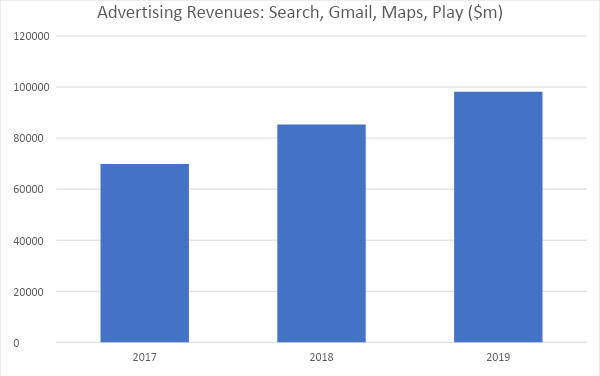
Advertising revenues from the sources shown above and other Google-owned properties (but excluding YouTube) have been growing at a healthy clip. There is little evidence of Amazon or other rivals eating Google’s lunch:
(Source: 10-k)
YouTube – yet another monopoly
It might not surprise you that Google is the most popular website in the world. Which site is in 2nd place? That would be YouTube.
I remember when YouTube was small, and had an intimate sense of community due to the small number of channels. The days when Evolution of Dance was the most viewed video.
Those days are now ancient history. Record labels gave in to the inevitable and uploaded their material voluntarily. The most-viewed video is now Despacito (6.7 billion views – nearly 1 view for every member of the human race). Baby Shark has a measly 5.7 billion views.
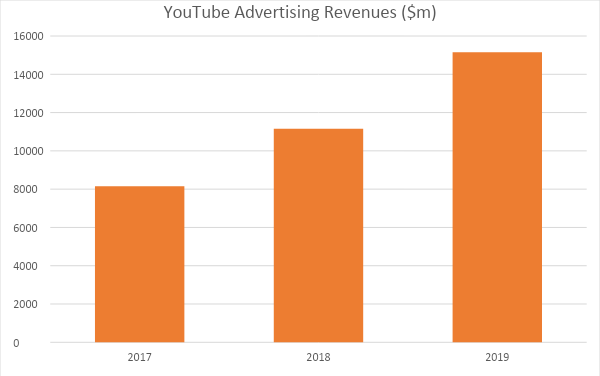
The serious financial point here is that advertising revenues on YouTube are exploding: they’ve nearly doubled in the last two years. Who said that elephants don’t gallop?
And remember the best thing about this: Google doesn’t have to create any content! Other people do all the hard work as far as content creation is concerned.
On a personal note, I’m fortunate enough not to watch any YouTube ads. Instead, I subscribe to YouTube Premium, which gets rid of all the ads, allows you to download videos, and lets you play the audio of a clip even when your phone’s screen is turned off.
This comes for a monthly fee which I consider to be worth it for a heavy user of the service. Strongly recommended!
3rd-party locations
Google has a range of advertising services for apps and websites: AdMob, Adsense and Google Ad Manager. Exploiting Google’s enormous data advantage, these tools are essential kit for app and website developers.
In total, Google’s share of the US digital ad market is estimated at 37%.
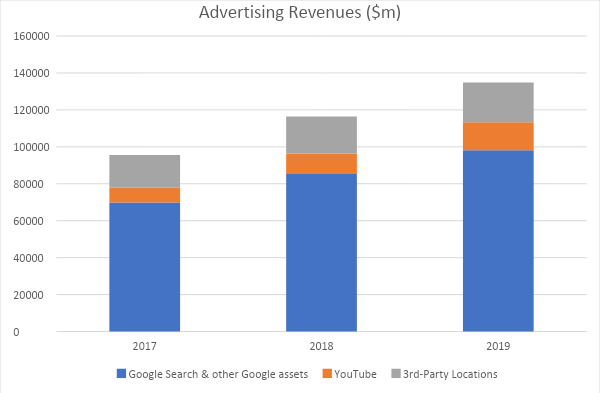
While revenue growth from this source has slowed, the overall trend in advertising revenue at Google remains healthy:
Beyond advertising…
The revenue picture isn’t over yet. While advertising accounts for 83% of revenues, we must not overlook the “Other” segment (non-advertising), which has seen its revenues grow by 56% in two years, from $10.9 billion to $17 billion.
This segment includes:
commissions relating to Google Play purchases
hardware sales (Google Nest, Pixelbooks, Pixel Phones, etc.)
YouTube Premium/YouTube TV
In addition, the “Cloud” segment includes Google Cloud Platform and G Suite, designed for businesses.
On another personal note, I recently switched from iPhone to Google Pixel – and have no regrets whatsoever.
This is just a hunch, but I think that the Pixel could, over time, become a serious threat to the iPhone. My reasoning is that Pixel doesn’t suffer from the same disadvantage as other Android phones, but instead enjoys one of the main historic advantages of iPhone: perfect harmony between hardware and software.
Think about it this way: other Android phones must be designed to work with Android software. But since Google is the primary developer of Android, it can tweak the Android software to ensure a perfect fit with the Pixel hardware. Google also has no incentive to add annoying bloatware to its phones (unlike other phone manufacturers in Android).
My own experience using the Pixel has been wonderfully smooth, and I honestly don’t miss the iPhone.
I also have some personal experience in website construction (using professional help), and have seen why G Suite is the default choice for professional developers.
What a story!
As a financial analyst, my instincts are always to go back to the raw numbers.
Google’s numbers are excellent: operating profit grew by 24% in 2019, and revenues are forecast to continue growing at a rate of somewhere around 15% - 18% per annum until 2022.
Stockopedia calculates Return on Capital at 15% and ROE at 18%. The Quality Rank is suitably high at 91/100.
And while the earnings multiple is likely to come under pressure in the event of a long-overdue bear market in equities, it is not starting at extra-terrestrial levels. It’s currently at 23x.
But those are just numbers. What’s most exciting to me is the quasi-monopolistic nature of so many of Alphabet’s activities, and the likelihood that super-normal profits will be generated for a long time to come.
A mental exercise
There’s a classic way to think about competition, and it goes like this. If a well-funded startup decided to compete, would it have a chance of succeeding?
When it comes to many of Alphabet’s activities, I don’t believe that a well-funded startup would stand a chance.
The problem for competitors is that much of Alphabet’s success is attributable to the enormous quantity of data that it has collected, and this data is not for sale to competitors. This data cannot be replicated, no matter how well-funded a competitor might be. This is why Bing can’t be an equally useful search engine, no matter how much money Microsoft pours into it.
When I look at Alphabet, I see a company with quasi-monopolistic positions in:
Internet Search
Videos
Maps
Advertising
Email (service & client)
App Downloads
The position in Cloud is more complicated. For example, in my own business activities, I use both Google Cloud services and Amazon’s AWS. They each have their strengths.
Is it possible to achieve a long-term competitive advantage in Cloud services? I honestly don’t know the answer to that one.
Weakness & Threats (the W and T in SWOT)
No company is a sure thing, and Alphabet does face its fair share of uncertainties.
Having extolled its strengths for long enough, let’s briefly consider some of the negative points.
An easy target for fines
The latest of these is another one from the European Commission, which has levied a $2.6 billion fine on Google for highlighting Google’s own shopping services in search results.
Rather like the imposition of an income-linked speeding ticket, an EU judge is reported to have said the following in court:
“You are one of the richest companies in the world,” he said, citing the example of someone with 120 euros and fined 2.4 euros for littering.
“Would you miss the 2.4 euros?”
Old-fashioned principles of justice have apparently gone out the window. If a company is rich, like Alphabet is ($120 billion in cash and marketable securities on its most recent balance sheet), then EU courts won’t feel ashamed to grab a few billion, from time to time.
Breaking up is hard to do
Democratic candidate Elizabeth Warren (who has dropped out of the race) planned to break up companies such as Google, and it’s not clear what would have happened to shareholders in that scenario – probably nothing good.
While tougher antitrust legislation is possible under the remaining candidates, that simply means higher fines as opposed to anything more radical. As the EU judge noted, Alphabet has no problem paying big fines.
The primary danger for investors is that a future US President tries and succeeds in a more radical plan, and does not adequately compensate shareholders for what happens. I have difficulty assessing how likely this is, and would therefore be reluctant to make Alphabet one of my core portfolio holdings.
Other bets
Alphabet has speculative ventures in life sciences, anti-aging, “moonshot technologies”, self-driving vehicles (in competition with GM’s Cruise), and many other areas.
These ventures mostly lose money, and their future monetisation is unclear (to say the least!). Collectively they have lost $8 billion since 2017.
Fortunately, the new CEO of Alphabet, Sundar Pichai (formerly the CEO of Google), has indicated that he favours a more disciplined approach to spending on these ventures.
Disclaimer
This is not financial advice. Our content is intended to be used and must be used for information and education purposes only. Please read our disclaimer and terms and conditions to understand our obligations.

18 comments
@ Graham Neary: Good write up, however you overlooked what in my opinion is probably Alphabet's most valuable asset: Deepmind
Deepmind is the world's leading AI company (based in London). They invented the AlphaGo, AlphaGo Zero algorithm etc..
Moreover, various other technological breakthroughs have come out of Deepmind:
https://deepmind.com/impact#si...
I'm sure that Alphabet will survive and do extremely well in the long term, for all the excellent reasons given by Graham. However, in the short term, the effects of the coronavirus may be bad for its profits. Although the increased number of people working from home or unable to leave home are likely to make greater use of the internet and Google, Alphabet's advertising revenues might be badly affected by many of its business customers going bankrupt or in dire financial straits.
from a Technical Analysis perspective............
There are multiple 'kisses' around the 1000$ line. Round numbers do influence investors.
For the record: In May 2017 the price reached there, dropped off, came back until October, when it 'broke out.' Then back twice more until July 2018, back down again in Dec, up in April 2019, back in June.
Sorry if you cannot follow, this is for my benefit, reading aloud from the chart!
I shall be looking to buy 'when' it reaches somewhere between 987$ & 1000$
The pressure is likely to be downwards because many portfolios hold it. Open ended funds will be facing redemption calls from frightened small investors. Such a liquid share will be sold off.
from a Fundamental perspective..............
The whole planet knows about it so unlikely to be undervalued.
Future growth certainly for long term holders.
If you get a good price you will feel better about holding on.
To everyone who gave a thumbs up or a comment - thanks very much! I appreciate the feedback and I'm glad you enjoyed this article.
Dear Mr Neary .
Thank you for an excellent analysis ; l just love quasi - monopolies .
Is there a purely FANG Etf quoted in London , or anywhere else ?
Regards , Julia .
See if this link helps Julia: https://etfdb.com/themes/faang-etfs/.
Alternatively you could research etfs listed on Trustnet.com in the Gbl ETF Equity - Tech Media & Telecom sector.
I don't think you will find anything that is purely the FAANG stocks, but some etfs will have a significant weighting in them.
The Polar Capital Technology Trust (LON:PCT) and Allianz Technology Trust (LON:ATT) (investment trusts) will also have some exposure to most of the FAANG stocks.
I never realised how expensive GOOG shares were, nearly £900 each, makes trading small amounts tricky.
Years ago I told my daughter I was trying a new search engine. She said 'why bother? Google is the best.' So I thought about it, bought the share and have sat on it since. There must be further downside as the c-virus spreads further - GOOG is a highly liquid share and a lot of people and institutions own it. It is an easy way to raise cash when fear or necessity dominates sentiment. I assume that a lot of companies will be cutting back on advertising until the threat has diminished. That doesn't change the fact that it is a quite remarkably successful company and is likely to remain so. It permeates a lot of our lives. It is fair to say that they don't pay enough tax, that as Graham points out they are effectively monopolists in some areas and vulnerable to political 'interference'. But a number of analysts think the value of the self-drive technology 'Waymo' might be very substantial. And the stock is still looking pretty cheap and even assuming a pretty difficult 2020 and perhaps 2021 all round the $115bn (end Dec 2019) net cash position is a nice cushion. Thank you for the note.
Thanks Graham. Very informative. I'm tempted to buy more $GOOGL on a dollar averaging basis over the next couple of months. We don't know if the price has bottomed out yet, but $GOOGL is a good candidate for leading the market recovery when it happens.
Great article Graham. I share your views. I believe Google has a lot of potential.
One other thing to mention is that it's now considered that "Voice" is the next huge growth area.
At the moment we just crack jokes at how stupid Alexa, Google and Siri are but over the coming years, this will be the growth area. There will be a move from using an app to just talking your order through. The reason is efficiencey. It will be more efficient to talk than to type.
Privacy won't stop this revolution because privacy is now a myth.
Google, Amazon and to a lesser extent Apple are best positioned for this.
Thanks for the summary it's really useful.
I think the missing piece here is Microsoft. Yes, their search has not worked out but they are building a fantastic PAAS (Platform as a Service) Azure that is not quite there with Amazons AWS but it's rapidly gaining ground. Google has struggled in this area with its Google cloud platform trying to evolve and simplify it with its Firebase offering.
Microsoft owns the PC market and Google has all but given up on its Chromebook. Apple is doing an amazing job but Microsoft still owns 77% of the market share.
Then there is "Social" which people do not realise that Microsoft owns Linked-In one of the most popular and cost-effective social platforms out there that they are pushing very successfully at the moment.
Google has YouTube and Facebook, with the aforementioned and Instagram. Apple is not participating in this area. Will they buy TikTok?
They are all such great companies perhaps the best option is to just invest in Apple, Google & Microsoft.
It's no surprise that Apple & Microsft shares are only down to the levels they were in December 2019!
Fantastic article, thanks!
I suppose my concern is we've had dominant companies before that have eventually succumbed to competition or changes in taste. EG Intel and Microsoft arguably didn't fully capitalise their near-monopoly status.
As an aside, AppleMaps is hugely improved of late. Used on an IOS device the detail shown in 3D/satellite view for the USA is staggering. Supposedly due to be rolled out to much of Europe later this year. Frustratingly it won't play ball with Windows pcs (at least using Chrome browser). There's a list of enhancements here https://www.apple.com/uk/ios/maps/
As a further aside, most of my cycling apps don't use GoogleMaps due to the heavy ongoing charges they'd have to pay as business users and then have to on-charge to subscribers. Instead they use newer pretenders such as OpenStreetMap in its various incarnations. Which aren't as good in most respects.
Great article Graham. I didn't see you mention the potential of their Stadia roll out. I believe they will successfully corner the video game market in a few years and as we know this is a massive market to capture.
Thank you for posting such a good analysis.Businesses such as Youtube Gmail Maps and cloud the revenue is generated by advertisments as we use the service for free.
Other ventures such as self driving vehicles seems far away and need a lot of investment and moonshot technologies seems light years ahead when it can be used by most people not the selected few.Maybe its a good time to invest when such ventures are in the pipeline.
I've used Brave with some success as a decentralised browser also get rewarded with BAT (basic attention tokens)
Love the article Graham, thanks. Google is one of my largest positions and I agree with all you are saying above.
To add my 2 cents: to me Google's valuation is all about Search. The other parts of Alphabet are nice: Youtube, Gmail, Maps, and Cloud are all excellent businesses in their own right and Waymo may well become one of them eventually as well but Search is in another category entirely.
Due to the 90% market share Google enjoys, along with the continuous growth in use of search engines to find a service provider (Accountants, Lawyers, Funerals, anything really) the value of key search words for every industry becomes larger and larger. As you state nobody looks at page 2 and if you are a London Accountant for example the value of paying up to be the top pick for "Best London Accountant" or similar is enormous (and the cost of not is equally so). Think of the pricing power on that - theoretically every service industry would keep bidding these keywords higher and higher until they returns just exceed their cost of capital. That may be extreme but shows the level of pricing power Google could have here. And this will only get larger over time as more services are conducted online. Add to that the online market space is growing rapidly from the current c. 20% level and Google requires little incremental capital and standard metrics get kicked out of the window, the potential scale that this could go is pretty crazy.
The upshot of all this also answers one of your fears of a forced break up and if my Alphabtet shares were swapped to Search, Youtube, Maps, Gmail etc. shares I think I would be just fine. As you state they are all either pretty close to monopolies or dominant monopolies in their own right so would work just fine on their own.
As you also state the strength of these monopolies just gets larger over time due to data. Having the scale and quality of data Google have is an enormous economic advantage that is not shown on the balance sheet but will help Alphabet companies out-compete any challenger. It is also different to the other really big data store of Facebook as you type what you want into Google. Google have not harvested what you want based on your personal data, to then advertise better at you which will lead to recurring privacy issues but you have told them exactly what to sell to you.
From a valuation perspective this also looks bizarrely undervalued. If you take today's Market cap of c. $900bn and take off Cash ($120bn), Youtube ($150bn - I have seen up to $300bn but we will be conservative, compare it to Netflix?), Waymo ($30bn), Cloud ($100bn - $225bn per Deutsche bank in Oct 2019 but we are now entering a recession it seems so revenues may take a hit), Maps (I cannot find anything via a Google search so lets be conservative and say $30bn, I have seen revenue estimates soon to be $11bn high margin high growth revenues so seems fair). So Search in this sum of the parts is implied at $470bn; that is a P/E of 10-14 (there are a lot of estimates so this is a wide P/E range) for one of the best businesses around, maybe one of the best ever invented.
Thank you for the awesome feedback and very interesting points! G