London Value Investor Conference 2015 - Part 1 - Simon Denison-Smith - Metropolis Capital

Once again this year I had the privilege of attending the London Value Investor Conference ("LVIC"), for the third consecutive year - thank you to the organisers for laying on such a superb event.
It was held last week (20 May 2015), at the QE Centre, opposite Westminster Cathedral - the same venue as UK Investor Show - but it targets a different audience, of mainly city professionals, family offices, hedge funds, etc.
So as I always say, LVIC is very much the Rolls-Royce of investor conferences - expensive, but top notch speakers. I think all value investors should try to get along to this conference, even if it's just once. After all, most of us wouldn't bat an eyelid at losing £ 800 on a trade, but very few are prepared to pay that amount for a conference which would give a valuable education, and an enjoyable experience.
The event also raised over £30k for a tremendously worthwhile, but small charity, Child Bereavement UK.
Metropolis Capital
LVIC is organised by Metropolis Capital. I first came across Metropolis in 2009, when the CEO of a Brighton-based listed IT training/staffing company called FDM, was trying to bully shareholders into accepting a dismally low takeover bid from himself and a PE backer. Being an FDM shareholder, and realising that the company was woefully undervalued, I wanted to stop the takeover bid, so I ended up speaking to Metropolis who were a major shareholder in FDM.
Confidentiality considerations mean I won't go into any detail on those conversations, but I was struck by how smart the guys at Metropolis are, and they certainly influenced events such that the price of the FDM takeover offer was improved a couple of times, helping all shareholders, including me.
FDM has since returned to the stock market, at a valuation many times that which it was bought out at. So, on principle I will never buy shares in this company again - having seen how management shafted shareholders in the past, grabbing the upside for themselves when things were going well - I see them as unscrupulous, and hence uninvestable.
Cisco Systems Inc (NSQ:CSCO)
Each year, either Simon Denison-Smith, or Jonathan Mills of Metropolis give a talk at LVIC about their in-depth research process, and go into detail about one or two of their favourite shares at the time. So I thought it would be fun to check back and see how they have fared!
In 2013, Simon highlighted Cisco Systems Inc (NSQ:CSCO) as one of their favourite shares. I did a write-up of that talk here on Stockopedia, which is worth a recap. At the time, on 9 May 2013, Cisco shares were $21.10, so what are they now, two years later?
Answer - they are $29.26, a healthy gain of nearly 39%.

With the "internet of things" being much talked about, I think Cisco could be an interesting share to research again now. I will ask Simon to confirm if he is still bullish on Cisco, and update this article with his response in due course.
Stockopedia covers US stocks now too, and I can reveal that Cisco currently (at 23 May 2015) has an extremely high StockRank of 97.
Also, please note from the usual Stockopedia graphics to the right, that Cisco has high quality scores, yet the valuation seems reasonable, even low, at a fwd PER of 12.9, and a healthy dividend yield of 2.85%.
Cisco's balance sheet is very strong too, with substantial net cash. So it ticks most of the boxes I look for, apart from being about 1,000 times bigger than most companies I look at!
J Smart & Co (Contractors) (LON:SMJ)
At the other end of the valuation spectrum Simon mentioned this Scottish, family-controlled property company, as a minnow stock that they liked. The reasons given were mainly a large discount to book value, plus hidden assets, and a good underlying free cashflow yield.
These shares were about 83p at the time in May 2013, and are now 103p, so a relatively modest increase of about 24%, plus dividends.
My opinion - I've had a very quick review of the most recent accounts, and it seems a bizarre company - with a huge asset base, which is generating very little overall return. However, the discount to NTAV is striking, so there's latent value in this share, but where's the catalyst to unlock that value? If the family are happy just tootling along as they are, then there's nothing outside shareholders can do.
Share buybacks are underway, so at least that provides an exit route for stale bulls, but is only going to make the shares even more illiquid.
However, if you're happy to just receive the 2.85% divis, and leave your capital tied up for possibly years, in the hope that one day a catalyst for unlocking the asset value will appear, then this could be worth looking at.
Owner-Occupied
At last year's LVIC, Jonathan Mills of Metropolis gave a talk called "Owner Occupied" (which I missed unfortunately, but I have a copy of the presentation slides) about the advantages of investing in founder run businesses.
Jonathan explained how businesses which are still run by their founder entrepreneur tend to display attractive traits.
At the start-up stage:
Entrepreneurs are formed by their early experiences.
All start-ups experience similar conditions, irrespective of their industry;
- Shortage of capital
- Short term sacrifice by entrepreneur (e.g. little to no salary, long hours)
- Sales dependent
- Have to adapt to survive
Founder run businesses tend to be:
- Long term driven
- Good capital allocators
- Customer focussed
- Restless innovators
So start-up conditions tend to forge the DNA of owner-occupied companies, and makes them good companies to invest in.

My opinion - this strikes a chord with me. Two of the most successful investors I know, Lord Lee, and David Stredder, attribute a lot of their success to taking long-term positions in family-controlled companies. So this is definitely an area I'll be paying closer attention to.
It's not a guarantee of success of course, and particularly with micro caps, you can end up in a company where the family derive most of the benefits, from jobs & sometimes high salaries, with minority investors receiving little, if any return.
So careful scrutiny of the track record of the family, and how they treat outside shareholders, is vital.
Admiral (LON:ADM)
The example given at last year's LVIC by Jonathan Mills, is Admiral. Here is the slide introducing Admiral & it's owner-occupied credentials, NB this slide is now a year old;
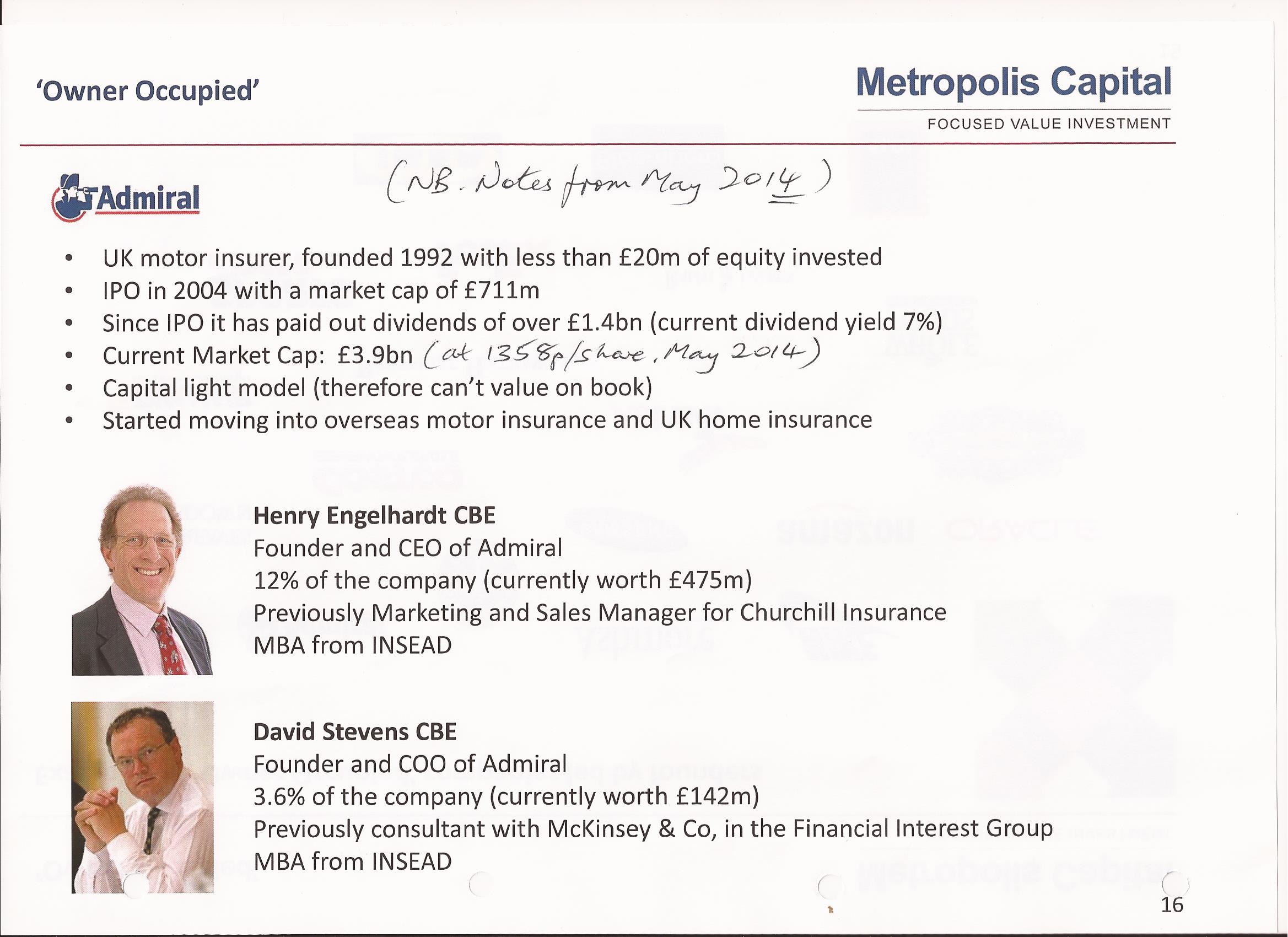
So apart from being owner-occupied, what did Metropolis like about Admiral (LON:ADM) this time last year?
- Potential from overseas expansion - small loss maker now, but large potential upside
- Long-term stability afforded by co-insurance with Munich Re
- Investment of float is conservative - entirely in cash, long term deposits, money market & short term debt
- Low cost model is Admiral's moat - combined ratio is materially lower than average
- Low expense ratio is key to Admiral's competitiveness
- Lowest staff costs, but pay staff more in equity than other insurers
- Low staff turnover - Admiral rates very highly in staff surveys
- Management are sensible capital allocators
- Pays big dividends instead of hoarding cash
- Customer-centric business model (but doesn't everyone say this?!)
- Restless innovation, e.g. multi-car policies, creating new brands (e.g. elephant.co.uk)
- Low PER of 13, in May 2014
- Normalised PER of 10.5 in May 2014
Result so far - In fairness, it should be said that one year is far too short a timescale, as Metropolis pick shares with a very long term horizon.
That said, the shares are now 1478p, so have gone up about 8.8%, plus divis of say another 7% on top from the purchase price - not a bad one year total return of about 15.8% before tax.
As you can see from the chart below, Admiral shares have usefully out-performed the FTSE 100 Index (beige comparison line) in the last two years. I wonder what caused the recent sharp dip?

My opinion - I don't have one, as Admiral is not a share I've looked at before, but it sounds interesting, and may be one I'll take a look at. The divi yield is showing on Stockopedia as a very attractive 6.1%.
Although I note that broker earnings forecasts have been steadily declining in the last year, which would need looking into. Competitive pressures biting maybe?

Regus (LON:RGU)
Moving to this year's conference, Regus, the serviced office company, is Metropolis's favoured stock pick for 2015. This may sound surprising, for a value-seeking fund to be flagging a company with no net asset backing (last reported NTAV was -£12.5m), huge lease liabilities (it rents long term, and sublets short term), which has previously almost gone bust in a recession.
However, there is method in their madness! Metropolis modelled Regus, and noted that it is only by year 4 that new offices make a profit. So in periods of expansion, such as now, the losses from new sites obscure the profits from established sites.
Metropolis calculate that the free cashflow yield is over 10%, at the current market cap of £2.4bn (at 257p per share). NB this is based on their own calculations, based on established sites only, so it won't tally with the published figures, where new sites obscure the cash generation of older sites.
Owner-occupied - following their theme from last year, Metropolis like founders to have a large stake, and Mark Dixon owns 31.4% of Regus, so a big tick in that box.
Metropolis note that Dixon is an efficient capital allocator - he won't open new sites in areas where the property market is too hot. If he can't secure his target ROCE, then he walks away from deals on new offices.
Dominant in sector - Regus is 13x bigger than its nearest competitor.
Moat? - the worry is that there is little to stop competition. However, Metropolis talked to people in the industry, landlords, etc, and came to the conclusion that Regus has "lots of little moats", e.g.
- Dominant web presence
- Global clients come to Regus first when they need space (e.g. Toshiba, Google)
- Good (property) broker relationships
- Expensive items like sophisticated IT which competitors might struggle to offer, generate 40% of Regus's income
- Ability to drive down the cost of sites, especially in a downturn
- Scale advantages (e.g. management, fit-out costs, IT)
Cyclicality - this is the big risk to Regus's business model. Regus almost went bust in 2000, and made losses in 2007-8 too. So at this point Metropolis almost abandoned the stock idea.
However, they noted that Regus remained profitable in the USA in 2007-8, and wondered why. It turns out that in the USA it was structured using lots of Special Purpose Vehicles (SPVs), ie. separate subsidiary company with no parent company guarantees - thus ring-fencing liabilities on any problem sites.
This USA model is now being rolled out in the UK, and elsewhere. What this means is that when the next recession bits, Regus will have the capacity to go back to landlords of loss-making sites, and negotiate a lower rent (usually in return for a longer term). If the landlord says no, then ultimately the SPV which operates that site can be liquidated, and the parent company walks away with no liabilities.
Taking this into account, Metropolis believe that with the stock currently at 10x its adjusted earnings estimates (the PER is much higher for the reported figures), then they reckon trough earnings in a recession might be roughly half current earnings, which is the experience of the USA company, which remained decently profitable in 2007-8. So 20x trough earnings is a price that Metropolis are happy to pay now.
Price target - Metropolis reckon that Regus shares are worth 370p assuming no further growth, 470p with 10% growth modelled, and 520p with 15% growth assumptions.
The shares are presently 257p, so the targets above offer potential upside of 44%, 83%, or 102%. Not bad going, if this analysis does turn out to be right.
Conclusion - Metropolis describe Regus as a "rare bargain in a difficult market". By difficult they obviously mean relatively expensive I'm guessing.
92% of offices are now in the SPV structure, so the new business model is already in place, which should enable Regus to fare much better in future recessions.
My opinion - I don't know enough about the company to comment, and bow to the detailed analysis done by Metropolis. The strong up-trend in share price lately, and the apparently high valuation (21.5 times broker forecast earnings, and only 1.8% divi yield) suggest that other investors have done similar sums to Metropolis, and are hence willing to pay up for the shares given that the business model has changed, and that underlying profitability is greater than reported profitability, and now more resilient to be capable of holding up better in future recessions.
So an interesting situation, that might be worth doing some more research on, in my view. Although I'd struggle to buy now, after such a good rise recently - I might put it on my watch list and buy on a big dip though.

Personally, I find it very interesting to hear the research process that accomplished value investors take, as much as their stock ideas. These guys are always interesting to listen to, and I think it's important to flag that their stock ideas tend to be lower risk - so holding these stocks in a downturn will probably give relative out-performance, whereas they might not necessarily out-perform in a bull market, when investors are often chasing more flaky, speculative stocks, and ditching their value shares to finance that. Of course that approach always comes badly unstuck on big market falls.
So thanks again to the guys at Metropolis for organising LVIC.
I hope to do one or two more articles from the conference, if readers find this article useful. If they don't, then I won't bother & will spend my weekend doing something else!
Regards, Paul.
Disclaimer
This is not financial advice. Our content is intended to be used and must be used for information and education purposes only. Please read our disclaimer and terms and conditions to understand our obligations.

17 comments
Massive thanks Paul - you have brightened up my bank holiday (return to work) blues! Very informative articles and really interesting to compare last year analysis with actual outcomes.
Keep up the great work.
Ben
thx Paul, v enlightening.
Some really great companies in there . The Owner Occupier analogy is particularly apposite for London housebuilder Berkeley group where Tony Pidgeley has produced brilliant returns for investors. Personally I have always used the term "owner driver" which I thought of after meeting Brian Souter of Stagecoach. (Ok, terrible pun, but true) Meeting him was always chalk and cheese with other professional management teams. Being the founder he knew the business backwards, and was always helpful I pointing out areas where his competition was substandard. The others were not in his knowledge league.
In general these owner occupier companies tend to be v frugal with shareholders capital (Henry at Admiral once told me they used to have a 10.30am team meeting in Cardiff so the guys at the Newport office could catch the cheaper trains after 10am). The founders with large shareholdings tend to keep running the company in the way that they founded it - on a shoestring. The very best never lose that ethos, but recognise the importance of investment back into the business. Run it well invested but with a frugal mind set.
A further extension of the owner occupier model is the franchise model: using other people's hard work, enterprise and importantly capital to further your own business expansion. This has been a hugely successful investment area for many people. The key here is to keep a the franchisees on a tight rein. They tend to be entrepreneurial people and will try things (often prohibited by the franchise agreement). If the franchise can work for both the licence owner and the franchisee in terms of getting the right agreement, a fair distribution of royalties / profits etc then the returns can be fantastic. Prime examples include Dominos Pizza plc (£DOM), Dominos Pizza inc ($DPZ), Buger King ($BKW), Intercontinental Hotels (£IHG) and Costa Coffee for Whitbread (£WTB).
Pls keep them coming Paul
Paul; I believe Regus fits into the type of share selection that N. Woodford described resulting from Macro economic changes; letting out office space was flat on it's back until the economy started to improve, as always, the time to buy; now I suspect that the growth has slowed. Like NW. I am concerned that the upturn in UK is mostly related to personal expenditure and not enough investment by industry.
Your comments on Regus are interesting. I generally agree with most comments about firms you write about however this firm is different. Ive rented office space from these cowboys in the past and I can only describe the experience as depressing. Generally speaking I like to invest in firms that I trust and like and where I can buy the product easily. Regus delight in making life difficult for tenants by continually making mistakes on invoices and not refunding for months, extortionate changing on extras that one needs to run an office and very poor customer service. Other friends who have used Regus in the past swear they will never use them again. Me too!!!
I appreciate this isn't the forum to get this off my chest but my point is that this firm will not survive in its present form or when serious competition emerges whilst it treats its clients like idiots. I would rather short this share anyway. Apologies for the rant!
Paul
Good write up - many thanks for your thoughts and thought-provoking comments
Thanks Paul for the write up and hope you find the energy/time for one or two more.
What I find interesting about these (and stuff one finds on YouTube or the written word - Manual of Ideas for example) is the insight it gives into the thought process/procedures of the investor, rather than trying to back test their stock picks. Then seeing whether I can duplicate some of that behaviour.
That said if I could have earned 39% + 5.8% of divis over two years from a mega cap like Cisco Systems Inc (NSQ:CSCO) I would have been very happy regardless of what other stocks in the sector or the sector as a whole had done.
As I have said before I hope to attend LVIC in the future (maybe next year!) - it must be very inspirational but in the meantime your write ups are really useful and am surprised that with 2000 reads there are only 12 comments!
Have a good rest of the bank holiday.
Hi Paul,
Thank you for taking the time to write up your notes from the conference. On Admiral Admiral (LON:ADM) note that Henry Engelhardt has recently announced his decision to step down from his role as CEO in one year's time. However, he will be replaced by co-founder and current Admiral Chief Operating Officer, David Stevens so good continuity there.
The earnings downgrades in recent months reflect primarily the down swing in the motor insurance cycle which has now turned. I also like their dividend policy which Mr. Englehardt summed up in their Report and Accounts as follows: "Our dividend policy has been clear since
flotation – we believe it is for our investors rather than Admiral to determine how they
wish to invest funds surplus to the requirements of our business."
Have a great Bank Holiday.
Thanks Paul
Keep writing more articles on the Value Investor conference please Paul
Yes, relative performance is problematic during bubbles for value investors. Most of the problem disappears though if you compare to sector benchmarks: bubbles are not (or very rarely) about some other people suddenly becoming better stock pickers than us, but thematic fads. When a sector goes to the sky, value investors can't find anything worth buying there and end up with strong sector biases (underweight on bubbly, overweight on the rest), but the relative performance within the remaining sectors should still be a meaningful measure of stock picking skill.
This suggests there may be an interesting niche in a bubble-value hybrid, perhaps as a long-short strategy, where you try to stock pick based on relative valuation within bubbly sectors, which should pay off when the crash comes and only the better half or so of the sector survives. There should be very little competition in that space as it's not a natural fit for common investor types!
Enjoy your meal! :-)
I don't know why though! Enjoy the holiday w/e.
Its either John Lee or Lord Lee but never Lord John Lee.
Corrected. Thx.
P.
From 9 May 2013 to today, the PHLX US Semiconductor index (SOX) has returned 56%.... So stock picking Cisco was not that good an idea....
Hi Cig,
Fair point. Although I imagine that with divis, the gap would be smaller. Also there's lower risk intrinsically in a bigger company, with a strong balance sheet, so a lower return would still be acceptable.
Looking on Yahoo, Cisco doesn't seem to be included in the SOX index, which seems strange. Maybe it has a different categorisation?
Regards, Paul.
Ah right, I thought Cisco was in SOX but it's a narrower chipmaker index. DJ Telco Equipement (DJUSCT) is perhaps a better index, and they're in. +31% so Cisco is slightly ahead here, but not so impressively as in nominal terms. As a more general point, stock pickers should not look at nominal performance, it's really the wrong metric for the game. It applies to bull and bear markets (eg someone who's doing -20% when everybody is doing -40% should celebrate!).
On Cisco itself I looked at it a while ago and don't like the management and business direction, they're thinking in old ways. It's relatively cheap and there's lot of inertia so fair margin of safety but mixed prospects. The internet of things is a red herring in my view. There's no killer app so far, and putting a few sensors here and there is not going to move the needle on Internet traffic, it's all pretty low bandwidth compared to say video streaming.
Cig,
I agree to a certain extent re relative performance. Although value players accept that they will probably under-perform the market during late-stage bull phases, but will clean up in bear markets & the subsequent early stage bull market.
So a value approach should out-perform in 5-year periods, but may not in say sub-2 year periods. But you're taking a lot less risk.
Woodford was talking about how extraordinarily tough he found it, to cope in 1998-2000, when his value-focussed approach was doing badly, yet TMT shares were going through the roof. He came close to losing his nerve I think, but didn't, and it was reputation-making for him when the TMT shares crashed & his fund then started doing well, as value shares recovered in 2001-2.
But more on that shortly. I might type up my notes from the Woodford Q&A session next, but before that I'm craving a cooked breakfast, so nipping out for that now!!!
Regards, Paul.